Why Use Escape Rooms for HR Training That Works
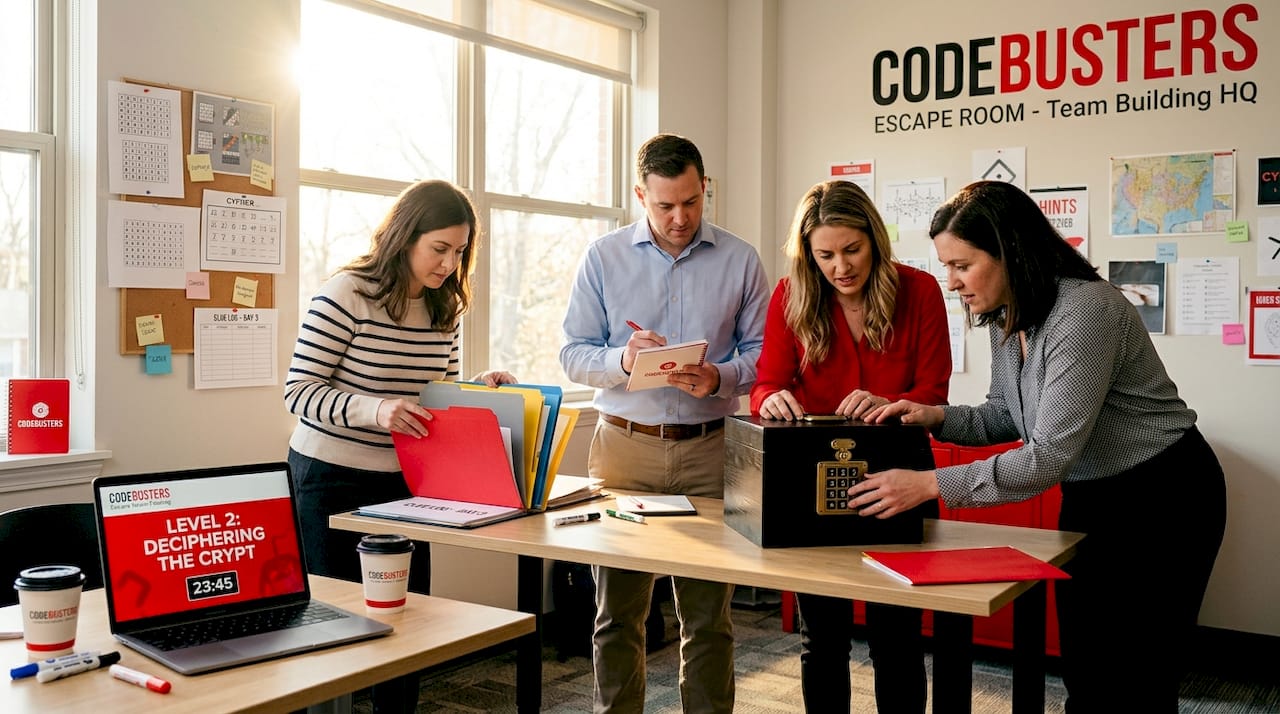
Most HR professionals know the feeling: you’ve spent weeks planning a training session, and within 24 hours, employees remember almost none of it. That’s not a guess. Traditional training retention drops to roughly 10% after one week, while gamified approaches like escape rooms hold closer to 50%. Understanding why use escape rooms for HR training starts with that gap. When your people are actively solving problems together under real pressure, they learn faster, retain more, and reveal team dynamics you’d never see in a conference room.
Table of Contents
- Key Takeaways
- Why escape rooms work for HR training
- Core benefits of escape rooms for HR teams
- How escape rooms compare to other training methods
- How to implement escape rooms in HR training programs
- My honest take on escape rooms as an HR training tool
- Bring your team to Codebustersescaperoom
- FAQ
Key Takeaways
| Point | Details |
|---|---|
| Retention is dramatically higher | Gamified training boosts knowledge retention by up to 40% compared to passive lecture formats. |
| Escape rooms surface team dynamics | Leadership and communication patterns emerge naturally, giving HR professionals usable development data. |
| Design intent is everything | Every puzzle must align with a specific learning objective, or the experience stays entertainment. |
| Debriefing multiplies impact | A structured post-session debrief is where most of the measurable learning transfer actually happens. |
| Flexible for modern teams | Escape rooms work for in-person, hybrid, and remote groups, making them adaptable to most organizations. |
Why escape rooms work for HR training
The case for using escape rooms in HR training is rooted in how the brain actually processes and stores information. When employees sit through slide presentations, their brains operate in passive reception mode. When they’re inside an escape room, they’re making decisions, testing hypotheses, communicating under pressure, and processing feedback in real time. That shift from passive to active learning changes everything.
Gamification aligns with learning objectives to increase engagement and retention by building in motivation, immediate feedback, and progression. Escape rooms do all three simultaneously. Participants feel the motivation of a ticking clock, get instant feedback when a puzzle solution works or fails, and experience clear progression as they unlock each challenge. That structure maps directly onto what learning science calls experiential learning.
The neuroscience backs this up. Emotional involvement strengthens memory encoding. When your team is laughing, frustrated, then triumphant, those emotional peaks create stronger neural pathways than any slide deck can. Self-efficacy scores increased significantly in groups who completed escape room training, which means participants walked away more confident in their ability to handle similar challenges on the job.
There’s also a social dimension that HR professionals often underestimate. Escape rooms foster collaboration through shared goals and interdependent problem solving. Unlike role-play exercises where one person performs while everyone else watches, escape rooms require every participant to contribute simultaneously. That’s social interdependence built into the format, which accelerates trust-building in ways few other HR training activities can match.
Core benefits of escape rooms for HR teams
Once you understand the learning science, the practical benefits become very concrete. Here’s what HR professionals and team leaders consistently report after incorporating escape rooms into their development programs:
-
Higher engagement from start to finish. Employees who dread mandatory training voluntarily extend time in escape rooms. The urgency of the clock and the satisfaction of solving puzzles sustain attention in a way that workshops rarely achieve. Participants rate escape rooms higher than other learning formats specifically for fostering team communication and collaboration.
-
Visible leadership identification. Natural leaders emerge quickly inside an escape room. You’ll see who steps up to organize the team, who communicates clearly under stress, and who gets stuck in a single approach instead of adapting. These observations give HR professionals a real behavioral baseline that annual reviews can’t replicate.
-
Pressure-tested decision making. Many workplace failures happen not because people lack knowledge but because they freeze or miscommunicate when stakes feel high. Escape rooms simulate that pressure in a safe environment. The lessons about decision making under stress transfer directly to high-stakes work situations.
-
Adaptable to different group sizes and formats. Corporate training escape rooms now exist in physical, virtual, and hybrid formats, which means remote teams and distributed offices can participate. A team of 6 and a department of 40 can both have structured experiences designed around the same learning objectives.
-
Measurable ROI. Immersive training programs reduce human error incidents by 30 to 60%, which translates directly into fewer costly mistakes and lower retraining expenses. When you frame escape room investment against incident reduction alone, the math often favors it.
Pro Tip: Record behavioral observations during the session, not just the debrief. You’ll capture leadership moments and communication patterns in real time that participants themselves don’t notice.
Using escape rooms for collaboration also creates a shared experience that outlasts the session. Teams who’ve solved problems together under pressure reference that experience for months. That shared memory becomes shorthand for how they work together going forward.
How escape rooms compare to other training methods
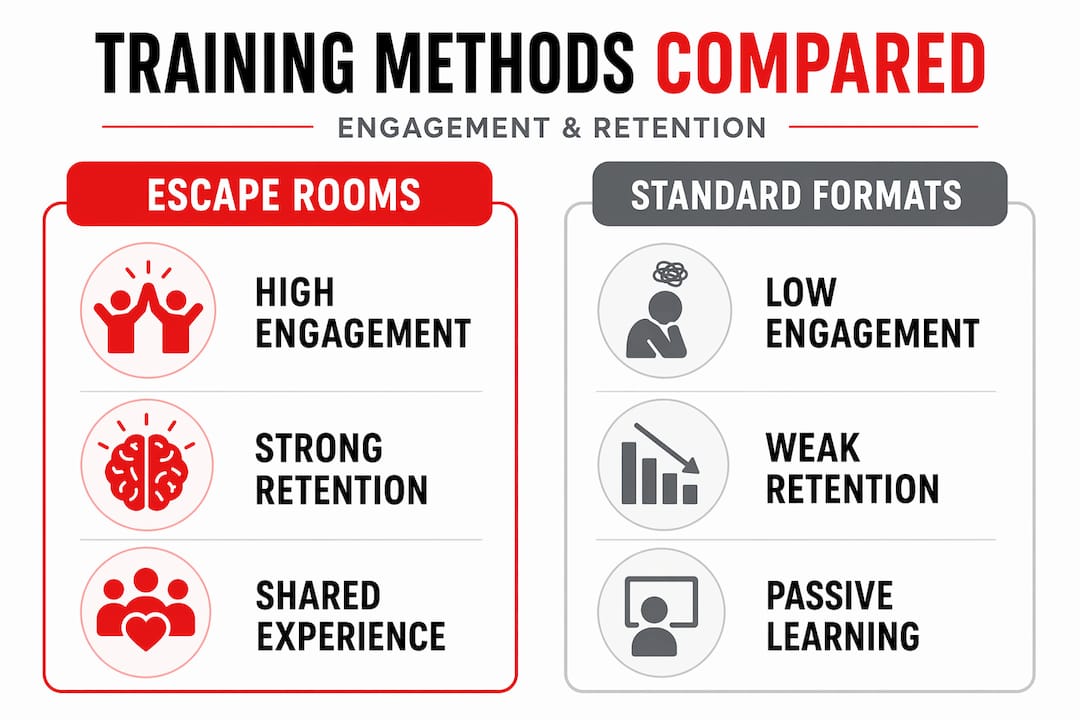
HR professionals evaluating training formats need a clear picture of where escape rooms fit relative to alternatives. The table below compares the most common approaches across four factors that matter most for training decisions.
| Method | Engagement | Retention | Cost | Scalability |
|---|---|---|---|---|
| Lecture or workshop | Low to medium | Low (~10% after 1 week) | Low | High |
| Online e-learning module | Low | Low to medium | Low | Very high |
| Offsite retreat | Medium to high | Medium | High | Medium |
| Simulation or role-play | Medium | Medium | Medium | Medium |
| Escape room | High | High (~50% after 1 week) | Medium | Medium to high |
The data shows escape rooms sitting at the intersection of high engagement and high retention, which is where effective HR training needs to land. Their main limitation is per-session cost relative to e-learning, and they require more facilitation effort than self-paced modules. For those reasons, escape rooms work best as a targeted intervention rather than a daily training format.
Compared to offsite retreats, escape rooms vs other team-building games deliver more structured learning because every puzzle can be mapped to a specific competency. A ropes course builds trust, but it doesn’t isolate communication breakdowns or reveal how someone approaches ambiguous problems. Escape rooms do both with precision.
The honest limitation is that escape rooms don’t scale cheaply for very large organizations running continuous training cycles. They’re most effective when used strategically: new team onboarding, leadership development cohorts, cross-functional collaboration sessions, or culture-change initiatives.
How to implement escape rooms in HR training programs
Getting this right requires more than booking a room and sending a calendar invite. The difference between a fun afternoon and a genuine learning experience comes down to design and facilitation decisions made before anyone walks through the door.
Here are the practices that separate effective escape room training from empty entertainment:
-
Map every puzzle to a learning objective. Effective escape room design requires each challenge to target a specific skill, whether that’s active listening, conflict resolution, or delegating under pressure. If you can’t articulate what a puzzle teaches, it doesn’t belong in a training-focused experience.
-
Choose or design for your participant profile. A team of executives solving a strategy challenge needs different complexity than a group of new hires practicing onboarding workflows. Match the difficulty level to where your participants currently are, not where you want them to be.
-
Plan the debrief as carefully as the experience. Most of the learning transfer happens in the 20 to 30 minutes after the session ends. Prepare specific questions that connect what happened inside the room to real workplace behaviors. “What did you do when communication broke down?” is more useful than “How did it feel?”
-
Use observations to inform development plans. Leadership qualities and communication dynamics that HR professionals observe during escape rooms are data. Document them and feed them into individual development conversations and team coaching plans.
-
Avoid the fun-only trap. The single biggest pitfall in corporate training escape rooms is using the activity purely for morale without any learning framework. Employees enjoy it but return to work having had fun rather than having grown. The experience must be bookended with clear objectives and structured reflection.
Pro Tip: Brief participants on the learning objectives before the session starts. Knowing that “we’re specifically working on cross-functional communication today” primes them to pay attention to the right behaviors inside the room.
For teams spread across locations, virtual escape room formats have matured significantly. They replicate the core dynamics of building teamwork skills through shared problem solving, though they require slightly more facilitator energy to maintain engagement without physical presence.
My honest take on escape rooms as an HR training tool
I’ve watched groups walk into escape rooms as polite colleagues and walk out as actual teams. That shift is real, and it’s not just anecdotal. What I’ve learned is that the magic isn’t in the puzzles themselves. It’s in the pressure, the ambiguity, and the fact that no single person can solve the room alone.
What I’ve also seen is that escape rooms get misused constantly. Companies book a session, everyone has a good time, and HR checks a box. Nothing changes because no one connected the experience to actual development goals. That failure isn’t the format’s fault. It’s a design and facilitation failure. When role differentiation and autonomy within escape rooms are intentionally built in, participants develop and display leadership skills organically. That organic quality is what makes the insights credible. People aren’t performing leadership. They’re doing it.
My advice to any HR professional considering this approach: treat the escape room as a diagnostic tool first and a training experience second. What you observe tells you more about your team’s real dynamics than most 360-degree reviews ever will. Use that information intentionally, and the return on the experience multiplies.
— CodeBusters
Bring your team to Codebustersescaperoom
If you’re ready to move from passive training to an experience your team will actually remember, Codebustersescaperoom in Colorado Springs is built for exactly that. Our rooms are designed with team dynamics in mind, and we work with HR professionals and team leaders to align the experience with your specific training objectives.
Whether you’re onboarding a new department, developing future leaders, or rebuilding collaboration after organizational change, our team-building escape rooms offer structured, customizable experiences that deliver real behavioral insights. We accommodate groups of different sizes, and our facilitation team can support post-session debriefs to translate what happened in the room into your broader development plan. Book your corporate session and see what your team looks like under pressure.
FAQ
Why are escape rooms effective for HR training?
Escape rooms are effective because they create active, emotionally engaging experiences where participants must communicate and solve problems under pressure. Gamified training improves retention by up to 40% compared to traditional passive methods, making the learning far more likely to transfer back to the workplace.
What HR skills can escape rooms actually develop?
Escape rooms develop communication, collaboration, leadership, and decision making under pressure. They also surface how individuals respond to ambiguity and stress, giving HR professionals behavioral data that traditional training methods rarely produce.
How do escape rooms compare to standard team-building workshops?
Escape rooms generate higher engagement and retention than standard workshops because the format demands active participation from everyone simultaneously. Unlike workshops where some participants disengage, the interdependent structure of escape rooms requires every person to contribute to reach the goal.
Do virtual escape rooms work for remote HR training?
Yes. Virtual escape room formats replicate the core collaboration dynamics of in-person experiences and are viable for distributed or hybrid teams. The key is pairing the experience with a structured facilitator-led debrief to capture and apply the learning.
How should HR professionals debrief after an escape room session?
A strong debrief connects observed behaviors inside the room to real workplace situations using specific, open-ended questions. Focus on communication breakdowns, leadership moments, and how the team adapted to obstacles, then tie those observations directly to your current development priorities.