Why escape rooms are so popular: trends explained
The escape room industry is anything but a passing fad. The global market reached $12.71B in recent years, with projections pointing toward $31 to $38 billion by 2032. That kind of growth doesn’t happen by accident. Something deeper is driving millions of people, from families in Colorado Springs to corporate teams across the country, to lock themselves in a room and race against the clock. This article breaks down the real reasons escape rooms keep growing, what makes them so addictive, and why your next group outing might just be the best one yet.
Table of Contents
- The unstoppable growth of escape rooms
- The science of fun: Why people love escape rooms
- What makes a great escape room? 5 design secrets
- Are escape rooms all they’re cracked up to be? Critiques and challenges
- A local’s perspective: What most guides miss about escape room popularity
- Ready to experience the excitement?
- Frequently asked questions
Key Takeaways
| Point | Details |
|---|---|
| Industry growth | Escape rooms have seen massive market growth and are especially popular in Colorado Springs. |
| Why people love them | Escape rooms blend social connection, teamwork, and engaging stories for all ages and groups. |
| Design secrets | Great escape rooms use innovative puzzles, thematic design, and adapt to players’ skill and group type. |
| Critiques and future | While some raise concerns about authenticity, the focus on real-time fun keeps people coming back. |
The unstoppable growth of escape rooms
Numbers rarely lie, and the escape room industry has some impressive ones. The global market hit $7.9B to $12.71B between 2022 and 2024, growing at a 14.8% compound annual growth rate. The US alone pulls in $400 to $500 million every year. These aren’t niche hobby numbers. This is a mainstream entertainment category that has outlasted skeptics and survived a global pandemic.
| Metric | Figure |
|---|---|
| Global market value (2024) | $12.71 billion |
| Projected global value (2032) | $31 to $38 billion |
| US annual revenue | $400 to $500 million |
| Average price per player | $35 |
| Female player share | 52% |
| Venues breaking even in year 1 | 70% |
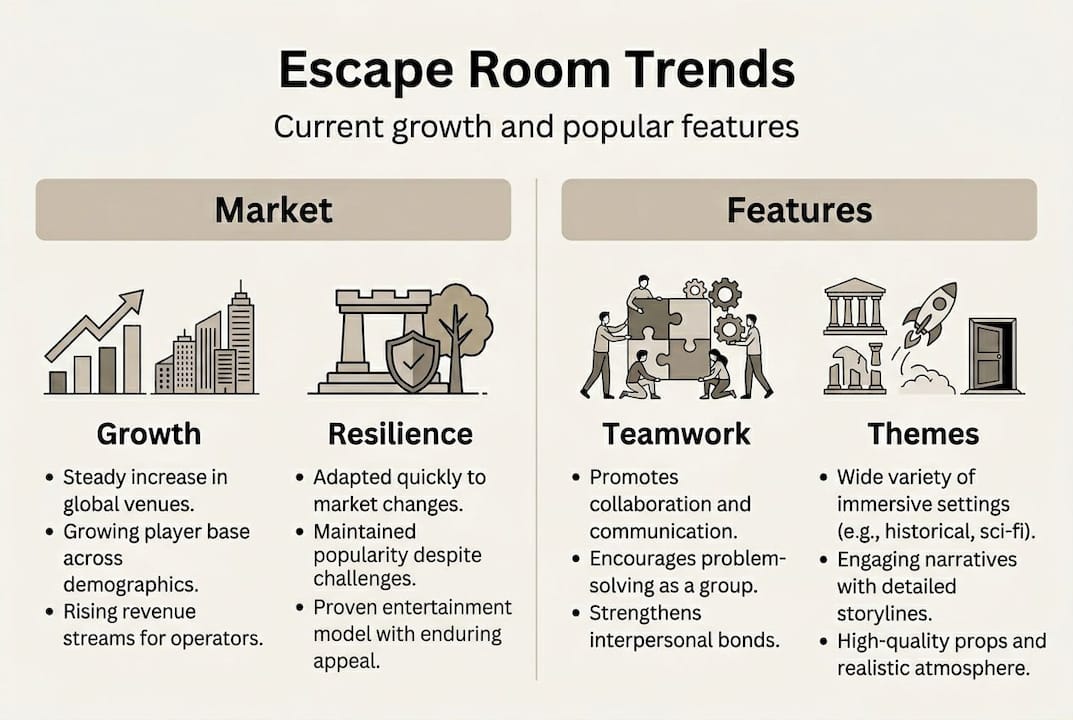
The industry’s post-pandemic resilience tells its own story. With 70% of venues breaking even in their first year and an average ticket price of $35 per player, escape rooms have proven they aren’t just a novelty. They’re a sustainable business model built on repeat customers and word-of-mouth buzz.
What’s especially interesting is the player demographic. With 52% female players, escape rooms have broken the stereotype that adventure entertainment skews male. This broad appeal is exactly why cities like Colorado Springs have become hotspots for the activity.
Colorado Springs specifically has earned a strong reputation on travel platforms, with top escape room venues locally consistently drawing high ratings from both residents and tourists. The city’s mix of outdoor adventure culture and close-knit community spirit makes it a natural fit for the escape room format. People here already value shared experiences and physical challenge. Escape rooms simply bring that indoors.
- Escape rooms attract groups of 2 to 12 players across all age ranges
- Corporate bookings make up a significant portion of weekday revenue
- Repeat visits are common, especially when venues rotate themes regularly
- Colorado Springs venues rank among the most reviewed in the Rocky Mountain region
For anyone exploring escape rooms in Colorado Springs, the local scene offers a surprising variety of themes, difficulty levels, and group sizes. The market has matured enough that quality is no longer a gamble.
The science of fun: Why people love escape rooms
Growth statistics explain the industry’s health, but they don’t explain why you keep wanting to go back. The answer lives somewhere between psychology, social bonding, and the simple thrill of solving something under pressure.
Escape rooms tap into what researchers call intrinsic motivation. You’re not playing for a prize. You’re playing because the challenge itself feels rewarding. When your team cracks a code or finds a hidden key, the brain releases dopamine, the same chemical tied to learning and achievement. That feeling is hard to replicate on a couch watching a screen.
“Escape rooms offer a rare combination of cognitive engagement and social connection that most entertainment formats can’t match. They put people in situations where communication and trust aren’t optional.”
The psychology behind escape rooms shows they’re particularly effective for building trust and communication under pressure. That’s exactly why corporate teams have adopted them so enthusiastically. When you’re stuck in a themed room with your coworkers, titles and hierarchies fade. What matters is who spots the pattern first and who listens.
Families benefit too. Parents and kids work as equals in an escape room, which flips the usual dynamic in a fun and memorable way. Teenagers who barely look up from their phones become fully engaged problem-solvers when a ticking clock is involved.
Themed rooms are a big part of the magic. Spy missions, haunted houses, time travel adventures, and sci-fi scenarios all create different emotional tones. A group of horror fans will respond differently than a family with young kids, and good venues design for that. The variety means you can visit multiple times and never feel like you’re repeating yourself.

Pro Tip: Before booking, ask the venue about difficulty levels and theme intensity. A room designed for seasoned enthusiasts can frustrate beginners, while a beginner room might bore a group of regulars. Matching the room to your group’s experience level makes a huge difference.
For groups looking for team-building activities in escape rooms, the format works because it creates shared stakes. Everyone wins or loses together, which builds a kind of camaraderie that a conference room exercise simply can’t manufacture.
What makes a great escape room? 5 design secrets
Not all escape rooms are created equal. The difference between a forgettable experience and one you talk about for months comes down to design. The best rooms follow five core principles that keep players engaged from start to finish.
| Design pillar | What it means |
|---|---|
| Logical coherence | Every puzzle has a clear, fair solution |
| Thematic integration | Puzzles feel like part of the story, not random obstacles |
| Difficulty curve | Challenges start easy and build toward epic moments |
| Parallel engagement | Multiple players can work simultaneously, then converge |
| Multiple intelligences | Puzzles reward different skills: visual, logical, physical, creative |
The five fundamental design principles behind successful escape rooms reveal something important: great rooms aren’t just collections of locks and keys. They’re carefully constructed narratives where every puzzle advances the story.
- Logical coherence keeps players from feeling cheated. If a solution requires a leap of logic that only the designer understands, frustration replaces fun.
- Thematic integration means puzzles feel like they belong in the world of the room. A spy room shouldn’t have a puzzle that feels like it came from a haunted house.
- Difficulty oscillation is the secret weapon. The best rooms don’t just get harder. They alternate between tense, difficult moments and satisfying breakthroughs that keep energy high.
- Parallel engagement ensures that a group of six isn’t watching two people solve everything. Smart design splits tasks so everyone contributes.
- Multiple intelligences means the room rewards different types of thinkers. One puzzle might need a sharp eye, another needs math, and another needs physical dexterity.
Narrative gating is another technique worth knowing. This is when completing a puzzle unlocks the next chapter of the story, not just the next lock. It keeps players emotionally invested rather than just mechanically moving through tasks.
Pro Tip: When evaluating a new venue, ask if the room adjusts puzzle complexity based on group size or experience. Venues that customize the experience tend to deliver far better results than those running a one-size-fits-all format.
Are escape rooms all they’re cracked up to be? Critiques and challenges
Fairness demands we look at the other side. Not everyone is convinced that escape rooms deserve their cultural moment, and some of the critiques are worth taking seriously.
The most pointed criticism is what some call the escape room illusion. The argument goes like this: escape rooms aren’t testing real genius or problem-solving ability. They’re carefully engineered experiences optimized for a feeling of success. The puzzles are designed to be solvable within 60 minutes by most groups, which means the challenge is simulated rather than genuine.
“The business model depends on players feeling smart enough to succeed, which means the difficulty ceiling is deliberately capped. True intellectual challenge would drive away paying customers.”
Critics also point to prop recycling and theme repetition as signs that the industry prioritizes profit over creativity. Walk into ten different escape rooms and you’ll likely see the same padlocks, UV flashlights, and combination safes. The novelty wears off faster than venues would like to admit.
There’s also a competitive threat on the horizon. The rise of e-sports and high-quality online entertainment gives groups another option for shared, competitive fun without leaving home. Subscription gaming platforms and virtual reality experiences are getting better every year.
- Simulated challenge may not satisfy serious puzzle enthusiasts long-term
- Prop and theme repetition can reduce replay value at lower-quality venues
- E-sports and online entertainment compete for the same group entertainment budget
- Some players report feeling railroaded rather than genuinely challenged
That said, most players aren’t looking for a PhD-level challenge. They want to laugh, communicate, and feel like heroes for an hour. The counterpoint to every critique is simple: the experience delivers joy, and joy doesn’t need to be intellectually rigorous to be valuable.
A local’s perspective: What most guides miss about escape room popularity
Most articles about escape room popularity stop at market stats and psychology research. They miss the human layer that actually explains why people keep coming back, especially in a city like Colorado Springs.
The real driver isn’t the puzzles. It’s the shared story you walk away with. When your coworker finally cracks the code with 30 seconds left, that moment becomes a story you tell at every office party for years. Escape rooms manufacture memories in a way that movies and restaurants simply don’t.
Colorado Springs venues have gotten particularly good at weaving local culture and creativity into their designs. The best rooms here don’t feel like generic products shipped from a franchise catalog. They feel like they were built by people who care about the experience.
In a world where most social time happens through screens, escape rooms force genuine presence. You can’t scroll your phone when the clock is ticking and your team needs you. That forced presence is rare, and it’s quietly one of the most valuable things the format offers. No guide seems to say it plainly enough: escape rooms are popular because they make people feel real.
Ready to experience the excitement?
Now that you understand what makes escape rooms tick, the best next step is obvious: go experience one yourself. Reading about dopamine and design principles is one thing. Standing in a themed room with your team, heart racing, clock counting down, is something else entirely.

CodeBusters Escape Room Colorado Springs is a veteran and family owned venue with award-winning rooms built for families, corporate teams, and enthusiasts at every skill level. Whether you’re planning a birthday, a team outing, or just a memorable night out, CodeBusters has a room designed for your group. Browse available themes, check group sizes, and book your session today. Your next great story starts here.
Frequently asked questions
Why are escape rooms so popular right now?
Escape rooms deliver immersive group fun, challenge critical thinking, and foster teamwork, driving a global market surge projected to reach $31 to $38 billion by 2032 across all ages and demographics.
Are escape rooms a good team-building activity for companies?
Yes, escape rooms build trust, sharpen communication, and train groups to solve problems under real pressure, making them one of the most effective and enjoyable team-building formats available for corporate groups.
How do escape rooms keep players coming back for more?
Innovative design using difficulty oscillation and narrative gating keeps each visit fresh, and rotating themes give returning players a genuinely new experience every time.
Do escape rooms appeal to all age and skill levels?
Yes, most venues adjust puzzle complexity for beginners, families, and experienced players, and offer a wide range of themes for every group from young children to seasoned enthusiasts.