What makes an escape room challenging: key factors for teams
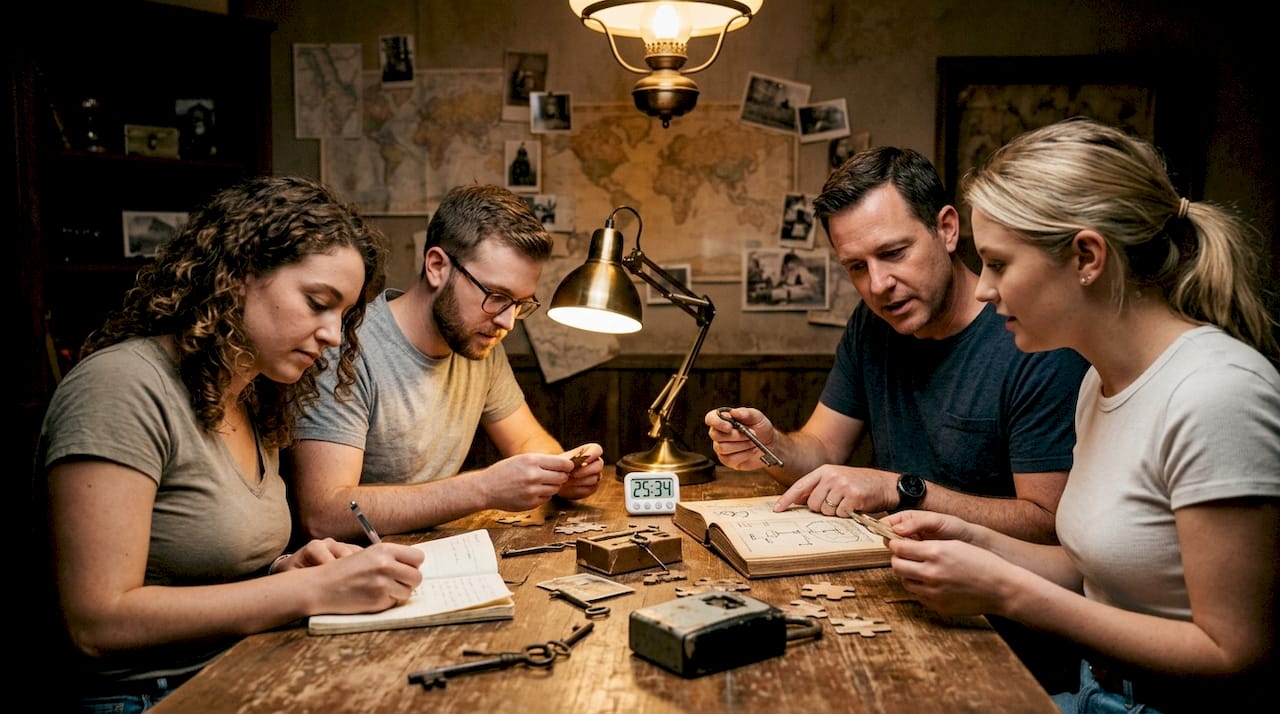
Most people assume escape rooms are hard because of tricky puzzles. Lock combinations, hidden codes, cryptic symbols — that’s the image. But groups who’ve actually played know the real story. The toughest moments rarely come from a single impossible puzzle. They come from six people talking over each other, missing an obvious clue in plain sight, or freezing up with three minutes left on the clock. If you’re planning a group outing or team-building event in Colorado Springs, understanding what actually drives difficulty will help you walk in prepared and walk out victorious.
Table of Contents
- Understanding the basics: What escape rooms are testing
- Puzzle design and logical flow: Where the real challenge begins
- Group dynamics and communication: The teamwork challenge
- The role of hints and clue systems in balancing difficulty
- Our take: Why challenge should always be fun, not frustrating
- Experience your own escape room challenge
- Frequently asked questions
Key Takeaways
| Point | Details |
|---|---|
| Teamwork is key | Strong communication and coordination define group success more than puzzle difficulty. |
| Logical puzzle flow | Consistent, fair puzzles enhance challenge while keeping the game engaging and solvable. |
| Hint systems matter | Well-designed clues support fairness and prevent frustration for recreational and team groups. |
| Enjoy the experience | The ultimate goal is shared fun, not just solving for the sake of difficulty. |
Understanding the basics: What escape rooms are testing
Escape rooms are not trivia contests. They are not IQ tests. They are carefully designed environments built to stress-test how a group of people functions under pressure. The puzzles are just the vehicle.
At their core, most escape rooms are measuring a handful of specific skills:
- Teamwork: Can your group divide tasks without stepping on each other?
- Observation: Are people scanning the room carefully or rushing to the most obvious props?
- Problem-solving: Can you connect information from different sources into one solution?
- Time management: Are you spending ten minutes on a single lock while other puzzles go untouched?
- Communication: Is everyone sharing what they find, or are people hoarding clues?
These skills are interconnected. A group of sharp puzzle-solvers can still fail if nobody talks. A group of average puzzle-solvers can succeed if they communicate well and stay organized.
“Non-linear game flow demands constant communication and task division to keep a group from collapsing under pressure.”
This is exactly why CodeBusters Escape Room challenges are built around layered experiences that reward group coordination just as much as individual cleverness. When you walk into a room with your team, you’re not just solving puzzles. You’re testing how well you function together when the stakes feel real and the clock is ticking.
The best escape room designers know that success rates and overall satisfaction are tied directly to these competencies. A room that only tests raw puzzle knowledge will frustrate casual players. A room that tests communication, observation, and teamwork creates memorable experiences for everyone involved.
Puzzle design and logical flow: Where the real challenge begins
Now that we’ve defined what escape rooms test, let’s zoom in on puzzle design — the heart of every challenging escape.
Not all puzzles are created equal. The best ones follow what designers call logical coherence. Every clue, every lock, every hidden message should feel like it belongs in the world of that room. When a puzzle makes sense within the story, solving it feels earned. When it feels random or disconnected, it just feels unfair.
The “10-Team Rule” is a useful benchmark in game design: if ten different groups all get stuck on the same puzzle, the puzzle is probably the problem, not the players. Good designers use this to identify where logical coherence breaks down.
| Puzzle type | Challenge level | Group impact |
|---|---|---|
| Linear sequence | Moderate | Easy to coordinate, lower chaos |
| Non-linear branching | High | Requires role division and strong communication |
| Narrative-embedded | Variable | Rewards immersed, observant players |
| Non-diegetic (out of context) | Frustrating | Breaks immersion and disengages teams |
As the design principle goes, logical coherence ensures fairness; puzzles that break from the room’s narrative world make the experience feel arbitrary rather than challenging.
Immersion plays a huge role here. When the story pulls you in, every puzzle feels like a natural part of the world. When a puzzle feels bolted on, it breaks the spell and makes difficulty feel cheap rather than rewarding.
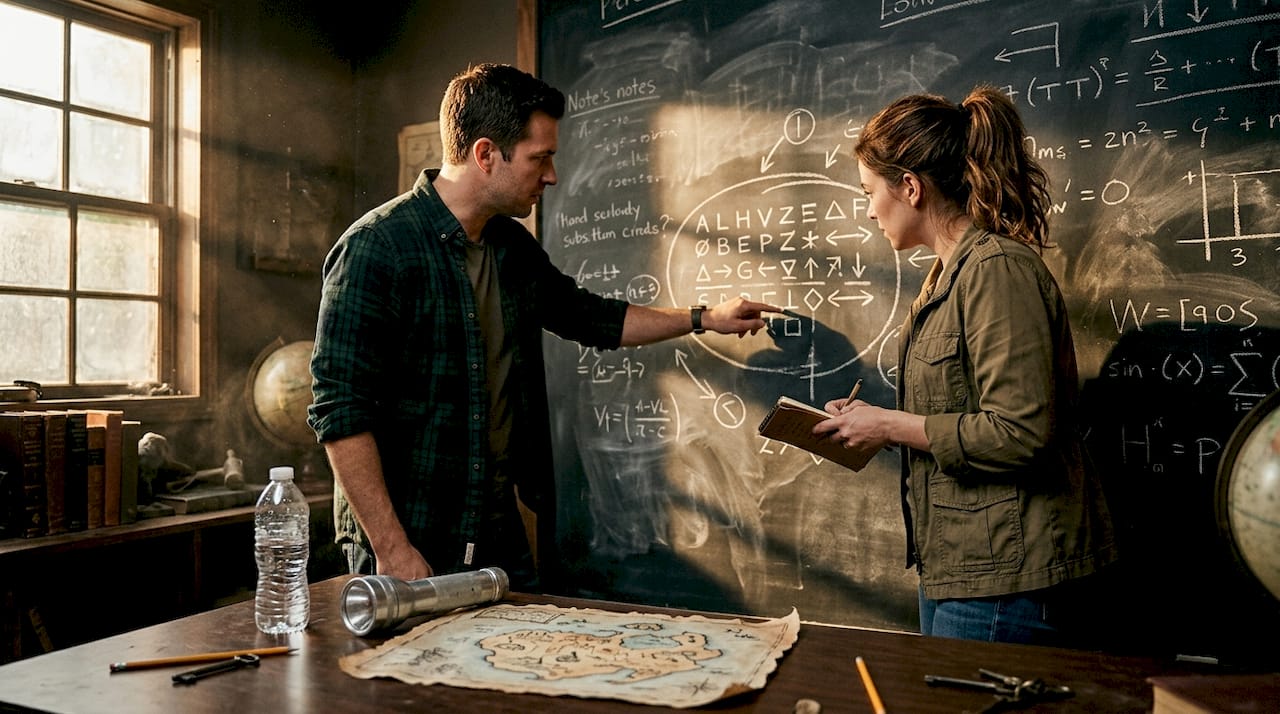
Pro Tip: Before your group starts, take thirty seconds to absorb the room’s theme and story. Players who understand the narrative context tend to approach puzzles with better intuition and spot connections faster.
Mix of linear and non-linear puzzle sequences also matters. A room that’s entirely linear can feel like a single-file line where one person does all the work. A room with branching paths lets everyone contribute at once, which raises both the challenge and the fun. Understanding room puzzle logic before you book helps you choose the right experience for your group’s skill level.
Group dynamics and communication: The teamwork challenge
With puzzle design understood, it’s time to look at the human element — how teams interact and why this shapes the challenge.
Time pressure is the great equalizer. Even the most organized group can unravel when the clock hits the ten-minute mark. Stress narrows focus, and people stop sharing information. Someone finds a key but doesn’t announce it. Someone else solves a cipher but doesn’t connect it to the lock across the room. These small communication failures stack up fast.
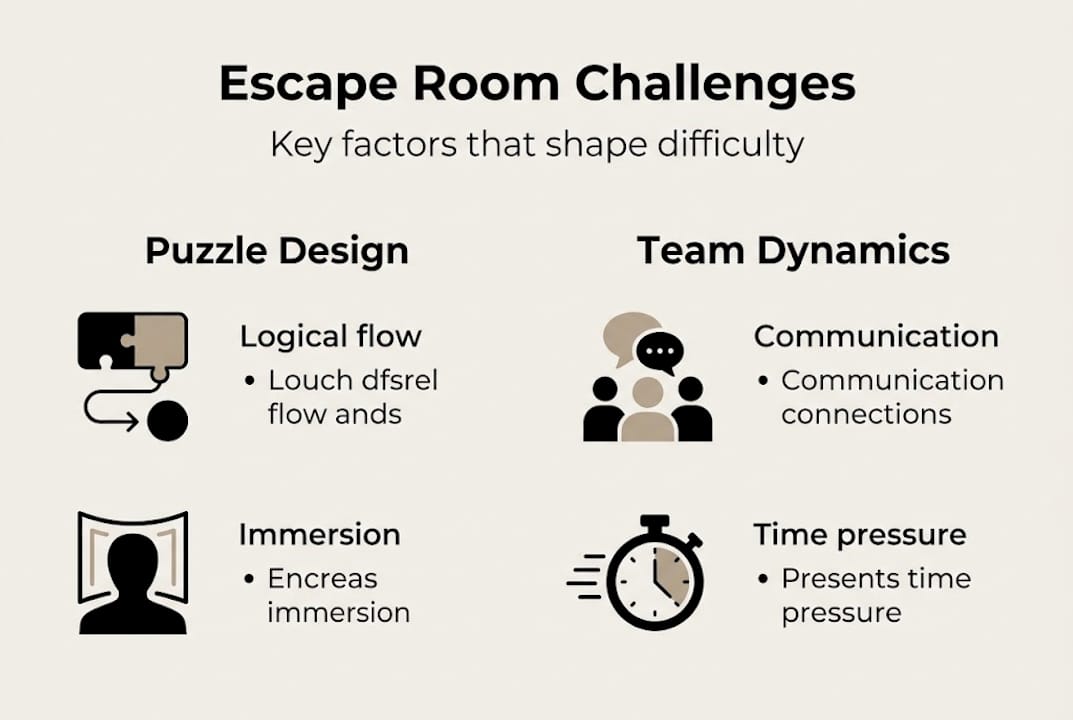
Non-linear game flow creates organization challenges that hit hardest when teams haven’t established clear communication habits before entering.
Here’s what effective teams tend to do differently:
- Announce every find immediately, even if you don’t know what it means yet
- Designate one person to track used clues and solved puzzles
- Rotate tasks so no one person gets tunnel vision on a single puzzle
- Call for a group check-in every fifteen minutes to share progress
| Communication habit | Effect on group performance |
|---|---|
| Open sharing of all finds | Reduces duplicated effort and missed connections |
| Designated tracker role | Keeps the group organized across multiple puzzle threads |
| Regular check-ins | Prevents individuals from going too deep down rabbit holes |
| Rotating tasks | Keeps energy up and brings fresh eyes to stuck puzzles |
Breakdowns most often come from missed details and poor information sharing, not from puzzles being too hard. The group that treats every new find as a team asset, rather than an individual discovery, consistently outperforms groups where people work in silos.
If you want to sharpen your group’s approach, reviewing escape room team strategies before your session can make a real difference in how smoothly your team coordinates.
The role of hints and clue systems in balancing difficulty
Groups may wonder if hints make things too easy or unfair — let’s clarify how hints actually help shape the challenge.
Hint systems come in several forms, and each creates a different experience:
- Live game master hints: A real person monitors your progress and delivers hints verbally or through a screen. This allows for personalized, context-aware guidance.
- Automated hint systems: Pre-recorded clues triggered by time or request. Consistent but less flexible.
- Tiered clue systems: Hints escalate from gentle nudges to direct answers. You choose how much help you want.
- Physical clue envelopes: Old-school but effective. Teams open them at their discretion.
Well-timed hints do something important: they rescue momentum. When a group is stuck, frustration builds quickly. A single well-placed hint can unlock twenty more minutes of engaged, energized play. The goal is never to make the room easier. It’s to keep the experience moving and satisfying.
At the same time, leaning on hints too heavily can hollow out the victory. There’s a meaningful difference between escaping with two hints and escaping with ten.
Pro Tip: Use your first hint early if you’re genuinely stuck, not as a last resort. Getting unstuck quickly preserves your group’s energy and confidence for the harder puzzles ahead.
From a design standpoint, hint need below 30% signals that a room’s difficulty is well-balanced. Rooms where most groups need constant hints are usually signaling a design problem, not a player problem. When you explore using hints in escape rooms as a strategic tool rather than an admission of failure, your group’s experience improves dramatically.
Our take: Why challenge should always be fun, not frustrating
Armed with this understanding of escape room structure and teamwork, here’s our honest perspective from inside the industry.
We’ve watched thousands of groups come through our doors in Colorado Springs. The ones who leave frustrated almost never blame the puzzles. They blame the experience of feeling stuck without any path forward, or the feeling that their team fell apart under pressure. That’s the real enemy: not difficulty, but unfair difficulty.
A room that’s hard because it demands real teamwork and sharp observation? That’s a great room. A room that’s hard because the puzzles are disconnected or the clues are buried in ways that feel random? That’s a design failure.
Our escape room design philosophy starts with one belief: challenge should always feel earned. Every puzzle should make you feel clever when you crack it, not lucky.
Before your group enters any room, set one simple ground rule: everything you find belongs to the team immediately. No exceptions. That single habit changes the entire dynamic and turns a group of individuals into an actual team. Challenge becomes fun when everyone feels like they contributed to the escape.
Experience your own escape room challenge
If you’re ready to put these insights into action, challenge yourself and your friends with a real escape room adventure.
At CodeBusters Escape Room in Colorado Springs, we offer a variety of themed rooms across different difficulty levels, from beginner-friendly adventures to rooms that will push even experienced groups to their limits. Whether you’re organizing a friends’ night out, a family event, or a corporate team-building session, we have an experience designed for your group.

Every room is privately booked, so your group gets the full experience without strangers. Our themed rooms like “Stranger 80’s” and “Flight of Deception” are built around the exact design principles covered in this article: logical puzzles, immersive narratives, and balanced difficulty. Book your Colorado Springs escape today and find out what your team is really made of.
Frequently asked questions
What makes an escape room especially difficult for groups?
Non-linear puzzles demand quick, clear communication and task division under time pressure, which is where most groups struggle most. The challenge multiplies when team members work independently instead of sharing information in real time.
How do hint systems impact the challenge level?
Well-designed hint systems balance difficulty by rescuing stuck teams without eliminating the satisfaction of solving puzzles. When hint need stays below 30%, it typically signals the room’s difficulty is appropriately calibrated.
Are escape rooms more about puzzles or teamwork?
Both matter, but teamwork and communication consistently determine group success more than raw puzzle-solving ability. A well-coordinated team with average puzzle skills will usually outperform a group of brilliant but uncoordinated individuals.
What tips help teams succeed in challenging escape rooms?
Assign a tracker role, announce every find immediately, and rotate tasks regularly to keep fresh perspectives on unsolved puzzles. Checking in as a group every fifteen minutes prevents tunnel vision and keeps everyone engaged and contributing.