What Is Team Bonding and Why It Matters

Team bonding is the deliberate process of building strong interpersonal connections among team members through shared experiences that create trust, psychological safety, and a genuine sense of belonging. Unlike casual office socializing, it is a structured practice with measurable outcomes. Teams with strong connections outperform others by up to 20%. That gap is not a coincidence. It reflects what happens when people feel safe enough to collaborate honestly, disagree productively, and carry each other through hard problems. If you lead a team or work on one, understanding what is team bonding and how to apply it strategically is one of the highest-leverage skills you can develop.
What is the difference between team bonding and team building?
These two terms get used interchangeably, but they describe fundamentally different activities. Getting them confused leads to wasted time and frustrated teams.
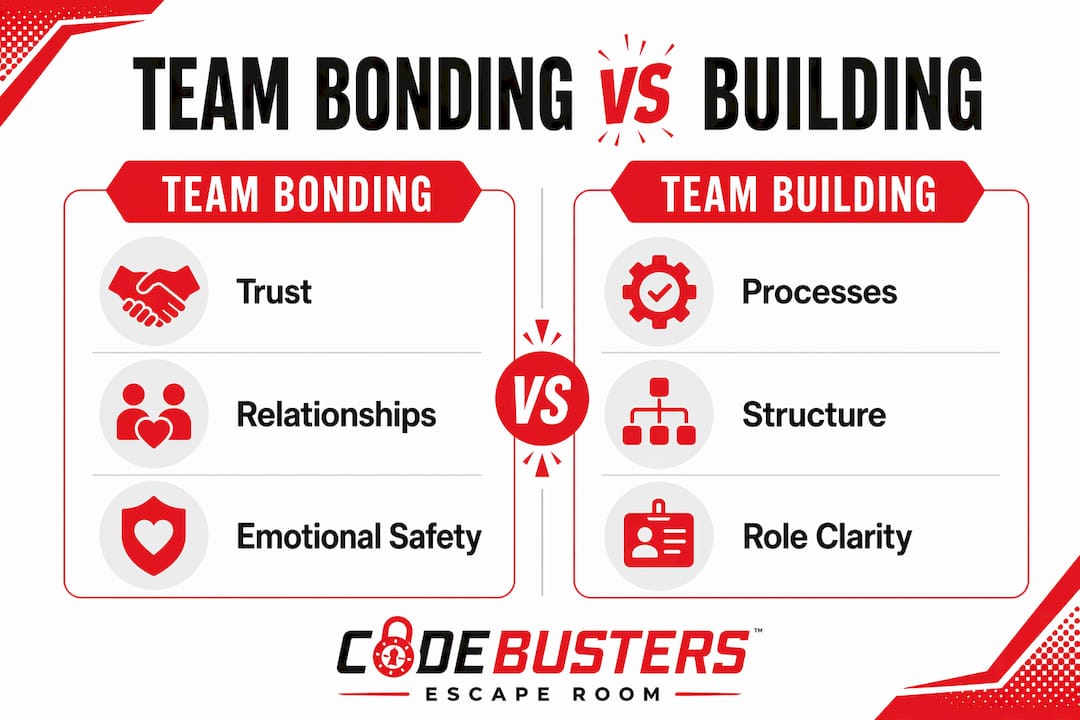
Team bonding focuses on who, meaning the relationships, trust, and emotional safety between people. Team building focuses on how, meaning the processes, roles, and outputs that make a team function. One is relational. The other is operational.
A useful way to think about it: bonding is the mortar, and team building is the bricks. Bricks stacked without mortar collapse under pressure. Mortar without bricks holds nothing together. You need both, but in the right order.
| Attribute | Team bonding | Team building |
|---|---|---|
| Primary focus | Relationships and trust | Processes and roles |
| Core question | Do we know and trust each other? | Do we know how to work together? |
| Typical activities | Personal trivia, shared meals, escape rooms | Workshops, role clarity sessions, retrospectives |
| Measurable outcome | Psychological safety, reduced conflict | Efficiency, output quality, accountability |
| Best used when | Trust is low or a team is newly formed | Processes are unclear or performance is inconsistent |
The table above shows why choosing the wrong approach backfires. A team that lacks trust will not benefit from a process workshop. They need bonding first. A team with strong relationships but unclear roles needs building, not another social event.
Pro Tip: Before planning any team activity, ask yourself one diagnostic question: “Is our main problem that we don’t trust each other, or that we don’t know how to work together?” Your answer tells you exactly which approach to use.
What are the proven benefits of team bonding?
The case for team bonding is not built on intuition. It is built on field research with real teams and measurable outcomes.

Biweekly bonding activities over three months reduce employee turnover by 4–4.5 percentage points compared to a baseline of 9–13%. That is a significant reduction in one of the most expensive problems any organization faces. Replacing a single employee typically costs between 50% and 200% of their annual salary, so even a modest retention improvement pays for itself quickly.
Beyond retention, the relational benefits are measurable too. Recurring bonding activities improve perceived collegiality and workplace friendships by approximately 0.2–0.25 standard deviations. That may sound abstract, but it translates to teams that communicate more openly, cover for each other more willingly, and report higher job satisfaction.
The disengagement problem makes bonding even more urgent. Consider the scale of the challenge:
- 70% of employees are disengaged at work, representing a massive drag on productivity and morale.
- Brief, 20-minute bonding exercises can begin to address this without requiring large budgets or full-day offsites.
- Psychological safety, the belief that you can speak up without being punished, is one of the clearest outcomes of consistent bonding.
- Reduced free-riding is another documented benefit. When people feel connected to their teammates, they are less likely to coast.
“Team bonding should not be dismissed as ‘fluff.’ When executed strategically, it is the essential mortar holding teams together.” — ITD World
The importance of team bonding becomes clearest when you look at what its absence costs. Disengaged employees, high turnover, and conflict-heavy teams are not personality problems. They are often structural ones, rooted in a lack of genuine human connection at work.
What are effective team bonding activities and ideas?
The best team bonding activities share three traits: they are low-barrier enough for everyone to participate, they create authentic personal moments rather than forced fun, and they happen regularly rather than once a year.
Here are proven formats organized by setting:
- Virtual coffee chats. Pair team members randomly for 15-minute video calls with no agenda. This works especially well for remote and hybrid teams who rarely interact outside of meetings.
- Personal trivia rounds. Each person submits three facts about themselves. The team guesses who matches each fact. This surfaces surprising personal details and creates genuine conversation.
- Two truths and a lie. A classic for a reason. It requires no prep, works in groups of any size, and generates laughter and curiosity in equal measure.
- Escape rooms. Structured problem-solving under time pressure forces real collaboration. Teams that work through escape room challenges together practice communication, trust, and creative thinking in a way that no icebreaker game replicates.
- Shared learning sessions. Ask a team member to teach the group something they know well, whether that is a professional skill or a personal hobby. This builds respect and reveals hidden expertise.
How often should you run bonding activities?
Frequency matters more than most leaders realize. One-off social events fade quickly. The research is clear: sustained, scheduled bonding over weeks produces measurable retention and performance benefits. A biweekly cadence of 20-minute sessions is the most evidence-backed starting point.
Choosing activities for your team’s context
Remote teams need activities that work over video. Hybrid teams benefit from formats that do not disadvantage people joining remotely. In-person teams have the most flexibility, but they also face the risk of defaulting to passive events like catered lunches that create no real connection.
Pro Tip: Integrate bonding into existing meetings rather than scheduling separate events. Opening a weekly standup with a two-minute personal question costs nothing and builds connection over time without adding to anyone’s calendar.
How does team bonding support long-term success?
Team bonding is not a destination. It is a foundation. The most common mistake leaders make is treating it as a one-time fix rather than an ongoing practice.
Psychological safety is the clearest long-term outcome of consistent bonding. When team members feel safe to share vulnerabilities and take risks without fear of judgment, they innovate more freely and flag problems earlier. Google’s Project Aristotle, one of the most cited studies on team effectiveness, identified psychological safety as the single most important factor in high-performing teams.
Bonding also sets the stage for deeper team building work. Facilitators who open workshops with short, low-barrier bonding exercises report that participants shift more readily from individual contributor mode to genuine collaborative thinking. The bonding creates receptivity. The building work that follows lands harder and sticks longer.
There are also clear limits to what bonding alone can achieve:
- Bonding cannot fix poor processes or unclear roles. Using it as a substitute for process improvement masks deeper operational problems.
- A team that bonds well but has no shared goals or accountability structures will still underperform.
- Bonding activities that feel inauthentic or forced, think mandatory karaoke nights, can backfire and reduce trust rather than build it.
The right sequence is bonding first, then building. Trust creates the conditions where process work actually takes hold. Skip the foundation and the structure stays fragile.
Key Takeaways
Team bonding is the relational foundation that makes every other team improvement effort more effective and more durable.
| Point | Details |
|---|---|
| Bonding vs. building | Bonding builds trust and relationships; building improves processes and roles. Use bonding first. |
| Performance impact | Teams with strong interpersonal connections outperform others by up to 20%. |
| Retention benefit | Biweekly bonding over three months reduces turnover by 4–4.5 percentage points. |
| Frequency over intensity | One-off events fade fast. Scheduled, recurring sessions produce lasting results. |
| Bonding has limits | It cannot replace process improvements. Use it as a foundation, not a cure-all. |
What I have learned from watching teams bond and break
Running an escape room venue in Colorado Springs, I have watched hundreds of teams walk through our doors. Some arrive as a tight unit. Most arrive as a collection of individuals who happen to share a workplace. What happens inside the room tells you everything about where their relationships actually stand.
The teams that struggle most are rarely the ones facing the hardest puzzles. They are the ones where nobody wants to be wrong in front of a colleague. That is a trust problem, not a skill problem. And no amount of process training fixes it.
What I have come to believe is that most leaders underinvest in bonding because it feels unquantifiable. They can measure sprint velocity or sales numbers. They cannot easily measure psychological safety. So they skip the mortar and wonder why the bricks keep falling.
The 2026 workplace adds another layer of complexity. Hybrid and remote arrangements mean many teams have never shared a physical space. The informal bonding that used to happen in hallways and at lunch tables no longer occurs by default. Leaders have to create those moments deliberately. The teams I see thrive are the ones whose leaders treat bonding as a scheduled, recurring practice, not a reward for hitting a quarterly target.
My honest advice: start small. A two-minute personal question at the top of your next meeting costs nothing. Do it every week for a month and watch what changes.
— CodeBusters
Try a real bonding experience with Codebustersescaperoom
If you want your team to experience genuine connection rather than just talk about it, an escape room delivers something no icebreaker worksheet can.
Codebustersescaperoom in Colorado Springs offers private room bookings designed for corporate teams, with themed experiences like “Flight of Deception” and “Stranger 80’s” that put real pressure on communication and trust. Teams that work through escape room puzzles together leave with shared stories, a clearer sense of each other’s strengths, and the kind of trust that carries back into the office. Whether your team is local or visiting Colorado Springs, Codebustersescaperoom is a practical, high-impact way to put team bonding into action. Book your session and give your team something worth talking about.
FAQ
What is team bonding in simple terms?
Team bonding is the practice of building genuine trust and personal connection among team members through shared experiences. It focuses on relationships rather than work processes.
How is team bonding different from team building?
Team bonding addresses the who, meaning interpersonal trust and belonging. Team building addresses the how, meaning roles, processes, and outputs. Bonding is the foundation; building is the structure on top.
How often should a team do bonding activities?
Biweekly sessions of around 20 minutes produce measurable results over a three-month period. One-off events have little lasting impact, so consistency matters far more than the size or cost of any single activity.
Can team bonding improve employee retention?
Yes. Research shows that biweekly bonding activities over three months reduce employee turnover by 4–4.5 percentage points compared to a baseline of 9–13%, making it one of the more cost-effective retention tools available.
What are the best team bonding activities for remote teams?
Virtual coffee chats, personal trivia rounds, and two truths and a lie all work well over video. The key is choosing formats that create authentic personal moments rather than passive participation.