Narrative Immersion: The Psychology of Feeling “Inside” a Story

Narrative immersion is the state in which an audience becomes so absorbed in a story that the boundary between observer and storyworld temporarily dissolves. You stop watching or reading and start experiencing. Three things to know immediately:
- The feeling of “being there” is not magic. It results from specific psychological mechanisms: focused attention, empathy, and embodied simulation.
- Immersion is measurable. Researchers use validated scales, behavioral proxies, and physiological signals to track it.
- Creators can design for it deliberately, across every medium from novels to escape rooms.
Key Takeaways
Narrative immersion is the state of psychological absorption in which an audience feels part of the storyworld, produced by attention, embodied simulation, and identification, and measurable through validated scales and behavioral proxies.
| Point | Details |
|---|---|
| Core definition | Immersion is absorbed engagement where the storyworld boundary dissolves, distinct from but related to transportation, presence, and identification. |
| Primary mechanisms | Attentional focus, perspective-taking, embodied simulation, and coherent storyworld construction all drive the experience. |
| Top creator levers | Sensory specificity, narrative-mechanic integration, consistent worldbuilding, and paced tension-release cycles produce the strongest immersion. |
| Measurement approach | Combine the Narrative Engagement Scale (self-report) with at least one behavioral proxy for a reliable, low-cost signal. |
| Apply the checklist | Run the 10-item creator checklist on your next project before user testing to catch the most common immersion breakers early. |
Table of Contents
- What narrative immersion actually means, and how it differs from related terms
- How narrative immersion happens in the mind
- How creators build narrative immersion across formats
- Examples of narrative immersion across different media
- Escape rooms as a concentrated case study in immersion design
- What immersion actually changes in audiences
- How researchers and creators measure narrative immersion
- What breaks narrative immersion, and how to fix it
- A 10-item checklist for creators designing immersive narratives
- Why immersion is worth designing for, and where the ethics get complicated
- Sources
What narrative immersion actually means, and how it differs from related terms
Immersion, transportation, presence, and identification get used interchangeably in casual conversation. They are not the same thing, and the distinctions matter if you want to build or study them.
Narrative immersion is the broad umbrella: the deep engagement or emotional connection in which an audience feels part of the storyworld. It appears across literature, film, games, VR, and live experiences.
Narrative transportation is a specific, measurable form of immersion. Psychologist Richard Gerrig introduced the travel metaphor: the reader or viewer is “transported” away from their current environment into the story, with attention, imagery, and feelings all redirected toward the narrative world. Melanie Green and Timothy Brock later operationalized this into a research framework, showing that transported audiences return from the story changed, much like a traveler who comes back with new perspectives.
Presence refers specifically to the sense of “being there” in a physical or spatial sense, most studied in VR contexts. Identification is the degree to which an audience member adopts a character’s perspective and feels their emotions as their own. Suspension of disbelief is best understood as an outcome of successful immersion rather than an act of willpower. When sensory and narrative coherence are high, audiences stop questioning the fiction automatically.
Transportation is one pathway to immersion. Identification and presence are others. All three can operate simultaneously in a well-designed experience.
How narrative immersion happens in the mind
Four cognitive and embodied processes drive the subjective experience of being inside a story:
- Attentional focus. Immersion requires that competing stimuli recede. A phone notification, an inconsistency in the plot, a squeaky chair — any of these can pull attention back to the real world. Sustained immersion depends on the story holding enough of the audience’s cognitive bandwidth that external cues lose salience.
- Perspective-taking and empathy. When readers or viewers adopt a character’s viewpoint, they simulate that character’s emotional state. This is identification in action. The Narrative Engagement Framework from PMC research treats identification as a core dimension of engagement, alongside interest, realism, and narrative presence.
- Embodied simulation. The brain processes vivid narrative descriptions using some of the same neural circuits it would use for real sensorimotor experience. Research on linguistic and narratological features shows that sensorimotor detail, verb tense, and spatial deixis all affect how intensely a reader constructs an embodied mental model of events. This is why “she grabbed the cold iron handle” lands harder than “she opened the door.”
- Coherent storyworld construction. The mind builds a mental model of the narrative world. Gaps, contradictions, or tonal shifts force the audience to repair the model consciously, which breaks the flow of immersion.
Pro Tip: To test whether your story is triggering identification, ask a test reader to describe the protagonist’s emotional state at three key moments without looking back at the text. If they can’t, the character’s inner life isn’t landing clearly enough to sustain immersion.
How creators build narrative immersion across formats
Immersion doesn’t happen by accident. Designers and writers pull specific levers, and the levers differ by medium.
Sensory specificity is the fastest route to embodied simulation. Concrete sensorimotor language (textures, temperatures, sounds, smells) activates the reader’s simulation systems more powerfully than abstract description. In text, this means choosing verbs and nouns that carry physical weight. In film, it means sound design as much as cinematography. In a physical space, it means every prop, scent, and ambient sound earning its place.

Coherent worldbuilding keeps the storyworld’s internal logic consistent. The rules don’t have to match reality, but they must match each other. A single anachronism in a period drama, or a puzzle in an escape room that has no logical connection to the story, forces the audience to step outside the fiction to make sense of the break.
Believable stakes give the audience a reason to stay emotionally invested. Stakes don’t need to be life-or-death; they need to feel real to the character. A character who doesn’t seem to care about the outcome signals to the audience that they shouldn’t either.
Pacing and rhythm regulate the intensity of immersion. Constant high tension exhausts audiences; constant low tension loses them. The most immersive experiences modulate between tension and release, giving the audience time to process before the next escalation.
Agency and choice are particularly powerful in interactive media. When audiences make decisions that affect the story, they shift from observers to participants. This is why video games and escape rooms can produce stronger presence than passive media, even with lower production budgets.
Pro Tip: In low-budget projects, prioritize sensory specificity and coherence over spectacle. A single well-chosen detail (the smell of gunpowder, a handwritten note in a specific handwriting style) does more for immersion than expensive set dressing that doesn’t connect to the narrative.
Examples of narrative immersion across different media
Immersion looks different depending on the medium, because each format has different affordances:
- Literature. Focalization (telling the story through a character’s perceptual and emotional filter) is the primary lever. Close third-person and first-person narration pull readers into a character’s consciousness. The linguistic techniques that matter most here are sensorimotor detail, present-tense narration, and minimal narratorial intrusion.
- Film. Cinematography, sound design, and editing create immersion by controlling what the audience perceives and when. Point-of-view shots and diegetic sound (sound that exists within the story world) are particularly effective at producing presence.
- Video games. Interactivity is the dominant lever. Player agency creates a sense of authorship over the narrative, which deepens identification with the protagonist. Open-world games extend this by making the storyworld explorable rather than linear.
- VR and AR. Embodied presence is the primary mechanism. Because the audience’s body is physically inside the represented space, the simulation systems activate more automatically. Research on narrative modality confirms that different media trigger different immersion indicators, which means measurement tools designed for text don’t translate directly to VR.
- Escape rooms and live experiences. Physical interaction, multisensory environment, and first-person agency combine in a format that offloads mental simulation into actual physical action. Hybrid formats like narrative podcasts with layered sound design occupy a middle ground between passive and active media.
Escape rooms as a concentrated case study in immersion design
Escape rooms are useful case studies precisely because they compress every immersion mechanism into a single 60-minute experience. There’s no passive observation. Every participant is a protagonist, every prop is a potential story element, and every puzzle either reinforces or undermines the narrative.
The design patterns that work, drawn from Codebusters Escape Room’s approach across its Colorado Springs locations:
- First-person agency from the first moment. Participants should feel like they are in the story, not being told about it. Briefings that frame the player as a character rather than a visitor set this up immediately. When participants feel like spectators rather than protagonists, immersion fails quickly.
- Puzzle-narrative integration. Every puzzle in a well-designed room has a story reason to exist. In Codebusters’ themed rooms like “Stranger 80’s” and “Flight of Deception,” the puzzles are embedded in the narrative logic of the world, so solving them feels like advancing the story rather than completing a task.
- Sensory continuity. Lighting, sound, props, and set design all reinforce the same storyworld. A single out-of-place element (a modern light switch in a 1980s room, a puzzle that uses contemporary iconography in a period setting) breaks the coherent mental model the audience has built.
- Graceful fail-safes. Immersion survives failure when the failure is narratively framed. A clue system that delivers hints in-character (a radio transmission, a coded message) keeps participants inside the story even when they’re stuck. Puzzle design that integrates clues with story beats is one of the most underrated immersion tools available.
The outcomes Codebusters observes align with what the research predicts: groups that stay immersed solve problems more collaboratively, report higher enjoyment, and leave with stronger shared memories of the experience.
What immersion actually changes in audiences
The effects of narrative immersion extend well beyond enjoyment. Research identifies several consistent outcomes:
- Persuasion and attitude change. Transportation reduces counterarguing. When audiences are absorbed in a story, they process its implicit messages with less resistance than they would apply to a direct argument. Green and Brock’s foundational work on transportation showed that transported readers were more likely to adopt story-consistent beliefs.
- Empathy. Identification with characters produces measurable increases in empathy toward groups the character represents. This effect is robust enough that narrative approaches are used in public health campaigns and conflict-resolution programs.
- Learning and retention. The Narrative Engagement Framework treats narratives as providers of mental and behavioral models. Stories that engage interest, realism, and identification help audiences encode and retain information more effectively than didactic instruction alone.
- Enjoyment. The validated narrative engagement scale shows that emotional engagement and narrative presence are strong predictors of enjoyment, independent of story quality ratings.
One nuance worth noting: very high transportation can sometimes reduce uptake of explicit educational messages, because the audience is too absorbed in the story to process the lesson as a lesson. The Narrative Engagement Framework addresses this directly, recommending that designers balance transportation with moments of reflection.
How researchers and creators measure narrative immersion
| Method | What it measures | Pros | Cons |
|---|---|---|---|
| Narrative Engagement Scale (self-report) | Understanding, attention, emotion, presence | Validated, low cost, cross-media | Retrospective; can’t capture moment-to-moment shifts |
| Behavioral proxies (time-on-task, task focus) | Sustained engagement during experience | Unobtrusive, real-time | Doesn’t distinguish immersion from confusion |
| Physiological measures (heart rate, skin conductance) | Arousal and emotional response | Objective, continuous | Expensive equipment; arousal ≠ immersion specifically |
| Observational coding | Body language, social interaction | Captures group dynamics | Labor-intensive; requires trained coders |
Two low-cost tests any creator can run: a post-experience questionnaire using the four dimensions of the narrative engagement scale (understanding, attention, emotion, presence), and a simple behavioral proxy like tracking how often participants look at their phones or ask out-of-character questions during the experience. Both together give a reasonable signal without specialized equipment.
No single method proves immersion definitively. Self-report captures subjective experience but is retrospective. Physiological measures capture arousal but can’t distinguish immersion from anxiety. The most reliable picture comes from triangulating two or more methods.
What breaks narrative immersion, and how to fix it
Storyworld inconsistency is the most common breaker. A single anachronism, a character who behaves against their established personality, or a prop that doesn’t belong in the world forces the audience to consciously repair their mental model. Fix: build a continuity document before production and run a dedicated consistency check before launch.
Technical glitches in digital or physical environments pull attention immediately to the medium rather than the story. A malfunctioning prop, a loading screen, or an audio dropout all remind the audience they are in a constructed experience. Fix: redundancy in critical systems and a pre-session technical check.
Explicit narrator intrusion in text (the narrator addressing the reader directly, or commenting on the story from outside it) breaks focalization and reminds the reader they are reading. Fix: stay in the character’s perceptual and emotional filter; if the narrator must speak, keep it brief and tonally consistent.
Puzzle-narrative mismatches in escape rooms are the equivalent of narrator intrusion. A puzzle that requires knowledge or skills the character wouldn’t plausibly have, or that uses mechanics with no story logic, signals to participants that they are playing a game rather than living a story. Fix: integrate puzzle design with narrative beats from the earliest design stage, not as an afterthought.
Poor pacing either exhausts or bores the audience out of immersion. Fix: map the emotional arc of the experience and check that tension and release alternate at intervals appropriate to the medium and audience.
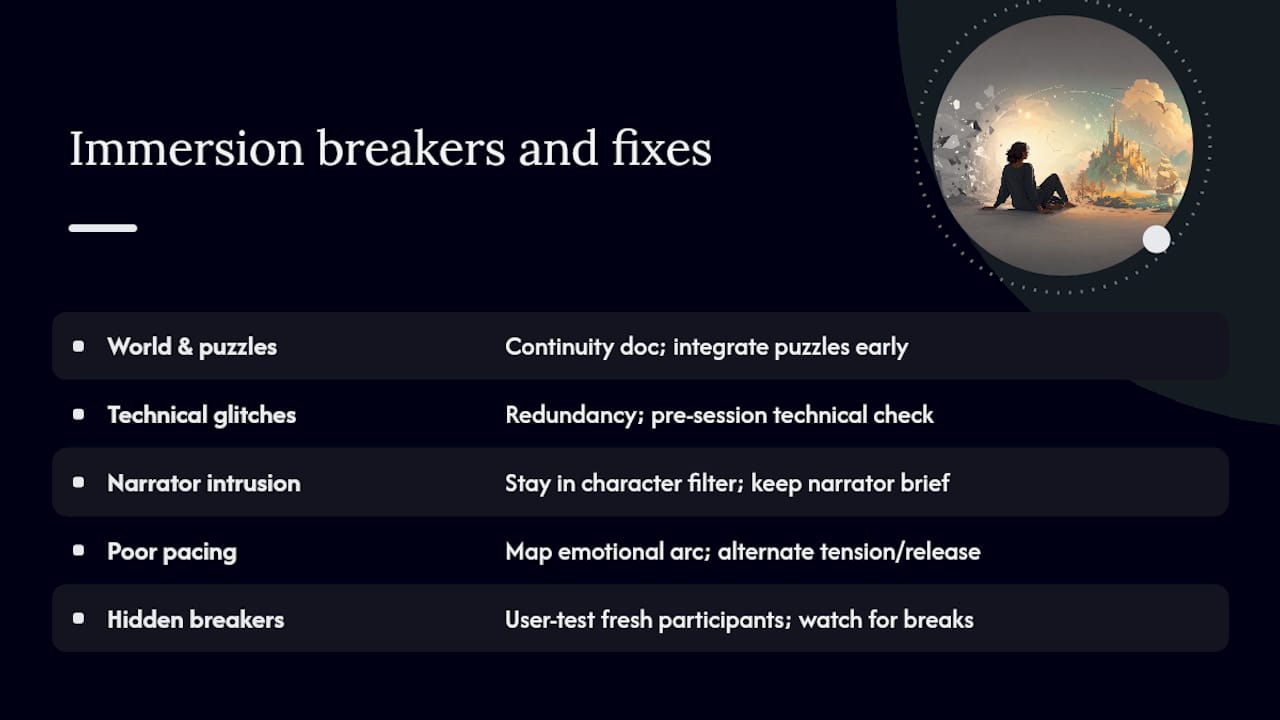
Hidden breakers are often invisible to creators. User testing with fresh participants, specifically watching for moments when they break character or disengage, reveals problems that internal review misses.
A 10-item checklist for creators designing immersive narratives
- Is the protagonist focalized in first or close third person where emotional depth matters? Test: can a reader describe the protagonist’s sensory experience at the story’s peak moment?
- Does every scene open with a grounding sensory detail? Test: read the first sentence of each scene aloud and check whether it places you physically in the world.
- Is the storyworld’s internal logic documented and consistent? Test: run a continuity check with someone who didn’t write the story.
- Do the stakes feel real to the character, not just to the plot? Test: ask a test reader what the character stands to lose.
- Does pacing alternate between tension and release? Test: map the emotional arc scene by scene and look for sustained flat stretches.
- Does every interactive element (puzzle, prop, choice) have a narrative reason to exist? Test: for each mechanic, write one sentence explaining its story logic.
- Are sensorimotor details specific rather than generic? Test: replace three adjectives with concrete nouns or verbs and check whether the scene becomes more vivid.
- Is narrator intrusion minimal and tonally consistent? Test: highlight every moment the narrator steps outside the character’s perspective and evaluate whether each is necessary.
- Have you tested with fresh participants and watched for disengagement moments? Test: note every instance of phone-checking, out-of-character questions, or visible confusion.
- Do you have at least two measurement methods planned for post-experience evaluation? Test: confirm you have a self-report instrument and at least one behavioral or observational proxy ready.
Why immersion is worth designing for, and where the ethics get complicated
At Codebusters Escape Room, narrative immersion isn’t a production flourish. It’s the mechanism through which a 60-minute experience becomes a memory that participants talk about weeks later. The research backs this up: immersed audiences learn more, feel more, and leave with attitudes shaped by what the story showed them. That’s a significant amount of influence for a designer to hold.
Which is exactly why the ethics deserve attention. Designing for deep immersion means designing for reduced counterarguing, heightened emotional response, and sometimes genuine fear or distress. In escape room contexts, that requires clear pre-experience communication about intensity levels, accessible opt-out mechanisms, and staff trained to recognize when a participant has crossed from engaged to overwhelmed. Informed consent isn’t a legal formality in this context. It’s a design requirement.
Iterative testing matters here too, not just for quality but for safety. The only way to know whether an experience crosses the line from thrilling to distressing is to watch real participants move through it, measure their responses, and adjust. Immersion that works is immersion that the audience chooses to stay inside.
Sources
- Narrative Means to Preventative Ends: A Narrative Engagement Framework for Designing Prevention Interventions - PMC
- Measuring Narrative Engagement: Media Psychology: Vol 12, No 4
- Narrative immersion: Some linguistic and narratological aspects
- Narrative immersion
- Tuning into tales: Effects of narrative modality on indicators of …
- Immersive interiority: how to collapse narrative distance to get emotion on the page