Adaptive Thinking in Teams: A Leader’s Guide

Adaptive thinking in teams is the collective ability to recognize when conditions have shifted and adjust strategy, roles, or behavior before the situation forces your hand. For leaders, that capacity translates directly into faster learning cycles, better decisions under uncertainty, and teams that recover from setbacks rather than stall in them. The Sandia National Laboratories adaptive thinking research operationalized this as recognizing environmental change and adjusting strategies, while the Rousseau & Aubé Team Adaptive Performance Scale and Pulakos-related frameworks give leaders practical ways to measure it.
Key Takeaways
Adaptive thinking in teams is a learnable, measurable skill set that leaders can build through deliberate practice, structured reflection, and a culture that rewards dissent and experimentation over false consensus.
| Point | Details |
|---|---|
| Core definition | Adaptive thinking is recognizing environmental change and adjusting strategy before conditions force the issue. |
| Top leader action | Model reframing and dissent publicly; teams mirror the behaviors their leader makes visible and safe. |
| Measurement starting point | Use the Rousseau & Aubé Team Adaptive Performance Scale items for a quick pulse check before and after any development initiative. |
| Biggest barrier | The illusion of agreement kills adaptation; ask “who sees this differently?” before closing every key decision. |
| Codebusters Escape Room | Offers private, facilitated escape-room sessions in Colorado Springs designed to surface and debrief adaptive team behaviors in a real-pressure, low-stakes setting. |
Table of Contents
- What does adaptive thinking in teams actually involve?
- Why adaptive thinking matters for team performance
- What traits do adaptive thinkers show in team settings?
- Seven strategies to build adaptive thinking across your team
- How adaptive thinking differs from related concepts
- How to measure and assess team adaptive thinking
- What blocks adaptive thinking and what leaders should do about it
- Using an escape-room exercise to practice adaptive thinking
- The thing most leaders get wrong about building adaptive teams
- Build adaptive thinking through experiential practice
- Sources
What does adaptive thinking in teams actually involve?
The phrase covers several distinct cognitive and social processes working together. Understanding each one helps you know which lever to pull when a team gets stuck.
- Recognition/disconfirmation: Noticing that current assumptions no longer fit the evidence. A team member who says, “Wait, this isn’t working the way we expected,” is doing this.
- Sensemaking: Collectively building a shared interpretation of what changed and why, so everyone is working from the same updated picture.
- Reframing: Deliberately shifting the mental frame. Instead of “how do we fix this plan,” the question becomes “what problem are we actually solving?”
- Generative experimentation: Running small, fast tests to find what works in the new conditions rather than debating the perfect answer. According to the adaptive thinking practitioner framework, structured practice and ego-management are what make this stage stick.
- Metacognition: The team’s ability to observe its own thinking process and catch when it is defaulting to habit.
One distinction worth keeping clear: individual adaptive thinking is a cognitive skill one person exercises. Team adaptive performance is what happens when those skills are coordinated across roles, shared mental models, and communication norms. A team of individually flexible people can still fail to adapt collectively if they never build the shared sensemaking layer.
Pro Tip: Run a five-minute “assumption audit” at the start of any project review. Ask the team: “What are we assuming that we haven’t checked recently?” That single question activates recognition and disconfirmation without requiring a formal process.
Why adaptive thinking matters for team performance
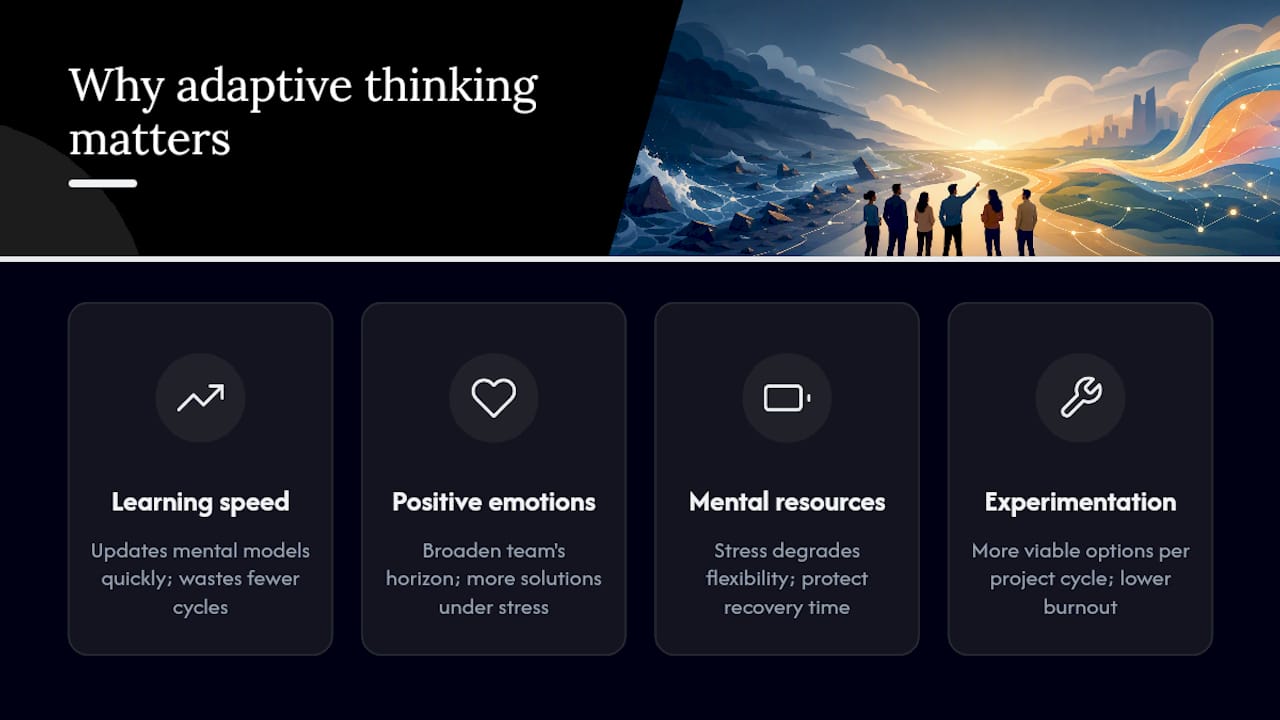
Speed of learning is the most direct payoff. Teams that update their mental models quickly waste fewer cycles on approaches that stopped working. They also recover faster from crises because they are not waiting for a top-down directive to tell them conditions changed.
Positive emotions broaden a team’s cognitive horizon and help groups see more solutions under stress. That is not a soft finding. It means that psychological safety and team morale are not separate from adaptive performance; they are part of the mechanism.
Cognitive flexibility depends on prefrontal resources, and stress degrades it. Teams under chronic overload literally lose the neural capacity for flexible thinking. Leaders who protect recovery time and vary the work are not being soft; they are maintaining the cognitive infrastructure the team needs to adapt.
On the innovation side, teams that practice rapid experimentation generate more viable options per project cycle. They also report lower burnout from repeated failure because they treat failed experiments as data rather than defeats. That shift in framing keeps people engaged rather than defensive.
What traits do adaptive thinkers show in team settings?
These are observable behaviors, not personality types. You can watch for them in meetings, project reviews, and under pressure.
- Open-mindedness: Actively solicits contradictory information rather than filtering for confirmation. Micro-habit: asks “what would have to be true for the opposite view to be right?”
- Cognitive flexibility: Switches between analytical and creative modes without getting stuck. Micro-habit: proposes at least two alternative framings before settling on one.
- Growth mindset: Treats setbacks as information. Micro-habit: after a miss, asks “what did we learn?” before asking “who is responsible?”
- Rapid alternatives generation: Produces multiple options quickly under constraint. Micro-habit: uses a “three options minimum” rule before any decision meeting.
- Sensemaking: Builds shared interpretations across the team. Micro-habit: paraphrases what others said before adding their own view.
- Transactive memory: Knows who on the team knows what, so the right expertise gets activated fast. Research on transactive memory systems shows this makes teams more effective at improvising when conditions shift rapidly.
- Willingness to experiment: Proposes small tests rather than waiting for certainty. Micro-habit: frames proposals as “let’s try this for two weeks and measure X.”
- Humility under pressure: Stays open to being wrong even when the stakes are high. BCG’s research on highly adaptive leadership teams identifies alignment on priorities and shared leadership behaviors as core to this trait at the team level.
Pro Tip: Score your team on these eight traits after a recent project post-mortem. You don’t need a formal survey. A quick 1–5 rating per trait per person, discussed openly, surfaces patterns faster than any assessment tool.
Seven strategies to build adaptive thinking across your team
1. Trigger-based contingency planning
Before any project launches, map two or three “if X then Y” triggers. If the key assumption fails, the team already knows which plan to shift to. This is not pessimism; it is pre-loaded sensemaking that cuts decision lag when conditions change.
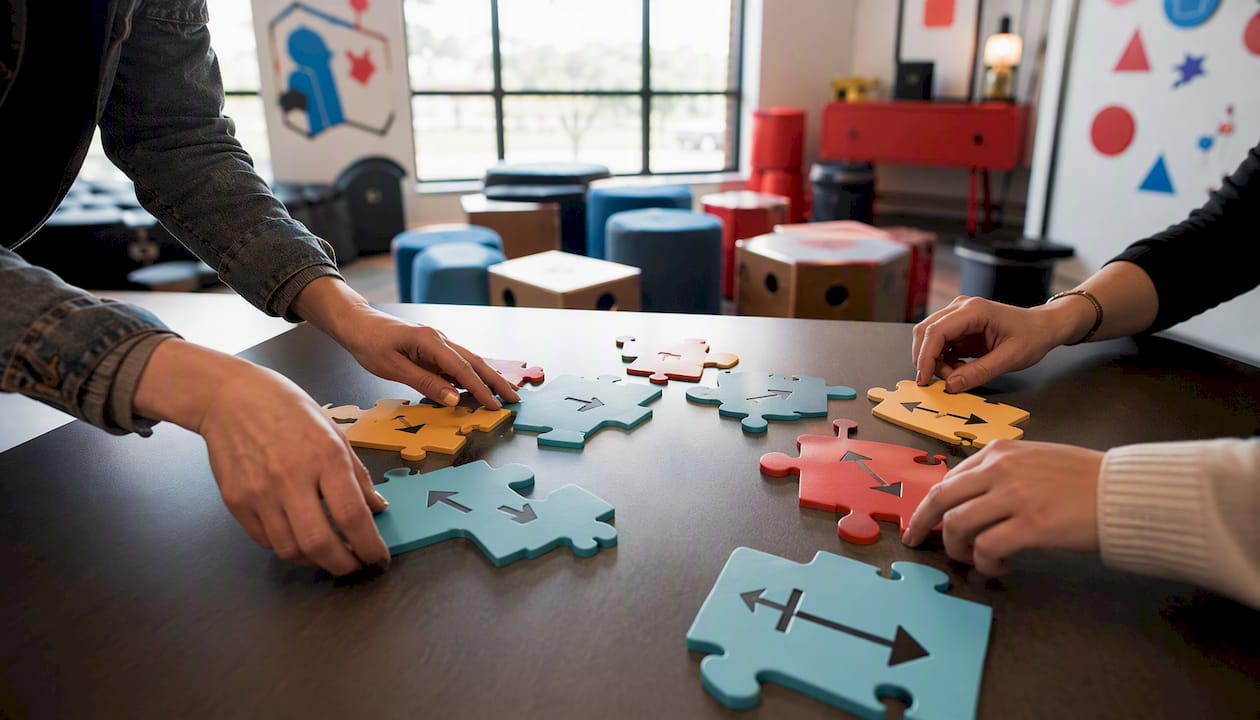
Track it by measuring how quickly the team activates a contingency after a trigger fires. Aim to significantly reduce that lag over time.
2. Structured after-action debriefs
After every significant event, run a 20-minute debrief using four questions: What did we expect? What actually happened? Why the gap? What do we change? Teams that pause for collective reflexivity and maintain shared mental models perform measurably better at improvised adaptation.
Track debrief frequency and whether the team’s next project shows fewer repeat errors.
3. Deliberate novelty exposure
Rotate team members into cross-functional meetings, assign reading from adjacent industries, or bring in a guest with a completely different background once a quarter. Novelty exposure and deliberate practice build cognitive flexibility at the neural level. Track how often team members reference outside-domain ideas in project discussions.
4. Role rotation
Swap functional responsibilities for a defined sprint. A project manager who spends two weeks in a client-facing role sees the problem differently. This builds transactive memory and breaks the role-silo patterns that kill collective sensemaking.
5. Hypothesis-driven experiments
Replace “let’s try this” with “our hypothesis is X; we’ll test it by measuring Y over Z weeks.” The discipline of stating a hypothesis before acting forces the team to make assumptions explicit, which is the first step in disconfirmation.
6. Cognitive diversity practices
Actively include people who think differently, not just people who have different backgrounds. Assign a “devil’s advocate” role in key decisions. Use diverse puzzle challenges as a design principle for team exercises.
7. Safe-to-fail prototyping
Create a formal category of “experiments” that are explicitly not judged as failures if they don’t work. The distinction between an experiment and a project matters culturally. Adaptive thinkers can be developed through training and a supportive culture, but only when the environment makes it safe to be wrong.
Pro Tip: Pick one strategy per quarter, not all seven at once. Overloading teams with new practices is itself a barrier to adaptivity. One practice, embedded well, compounds faster than seven practices adopted poorly.
How adaptive thinking differs from related concepts
These distinctions matter because the wrong diagnosis leads to the wrong intervention.
- Adaptive thinking vs. growth mindset: Growth mindset is a belief about ability (“I can improve”). Adaptive thinking is a cognitive and behavioral skill set (“I can recognize change and respond to it”). You can have a growth mindset and still freeze when conditions shift. Adaptive thinking requires the additional capacity to act on that belief in real time.
- Adaptive thinking vs. creativity/divergent thinking: Creativity generates novel ideas from scratch. Adaptive thinking is change-responsive: it activates when the environment signals that current approaches are failing. A creative team that never monitors for environmental signals can produce brilliant ideas that are completely disconnected from what the situation actually requires.
- Adaptive thinking vs. organizational agility: Agility is a structural and capability property of an organization (sprint cycles, flat hierarchies, modular teams). Adaptive thinking is a cognitive and process skill that individuals and teams exercise. You can build an agile structure and still have teams that default to fixed patterns under pressure. Adaptive thinking is what fills the gap between agile structure and agile behavior.
How to measure and assess team adaptive thinking
Measurement is where most leaders stop. The good news is that you don’t need a psychometrician. A rapid scoping review by Clerici et al. found team-level adaptivity research is conceptually rich but empirically sparse, and recommended applied self-report and observational scales as the most practical options for practitioners.
Observation checklist (use during meetings or simulations):
- Does the team notice when a plan is failing before being told?
- Do members voice alternative interpretations, or does the first framing stick?
- Does the team update its shared picture when new information arrives?
- Are experiments proposed before solutions are locked in?
- Does the team know who to pull in when a new type of problem appears?
- Is dissent expressed openly, or does quiet agreement dominate?
- Do members ask clarifying questions rather than assuming?
- Does the team debrief after unexpected events?
Sample pulse-check survey items (adapted from Rousseau & Aubé’s Team Adaptive Performance Scale and Pulakos-related frameworks):
- “When our situation changes unexpectedly, our team adjusts its approach quickly.”
- “Team members actively look for signals that our current plan needs updating.”
- “We regularly discuss what we assumed versus what actually happened.”
- “Our team generates multiple options before committing to a course of action.”
- “We know which team member to involve when we face an unfamiliar problem.”
| Measurement approach | What it captures | Best used when |
|---|---|---|
| Self-report scale (e.g., Rousseau & Aubé) | Team members’ perception of their own adaptive behaviors | Baseline assessment, training evaluation |
| Supervisor/observer rating | Behavioral frequency as seen from outside the team | Performance reviews, coaching conversations |
| Simulation-based assessment | Real-time recognition and response under controlled pressure | High-stakes team development, pre-deployment readiness |
| Task-based cognitive test | Individual cognitive flexibility contributing to team capacity | Hiring, role-fit assessment |
What blocks adaptive thinking and what leaders should do about it
Most teams don’t fail to adapt because they lack intelligence. They fail because the environment punishes the behaviors that adaptation requires.
Red flags that a team is stuck in fixed-pattern thinking:
- Every project debrief reaches the same conclusions with no behavior change
- Dissent disappears in meetings but resurfaces in side conversations
- The team escalates every unexpected event rather than handling it locally
- New information gets filtered to fit the existing plan rather than updating it
- The same person always frames the problem and no one reframes it
Common barriers and leader stop/start actions:
| Barrier | Stop doing | Start doing |
|---|---|---|
| Illusion of agreement | Accepting silence as consensus | Asking “who sees this differently?” before closing a decision |
| Speed-over-reflection pressure | Skipping debriefs when time is tight | Protecting 20 minutes post-event, non-negotiable |
| Punishment of failure | Treating failed experiments as performance issues | Distinguishing experiments from commitments explicitly |
| Homogenized information flows | Routing all information through one person | Creating direct lateral channels between team members |
| Role silos | Assigning problems strictly by function | Rotating problem ownership across roles quarterly |
| Stress-induced rigidity | Adding workload when performance drops | Reducing cognitive load before demanding flexible thinking |
Leaders often mistake quiet agreement for shared understanding. Adaptive teams need active dissent and voiced alternative interpretations to avoid the illusion of agreement, which is one of the most reliable predictors of collective failure under pressure.
Using an escape-room exercise to practice adaptive thinking
An escape-room-style simulation is one of the most efficient ways to surface adaptive behaviors in a low-risk setting. The structure forces recognition, reframing, and rapid experimentation within a bounded time frame, which makes observation straightforward.
Facilitation checklist:
- Set a clear time limit (45–60 minutes works well for most groups)
- Assign roles before entry: one observer who does not participate but tracks behaviors
- Brief the team that the goal is not just to escape but to notice how they think
- Choose a room with genuine ambiguity, where challenge design creates safe-to-fail conditions
- Have the observer note: who reframes first, who generates alternatives, who updates the shared plan
Debrief prompts (run immediately after, while experience is fresh):
- When did you first realize your initial approach wasn’t working? What triggered that recognition?
- Who proposed the reframe that changed the team’s direction? What made it land?
- Were there moments when the team held onto a failing strategy too long? What kept you there?
- How did you decide who to involve when a new type of puzzle appeared?
- What assumptions did you bring in that turned out to be wrong?
- Where did the team’s shared picture break down, and how did you rebuild it?
- What would you do differently in the first five minutes if you ran it again?
- Which of those behaviors shows up in your actual work, and which doesn’t?
These prompts map directly to the components covered earlier: recognition, sensemaking, reframing, transactive memory, and metacognition. The same debrief structure scales to workplace simulations run by internal facilitators. Escape rooms build stronger teams precisely because the pressure is real enough to activate genuine adaptive behaviors, but the stakes are low enough that people take risks they wouldn’t take at work.
The thing most leaders get wrong about building adaptive teams
The conventional advice is to hire for adaptability. That is not wrong, but it misses the bigger lever. Most teams already have people who can think adaptively. What they lack is a culture that makes those behaviors visible and rewarded.
The teams that develop adaptive thinking fastest are not the ones with the most training hours. They are the ones where the leader models the behavior publicly: says “I was wrong about that,” proposes a reframe in front of the group, runs a small experiment instead of waiting for certainty. That visible modeling gives everyone else permission to do the same.
The pause for reflexivity is the single most underused tool in leadership. Not a long retrospective, not a formal process review. Just a two-minute stop mid-project to ask: “Are we still solving the right problem?” That question, asked consistently, builds the metacognitive habit faster than any workshop.
Build adaptive thinking through experiential practice
Facilitated experiential sessions let teams practice recognition, rapid prototyping, and shared sensemaking in a setting where the feedback is immediate and the debrief is built in. Before booking any provider, ask three questions: Can they customize the challenge to surface specific adaptive behaviors your team needs to develop? Do they offer a structured debrief that maps observations to real-work patterns? Can they provide a simple measurement baseline before and after the session?
Codebusters Escape Room designs private, themed experiences in Colorado Springs that put teams under genuine time pressure, with ambiguous puzzles that require exactly the reframing and rapid experimentation this guide describes. Corporate groups get a private booking, a facilitated debrief, and a session designed around team-building outcomes rather than just entertainment. Check availability and book your team’s session at Codebustersescaperoom.
Sources
- The adaptability advantage — how to thrive in a changing world
- How to create a team of adaptive thinkers
- Adaptive Thinking Laboratory Directed Research and Development report (Sandia National Laboratories)
- Adaptive team performance and sensemaking (rapid scoping review) — Clerici et al.
- Getting the knack for team-improvised adaptation: The role of reflexivity and team mental model similarity
- From Fragile to Flexible: How adaptive thinking protects your brain
- Mastering the skill of adaptive thinking: How flexibility becomes your greatest professional asset
- The Five Traits of Highly Adaptive Leadership Teams