What Is a Mystery Room Concept? Your Complete Guide
What is a mystery room, exactly?
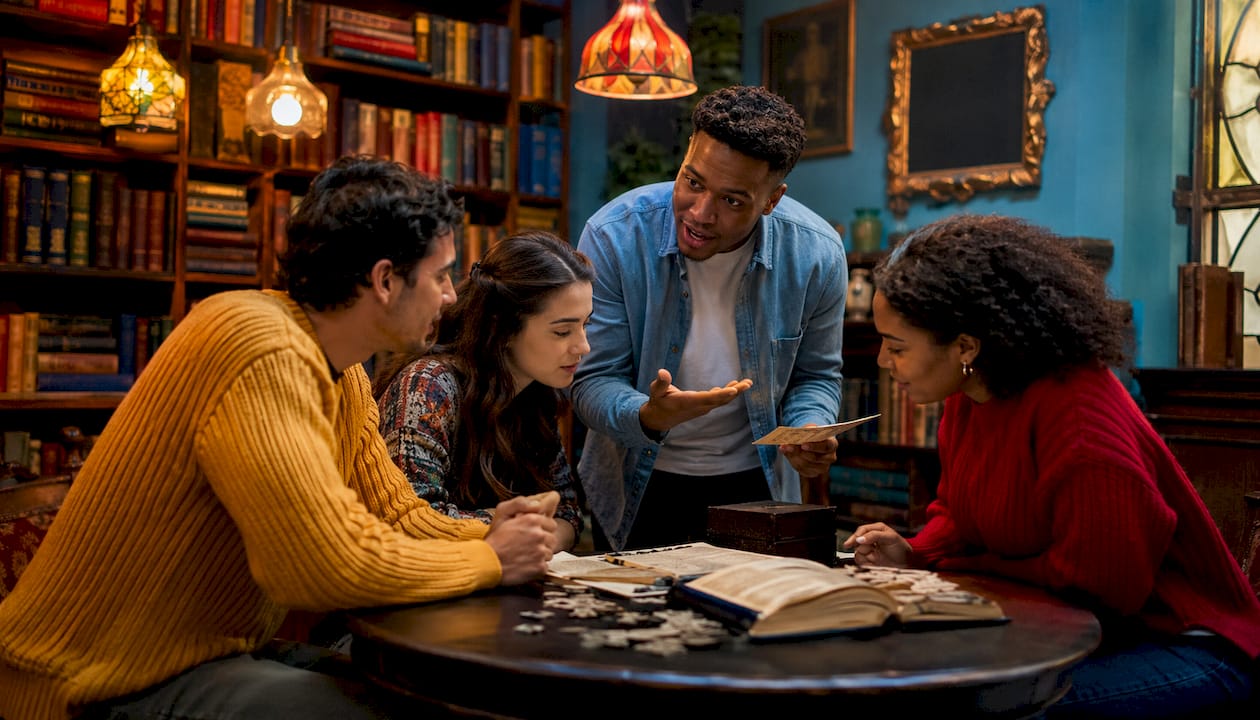
A mystery room, more widely known as an escape room, is a live-action, team-based game where players work together to find clues, solve puzzles, and complete a mission within a set time limit. The environment is fully themed, the story is built into the walls, and the clock is always running. You are not watching the experience unfold. You are inside it.
The terms “mystery room” and “escape room” describe the same activity. “Mystery” leans into the narrative and detective angle, while “escape” highlights the most common objective: getting out. Either way, the gameplay is identical, built around clues, puzzles, and teamwork inside an immersive set.
Here is what every mystery room concept shares at its core:
- A themed environment: Prison cells, haunted mansions, space stations, 1980s arcades. The setting is designed to feel real.
- A central mission: Usually escaping the room, but sometimes cracking a code, solving a crime, or stopping a countdown.
- A time limit: Typically 45 to 60 minutes, though some longer formats run up to two hours.
- Cooperative gameplay: Teams of two to ten players work together, not against each other.
- Puzzle progression: Solving one puzzle unlocks the next clue, area, or stage of the story.
- No outside knowledge required: Every fact you need to win is already inside the room.
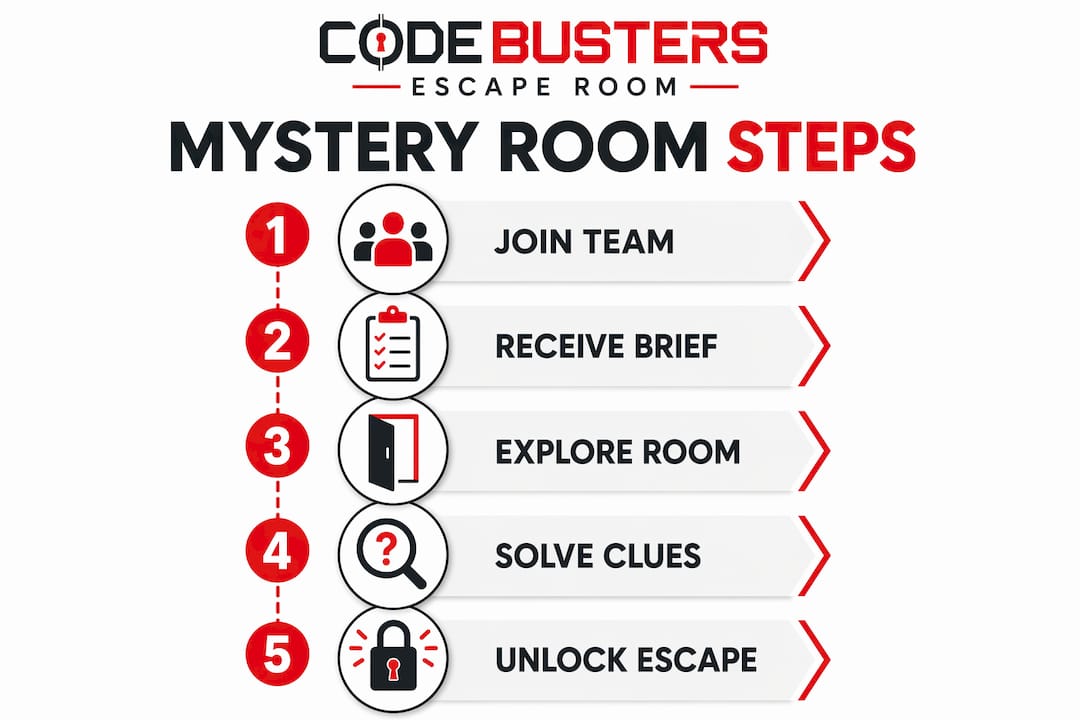
How to play a mystery room: step by step
Walking into your first mystery room feels disorienting in the best possible way. Here is how a typical session runs from start to finish.
-
Get the briefing. Before the clock starts, a game master explains the backstory, the rules, and the objective. Pay attention. The setup often contains your first clue.
-
Enter the room and start the clock. The moment you step inside, the timer begins. Most rooms give you 45 to 60 minutes. Longer, more elaborate experiences can run up to 90 minutes.
-
Spread out and explore. Resist the urge to huddle. Split up and search the room systematically. Look under furniture, inside books, behind frames. Call out anything that seems out of place.
-
Share what you find. Communication is the single biggest factor in whether a team succeeds. Announce every clue you discover, even if you do not immediately know what it means.
-
Connect clues to puzzles. Mystery rooms are built in layers. A number you found in one corner might unlock a padlock across the room. Keep clues visible and organized so the whole team can see them.
-
Solve in stages. Most rooms are not one big puzzle. They are a series of smaller ones, each unlocking the next. Progress feels like peeling back layers of the story.
-
Use your hints. Nearly every venue offers hints through the game master, usually via a screen or intercom. Using a hint is not failure. It keeps the game moving and the experience enjoyable.
-
Complete the mission. Whether you escape, crack the case, or stop the countdown, the final moment is designed to feel earned. Teams that communicate well and delegate tasks consistently reach it faster.
Pro Tip: Assign one person to manage found clues. Laying everything out in one visible spot prevents the classic mistake of a team member solving a puzzle that was already cracked ten minutes ago.
How mystery rooms are designed and what makes puzzles work
The puzzle design is where a mystery room either comes alive or falls flat. Great rooms do not just throw locks and codes at you. They build puzzles that feel like natural extensions of the story.
Puzzle types vary widely and are chosen to match the theme:
- Riddles and wordplay: Common in detective or literary themes, where language is part of the atmosphere.
- Pattern recognition: Spotting sequences in symbols, colors, or shapes, often hidden in plain sight within the set design.
- Cipher decoding: Substitution codes, Morse code, and symbol-based ciphers that reward careful observation.
- Physical object interaction: Assembling pieces, untying knots, or manipulating props to reveal hidden information.
- Math and logic puzzles: Sudoku-style grids, number sequences, or spatial reasoning challenges.
What separates a good room from a great one is how these puzzles connect to the narrative. A cipher is just a cipher until the story gives you a reason to care about what it says. Narrative-driven puzzle design is what creates genuine immersion rather than a scavenger hunt with a theme coat of paint.
Designers also work hard to balance difficulty. Rooms are built so that any required knowledge is provided within the game environment itself. You will never need a chemistry degree or a geography textbook. The room gives you everything you need. The challenge is recognizing it.

Pro Tip: When you feel stuck, step back and look at the room as a whole. Designers often hide the connection between two puzzles in the set dressing itself, not in the puzzle pieces.
Common concerns and misconceptions about mystery rooms
First-timers often arrive with assumptions that make the experience feel more intimidating than it is. Most of those assumptions are wrong.
- “I need to be smart to succeed.” Mystery rooms test lateral thinking and teamwork, not academic intelligence. A team with good communication will consistently outperform a team of experts who do not talk to each other.
- “Mystery rooms and escape rooms are different things.” They are not. The terms are interchangeable. “Mystery room” emphasizes the narrative; “escape room” emphasizes the objective. The experience is the same.
- “Most people fail.” The average success rate is around 30%, which sounds low until you realize rooms are deliberately designed to be challenging. Not escaping is still a full, satisfying experience. Many players book again specifically because they want to beat the room.
- “It’s physically demanding.” Challenges in mystery rooms are far more mental than physical. You will search, crouch, and reach, but nothing requires athletic ability.
- “It’s not suitable for kids or older adults.” Well-designed rooms are built for mixed-age groups, and many venues offer rooms at different difficulty levels. Age is rarely a barrier.
- “You need prior experience.” Every room starts fresh. The briefing covers everything you need to know before the clock starts.
What experts say about designing great mystery rooms
The best mystery rooms are not just clever. They are psychologically calibrated to keep players in a state of engaged focus, where the challenge feels just hard enough to be satisfying without tipping into frustration.
That concept of flow, being fully absorbed in a challenge that matches your skill level, is central to why mystery rooms work as entertainment. Designers at venues like Codebusters Escape Room build toward it deliberately, calibrating puzzle difficulty so teams feel momentum rather than stagnation.
Several principles consistently show up in well-crafted rooms:
- Every puzzle serves the story. A lock combination is not arbitrary. It comes from a date in the narrative, a symbol in the set, or a character’s history.
- Teamwork is baked into the design. Some clues are physically separated so that players must share information to connect them.
- Hints are part of the experience. The best venues design hint systems that nudge rather than solve, preserving the satisfaction of the final breakthrough.
- Pacing matters. Rooms build toward a climax. Early puzzles are more accessible; later ones layer complexity as the story intensifies.
Communication among players is the variable that design cannot fully control, which is why the most successful teams treat it as a strategy, not an afterthought.
What themes and storylines do mystery rooms use?
The theme is the first thing you notice and the last thing you forget. It sets the tone, justifies the puzzles, and gives the mission emotional weight. Mystery rooms pull from a wide range of genres and settings, and the best venues build original storylines rather than borrowing generic tropes.
Common themes include:
Detective and crime: Players investigate a murder, crack a heist, or expose a conspiracy. These rooms lean heavily on documents, coded messages, and deductive reasoning.
Horror and supernatural: Haunted houses, cursed artifacts, and paranormal investigations. The atmosphere does as much work as the puzzles, using lighting, sound design, and unexpected scares to keep tension high.
Science fiction: Space stations, time travel, and dystopian labs. Codebusters Escape Room’s “Past to the Future” and “Flight of Deception” rooms fall into this category, using futuristic props and technology-based puzzles.
Historical and adventure: Pirate ships, ancient temples, Cold War spy missions. These themes let designers use period-accurate props and real historical details as puzzle elements.
Pop culture: Rooms inspired by beloved films, TV shows, and decades. Codebusters’ “Stranger 80’s” room, for example, draws on 1980s nostalgia to build a world players already feel connected to before they even start.
The storyline is not decoration. It is the reason every puzzle exists. When the theme is strong, solving a cipher feels like uncovering a secret rather than completing a task. That is the difference between a room you finish and one you remember.
Where did mystery rooms come from?
The escape room concept has a surprisingly short history for something that now spans thousands of venues worldwide. The format traces back to point-and-click video games from the early 2000s, where players navigated locked rooms by finding and combining objects. The leap from screen to physical space happened in Japan around 2007, when SCRAP Entertainment created the first live-action escape game in Kyoto.
SCRAP later brought the format to North America, and one of its earliest American experiences, “Escape From the Mysterious Room,” became a landmark title. That early version was heavily focused on scavenging and quite difficult, with minimal narrative and little of the immersive set design that defines modern rooms. Players who experienced it describe it as closer to a puzzle competition than a story.
The industry evolved fast. By the mid-2010s, venues across the United States were building elaborate themed environments, hiring set designers, and writing original storylines. The shift from scavenger hunt to immersive theater changed what mystery rooms could be. Today, rooms like those at Codebusters Escape Room in Colorado Springs represent the mature end of that evolution, where every prop, every puzzle, and every line of backstory serves a unified experience.
The escape room format also draws from live-action role-playing, interactive theater, puzzle hunts, and haunted houses, which explains why the experience feels like several things at once without being exactly any of them.
What types of mystery rooms can you choose from?
The format has expanded well beyond a single room with a padlock. Players now have three broad categories to choose from, each with a distinct feel.
Physical rooms
The original format. You are physically inside a built environment, surrounded by real props, real locks, and real set design. Physical rooms offer the highest level of immersion because the environment is tangible. You can touch, move, and interact with everything around you. This is what Codebusters Escape Room specializes in, with fully built themed spaces in Colorado Springs designed for groups of varying sizes and experience levels. For those curious about creative escape room themes and how venues approach set design, the range of concepts being built commercially continues to grow.
Virtual rooms
Online mystery rooms became widely available after 2020 and remain popular for remote teams and players who cannot access a physical venue. A game master runs the session via video call, guiding players through a digital environment. The puzzle logic is the same; the physical presence is not. Virtual rooms work well for corporate team building when a group is spread across multiple locations.

Hybrid rooms
Some venues now offer a mix: a physical room where remote players can participate through cameras and screens, contributing to puzzle solving alongside the in-person team. Others use augmented reality overlays to add digital elements to a physical space. Hybrid formats are still developing, but they point toward where the industry is heading as technology becomes cheaper and more accessible.
What you actually get out of a mystery room experience
The obvious draw is fun. But mystery rooms consistently deliver more than entertainment, which is part of why they have become a go-to activity for birthdays, corporate events, date nights, and family outings.
Critical thinking under pressure. The time limit is not just a mechanic. It trains you to prioritize, make decisions with incomplete information, and stay calm when the clock is running down.
Real teamwork. Mystery rooms expose how a group actually functions. Who takes charge? Who spots details others miss? Who gets tunnel vision on one puzzle while the rest of the room goes unexplored? The team dynamics that emerge are often more revealing than any team-building workshop.
A shared story. Whether you escape or not, you leave with a specific memory tied to a specific group of people. That shared narrative is harder to manufacture than it sounds.
Genuine satisfaction. Solving a puzzle that stumped you for ten minutes produces a real dopamine response. Designers know this and build rooms to deliver those moments repeatedly, not just at the end.
Mystery rooms also scale well. A first-timer and a veteran can play the same room and have equally valid experiences, because the challenge is calibrated to the group, not to a fixed standard. That accessibility, combined with the variety of puzzle challenges available across different rooms and themes, is what keeps players coming back.
Ready to experience it for yourself? Codebusters Escape Room in Colorado Springs offers fully themed, private mystery rooms for families, friends, and corporate groups, with original storylines and puzzles built for every experience level.

Book your mystery room adventure at Codebusters Escape Room today.
Key Takeaways
Mystery rooms and escape rooms are the same live-action, team-based puzzle experience, built around immersive themes, cooperative clue-finding, and a time limit of typically 45 to 60 minutes.
| Point | Details |
|---|---|
| Same concept, two names | “Mystery room” and “escape room” describe identical gameplay; only the emphasis differs. |
| Time limit is standard | Most rooms are designed to run about an hour, with some formats lasting longer. |
| No expertise required | All knowledge needed to solve puzzles is provided inside the room itself. |
| Success rate is around 30% | Rooms are designed to be challenging; not escaping is still a complete, satisfying experience. |
| Three format options | Physical, virtual, and hybrid rooms each offer the same puzzle logic with different levels of immersion. |