Veteran Owned Escape Room Meaning: What It Really Means
A veteran owned escape room is an escape room business where military veterans hold at least 51% ownership and maintain active control over daily operations and long-term strategy. This designation goes far beyond a marketing label. It reflects the same federal standards applied to Veteran-Owned Small Businesses (VOSBs) across all industries, including entertainment. When Codebustersescaperoom in Colorado Springs identifies as veteran and family owned, that claim carries specific legal and ethical weight. Understanding the veteran owned escape room meaning helps you spend your money where it genuinely supports those who served.
What does “veteran owned escape room” mean officially?
The phrase “veteran owned escape room” does not have a separate industry definition. In practice, it borrows directly from federal business ownership standards, which require 51% veteran ownership and meaningful operational control by one or more military veterans. The U.S. Small Business Administration (SBA) and the Department of Veterans Affairs (VA) both recognize two primary designations: the Veteran-Owned Small Business (VOSB) and the Service-Disabled Veteran-Owned Small Business (SDVOSB).
These designations are not honorary titles. Federal rules under 13 C.F.R. § 128.200 specify that the veteran must hold unconditional, direct ownership of at least 51% of the business. Beyond the ownership percentage, the veteran must also control the highest executive role, manage day-to-day decisions, and set the company’s strategic direction. Non-veterans may hold minority stakes or fill supporting roles, but they cannot exercise control over the business without invalidating the veteran-owned designation.
For an escape room business, these criteria apply exactly the same way. If a veteran owns 51% of the LLC and serves as the operating manager who decides staffing, pricing, and room design, that business qualifies as veteran owned. If a veteran holds a 30% stake and a non-veteran partner runs operations, the business does not qualify, regardless of how it markets itself.
Here is what the federal framework requires for a legitimate veteran-owned business claim:
- Ownership threshold: At least 51% of the business must be unconditionally owned by one or more veterans.
- Control of daily operations: The veteran must manage the business on a day-to-day basis, not just hold a title.
- Highest officer role: The veteran must hold the highest executive position, such as CEO, President, or Managing Member.
- Long-term strategic control: Decisions about business direction, major contracts, and growth must rest with the veteran owner.
- Time commitment: Federal rules require the veteran to dedicate sufficient time to the business to demonstrate genuine control.
Pro Tip: If you want to verify a business’s veteran-owned status before booking, ask directly whether the owner holds a VOSB or SDVOSB designation through the SBA or VA. A legitimate veteran-owned business will answer that question without hesitation.
Veteran-founded vs. veteran-operated vs. veteran-owned: what’s the difference?
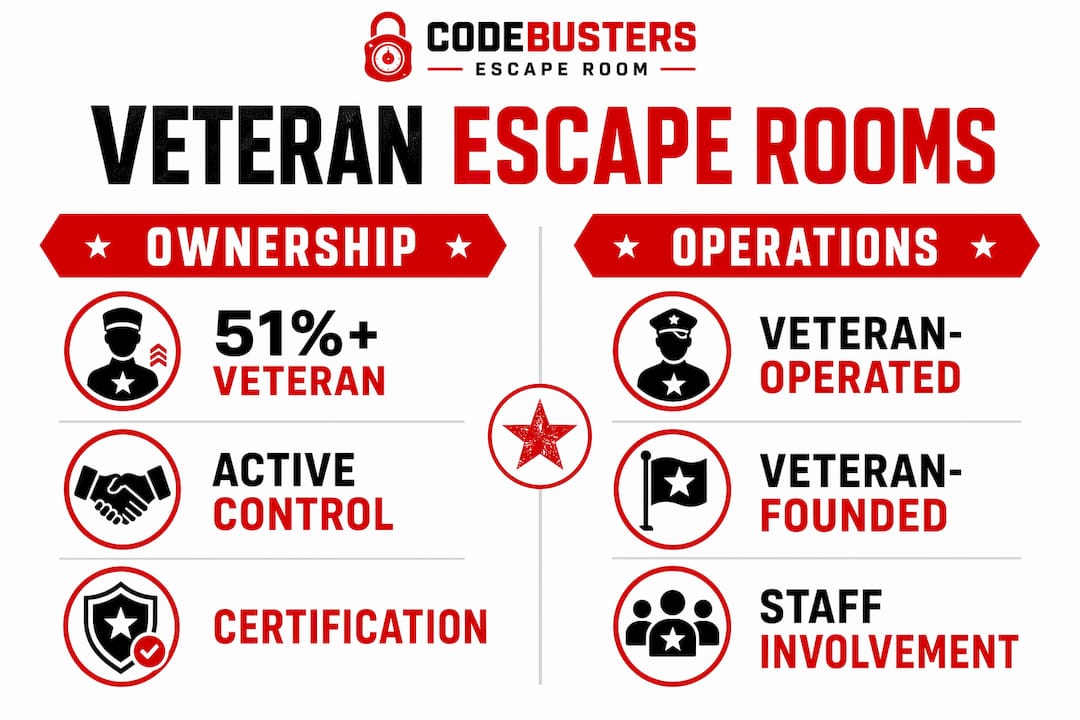
These three terms sound similar but carry very different meanings. Confusing them is one of the most common mistakes consumers make when trying to support veteran entrepreneurs.
| Term | What it means | Meets ownership threshold? |
|---|---|---|
| Veteran-founded | A veteran started the business but may have sold equity or stepped back from control | Not necessarily |
| Veteran-operated | Veterans run the business in management roles but may not hold majority ownership | Not necessarily |
| Veteran-owned | A veteran holds at least 51% ownership and controls daily operations and strategy | Yes |
“Veteran-founded” is a historical claim. It tells you who started the company, not who owns or runs it today. A veteran may have launched an escape room in 2018, sold 70% of the business to investors by 2022, and retained only a minority stake. That business can still truthfully say it was veteran-founded. It cannot truthfully say it is veteran-owned under federal standards.
“Veteran-operated” means veterans are in the building and making decisions, but ownership may sit with non-veteran investors or partners. This is common in franchise models where a veteran manages a location without holding majority equity. The experience may feel authentic, but the economic benefit of your patronage flows primarily to non-veteran owners.
Certification or eligibility verification is the clearest way to separate genuine ownership claims from promotional language. A business that has pursued SBA or VA recognition has submitted documentation proving ownership percentages and control structures. One that only uses veteran branding in its marketing has made no such commitment to transparency.
Why veteran ownership in escape rooms matters to you
Veteran ownership is not just a credential. It shapes how a business operates, what it values, and how it serves its community.
Veterans bring a specific leadership style to business. Military service trains people in mission clarity, team accountability, and performing under pressure. These qualities translate directly into escape room design and operations. Veteran-owned escape rooms often build experiences around authentic teamwork mechanics, where communication and role distribution determine success, mirroring real operational environments. That is not accidental. It reflects how veteran owners think about problem-solving.
“Supporting a veteran-owned escape room means your entertainment dollars go directly toward veteran economic empowerment, community investment, and a business culture built on service, accountability, and mission.”
The economic case for supporting veteran businesses is concrete. Veteran entrepreneurship promotes financial independence for those transitioning out of military service, reduces reliance on government support programs, and builds local tax bases. When you book an experience at a veteran-owned escape room, you are contributing to that cycle directly.
The community impact extends further. Many veteran-owned escape rooms hire other veterans, partner with veteran service organizations, or host events specifically designed for military families and first responders. This creates a network effect where one veteran-owned business supports a broader veteran community. The interactive experience design at veteran-led venues also tends to reflect higher standards of guest engagement, because the owners understand mission briefings, team roles, and high-stakes decision-making from personal experience.
From a customer perspective, you also get a more authentic product. Veteran-themed escape rooms designed by actual veterans carry a credibility that purely commercial rooms cannot replicate. The details in the narrative, the team dynamics built into the puzzles, and the overall atmosphere reflect lived experience rather than research.
How to identify a genuine veteran-owned escape room
Knowing what to look for protects you from vague veteran branding and helps you direct your support accurately.
-
Ask about certification. A VOSB or SDVOSB certification from the SBA or VA is the gold standard. Official SBA or VA recognition confirms that ownership and control documentation has been reviewed and approved by a federal agency.
-
Check the ownership disclosure. Legitimate veteran-owned businesses state the ownership percentage clearly. Look for language like “51% veteran-owned and operated” rather than vague phrases like “veteran-inspired” or “veteran-friendly.”
-
Research the owner’s background. Most genuine veteran entrepreneurs are proud of their service and mention it openly on their website, social media, or in interviews. A quick search for the owner’s name alongside their military branch or service period confirms the claim.
-
Look for veteran business registries. The SBA’s Dynamic Small Business Search and the VA’s Vendor Information Pages both list certified veteran-owned businesses. Checking these registries takes less than five minutes and gives you a definitive answer.
-
Evaluate the language used. “Veteran-owned” is a specific claim. “Veteran-founded,” “veteran-inspired,” or “veteran-themed” are not. If a business uses the latter terms exclusively, ask follow-up questions before assuming it meets ownership standards.
Pro Tip: When visiting an escape room that claims veteran ownership, ask the staff who owns the business and whether the owner is a veteran. Genuine veteran owners are almost always willing to share that story. Evasive answers are a signal worth noting.
Key takeaways
A veteran owned escape room is defined by 51% veteran ownership and active veteran control, not by branding or military-themed decor.
| Point | Details |
|---|---|
| Ownership threshold is 51% | Federal standards require veterans to hold at least 51% unconditional ownership to qualify. |
| Control matters as much as ownership | Veterans must manage daily operations and hold the highest executive role, not just a title. |
| Terms like “veteran-founded” differ | “Founded” and “operated” do not meet the same legal standard as “owned” under SBA or VA rules. |
| Certification confirms authenticity | SBA and VA certifications verify ownership and control claims beyond marketing language. |
| Supporting veteran owners has real impact | Patronage drives veteran economic empowerment, local hiring, and community investment. |
What we’ve learned running a veteran-owned escape room in Colorado Springs
Running Codebustersescaperoom has taught me something that no business school course covers: the military mindset is not a marketing asset. It is an operating system. When you have spent years in environments where unclear communication costs more than a lost sale, you build businesses differently. Every room we design at Codebustersescaperoom starts with a mission brief, not a mood board. The puzzles are structured around team roles because that is how real problems get solved under pressure.
What I find most interesting about the growing conversation around veteran-owned escape rooms is how often people conflate the label with the experience. A room with military props and camouflage walls is not a veteran-owned escape room. A business where a veteran makes every meaningful decision, carries the financial risk, and shows up every day is. That distinction matters to me personally, and I think it should matter to customers too.
The most rewarding part of this work is watching groups, especially corporate teams and military families, leave a session having genuinely collaborated in ways they did not expect. That outcome is not accidental. It comes from designing experiences through the lens of someone who has lived in high-stakes team environments. If you are going to support a veteran-owned business, look for that depth of intention. It is the clearest sign that the ownership claim is real.
— CodeBusters
Experience a real veteran-owned escape room in Colorado Springs
Codebustersescaperoom is a veteran and family owned escape room business in Colorado Springs, Colorado, with award-winning rooms designed for groups of all sizes and experience levels. Every experience, from “Flight of Deception” to “Stranger 80’s,” is built with the mission-driven design philosophy that comes from genuine veteran ownership, not just veteran branding.
Whether you are planning a corporate team-building event, a family outing, or a night out with friends, Codebustersescaperoom offers private room bookings and themed experiences that reflect real veteran values. Book your session or explore all available rooms at Codebustersescaperoom and support a business where veteran ownership is documented, not decorative. Gift vouchers are also available for anyone looking to give the experience as a present.
FAQ
What is a veteran owned escape room?
A veteran owned escape room is an escape room business where military veterans hold at least 51% ownership and control daily operations and strategic decisions, following the same federal standards applied to Veteran-Owned Small Businesses (VOSBs).
How is “veteran-owned” different from “veteran-founded”?
“Veteran-founded” means a veteran started the business but may no longer hold majority ownership or control. “Veteran-owned” requires the veteran to currently hold at least 51% ownership and manage the business actively.
How can I verify if an escape room is truly veteran-owned?
Check the SBA’s Dynamic Small Business Search or the VA’s Vendor Information Pages for VOSB or SDVOSB certification. You can also ask the business directly about ownership percentage and control structure.
What is an SDVOSB and does it apply to escape rooms?
An SDVOSB is a Service-Disabled Veteran-Owned Small Business, a federal designation for businesses where veterans with service-connected disabilities hold at least 51% ownership and control. This designation can apply to any small business, including escape rooms.
Why does supporting veteran-owned escape rooms matter?
Supporting veteran-owned escape rooms directs spending toward veteran economic empowerment, funds businesses that often hire other veterans, and sustains community-focused enterprises built on military values of accountability and service.