Top Advantages of Group Puzzles for Teams and Bonds
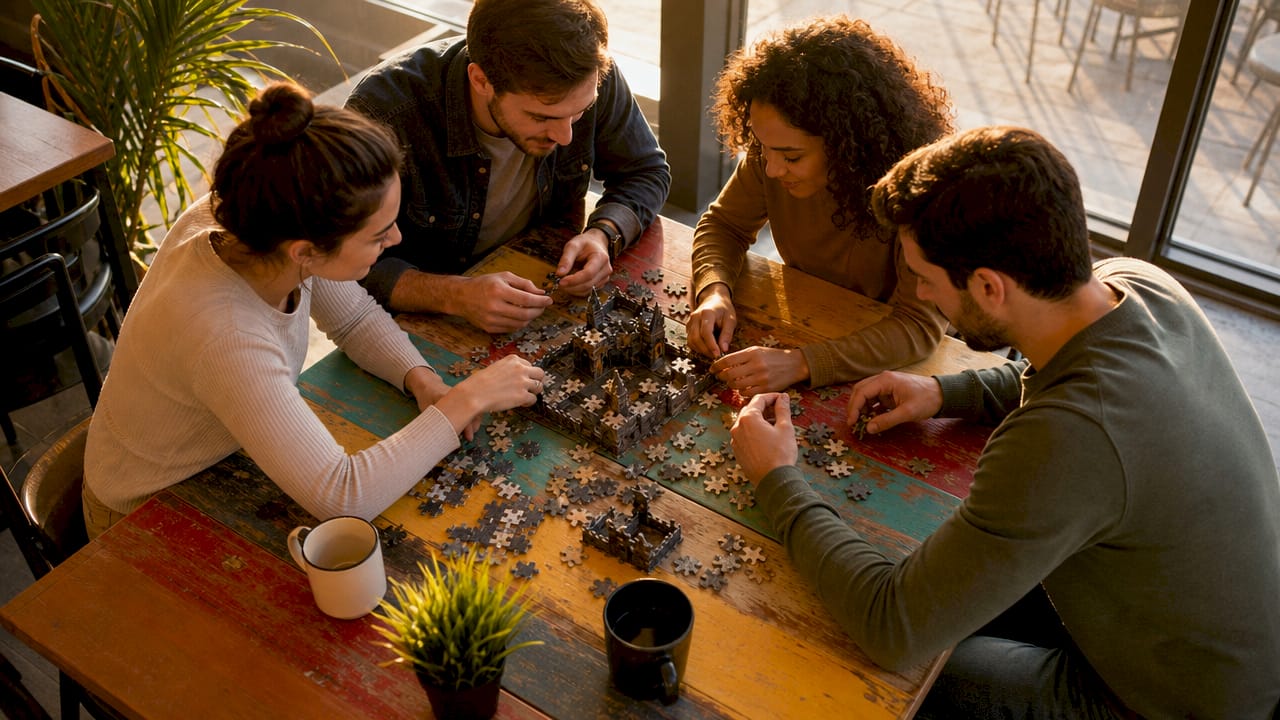
Group puzzles are defined as collaborative problem-solving activities where two or more people work together toward a shared solution, and research confirms they deliver measurable cognitive, social, and emotional benefits simultaneously. The advantages of group puzzles extend well beyond simple entertainment. They train metacognition, reduce workplace stress, build trust between strangers, and create the kind of shared accomplishment that expensive corporate retreats struggle to replicate. Studies from Newverest, behavioral science research published at dachb.com, and guidance from Puzzlebooks.cloud all point to the same conclusion: regular group puzzle sessions produce real, lasting improvements in how people think and connect.
1. Cognitive benefits of solving puzzles in groups
Group puzzles engage multiple brain systems at once. Participants must hold partial information in working memory, test hypotheses, and revise strategies in real time. That combination of demands produces cognitive gains that solo puzzling simply cannot match.
The most significant of these gains is metacognition. Metacognition is trainable through collaborative puzzle review, and it predicts puzzle success more reliably than raw intelligence or prior experience. Metacognition is the ability to monitor your own thinking, recognize when a strategy is failing, and switch approaches before wasting time. Groups that debrief after each session develop this skill faster than those who just move on to the next puzzle.
Critical thinking also sharpens through group puzzle-solving. When two people disagree on where a piece belongs, both must articulate their reasoning. That verbal defense of a hypothesis is exactly the kind of structured thinking that transfers to professional problem-solving. Dopamine release tied to each small “click” of a correct placement reinforces motivation and keeps focus high throughout the session.
Pro Tip: After finishing any group puzzle, spend five minutes asking each participant what strategy they used and what they would change. That brief debrief is where the metacognitive training actually happens.
Key cognitive skills sharpened by group puzzles:
- Working memory: Holding multiple partial patterns in mind simultaneously
- Spatial reasoning: Rotating and fitting shapes mentally before physically testing them
- Pattern recognition: Identifying color gradients, edge shapes, and texture clusters
- Strategic flexibility: Shifting from one section to another when progress stalls
- Focused attention: Sustaining concentration despite ambient conversation
2. How group puzzles boost social skills and team dynamics
Group puzzles remove the pressure of forced conversation. When people share a physical task, talking becomes natural rather than obligatory. That shift from awkward small talk to purposeful collaboration is one of the most underrated social advantages of puzzles for new teams or mixed-age groups.
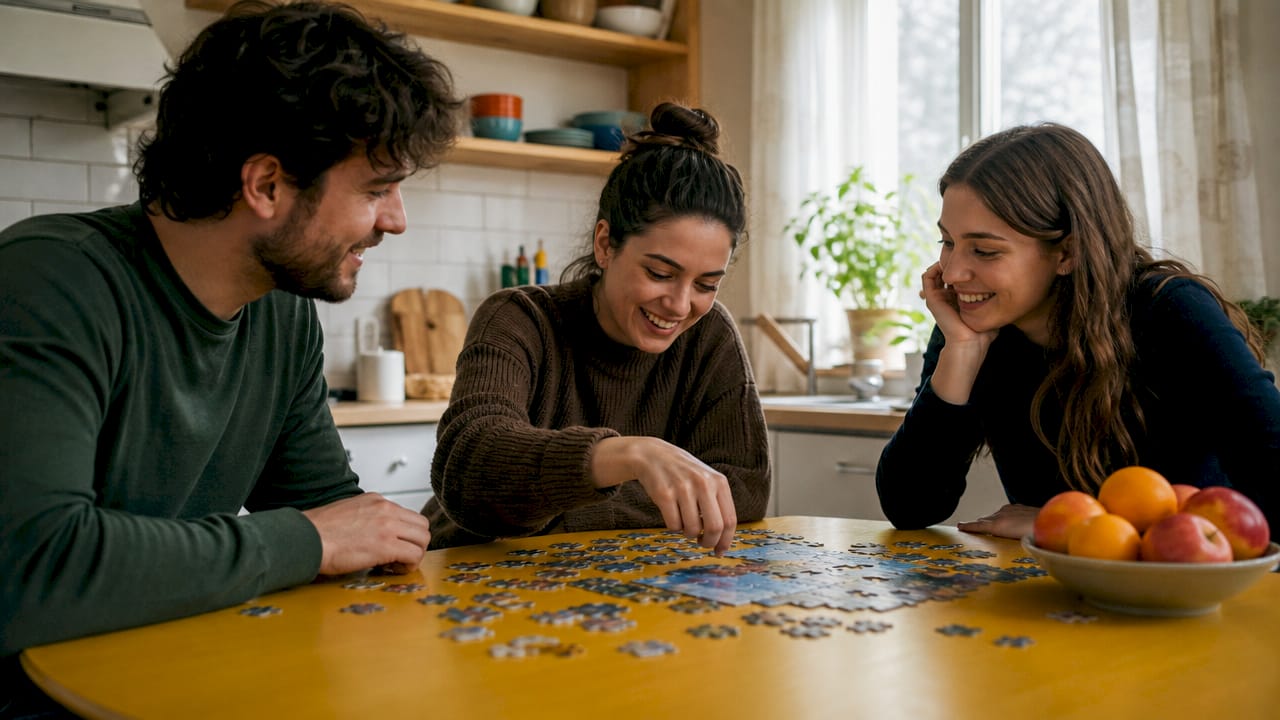
Trust builds through shared challenge. When a colleague spots the piece you have been searching for and hands it over without comment, a small but genuine moment of goodwill occurs. Multiply that across a two-hour session and you have a group that has practiced generosity, patience, and mutual respect dozens of times without anyone calling it a team-building exercise.
Listening skills improve because group puzzles reward them. The person who actually hears “I think the blue section goes in the upper left” and acts on it moves the group forward. The person who ignores that input and duplicates effort slows everyone down. That immediate, visible feedback loop teaches active listening faster than any workshop.
“Puzzles foster collective joy, organic collaboration, and build soft skills in corporate teams at a fraction of the cost of retreats.” — Newverest
Social anxiety decreases when the activity provides a shared focus. New employees, introverted team members, and people joining an unfamiliar group all benefit from having something concrete to look at and contribute to. The puzzle becomes a social equalizer. No one needs to perform or impress. They just need to find the next piece.
3. Best practices for choosing and organizing group puzzles
Selecting the right puzzle is as important as doing the puzzle. A mismatch between group size and puzzle complexity produces frustration rather than flow.
For groups of three to six people, 200 to 500 piece puzzles typically require six to ten hours across multiple sessions, which creates enough work for everyone without bottlenecks. That size range also allows natural task division: one person sorts edges, another organizes by color, a third builds interior clusters. Parallel work prevents the single-file collaboration that kills momentum.
Recommended session structure for skill-building:
- Sort and organize pieces before any placement begins (10 minutes)
- Assign zones or color families to sub-groups
- Work in 10 to 20 minute focused sessions twice per week rather than marathon sittings
- Rotate zones halfway through to expose everyone to different challenges
- Debrief briefly at the end of each session
Pro Tip: Assign one person the “devil’s advocate” role. Their job is to question the group’s current approach every 20 minutes. This single structural intervention prevents the conformity pressure that causes groups to keep forcing wrong pieces.
| Puzzle type | Best group size | Complexity level | Primary benefit |
|---|---|---|---|
| 200-piece jigsaw | 2 to 4 people | Low | Accessibility, low pressure |
| 500-piece jigsaw | 4 to 6 people | Medium | Task division, communication |
| 3D modular puzzle | 3 to 8 people | High | Spatial reasoning, role clarity |
| Escape room puzzle set | 4 to 10 people | Very high | Rapid teamwork, strategic thinking |
Social loafing and conformity are the two most common failure modes in group puzzles. Both can be addressed structurally. Split large groups into sub-teams of two or three, give each sub-team a defined section, and require them to present their progress to the full group at the midpoint. That accountability structure eliminates passive participation without creating competitive pressure.
4. Situational advantages of different types of group puzzles
Not every group puzzle delivers the same benefits. The format you choose shapes the specific skills and social dynamics that emerge.
Jigsaw puzzles are the most accessible entry point. They require no prior experience, cost under $30, and work for groups ranging from families to corporate teams. Their low-pressure nature makes them ideal for groups that include introverts or people who feel intimidated by competitive games. The collaborative puzzle benefits here center on patience, communication, and shared focus rather than speed or performance.
3D puzzles add a spatial reasoning dimension that flat jigsaws cannot provide. Building a modular structure requires teams to coordinate assembly sequences, which creates natural leadership moments and exposes each person’s spatial strengths. Groups working on 3D puzzles tend to develop clearer informal roles than those working on flat jigsaws.
Escape rooms represent the most intense version of group puzzle-solving. Every puzzle connects to a narrative, time pressure is real, and the group must communicate rapidly to share discoveries across the room. Research confirms that groups outperform individuals on complex, ambiguous puzzles. Escape rooms are designed to be exactly that: complex and ambiguous. The format rewards diverse thinking styles and punishes groupthink, making it one of the most effective tools for enhancing teamwork through puzzles in a single session.
Digital vs. physical puzzles produce different social outcomes. Physical puzzles create shared physical space and tactile collaboration. Digital puzzles allow remote teams to connect across distances but lose the nonverbal communication that makes in-person puzzling so socially rich. For teams that can meet in person, physical formats consistently produce stronger social bonding.
5. How group puzzles support mental health and reduce stress
The mental health benefits of group puzzle-solving are concrete and measurable. A shared puzzle station introduced in a workplace improved job satisfaction and reduced stress within eight months, at a cost under $100. That return on investment is difficult to match with any other wellness intervention.
The mechanism is straightforward. Puzzle-solving produces dopamine with each successful placement. In a group setting, that dopamine release is amplified by social reinforcement. When a teammate celebrates your correct piece, you receive both the intrinsic reward of solving and the social reward of recognition. That combination creates a positive feedback loop that sustains engagement and lifts mood.
“Group puzzles normalize the ‘not knowing the answer yet’ mindset, fostering patience and resilience that transfer to complex real-world problem-solving.” — Indeed.com
Tolerance for ambiguity is one of the most transferable skills group puzzles build. Sitting with an unsolved section, resisting the urge to force a piece, and trusting that the answer will emerge with more information. That practice directly mirrors the patience required in professional environments where problems rarely have obvious solutions.
Pro Tip: Place a 300-piece puzzle on a common table in your office break room with no deadline and no assigned participants. The informal, voluntary nature of the activity is what makes it effective. People contribute when they want to, and the collective progress creates a sense of shared ownership.
Shared accomplishment at the end of a group puzzle session produces collective joy that is qualitatively different from individual satisfaction. The group has created something together. That experience of joint creation is a genuine social bond, not a simulated one.
Key takeaways
Group puzzles deliver cognitive, social, and emotional benefits that compound over repeated sessions, making them one of the most cost-effective collaborative activities available to any team or group.
| Point | Details |
|---|---|
| Metacognition is the top cognitive gain | Collaborative puzzle review trains strategic self-awareness more than raw intelligence. |
| Session structure determines outcomes | Short sessions of 10 to 20 minutes twice weekly outperform infrequent marathon sittings. |
| Puzzle complexity should match group goals | Complex puzzles favor group collaboration; simple tasks can suffer from coordination overhead. |
| Structural roles prevent social loafing | Assigning a devil’s advocate and sub-team zones keeps every participant actively engaged. |
| Low cost, high return | A puzzle station under $100 measurably improves team connection and reduces stress within months. |
What we have learned running group puzzles at Codebustersescaperoom
The most surprising thing we have observed after running hundreds of group puzzle sessions in Colorado Springs is this: the groups that struggle most at the start almost always finish strongest. The early friction, the disagreements over strategy, the person who insists on sorting every single piece before placing one. That friction is not a problem. It is the training.
What conventional wisdom gets wrong about group puzzles is the assumption that harmony produces the best results. It does not. Productive disagreement does. The groups that allow one person to dominate the strategy, or that avoid challenging a wrong approach to keep the peace, consistently plateau. The groups that argue, test competing ideas, and occasionally abandon an entire section to start fresh. Those groups finish faster and leave with stronger relationships.
We have also noticed that the cognitive benefits of puzzle-solving in groups show up in unexpected places. Teams that puzzle together regularly start handling ambiguous work problems differently. They sit with uncertainty longer before demanding a resolution. They ask more questions before committing to a direction. Those are not small changes. In a professional context, they are the difference between reactive and strategic thinking.
If you are considering group puzzles for your team or family, start with a format that creates genuine challenge. An easy puzzle produces a pleasant afternoon. A hard puzzle produces a real experience. The escape room format takes that principle to its logical conclusion: every puzzle matters, the clock is real, and the group either solves it together or does not solve it at all.
— CodeBusters
Experience the benefits of group puzzles at Codebustersescaperoom
Codebustersescaperoom in Colorado Springs designs every room around the exact benefits this article describes: rapid communication, shared problem-solving, and the collective satisfaction of cracking a challenge no one person could solve alone.
Rooms like “Stranger 80’s,” “Flight of Deception,” and “Past to the Future” are built for groups of varying sizes and experience levels, so whether your team has never done an escape room or considers itself expert, there is a room calibrated to push you in the right direction. Private bookings mean your group gets the full experience without distraction. Booking takes minutes at Codebustersescaperoom. If you want to understand what group puzzle-solving actually feels like at its most intense, this is the place to find out.
FAQ
What are the main advantages of group puzzles?
Group puzzles improve metacognition, communication, trust, and stress resilience simultaneously. They also deliver these benefits at a fraction of the cost of structured team-building retreats.
How long should a group puzzle session last for best results?
Sessions of 10 to 20 minutes twice per week produce stronger skill-building outcomes than single long sessions. Consistent short sessions allow the brain to consolidate learning between meetings.
Do groups always perform better than individuals on puzzles?
Groups outperform individuals on complex, ambiguous puzzles but can underperform on simple tasks due to coordination overhead. Choosing a puzzle with the right complexity level for your group is the key variable.
How do escape rooms compare to jigsaw puzzles for team building?
Escape rooms add time pressure and narrative stakes that accelerate communication and strategic thinking, making them more effective for rapid team bonding. Jigsaw puzzles are better for low-pressure, ongoing social connection.
What is the best puzzle size for a group of four to six people?
Puzzles in the 200 to 500 piece range work best for groups of four to six, providing enough complexity for meaningful task division without creating bottlenecks that leave participants idle.