The Role of Storytelling in Escape Rooms That Captivate
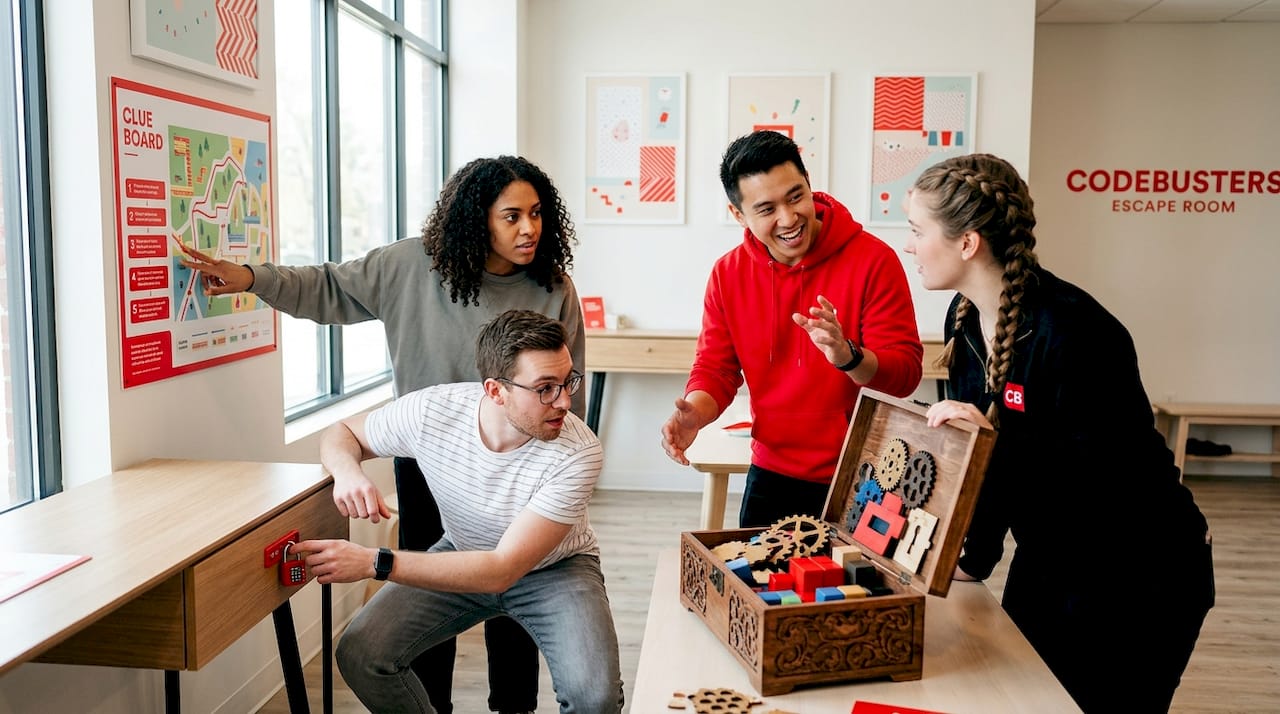
Storytelling in escape rooms is the structural force that transforms a collection of padlocks and puzzles into a world players genuinely want to inhabit. The role of storytelling in escape rooms goes far beyond setting the scene. Narrative connects each puzzle to a larger purpose, giving players a reason to care whether they succeed. A 2026 study with 81 participants found that high narrative levels significantly increased enjoyment in puzzle games. That finding confirms what experienced designers already know: story is not decoration. It is the engine.
How does narrative shape player engagement in escape rooms?
The role of storytelling in escape rooms operates through emotional investment. When players understand why they are solving a puzzle, not just what they are solving, their attention sharpens and their enjoyment deepens. The 2026 study on narrative and puzzle games confirmed that high-narrative conditions increased both enjoyment and emotional demand compared to low-narrative conditions. Higher emotional demand means players are more mentally present, which is exactly the state designers want to sustain for 60 minutes.

Narrative also functions as an emotional hook. A well-placed story beat, such as discovering a character’s journal mid-game or hearing a distress signal through a prop radio, redirects flagging attention back to the experience. These moments work because they shift the player’s role from puzzle-solver to participant in a story. Narrative immersion compresses emotional arcs into shared, hour-long live experiences, turning players into characters within the story. That compression is what makes escape rooms feel different from board games or video games.
Escape room narratives also influence group dynamics. When a team shares a story context, communication becomes more purposeful. Players assign roles organically, debate interpretations of clues, and build shared meaning around the experience. This social dimension is one reason narrative-driven escape experiences consistently generate stronger word-of-mouth than purely mechanical puzzle rooms.
Key ways narrative increases engagement:
- Emotional anchoring: Story context gives players a personal stake in the outcome, increasing focus and persistence through difficult puzzles.
- Attention recovery: Narrative beats act as reset points that re-engage players who have mentally drifted during a challenging sequence.
- Social cohesion: A shared story gives teams a common language, which accelerates collaboration and reduces conflict over puzzle approaches.
- Reward amplification: Solving a puzzle that advances the story feels more satisfying than solving one that simply opens a box.
Pro Tip: Design at least one narrative reveal that occurs at the midpoint of your room. This is the moment when player energy typically dips, and a story surprise, such as a plot twist or a new character introduction, resets momentum without requiring a hint.
What storytelling techniques work best for escape room designers?
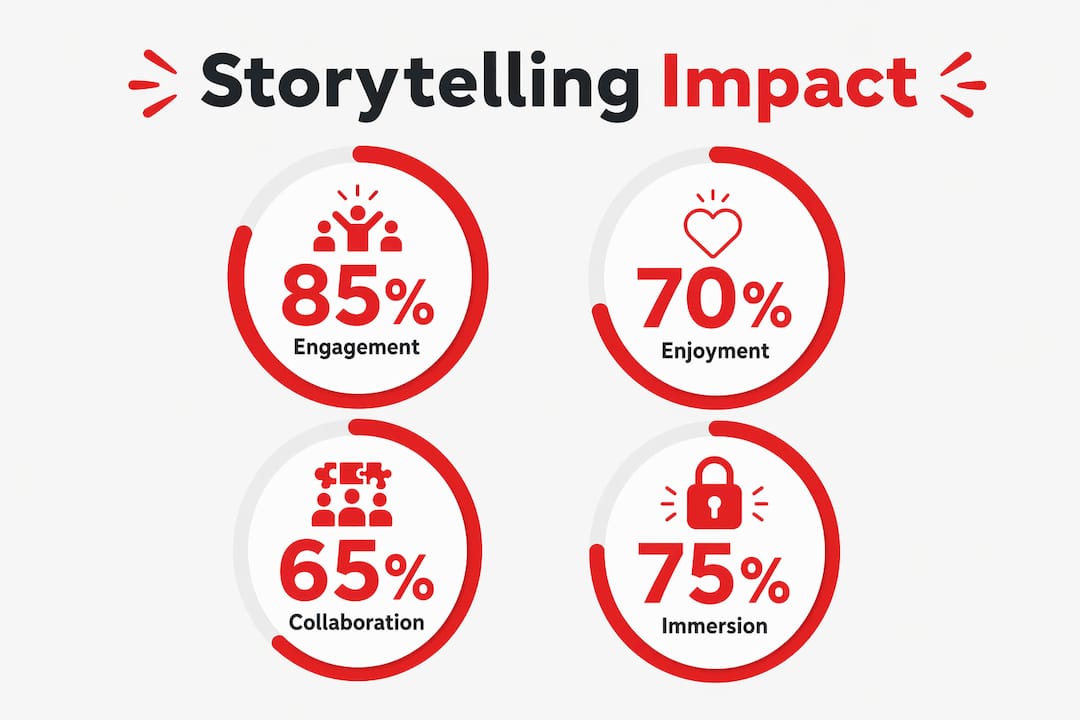
Effective escape room narratives do not front-load exposition. Narrative pacing must align with clue availability to avoid stalling the story, and narrative progress should emerge through puzzle completion rather than lengthy dialogue. A player reading three paragraphs of backstory on a wall panel is not immersed. A player who discovers that backstory by decoding a cipher is living the story.
Here is a practical framework for building narrative into a 60-minute escape room:
- Open with a premise, not a history. Give players a clear goal and immediate stakes in the first 90 seconds. “You have 60 minutes to find the antidote” works. A five-minute audio recording of the villain’s origin story does not.
- Map story beats to puzzle dependencies. High-end narrative escapes map player journeys and puzzle dependencies to coordinate story reveals and maintain narrative logic. Each solved puzzle should unlock not just a physical mechanism but a piece of the story.
- Use the environment as a narrator. Props, set dressing, lighting changes, and sound design carry story weight without consuming player time. A cluttered desk tells a character’s personality. A flickering light signals danger. These are passive storytelling techniques that work continuously in the background.
- Pace reveals for the final third. The most significant story disclosure should land in the last 15 to 20 minutes, when players are most invested and the time pressure is highest. This alignment between narrative climax and game climax creates the emotional payoff that players remember and describe to others.
- Account for variable player engagement with exposition. Narrative design is an interactive system that reflects player choices and environmental storytelling, not a fixed script. Some players will read every prop. Others will ignore all text. Design story delivery so both groups reach the same understanding through different paths.
Pro Tip: Test your room with players who actively avoid reading props. If they still understand the core story through environmental cues alone, your narrative design is working. If they are confused, your story is too dependent on optional text.
The storytelling techniques in games that translate best to escape rooms share one quality: they reward curiosity. Every object a player picks up should have the potential to deepen the story, even if its primary function is mechanical. This dual-purpose design philosophy is what separates memorable rooms from forgettable ones.
Scene-based vs. non-scene-based narratives: which approach wins?
Not all narrative strategies produce the same results. Research comparing scene-based and non-scene-based narrative approaches reveals a measurable performance gap. Experimental data from 80 participants showed that scene-based narratives produced significantly higher scores in focused attention and reward sensations compared to non-scene-based approaches. The difference matters because focused attention is the cognitive state that makes puzzle-solving feel effortless rather than frustrating.
| Narrative approach | Effect on focused attention | Effect on reward feeling | Player feedback |
|---|---|---|---|
| Scene-based narrative | Significantly higher | Significantly higher | Feelings of participation and immersion |
| Non-scene-based narrative | Lower | Lower | Disengagement and frustration reported |
The practical implication is direct. A room where the story and the physical environment align, where a Victorian mystery room looks, sounds, and feels Victorian, produces a fundamentally different cognitive experience than a room where the story is delivered through a screen in an otherwise generic space. Thematic alignment between story and environment is not an aesthetic preference. It is a design requirement for sustained player interest.
Non-scene-based approaches tend to create what researchers describe as narrative dissonance. Players receive story information that contradicts what their senses are telling them, and the brain resolves that conflict by discarding the story. The result is a room that feels like a puzzle collection with a theme pasted on top, which is exactly the experience that generates lukewarm reviews. Thematic elements in escape rooms must be integrated at the environmental level, not applied as a surface layer after the puzzles are built.
How does storytelling support collaboration and learning in escape rooms?
The importance of narrative in escape rooms extends well beyond entertainment. Educational escape rooms using fictional narrative scenarios support engagement and teamwork, with one study documenting 60-minute games followed by 45-minute debriefings across 12 sessions, all generating positive feedback and measurable learning outcomes. The narrative frame is what makes the learning feel consequential rather than academic.
In professional education, story-driven escape rooms have shown particular strength in clinical training. A pilot using diagnostic reasoning scenarios with nursing students showed positive outcomes in surveys and observational guides, with participants reporting improved diagnostic confidence and stronger peer connections. The story context, in this case a patient scenario with real stakes, gave learners a reason to apply knowledge under pressure rather than simply recall it.
Several outcomes emerge consistently from narrative-driven escape rooms used in collaborative settings:
- Peer connection: Shared story investment creates common ground between participants who may not know each other well, accelerating trust and communication.
- Distributed problem-solving: Story complexity encourages teams to divide cognitive labor, with different players tracking different narrative threads simultaneously.
- Sustained emotional engagement: Adjusting group size and experience-level differentiation helps maintain emotional engagement and inclusiveness in professional escape rooms, particularly when narrative complexity is calibrated to the group.
- Transfer of learning: Players who solve problems within a narrative context are more likely to recall and apply those problem-solving strategies in real situations, because the story provides a memorable retrieval cue.
The escape room collaboration benefits documented in both entertainment and educational contexts share a common cause: narrative gives teams a shared purpose that transcends individual puzzle-solving. That shared purpose is the social glue that makes the experience feel meaningful long after the timer stops.
Key takeaways
Storytelling in escape rooms is the design variable with the greatest measurable impact on player enjoyment, attention, and collaboration.
| Point | Details |
|---|---|
| Narrative increases enjoyment | High-narrative conditions significantly raised enjoyment scores compared to low-narrative conditions in a 2026 study. |
| Scene-based design outperforms | Scene-based narratives produced higher focused attention and reward feelings than non-scene-based approaches. |
| Story beats drive puzzle pacing | Mapping narrative reveals to puzzle completions maintains momentum and prevents story stalls within 60-minute formats. |
| Collaboration deepens with story | Shared narrative context accelerates team communication and distributed problem-solving in both entertainment and educational rooms. |
| Thematic alignment is non-negotiable | Environmental and narrative coherence is a design requirement, not an aesthetic choice, for sustained player immersion. |
Why narrative design is harder than it looks
After years of watching players move through escape rooms, I have come to one conclusion that most design conversations avoid: the story is almost always the last thing built and the first thing that breaks. Designers spend months engineering puzzle mechanics, sourcing props, and wiring electronics. Then, in the final weeks, they write a backstory and record an intro video. That sequence produces exactly the kind of narrative dissonance the research identifies.
The rooms that genuinely captivate players, the ones where people stand in the lobby afterward still talking about the story, are built story-first. The puzzle exists to serve the narrative, not the other way around. Established engagement theories like Narrative Transportation require real adaptation for escape rooms, because puzzles compete directly with story absorption for player attention. The solution is not less story. It is smarter story delivery, where every puzzle is a story moment.
Player agency complicates this further. Unlike a film or a novel, an escape room cannot control the sequence in which players encounter information. Two groups will experience the same room in a different order and reach different emotional peaks. The best narrative designs account for this by building story logic that holds regardless of sequence, using environmental storytelling that works in any order rather than a linear plot that requires specific discovery timing.
The future of escape room narratives will likely involve technology, specifically adaptive audio, triggered lighting, and responsive prop systems that react to player progress. But technology is not the constraint. The constraint is the willingness to treat story as a first-class design element from day one.
— CodeBusters
Experience story-driven escape rooms in Colorado Springs

Codebustersescaperoom in Colorado Springs builds every room around a story that players live rather than watch. Rooms like “Stranger 80’s,” “Past to the Future,” and “Flight of Deception” each use thematic alignment, environmental storytelling, and puzzle-driven narrative reveals to create the kind of immersive experience the research describes. Whether you are bringing a corporate team, a family group, or a crew of enthusiasts, the narrative design at Codebustersescaperoom is built to hold your attention from the first clue to the final reveal. Book your escape and find out what it feels like when the story and the puzzle are the same thing.
FAQ
What is the role of storytelling in escape rooms?
Storytelling in escape rooms connects individual puzzles into a meaningful narrative arc, giving players emotional stakes and a reason to stay engaged. Research shows that high-narrative conditions significantly increase player enjoyment compared to low-narrative formats.
How do scene-based narratives improve the escape room experience?
Scene-based narratives align the physical environment with the story, producing measurably higher focused attention and reward feelings in players. Rooms where the setting and story contradict each other generate disengagement and frustration instead.
Can narrative-driven escape rooms be used for professional training?
Yes. Studies with nursing students using diagnostic reasoning scenarios showed that story-driven escape rooms improved clinical confidence and peer connection. The narrative frame makes learning feel consequential rather than academic.
How should designers pace storytelling within a 60-minute room?
Narrative reveals should emerge through puzzle completion rather than upfront exposition, with the most significant story disclosure landing in the final 15 to 20 minutes. This aligns the narrative climax with peak time pressure for maximum emotional impact.
Do escape room stories improve team collaboration?
Shared narrative context gives teams a common purpose that accelerates communication and distributed problem-solving. Escape rooms and team collaboration research consistently shows that story investment strengthens group dynamics beyond what purely mechanical puzzle rooms achieve.