The Role of Puzzles in Teamwork for Business Teams
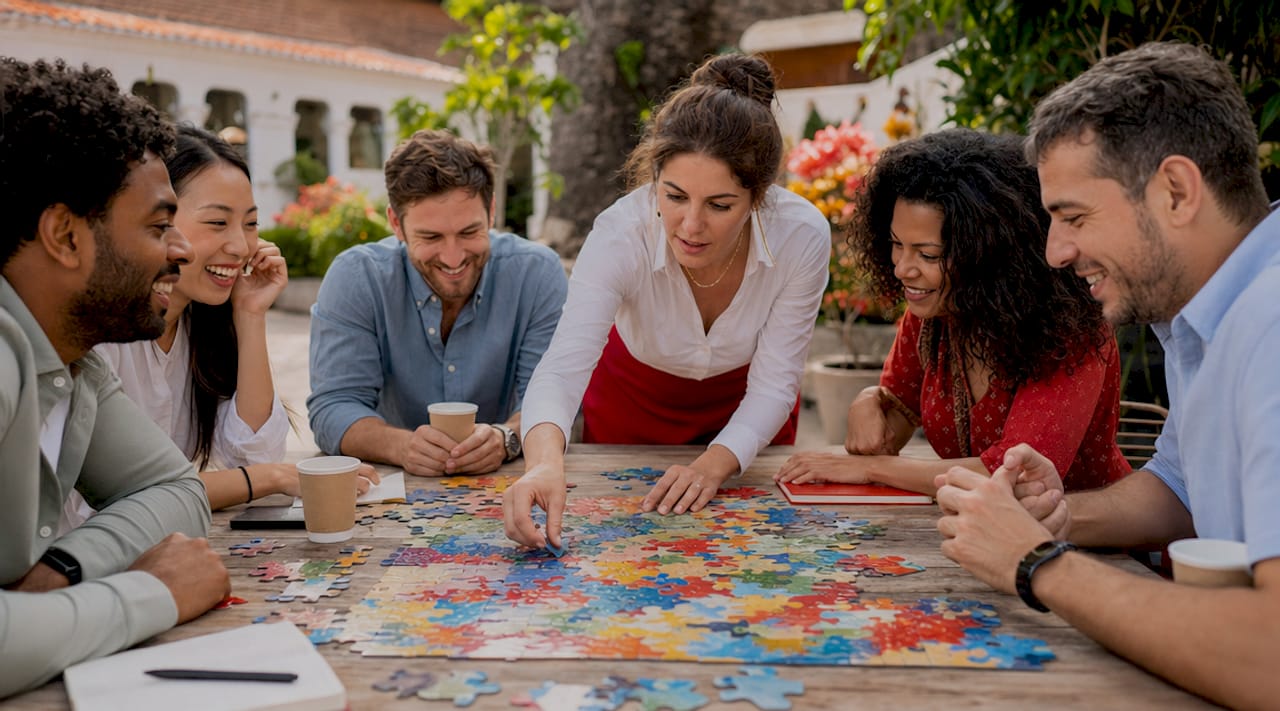
Puzzles are defined as structured problem-solving tools that train teams in communication, decision-making, and collaboration by creating shared challenges that require coordinated effort and diverse cognitive strengths. The role of puzzles in teamwork extends far beyond entertainment. Activities like escape rooms, the Broken Square, and collaborative jigsaw puzzles expose real communication patterns, surface leadership habits, and build the kind of trust that formal training rarely achieves. Research confirms that teams report higher cohesion and communication after regular puzzle-based activities. For managers who want measurable behavioral change, not just a fun afternoon, puzzles are one of the most efficient tools available.
How puzzles improve teamwork through communication and problem-solving
The role of puzzles in teamwork is most visible in how they force dialogue. No team member holds all the information needed to solve a well-designed puzzle. That constraint makes communication non-optional. Teams must share observations, test assumptions out loud, and actively listen to each other, often under time pressure that mirrors real workplace conditions.
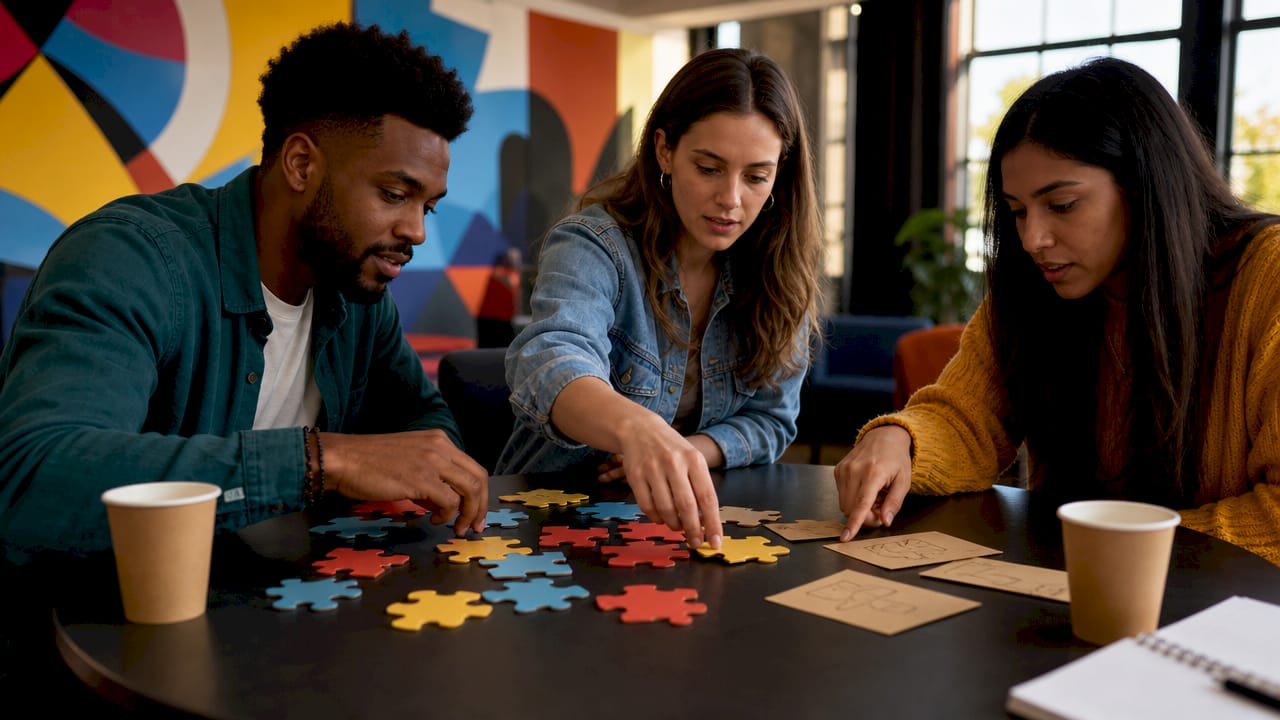
Puzzles also train teams in iterative problem-solving. When one approach fails, the group must regroup, reassess, and try again. This cycle builds tolerance for ambiguity and frustration, two skills that are directly transferable to complex projects where the path forward is rarely obvious. Teams that practice puzzle-solving report improved patience and a stronger willingness to share partial information rather than waiting for certainty.
The communication patterns that emerge during puzzle activities are revealing. You will see who speaks first, who defers, who checks details, and who takes charge when the group stalls. These behaviors are the same ones that shape daily work dynamics, but they are rarely visible in meetings or project updates.
- Information sharing: Puzzles reward teams that share observations freely rather than hoarding data.
- Active listening: Progress stalls when team members talk past each other, making listening a survival skill.
- Role flexibility: Different puzzle stages require different strengths, so leadership naturally rotates.
- Conflict tolerance: Disagreements about approach must be resolved quickly, building real-time negotiation skills.
Pro Tip: Assign one person per session to observe communication patterns rather than participate. Their notes after the activity will reveal more about your team’s dynamics than a month of performance reviews.
Escape rooms, Broken Square, and jigsaw puzzles compared
Different puzzle formats develop different teamwork capabilities. Choosing the right format depends on what your team needs most.
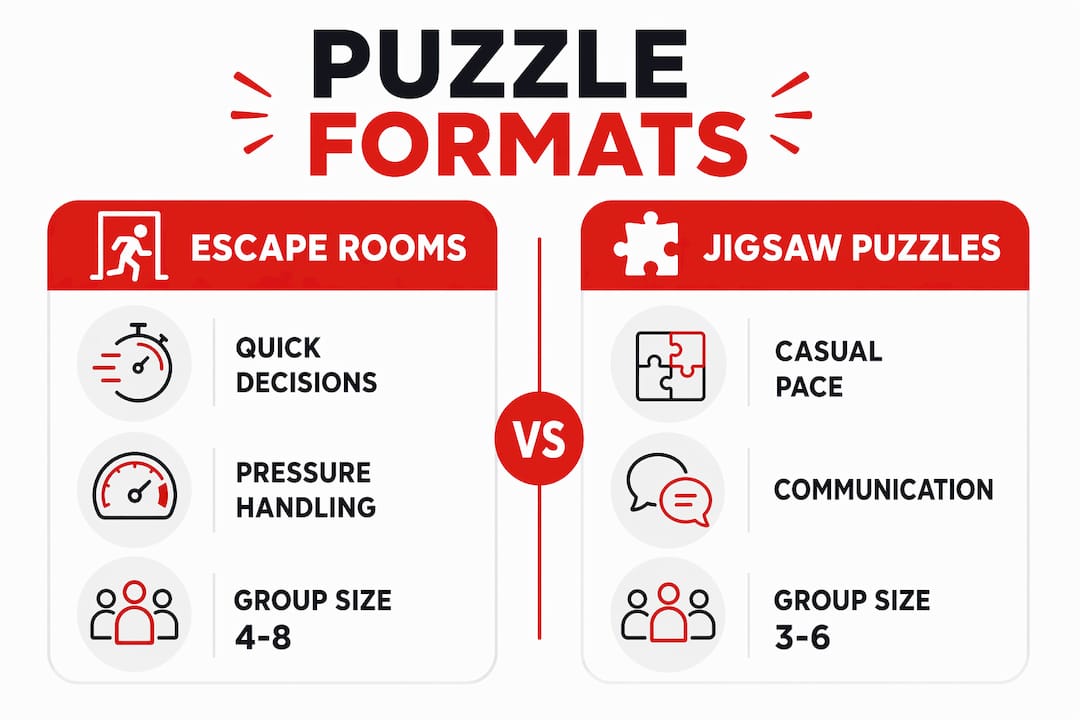
Escape rooms compress decision-making cycles into a 60-minute session, training staff for faster real-world choices. The time constraint forces distributed leadership because no single person can process every clue simultaneously. Teams must delegate, trust, and act on incomplete information. Managers consistently observe that the behaviors surfaced in escape rooms transfer directly to daily workflows, particularly in how teams handle pressure and ambiguity.
The Broken Square activity operates on a different principle. Non-verbal communication rules govern the exercise: participants cannot speak or take pieces from others, only offer them. This constraint exposes delegation habits, patience levels, and emotional intelligence in ways that verbal exercises cannot. Teams that struggle with information withholding in the office will struggle visibly in the Broken Square, making it a precise diagnostic tool.
Jigsaw puzzles serve a different purpose. They are lower pressure, longer in duration, and well suited to casual team bonding or onboarding sessions. The shared focus of assembling a large puzzle creates natural conversation and a sense of collective accomplishment without the intensity of a timed challenge.
| Puzzle type | Primary skills developed | Best group size | Ideal use case |
|---|---|---|---|
| Escape room | Decision-making, leadership under pressure, communication mapping | 4 to 10 | Corporate training, performance reviews |
| Broken Square | Non-verbal communication, patience, emotional intelligence | 5 to 20 | Conflict resolution, new team integration |
| Jigsaw puzzle | Collaboration, shared focus, casual bonding | 4 to 15 | Onboarding, low-pressure team bonding |
| Digital puzzle tools | Remote collaboration, async problem-solving, onboarding | Any size | Hybrid or distributed teams |
The key is matching the puzzle format to the specific gap in your team’s performance. If communication breaks down under pressure, escape rooms are the right choice. If the issue is passive behavior or information hoarding, the Broken Square will surface it within minutes.
What science and experts say about puzzles and team dynamics
Physical puzzles engage the brain’s Default Mode Network, which screen overload actively suppresses. Tactile engagement restores emotional clarity and mental resilience, which means puzzle activities do more than build soft skills. They reset the cognitive state that makes those skills accessible in the first place. For teams running on back-to-back video calls, this reset has measurable value.
Experts describe puzzles as structured reps that surface leadership and communication habits rapidly. A manager watching a team attempt an escape room will see who checks details, who speaks first, and who shuts down under pressure. That information is available in a single hour, without a formal assessment or survey.
“Escape rooms and puzzle challenges are effective not because of the puzzles themselves, but because they impose constraints that force reliance on teammates, revealing true communication maps.” (Source)
This insight reframes how managers should think about puzzle activities. The puzzle is not the product. The behavioral data it generates is the product. Effective team puzzles require diverse cognitive styles and distributed ownership, which prevents any single personality from dominating and ensures that spatial, logical, and linguistic thinkers all contribute at different stages.
The emotional dimension matters too. Teams that complete a shared challenge together experience a genuine sense of accomplishment. That shared experience builds psychological safety, which is the foundation of honest communication in the workplace.
Pro Tip: Schedule a 20-minute debrief immediately after any puzzle activity. Ask three questions: What worked? What slowed us down? What would we do differently? The answers will map directly onto your team’s real work challenges.
How to integrate puzzles into your team development program
Using puzzles in corporate training works best as a sustained practice rather than a one-off event. A single escape room session is valuable, but teams that engage with puzzle-based activities quarterly show compounding improvements in communication and problem-solving. Digital and physical puzzles support rapid skill practice and onboarding with measurable progress through metrics like completion time and hint usage.
Here is a practical framework for integrating puzzles into your team development calendar:
- Assess your team’s current gap. Identify whether the primary issue is communication breakdown, passive participation, decision-making speed, or trust. This determines which puzzle format to use first.
- Select puzzle complexity deliberately. New teams or teams with low psychological safety need lower-stakes puzzles before high-pressure formats like escape rooms. Start with jigsaw puzzles or word-based challenges, then escalate.
- Schedule regular sessions. Quarterly puzzle activities outperform annual team-building events. Frequency builds the habit of collaborative problem-solving, not just the memory of a single experience.
- Assign a facilitator, not just a participant. The facilitator observes, takes notes on communication patterns, and leads the debrief. This role is separate from the team solving the puzzle.
- Run a structured debrief. Post-puzzle debriefing is vital for converting activity into permanent behavioral change. Without it, the session remains a game rather than a learning experience.
- Track metrics across sessions. Record completion times, hint usage, and communication notes. Improvement in these metrics over time reflects genuine skill development.
- Adapt for hybrid teams. Digital puzzle platforms support remote and distributed teams. Tools like online escape room formats and collaborative word puzzles replicate the constraint-based dynamics that make physical puzzles effective.
For teams that include remote members, the escape rooms vs. other games comparison is worth reviewing before selecting a format. Not every puzzle activity translates equally well to a virtual setting, and choosing the wrong format for a hybrid team can undermine the psychological safety you are trying to build.
Key takeaways
Puzzles develop teamwork by imposing constraints that force communication, distributed leadership, and shared problem-solving, making behavioral patterns visible in ways that standard meetings and reports cannot.
| Point | Details |
|---|---|
| Communication is the core mechanism | Puzzles make dialogue non-optional, surfacing real communication habits within a single session. |
| Format determines the skill developed | Escape rooms build decision-making speed; the Broken Square targets non-verbal communication and patience. |
| Debrief converts activity into learning | Without structured reflection, puzzle sessions remain games rather than behavioral development tools. |
| Frequency compounds the benefit | Quarterly puzzle activities produce stronger, more lasting improvements than one-off team events. |
| Metrics make progress visible | Tracking completion times and hint usage across sessions shows measurable skill development over time. |
What we’ve learned running teams through puzzles at Codebustersescaperoom
I’ll be honest: when we first started hosting corporate groups at Codebustersescaperoom, I expected teams to treat our rooms as a break from work. What I observed instead surprised me. Within the first 15 minutes of a session, the real team dynamics were on full display. The person who dominates meetings often became a bottleneck in the room. The quiet analyst who rarely speaks up in the office frequently solved the critical clue.
The teams that struggled most were not the ones with the least experience. They were the ones with the least psychological safety. When people are afraid to suggest a wrong answer, puzzle progress stalls completely. That observation changed how I think about team-building. The puzzle does not build the team. It reveals what the team already is, and gives everyone, including the manager, a shared reference point for honest conversation afterward.
The teams that got the most value were the ones whose managers stayed in observer mode and came prepared with specific questions for the debrief. Complexity balance matters too. A room that is too easy produces no useful data. A room that is too hard produces frustration without insight. The sweet spot is a challenge that requires genuine collaboration but remains solvable within the session. That balance is what we design for across every room at Codebustersescaperoom, from “Flight of Deception” to “Stranger 80’s.”
If you take one thing from our experience: the debrief is not optional. It is where the learning happens.
— CodeBusters
Build your team’s skills with Codebustersescaperoom
Corporate teams in Colorado Springs have used Codebustersescaperoom to surface real communication patterns, develop decision-making skills, and build the kind of trust that transfers directly to the workplace. Each themed room, including “Past to the Future,” “Flight of Deception,” and “Stranger 80’s,” is designed to require distributed leadership and genuine collaboration.
Codebustersescaperoom offers private room bookings for corporate groups, with experiences tailored to different group sizes and difficulty levels. Whether you are onboarding a new team or strengthening an existing one, the escape room experiences at Codebustersescaperoom give managers the behavioral data and shared experience that formal training rarely delivers. You can also explore corporate event entertainment ideas to build a full team-building program around your escape room session. Book your session at Codebustersescaperoom and see what your team is actually made of.
FAQ
What is the role of puzzles in teamwork?
Puzzles function as structured problem-solving activities that force communication, distributed leadership, and shared decision-making. They surface real team dynamics in a single session, giving managers behavioral data that standard meetings do not provide.
How do escape rooms benefit corporate teams?
Escape rooms compress decision-making into 60 minutes, training teams to act on incomplete information under pressure. The constraints of the room create a visible communication map that transfers directly to workplace behavior.
How often should teams do puzzle-based activities?
Quarterly sessions produce compounding improvements in communication and problem-solving. A single annual event builds a memory; regular practice builds a habit.
What makes a puzzle activity a learning experience rather than just a game?
Structured post-puzzle debriefing is the difference. Analyzing what worked, what slowed the team down, and what would change next time converts the activity into permanent behavioral development.
Can puzzle activities work for remote or hybrid teams?
Digital puzzle platforms replicate the constraint-based dynamics of physical puzzles and support remote collaboration effectively. The key is selecting formats that require real-time communication rather than async individual tasks.