The Role of Communication in Escape Rooms: Team Guide
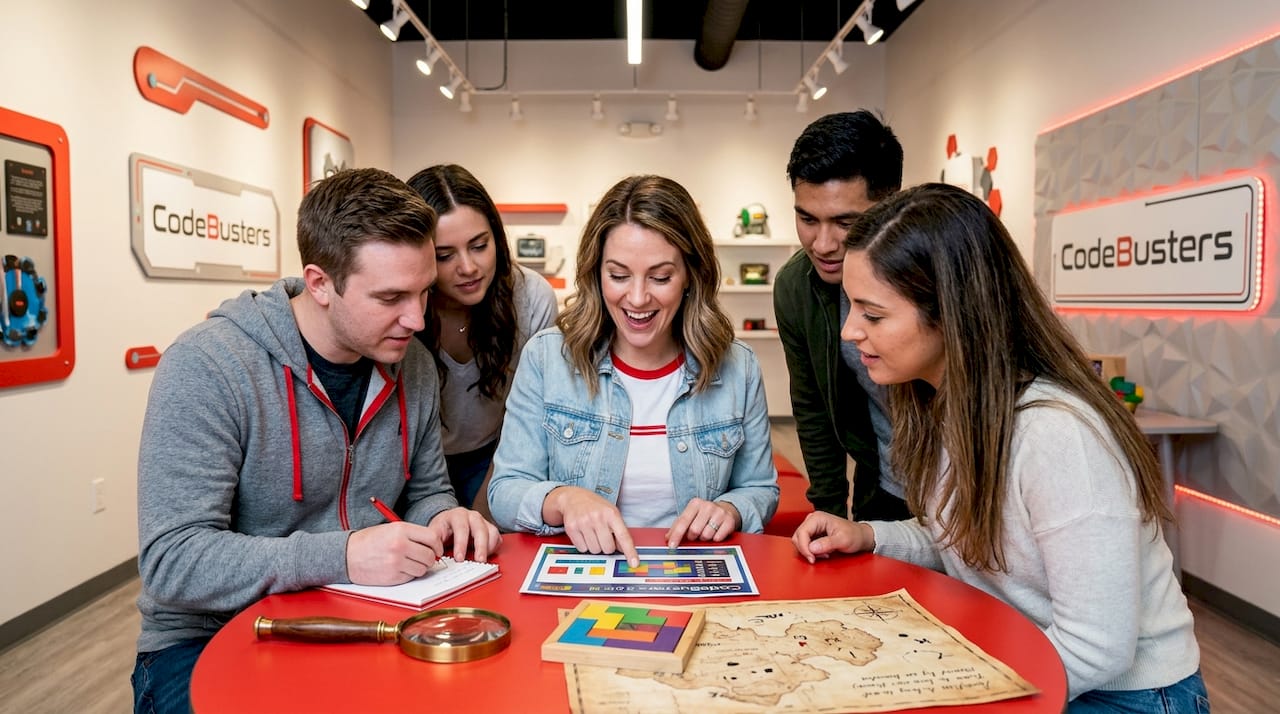
Communication is the single mechanism that determines whether an escape room team succeeds or falls apart. When players share observations clearly, negotiate tasks quickly, and update each other in real time, puzzle chains collapse in minutes. When they don’t, the clock runs out. The role of communication in escape rooms goes beyond talking. It covers how teams encode information, assign roles, and build shared understanding under pressure. Research from Niagara College, JMIR Medical Education, and Esports Wales all confirm that structured communication directly improves team coordination and escape room outcomes.
How communication strategies impact teamwork and problem-solving
Effective communication in team gaming produces better coordination and strategy, while poor communication produces chaos and defeat. The same principle applies directly to escape rooms, where every second of confusion costs progress. Teams that communicate with clarity and purpose consistently outperform those that rely on individual effort.

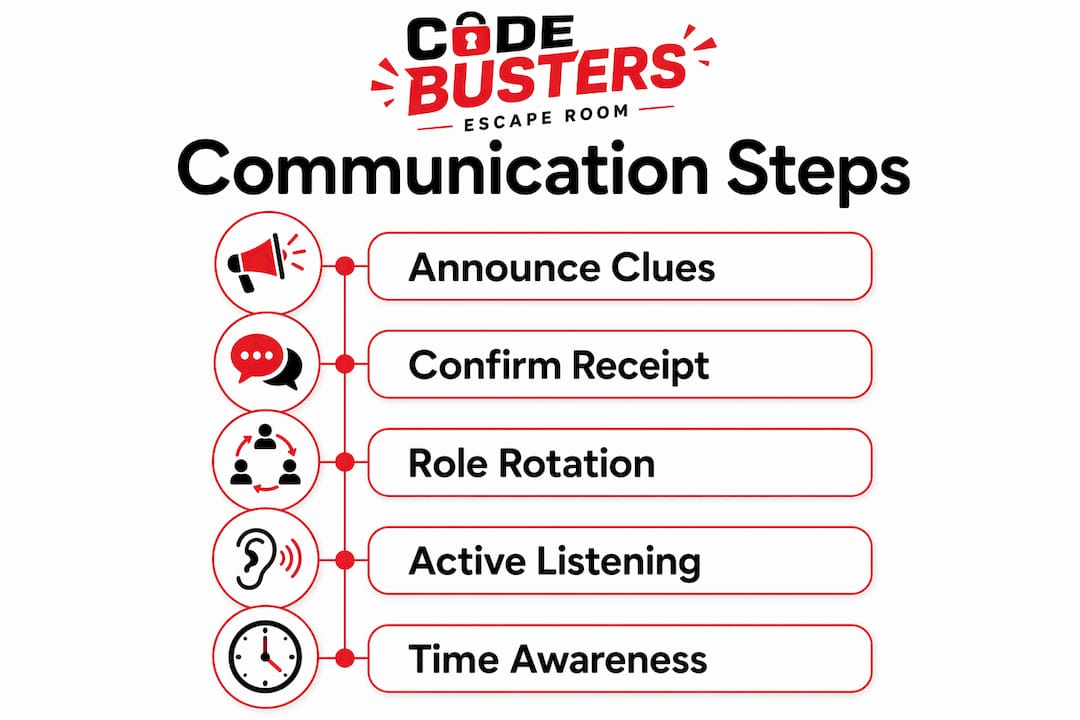
Active listening is the most underrated skill in any escape room. When a teammate calls out a clue, the instinct is to keep working on your own puzzle. Resisting that instinct and processing what was said prevents duplicated effort and surfaces connections between clues that no single player would spot alone. A team where everyone listens is a team that solves faster.
Clear expression matters just as much. Vague statements like “I found something over here” waste time. Specific statements like “There’s a four-digit lock on the left wall and I have a number sequence from the bookshelf” give teammates the context they need to act immediately. The difference between these two approaches is the difference between a team that converges on a solution and one that circles the same dead ends.
Concise updates keep the group’s shared mental model accurate. As puzzles open new areas or reveal new clues, a quick verbal summary to the whole team prevents anyone from working on information that’s already been resolved. Think of it as a live status board spoken out loud.
- Call out every clue immediately, even if you don’t know what it connects to yet.
- Confirm receipt when a teammate shares information, so they know it landed.
- Summarize progress every five to seven minutes to reset the group’s shared picture.
- Ask direct questions rather than making assumptions about what others have found.
Pro Tip: Before the game starts, agree on one person to act as the “information hub” for the first ten minutes. Their job is to repeat clues back to the group and track what’s been tried. Rotate this role as the game progresses.
How escape room design shapes team coordination
Role-based tasks and time constraints produce richer task-related communication and faster convergence on shared plans compared to unstructured settings. This is not accidental. Escape room designers build these pressures deliberately to force the kind of communication that teams avoid in low-stakes environments. The design itself is the communication catalyst.
Time limits create urgency that strips away hesitation. In a normal meeting, people hold back ideas because they fear judgment. Inside a 60-minute escape room, there’s no time for that filter. Players say what they see, share half-formed theories, and accept correction quickly. This urgency produces a communication quality that most teams never reach in their regular work.
Role assignments push teams toward explicit negotiation. When one player is designated to handle combination locks and another handles written clues, they must communicate their findings to each other to make progress. Neither can succeed alone. This interdependence is the structural engine behind the importance of teamwork in escape rooms.
VR educational escape rooms show that even in digital formats, the design produces spontaneous real-life communication and cooperation, improving connectedness and motivation among participants. The medium changes, but the communication dynamic stays consistent because the design elements remain the same.
| Design element | Communication effect |
|---|---|
| Time limit (60 minutes) | Removes hesitation; forces immediate, direct speech |
| Role-based tasks | Creates interdependence; requires explicit information exchange |
| Multi-stage puzzles | Demands sequential updates and shared logic |
| Spatial separation | Requires verbal relay of clues across the room |
| Increasing difficulty | Triggers leadership shifts and adaptive communication |
Pro Tip: If your group is playing a room with spatial separation, assign one person to physically move between areas and relay information. This “bridge” role prevents the most common information silo problem in larger groups.
Why debriefing after the game matters more than you think
Structured debriefing reinforces learning and teamwork appreciation after gameplay, with a 45-minute debrief producing significant gains in learning objectives. Most teams skip this step entirely, which means they leave the most valuable part of the experience on the table. The escape room is the test. The debrief is where you actually learn.
A facilitated debrief works by surfacing moments that players experienced but didn’t consciously process. A leadership shift that happened at the 30-minute mark, a clue that sat unshared for ten minutes, a moment when two people worked on the same puzzle without knowing it. These are the communication breakdowns that a debrief makes visible and correctable.
Resilience-focused debriefing helps teams reflect on communication complexity and successful management of setbacks, building adaptive teamwork skills that transfer to real-world environments. This approach goes beyond reviewing what went wrong. It asks teams to identify moments where they adapted, recovered, and communicated through confusion. That reflection builds tolerance for ambiguity, which is one of the most transferable skills any team can develop.
Medical education programs and corporate training departments both use escape room debriefs for exactly this reason. The experience creates a shared reference point that makes abstract communication concepts concrete and personal.
- Identify one communication breakdown and trace it back to its root cause.
- Name one moment where the team’s communication worked exceptionally well.
- Discuss role clarity: did everyone know what they were responsible for?
- Agree on one specific behavior to change in the next team challenge.
Common communication pitfalls and how to fix them
Escape rooms expose information hoarding, dominant voices, and leadership shifts in real time, making these dynamics visible and correctable during debriefs. These are not personality flaws. They are communication patterns that emerge under pressure, and recognizing them is the first step to changing them.
Information hoarding is the most common failure mode. A player finds a clue, assumes it’s not relevant yet, and keeps working on it privately. Meanwhile, another player has the matching piece and is stuck. The fix is a simple team norm: every clue gets announced to the group within thirty seconds of discovery, regardless of whether its purpose is clear.
Dominant voices suppress ideas without intending to. When one person speaks first and confidently, others defer even when they have better information. Rotating who speaks first on each new puzzle area breaks this pattern. It distributes cognitive load and surfaces ideas that would otherwise stay silent.
Unclear roles create duplication and conflict. Two people working the same lock while a third area goes unexplored is a direct result of no role assignment. The solution is a 90-second planning conversation before the game starts.
- Assign a coordinator whose job is to track which puzzles are open and which are solved.
- Split the room into zones at the start and assign at least one person to each zone.
- Set a communication norm: all clues announced out loud, all solutions confirmed verbally.
- Rotate the leadership role every fifteen minutes to prevent one voice from dominating.
- Call a 30-second team huddle if the group feels stuck for more than five minutes.
Facilitators observing escape room events can identify key communication inflection points, including coordination starts, information stalls, and leadership shifts, to provide targeted feedback. If your group has a facilitator, ask them specifically what they observed about your communication patterns. That feedback is more valuable than any hint about the puzzles.
Pro Tip: Assign someone to watch the clock and call out time at the 45-minute, 30-minute, and 15-minute marks. Time awareness changes communication behavior. Teams that know they have 15 minutes left communicate with noticeably more urgency and precision.
Communication roles include encoding, transmitting, receiving, and decoding messages that enable mutual understanding and decisions. In an escape room, every player cycles through all four roles constantly. Understanding this cycle helps teams recognize when a message failed at transmission versus when it failed at decoding. That distinction changes how you fix the problem.
Key takeaways
Communication drives escape room success because it enables information sharing, role coordination, and adaptive problem-solving under time pressure.
| Point | Details |
|---|---|
| Announce clues immediately | Every discovery shared within 30 seconds prevents information silos and accelerates puzzle connections. |
| Use design elements intentionally | Time limits and role assignments force the communication quality teams rarely achieve in low-stakes settings. |
| Debrief after every session | A structured debrief is where communication learning consolidates and transfers to real-world teamwork. |
| Fix dominant voices early | Rotating who speaks first on each puzzle area distributes ideas and prevents suppression of key insights. |
| Plan roles before the clock starts | A 90-second pre-game role assignment eliminates duplication and gives every player a clear communication function. |
What we’ve learned from watching teams communicate under pressure
Running escape rooms at Codebustersescaperoom has given us a front-row seat to hundreds of team communication patterns, and the most consistent finding surprises people. The teams that escape fastest are rarely the smartest. They’re the ones that talk the most efficiently. Not the most, but the most efficiently. Short, specific, confirmed. That’s the pattern.
We’ve watched groups of engineers go silent for ten minutes because everyone assumed someone else was tracking the clues. We’ve watched groups of teenagers with no corporate training clear a room in 40 minutes because one of them naturally took the coordinator role and kept everyone updated. The skill is learnable, and the escape room is one of the few environments where you can practice it with real stakes and immediate feedback.
The real-world transferability of these skills is not theoretical. Teams that practice communication in escape rooms report that the experience changes how they run meetings, delegate tasks, and handle ambiguity at work. The room is a pressure cooker that reveals your actual communication habits, not the ones you think you have.
Our advice: go in with a communication plan, not just a puzzle strategy. Decide who coordinates, how you’ll share clues, and when you’ll call a huddle. Then watch how quickly the room opens up.
— CodeBusters
Experience communication-driven escape rooms in Colorado Springs
Codebustersescaperoom designs every room in Colorado Springs with team coordination at the center. Rooms like “Flight of Deception,” “Stranger 80’s,” and “Past to the Future” are built with interdependent puzzles that require players to share information, negotiate roles, and adapt under time pressure. These aren’t solo experiences dressed up as group activities. They’re genuine tests of how well a team communicates.
Whether you’re booking for a corporate group looking to sharpen team coordination or a group of friends who want to put their communication skills for escape rooms to the test, Codebustersescaperoom offers private room bookings for groups of various sizes. Visit Codebustersescaperoom to browse rooms, check availability, and book your session. You can also explore the escape room selection guide to find the right room for your group’s size and experience level.
FAQ
What is the role of communication in escape rooms?
Communication is the primary mechanism that enables teams to share clues, coordinate tasks, and solve puzzles within the time limit. Without active information exchange, teams duplicate effort and miss connections between clues that only become visible when everyone’s findings are pooled.
How do communication strategies improve escape room performance?
Specific strategies like announcing clues immediately, confirming receipt, and rotating the coordinator role prevent information silos and keep the team’s shared understanding accurate. Teams that use these strategies converge on solutions faster than those relying on individual effort.
Why does debriefing matter for communication skill development?
A structured debrief is where communication learning consolidates most strongly after the escape room experience. Research from JMIR Medical Education shows that a 45-minute debrief produces significant gains in teamwork appreciation and learning objectives that gameplay alone does not achieve.
What are the most common communication pitfalls in escape rooms?
Information hoarding, dominant voices, and unclear roles are the three most frequent breakdowns. Each one is correctable with a short pre-game planning conversation and a team norm that requires all clues to be announced out loud within 30 seconds of discovery.
Can escape room communication skills transfer to real-world teamwork?
Yes. The communication patterns practiced under escape room pressure, including active listening, concise updates, and role negotiation, directly mirror the skills needed in workplace collaboration, project management, and crisis response.