Step by Step Team Coordination for Managers

Step by step team coordination is a structured process of assigning decision roles, defining communication norms, and building repeatable workflows so teams deliver projects without constant oversight. Most coordination failures are not people problems. They are design problems. 75% of cross-functional teams fail due to missing decision frameworks like DACI or RAPID. That number signals a fixable structural gap, not a talent shortage. The good news: a deliberate, stepwise approach to coordination replaces chaos with clarity, cuts wasted meetings, and gives every team member a clear lane to operate in.
What are the prerequisites for step by step team coordination?
Before you run a single sprint or kick off a project, you need four foundational elements in place. Skipping them is the single biggest reason teams spend weeks relitigating the same decisions. Teams without documented decision frameworks and working agreements lose up to 8 weeks to repeated coordination failures. That is two months of productivity gone before the real work begins.
Define decision ownership first
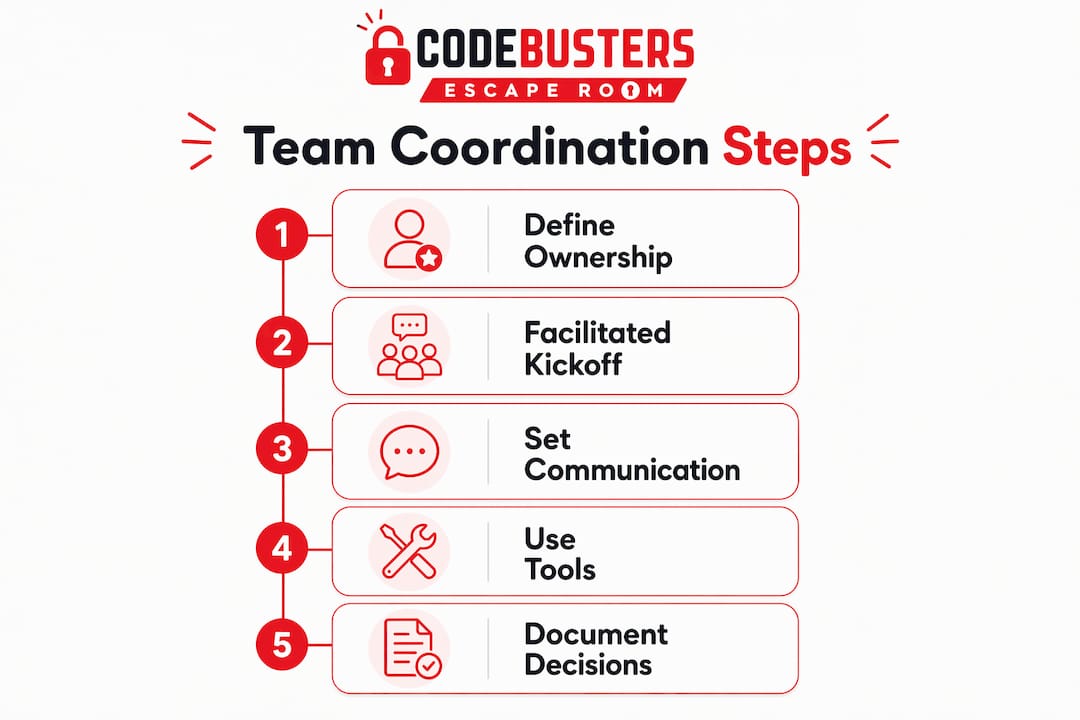
Ownership must be explicit and singular. Every decision needs one named driver, whether you use DACI (Driver, Approver, Contributor, Informed) or RAPID (Recommend, Agree, Perform, Input, Decide). Shared ownership is no ownership. When two people both think they own a call, neither acts, and the team stalls.

Establish working agreements
Working agreements are the written rules your team commits to before work starts. They cover communication style, expected response times, meeting rhythm, and how the team defines “done” for any deliverable. Without them, every norm becomes a negotiation. With them, the team runs on autopilot for routine decisions.
- Communication channels: Which tool handles urgent requests vs. async updates? Slack for quick questions, email for formal approvals, and a project tracker like Asana or Jira for task status.
- Response time expectations: Define what “urgent” means. A 4-hour window for Slack messages and a 24-hour window for email prevents the anxiety of unanswered pings.
- Definition of done: Every deliverable needs a written acceptance criterion. “Good enough” is not a standard.
- Meeting rhythm: Agree on which meetings are fixed, which are optional, and which can be replaced by async updates.
Run a facilitated kickoff session
A 2–4 hour kickoff session that locks in ownership and norms pays back its time investment within the first two weeks. Use it to walk through the project scope, assign decision roles, and surface dependencies before they become blockers. Bring a facilitator, even if that is you with a structured agenda, to keep the session from drifting into open discussion.
Pro Tip: Record the kickoff session and publish a one-page summary of all decisions made. New team members onboarding later will thank you, and the team avoids the “I thought we agreed on…” conversation.
How to structure communication rhythms and meetings
Effective team collaboration does not require more meetings. It requires better-designed ones. Efficient multi-team coordination can run on a 30-minute weekly sync and a half-day quarterly alignment session. That is a fraction of the meeting load most teams carry, and it works because the structure does the heavy lifting.
Here is a proven communication rhythm you can implement immediately:
-
Daily async status updates. Each team member posts a brief written update in your project tracker. What did they complete? What are they working on today? What is blocked? This replaces the daily standup for distributed or hybrid teams and gives everyone a shared view of progress without scheduling overhead.
-
Weekly 30-minute cross-team sync. Fix the agenda in advance: blockers, dependencies, and decisions that require group input. Nothing else. If a topic needs more than five minutes, it goes offline to a smaller group.
-
Publish a team API. A team API documents what your team builds, how other teams request work from you, and your service-level agreements. Publishing this interface cuts cross-team coordination questions by half. Think of it as a public contract between teams that removes the need for constant clarification calls.
-
Take dependency resolution offline. When two teams have a dependency conflict, the owners of those two workstreams meet separately. The full team sync is not the place to negotiate timelines. Resolve it bilaterally, then report the outcome to the group.
-
Quarterly half-day strategy alignment. Once per quarter, bring all team leads together to review priorities, adjust resource allocation, and reset shared goals. This is where you catch drift before it becomes misalignment.
-
Async as the default. Synchronous communication is expensive. Every meeting pulls people out of focused work. Default to written, asynchronous updates and reserve live conversation for decisions that genuinely require real-time input.
Pro Tip: Create a shared “decisions log” in Notion, Confluence, or a simple Google Doc. Every decision made in a meeting gets recorded there within 24 hours. This single habit eliminates the “did we agree on this?” conversation permanently.
Which tools and methods maintain visibility and ownership?
Tools do not create coordination. They support it. Coordination works best as designed infrastructure layered in this specific order: ownership, visibility, handoffs, and rhythm. Deploying a tool before you have established ownership is like installing a dashboard in a car with no engine. The display looks good but nothing moves.
The table below maps each coordination layer to its purpose and the tools that support it.
| Coordination Layer | Purpose | Supporting Tools |
|---|---|---|
| Ownership | Assign a single accountable person per decision or deliverable | DACI/RAPID frameworks, Asana, Linear |
| Visibility | Give the full team a shared view of task status and progress | Jira, Trello, Monday.com, Notion |
| Handoffs | Track deliverable transfers between teams as explicit events | GitHub pull requests, Jira tickets, documented checklists |
| Rhythm | Maintain predictable meeting and update cadences | Google Calendar, Slack reminders, recurring Loom updates |
Treat handoffs as deliverables, not events
Most coordination breakdowns happen at handoff points. A handoff is not a conversation. It is a documented transfer of a completed deliverable with a clear acceptance criterion attached. When team A hands work to team B, there should be a ticket, a checklist, or a pull request that both parties sign off on. Verbal handoffs disappear. Written ones do not.
Document decisions with consensus protocols
Consensus protocols and decision records reduce repeated re-coordination by maintaining a live, authoritative shared state. When a decision is recorded with the rationale, the alternatives considered, and the person who made the call, the team stops relitigating it. The record becomes the single source of truth. Tools like Confluence, Notion, or even a shared Google Doc work well for this. The format matters less than the habit.
What are the most common coordination challenges and fixes?
Even well-designed coordination systems break down. Knowing the failure patterns lets you diagnose and fix them fast rather than watching a project drift for weeks.
-
Unclear ownership. The symptom is decisions that never get made or get made twice by different people. The fix is auditing your decision log and assigning a single named driver to every open item. If no one owns it, it does not get done.
-
Excessive meetings. When teams schedule meetings to discuss meetings, the coordination system has failed. Async automated status updates replace most status meetings effectively. Audit your recurring calendar and cancel any meeting that could be a written update.
-
Coordination tax. Coordination tax is the cumulative time teams spend managing work rather than doing it. Reducing synchronous dependencies decreases this tax and improves how fast teams actually deliver. Measure it by tracking how many hours per week each person spends in coordination activities versus focused work.
-
Slow blocker resolution. The best metric for coordination health is the median time between when a blocker appears and when it gets resolved. If that number is growing, your escalation path is broken. Fix it by assigning a single person to own blocker resolution and giving them authority to pull in whoever is needed.
“Teams should treat coordination as intentional infrastructure, not incidental overhead, to maximize productivity and reduce burnout.” — Cross-Functional Project Management Playbook, Quire
New teams face an additional challenge: ramp-up time. New teams take 60–90 days to reach reliable performance. Structured onboarding with clear role definitions and regular retrospectives cuts that window significantly. Build retrospectives into your rhythm from week one, not as a crisis response but as a standard operating procedure.
Key takeaways
Effective step by step team coordination requires deliberate infrastructure built in layers, starting with ownership and ending with rhythm, not the other way around.
| Point | Details |
|---|---|
| Start with decision ownership | Assign a single named driver per decision using DACI or RAPID before any work begins. |
| Write working agreements early | Document communication norms, response times, and definitions of done in a kickoff session. |
| Default to async communication | Replace status meetings with written updates to cut coordination tax and protect focused work time. |
| Treat handoffs as documented transfers | Record every handoff with a ticket or checklist so nothing falls through the gap between teams. |
| Measure blocker resolution speed | Track median time from blocker appearance to resolution as your primary coordination health metric. |
Why coordination architecture beats ad hoc management
Running escape rooms at Codebustersescaperoom has taught me something that applies directly to corporate team management: coordination that is not designed in advance gets improvised under pressure, and improvised coordination is expensive.
Every escape room we run at Codebustersescaperoom is a live coordination exercise. Players who walk in without assigning roles, agreeing on communication norms, or defining who makes the final call on a puzzle spend the first ten minutes talking over each other. The teams that succeed are the ones who take thirty seconds at the start to say “you handle the locks, I handle the clues, she makes the final calls.” That is a working agreement. It takes thirty seconds to set up and saves ten minutes of friction.
The same principle applies at scale. The managers I have seen struggle most with team coordination are the ones who treat it as something that should happen naturally. It does not. Shared mental models and implicit coordination only emerge after a team has built explicit coordination habits first. You have to design the system before the system can run itself.
The counterintuitive lesson: fewer meetings create more accountability, not less. When you remove the weekly status meeting and replace it with a written update, you find out very quickly who is actually tracking their work and who was relying on the meeting to catch up. That visibility is uncomfortable at first. It is also exactly what good management requires.
Start small. Run one facilitated kickoff. Publish one team API. Track one blocker metric. The compounding effect of those three habits will outperform any project management tool you buy.
— CodeBusters
Build real coordination skills with Codebustersescaperoom
Team coordination frameworks look clean on a whiteboard. They get tested under pressure. Codebustersescaperoom in Colorado Springs puts corporate teams inside immersive, time-pressured scenarios where role clarity, communication, and fast decision-making determine whether the group succeeds or fails.
Rooms like “Flight of Deception” and “Stranger 80’s” are designed for groups of varying sizes and require exactly the skills this article covers: clear ownership, fast handoffs, and real-time communication under constraints. For managers who want their teams to practice coordination under pressure, a private booking at Codebustersescaperoom delivers a memorable, high-stakes environment that no workshop can replicate. Explore team building experiences at Codebustersescaperoom and book a session for your group today.
FAQ
What is step by step team coordination?
Step by step team coordination is a structured method of assigning decision roles, establishing communication norms, and building repeatable workflows before project work begins. It replaces ad hoc coordination with a designed system that reduces overhead and improves delivery speed.
How do DACI and RAPID frameworks improve coordination?
Both DACI and RAPID assign a single named decision driver per decision, which eliminates the accountability gaps that stall progress. Teams using these frameworks resolve decisions faster because everyone knows who has the final call.
How many meetings does good team coordination require?
Efficient coordination can run on a 30-minute weekly sync and a half-day quarterly alignment. Most status meetings can be replaced with async written updates, which frees focused work time and cuts coordination tax.
What is the best metric for measuring coordination health?
The median time between a blocker appearing and being resolved is the single most useful coordination health metric. A rising number signals a broken escalation path that needs immediate attention.
How long does it take a new team to coordinate reliably?
New teams typically take 60–90 days to reach reliable performance. Structured onboarding with clear role definitions, working agreements, and regular retrospectives from week one shortens that window considerably.