Step-by-step escape strategy: master your escape room
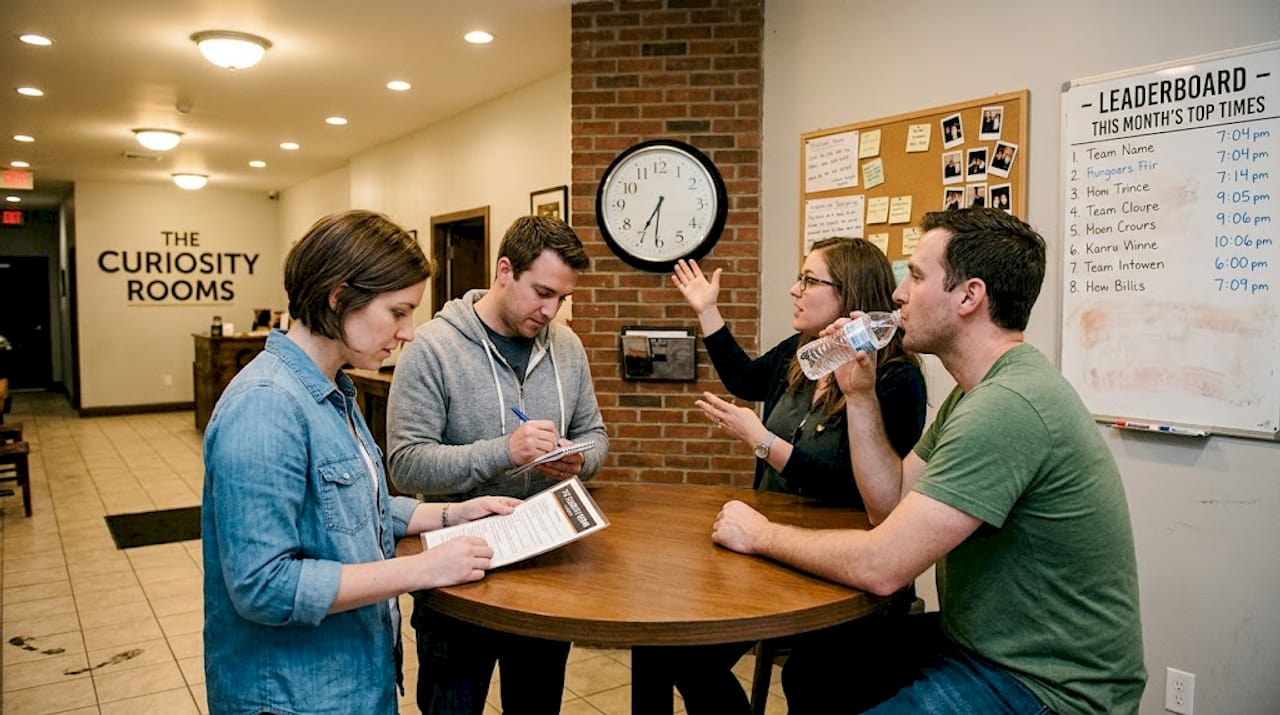
The clock reads 8 minutes. Your team is staring at a locked box, three unused clues are scattered on the floor, and nobody agrees on what the combination means. Sound familiar? That pressure is exactly what makes escape rooms so thrilling, and so humbling. But here’s the thing: the teams who escape consistently aren’t smarter. They just show up with a plan. This guide walks you through a proven, step-by-step escape strategy so you spend less time panicking and more time celebrating a well-earned victory with your crew in Colorado Springs.
Table of Contents
- Preparing for your escape: What to know before you start
- Step-by-step escape strategy: The core process
- Avoiding common mistakes and troubleshooting setbacks
- Verifying your escape: Success metrics and post-room debrief
- What most escape room teams get wrong (and how to do better)
- Ready to put your escape strategy to the test?
- Frequently asked questions
Key Takeaways
| Point | Details |
|---|---|
| Preparation matters | Reviewing rules and team roles before entry leads to smoother escapes. |
| Clear steps drive success | Following a defined strategy maximizes your chances to beat the room clock. |
| Learn from setbacks | Recognizing mistakes and adapting quickly helps teams finish strong. |
| Debrief and celebrate | Analyzing your escape experience improves teamwork for next time. |
Preparing for your escape: What to know before you start
Most teams lose the escape before they even enter the room. They walk in excited, immediately scatter in different directions, and start grabbing every object in sight. Within ten minutes, clues are mixed up, two people are working the same puzzle, and nobody knows who found what. Preparation fixes all of that.
Start by assigning loose roles before you go in. You don’t need formal job titles, but someone should be a clue organizer, someone a puzzle solver, and someone the communicator who keeps the group updated on progress. Roles can rotate, but having a starting structure prevents the chaos of everyone doing the same thing at once.
Here’s what to bring and what to leave behind:
- Bring: Sharp eyes, a willingness to communicate everything you find, and a positive attitude
- Leave behind: Outside tools, phones used for research, and any attitude that puts winning above teamwork
- Optional: A small notepad if allowed, to log codes and patterns
Escape room themes and tips reinforce that understanding room rules before entering is essential for effective teamwork. Read the briefing carefully. Most game masters give you critical rules in those first two minutes that players ignore because they’re too eager to start.
Pro Tip: Ask the game master before you begin if there are any rules unique to this specific room. Some rooms have off-limit areas or special mechanics that aren’t obvious.
Use this quick comparison to understand what kind of room your team might face:
| Feature | Classic escape room | High-tech escape room |
|---|---|---|
| Puzzle style | Padlocks, keys, physical clues | Digital panels, sensors, app-based |
| Communication style | Verbal and visual | Verbal and tech-driven |
| Difficulty curve | Gradual | Can spike suddenly |
| Best team type | First-timers and mixed groups | Experienced players and tech-savvy teams |
| Hint system | Staff knocks or intercom | Screen prompts or automated |
Knowing what you’re walking into helps your team calibrate their expectations and reduce early frustration.
Step-by-step escape strategy: The core process
Once you’re inside and the timer starts, resist the urge to rush. The first two minutes are for scanning, not solving. Walk the entire room calmly and call out everything you see. Don’t touch yet. Just observe and narrate. This gives your whole team a shared mental map.
Here’s the process that consistently gets teams through the door:
- Scan the room together and verbally catalog every object, symbol, and surface
- Separate clues from props and place active clues in one central location
- Assign each puzzle to a specific person or pair based on your pre-assigned roles
- Solve in parallel when possible, so multiple puzzles progress at once
- Share every discovery immediately, even if it seems irrelevant
- Log codes and combinations in one place so nothing gets forgotten
- Reassemble as a group when stuck, and rotate fresh eyes onto the problem
- Use hints intentionally, not as a last resort but as a strategic tool
Escape strategy advice confirms that dividing tasks and rotating puzzle roles improves success rates significantly. This is especially true in larger groups where tunnel vision on one puzzle leaves others untouched.
“The best teams treat the escape room like a relay race, not a solo sprint. Every person has a leg to run, and passing the baton cleanly is the real skill.”
Common sticking points include overthinking simple locks and under-communicating found clues. If you’ve spent more than five minutes on one puzzle without progress, move on and return with fresh eyes. Fixating wastes time that other puzzles could use.
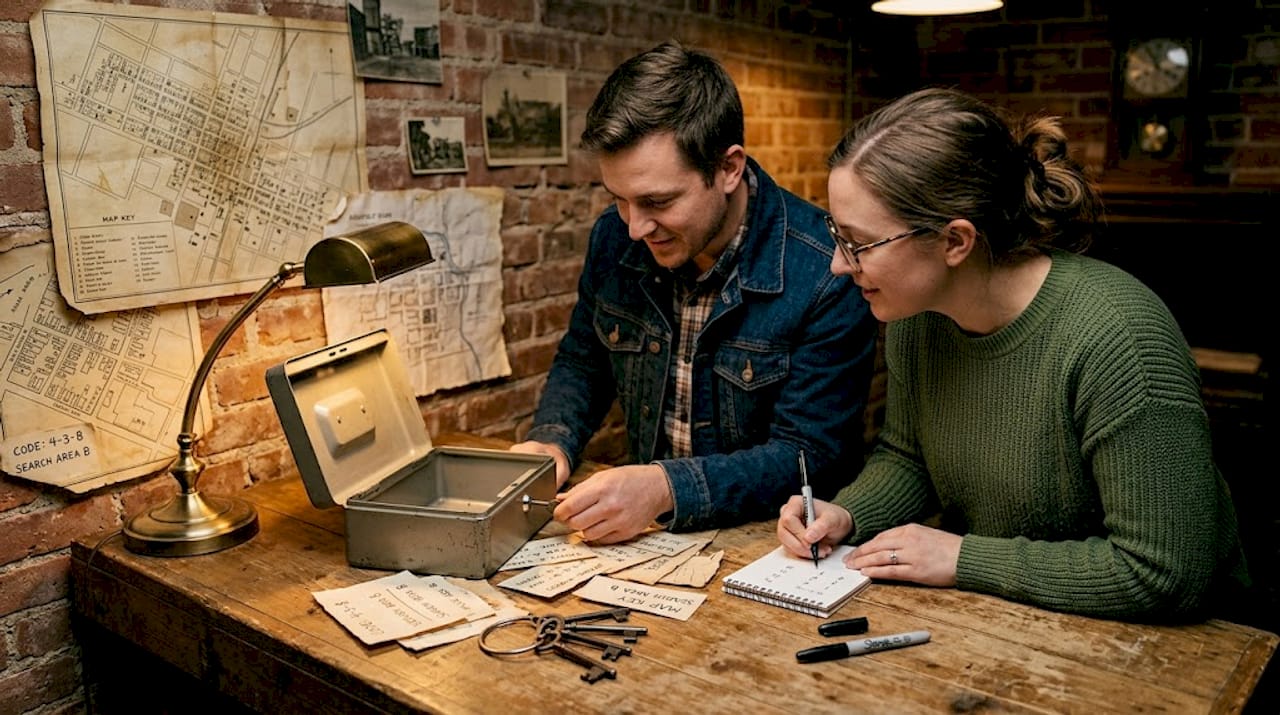
| Strategy | Average success improvement |
|---|---|
| Role assignment before entry | Up to 30% higher completion rate |
| Centralizing found clues | Reduces duplicate effort by 40% |
| Rotating puzzle partners | Increases solve speed by 25% |
| Strategic hint use | Saves an average of 8 minutes |
Avoiding common mistakes and troubleshooting setbacks
Even the best-prepared teams encounter setbacks. Knowing how to recover can mean the difference between escaping and running out of time.
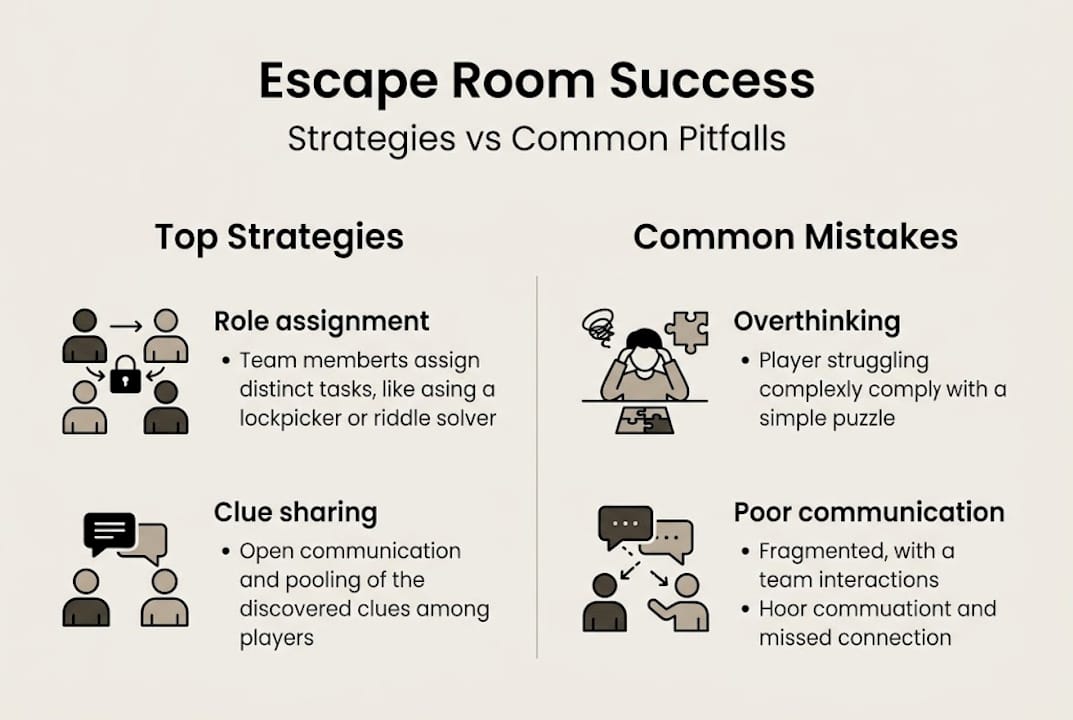
Here are the top five mistakes that sabotage most escape room attempts:
- Hoarding clues: Holding onto a clue without sharing it with the group creates blind spots
- Ignoring the debrief at the start: Missing a key rule costs minutes later
- One person dominating: When one player takes over, others disengage and team IQ drops fast
- Skipping a clue because it looks unimportant: Every object in a well-designed room serves a purpose
- Waiting too long to ask for hints: Hints and troubleshooting show that seeking hints at the right time can prevent wasted effort and keeps momentum alive
“Asking for a hint isn’t admitting defeat. It’s a tactical decision. The teams that use hints well almost always outperform teams that refuse them out of pride.”
When your team hits a wall, call a 60-second reset. Have everyone step back from their current puzzle, share what they’ve found so far, and look at the room with fresh eyes as a group. This micro-debrief often reveals connections that were invisible when heads were down.
Maintaining positive team dynamics under pressure matters more than most players realize. Frustration is contagious. So is confidence. If someone makes a wrong call, acknowledge it briefly and move forward. There’s no benefit to dwelling on a missed combination when the clock is running.
Etiquette reminders that many players overlook: don’t force locked objects, avoid piling on one person’s idea without hearing alternatives, and keep your voice calm even when the timer feels deafening. Rooms are designed to be solved. Trust that and trust each other.
Verifying your escape: Success metrics and post-room debrief
With the escape complete, take these final steps to maximize what your team learned and celebrate your victory.
Your game master will often share your stats immediately after the room. Pay attention to them. Here’s how to read what they mean:
- Time remaining: More than 10 minutes left means your team has strong fundamentals. Under 5 minutes suggests tighter coordination is needed next time.
- Hints used: Zero hints can mean excellent teamwork or missed puzzles. One to two hints used strategically is the sweet spot for most groups.
- Puzzle accuracy: If your team frequently entered wrong codes, the issue is likely rushing rather than misunderstanding.
- First puzzle solved: How fast you cracked the opening puzzle tells you a lot about your scanning effectiveness.
- Stuck points: Note which puzzles held you up longest. These reveal your team’s weakest coordination area.
Team debrief methods confirm that debriefing as a group improves future success and team bonding in measurable ways. Even five minutes of post-room conversation can sharpen your next attempt significantly.
Pro Tip: After the room, ask your game master what the most commonly missed clue is. Their answer will often surprise you and teach your whole team something new about observation.
Celebrate the wins, even small ones. Did someone crack a cipher under pressure? Acknowledge it. Did a quiet team member spot the key detail that unlocked the final puzzle? Make sure everyone knows. These moments build the shared identity that makes future challenges easier and more enjoyable.
Building team morale after the escape is just as important as building strategy before it. Teams that celebrate thoughtfully and debrief honestly improve dramatically from session to session.
What most escape room teams get wrong (and how to do better)
After watching hundreds of groups work through escape rooms, one pattern stands out above all others: teams that appoint an informal “leader” early and then defer to that person for every decision consistently underperform teams where leadership rotates naturally.
The problem isn’t leadership itself. It’s rigidity. When one voice dominates, three or four other brains go quiet. Those quiet brains often hold the insight that solves the room.
Escape room expert advice points toward open communication and role rotation as the most reliable framework for high-performing teams. The practical way to do this: whoever is closest to a puzzle leads it, not whoever is loudest in the group.
The framework most guides miss is what we call the “share first, solve second” rule. Before anyone works on an individual puzzle, they call out what they’ve found to the whole group. This 10-second habit prevents the single biggest time-waster in escape rooms: two people solving the same puzzle independently while a third puzzle sits untouched.
Strategy matters. But team culture is what actually wins.
Ready to put your escape strategy to the test?
Now that you’ve got a real plan in hand, the next step is putting it into practice somewhere worthy of your effort. Colorado Springs has exactly the kind of immersive, high-quality rooms that make every strategy feel alive.
At CodeBusters Escape Room, you’ll find themed rooms built for groups who take the experience seriously, from first-timers to seasoned players. With rooms like “Stranger 80’s,” “Flight of Deception,” and “Past to the Future,” every visit gives your team a new challenge to apply everything you’ve just learned. Book your escape room adventure and see how your strategy holds up when the clock is real and the stakes feel higher than ever.
Frequently asked questions
How long does an average escape room take?
Most escape rooms are designed for 60-minute sessions, though time can vary slightly based on room difficulty and the size of your group.
Is it okay to ask for hints during an escape room?
Absolutely. Hints boost success rates when used at the right moment, so treat them as a smart tool, not a sign of failure.
What should I wear or bring to an escape room?
Comfortable clothing and closed-toe shoes work best. Leave outside tools and extra accessories at home since most rooms don’t allow them.
How do escape rooms help with team building?
Escape rooms improve group cohesion by requiring real-time communication, role flexibility, and creative problem-solving under pressure, which are skills that transfer directly to any team environment.