Private vs Public Escape Rooms: Which Is Right for Your Group?

In a private escape room, you book the whole room and play only with the people you brought. In a public (or shared) game, you buy individual spots and may be placed with strangers to fill the team. Private suits families, parties and work teams. Public can suit a couple or a small group that wants a lower entry cost. At CodeBusters in Colorado Springs, every game is a private room, so the rest of this guide shows you how to decide, what to check before booking, and how each format plays out for different groups.
TL;DR
- Private: you pay for the room and the team is exactly who you invited. Public: you pay per player and may share with strangers.
- Pricing models differ. Public rooms often favor small groups, while private rooms ask you to pay for the room whatever the headcount.
- Families, birthday groups and corporate teams usually get more from a private game, because the team’s communication is the experience.
- Before booking anywhere, confirm privacy, minimum and maximum players, game length, and the cancellation and arrival rules.
- We run private rooms only, at two Colorado Springs locations, so you never share a room with anyone you did not bring.
Table of Contents
- What the difference actually is
- How pricing works in each format
- What playing with strangers does to the game
- Which format fits which group
- Group size: the question behind the question
- What to check before you book any escape room
- Puzzle room vs escape room: is there a difference?
- Our perspective
- Book a private room in Colorado Springs
- A quick decision guide
- FAQ
- Sources
What the difference actually is
The label “private” describes who is in the room, not how good the room is. The puzzles, story and set can be identical in both formats. What changes is the booking model.
A private game reserves a time slot for your group alone. Nobody else can be added to it. The group size is known when you book, so the venue can plan the reset and the hints around you.
A public game sells seats. If you book two spots and the room holds six, the venue may add other bookings to your slot. Some venues also run a hybrid, letting customers book a whole room, buy individual spots in a shared room, or join a partly booked public game.

That hybrid is why the same question shows up in so many search results: “Is this room private?” Venues answer it differently, and some answer it only if you ask. A booking page that does not say clearly is worth a quick call or email.
How pricing works in each format
Private and public rooms are priced on different logic, and that changes which one is cheaper for you.
- Public rooms charge per person. Industry sources note that this can be more affordable for smaller groups, since you only pay for the seats you fill.
- Private rooms charge for the room. The same source explains that you pay for the whole room regardless of how many players show up. Suppliers describe the logic this way: with public bookings, group size can change, so per-player pricing is common, while with private bookings the player count and final price are known upfront.
In practice, that makes a private room feel expensive for two people and a good deal for a full team. The more of the room’s capacity you use, the more the private format makes sense on cost alone. A group of friends splitting the total sees a per-person figure that is easy to compare with a public ticket.
We do not publish room prices in this article because the current rates for each room are on our booking pages. Our guide to what an escape room private party costs walks through how to think about it, and the room list is where you pick a game and see availability.
A simple way to run the numbers
- Count the players you can realistically bring, not the number you hope for.
- Compare the private room total divided by that headcount against the per-person public price.
- Add what you value that is not in the price: choosing your own time, no waiting for a stranger to arrive, and no mismatched play styles.
If your group is near the room’s maximum, the private price per head usually stops being a talking point. If you are a pair, you are the case where public deserves a look, as long as you are comfortable teaming up with strangers.
What playing with strangers does to the game
An escape room is a cooperative task under a clock. Research on escape-room design points out that these games demand significant interaction and task interdependence, so how players communicate and rely on each other shapes the experience materially. That is the heart of the private vs public question.
With strangers, the first ten minutes often go to figuring out who is who. People speak less, hold back ideas, or one confident player takes over. With a group you already know, you start with shared shorthand, known strengths and permission to say “that’s wrong” without anyone taking offense.
The same review cites evidence that team-building escape rooms can improve perceptions of group cohesion and team efficacy, and that hint and feedback systems can support psychological safety and reduce disagreements. Both of those work better when the people in the room already have something to build on, or a reason to build it.
To be fair to public games: some players love meeting new people, and a good mix of strangers can bring a skill your own group lacks. If that is your idea of a fun night, a shared game is a legitimate choice. If your idea of a fun night is laughing with the people you came with, private is the format built for it.
Which format fits which group
Families and mixed-age groups
Kids, parents and grandparents solve differently. A younger player may spot the small detail while an adult handles the logic. Strangers rarely have the patience to make room for that. In a private room you set the pace and decide who gets to try the lock. Our tips for mixed-age family groups cover how to split tasks so everyone contributes.

Friends and birthday parties
The point is the shared story you will retell afterward. A private room lets you be loud, make wrong guesses out loud, and cheer together. You also control the start time, which matters when you are coordinating eight people and a dinner reservation. If you are planning a larger party, our group events and parties page is the place to start.
Corporate teams
Work teams have reporting lines, quiet voices and habits that show up under pressure. Putting them in a room with strangers dilutes what you are trying to learn. A private session keeps the debrief focused on your own people. If you are weighing several formats for an offsite, this look at team building options compared shows how groups think about the choice, and our own pieces on how escape rooms build stronger teams and corporate team building collaboration go deeper on the workplace side.
Couples and pairs
This is where public can make sense on cost, since a private room is priced for a team. Still, many pairs choose a smaller private game for a date because they want to play at their own speed and not share the moment.
Group size: the question behind the question
Private vs public is partly a group-size decision. Too few players means a heavier workload for each person. Too many means people stand at the back with nothing to do. A private booking lets you tune the number to the room instead of letting the schedule do it. Our article on how group size affects escape room fun and success explains how to find that sweet spot.
Good communication matters as much as headcount. If you want to get more from whichever format you choose, read the role of communication in escape rooms before you go.
What to check before you book any escape room
Whether you choose private or public, these are the points that save you from surprises. The answers should be on the booking page. If they are not, ask.
| Check | Why it matters |
|---|---|
| Is the booking private? | Confirms whether other parties can be added to your slot. |
| Minimum and maximum players | Tells you whether your group fits and what you pay if it is smaller than the room allows. |
| Pricing model | Per person or per room changes the total for your headcount. |
| Game length and arrival time | Standard games usually run on a clock, commonly about 45 to 60 minutes, per the general definition of an escape room, and you should arrive early for the briefing. |
| Difficulty and theme | Match them to your least experienced player, not your most. |
| Age guidance | Check it for any children in the party. |
| Cancellation and rescheduling | Group plans change, so read the policy before paying. |
| Discounts | Ask about military, veteran or group rates if they apply to you. |
| Gift options | A voucher is easier than picking a date for a group that has not agreed yet. |
One more tip: look at the real settings, not just the theme names. A room that places you inside a set that feels like a place is a different experience from a room that is mainly locks on a table.
Puzzle room vs escape room: is there a difference?
People use the two terms almost interchangeably, and most venues do too. An escape room is a team game where you solve puzzles against a clock inside a themed space. The goal does not have to be literally escaping, and a game can span more than one room. “Puzzle room” is mostly a looser name for the same idea, though some use it to mean a game that leans on puzzles over story or set. When you book, read the room description: it tells you more than the label does.
Our perspective
We run private rooms only. That is a choice we made on purpose, and it comes from watching what happens to a group at the moment the door closes.
The best moments in our rooms are not the final unlock. They are the second a nine-year-old finds the clue an adult walked past, or the instant a quiet coworker solves the thing the loudest person was stuck on. Those moments need a room where your people are the only people.
We are family and veteran owned, and we offer discounts for military and veterans. We also have a lot of themes to choose from across our two Colorado Springs locations, from a real airplane to a pirate ship, so a private booking does not mean a limited choice. Whether you want a family-friendly adventure or a harder room for experienced players, you can pick the story first and the group second.
Our guests have left more than 8,500 reviews, and that feedback is why we keep the model simple: your group, your room, your clock.
CodeBusters
Book a private room in Colorado Springs
If you have decided private is the right fit, you can browse all 13 of our themes on the rooms page. Every booking is a private room for your group, and we host birthday parties, family outings and corporate sessions. Prefer to let someone else pick the date? A gift voucher lets the recipient choose.
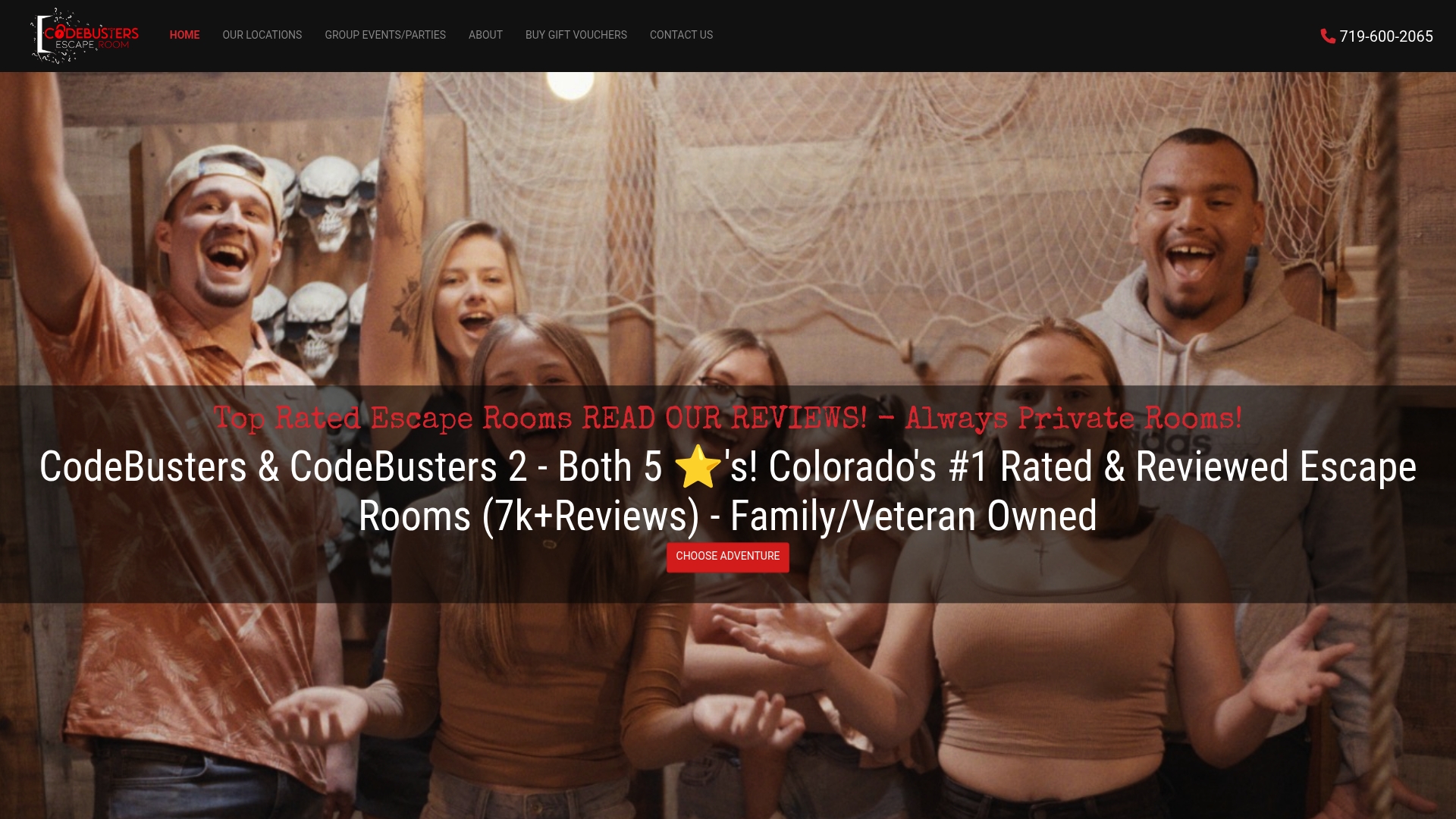
A few rooms to start with, depending on your group:
- Past to the Future for a story-driven adventure through time.
- Flying Dutchman if your group likes a pirate ship setting.
- Flight of Deception: The Royal Takeover for a game set on a real airplane.
- The Great Gamenight Escape for a playful, game-themed session with friends.
- Jigsaw’s Lair for older teens and adults who want something darker.
A quick decision guide
Still undecided? Run through these in order.
- Are you bringing four or more people you know? Private is probably the better experience, and the cost is shared.
- Are there children, older relatives or first-timers? Private, so you set the pace.
- Is this for work? Private, so the session reflects your own team.
- Are you one or two people on a tight budget, and happy to meet new players? Public may be worth a look where it is offered.
- Is the booking page unclear about privacy? Ask before paying, and get the answer in writing.
The common thread: the more the experience depends on who is in the room, the more a private game pays off.
FAQ
Are all escape rooms private?
No. Some venues sell individual spots and place strangers together to fill a room, while others offer private bookings only. Some offer both. Check the booking page or ask before you pay. At CodeBusters, every game is a private room.
Is a private escape room more expensive?
Per room, yes, because you pay for the whole room rather than a seat. Public rooms can be cheaper for small groups, but as your headcount rises the per-person cost of a private room tends to come into line. Check the current rate on the room’s booking page.
Can I join a game alone or as a pair?
That depends on the venue. Shared games are built for it, since the venue fills the remaining seats. Private rooms are booked as a group, so a solo player would be paying for the room. Look at a venue’s minimum player count before you choose.
Is a private room better for kids and families?
In most cases, yes. Younger players often need more time and encouragement, and a family group can adapt to that in ways strangers cannot. Look for age guidance on each room’s page and choose a theme that suits your youngest player.
Is a puzzle room the same as an escape room?
Mostly. The terms are used interchangeably, and both describe a themed, timed, cooperative puzzle game. Read the room description to see how much it leans on story, set and puzzles.
Sources
- Escape Room Pricing Strategies: Public vs. Private Rooms
- How to price your Escape Room game
- Planning an Escape: Considerations for the Development of Escape Rooms
- Escape room, Wikipedia
- Team Building Madrid: Ideas and Options Compared