How to plan an engaging corporate retreat in Colorado Springs
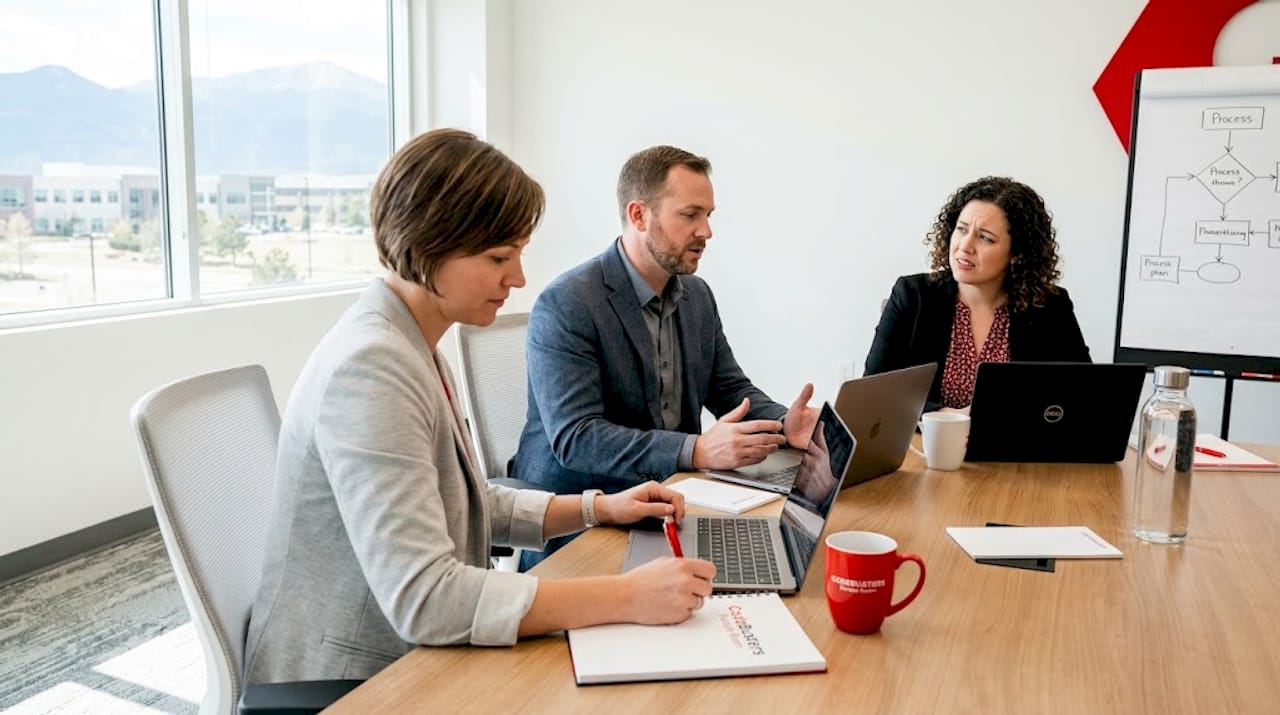
Corporate retreats in Colorado Springs have a reputation for looking great on paper and falling flat in practice. Teams return to the office having attended another round of forgettable icebreakers, and leaders wonder why morale didn’t budge. The difference between a retreat that transforms team dynamics and one that wastes budget comes down to deliberate planning. This guide walks you through every phase, from setting clear objectives and choosing the right venue to building a balanced agenda and measuring real outcomes, so your next retreat delivers lasting collaboration and not just a change of scenery.
Table of Contents
- Define the objectives and assemble your team
- Choose the right venue in Colorado Springs
- Design a memorable agenda
- Prepare logistics and troubleshoot common challenges
- Evaluate retreat impact and sustain momentum
- What most corporate retreat guides miss: engagement is the real outcome
- Take the next step: plan your team-building retreat with CodeBusters Escape Room
- Frequently asked questions
Key Takeaways
| Point | Details |
|---|---|
| Set clear retreat objectives | Identifying specific goals ensures your team-building retreat delivers measurable outcomes. |
| Pick the ideal Colorado Springs venue | Choosing a venue with flexible, engaging spaces drives participation and collaboration. |
| Craft a balanced retreat agenda | Mix workshops, activities, and downtime for maximum engagement and lasting impact. |
| Handle logistics proactively | Early planning for transportation, meals, and schedules helps the event run smoothly. |
| Prioritize team engagement | Incorporating collaborative activities like escape rooms boosts morale and strengthens relationships. |
Define the objectives and assemble your team
Every high-impact retreat starts with a brutally honest answer to one question: what do you actually need this retreat to accomplish? Without a clear answer, you end up with a schedule that pleases nobody and advances nothing. Vague goals like “team bonding” rarely translate into measurable improvements unless you define exactly what bonding looks like for your group.
Common retreat goals fall into three categories:
- Relationship building: Strengthening trust between team members who rarely collaborate face-to-face
- Creative brainstorming: Generating fresh ideas for upcoming projects or organizational challenges
- Skill development: Practicing communication, leadership, or problem-solving in lower-stakes environments
- Strategic alignment: Getting leadership and staff on the same page about company direction
Once your objectives are clear, assemble a planning committee rather than letting one person carry the entire load. Include voices from HR, at least one senior leader, a front-line employee representative, and an event coordinator if budget allows. This mix prevents the retreat from becoming a top-down experience that feels staged rather than genuine.
Team building activities like collaborative puzzle-solving are particularly effective at hitting multiple objectives simultaneously. Escape room businesses in Colorado Springs can facilitate team-building objectives through collaborative puzzles, making them a smart option to include early in your planning conversations.
Pro Tip: Invite someone from outside the leadership tier onto your planning committee. Frontline employees often know what actually motivates their peers, and their input will keep the agenda grounded in reality rather than executive assumptions.
Choose the right venue in Colorado Springs
Colorado Springs offers a genuinely diverse set of venue options, from mountain lodges to downtown conference centers to immersive entertainment spaces. The venue you choose will shape the tone of every activity, so treat this decision as strategically as you would a product launch location.
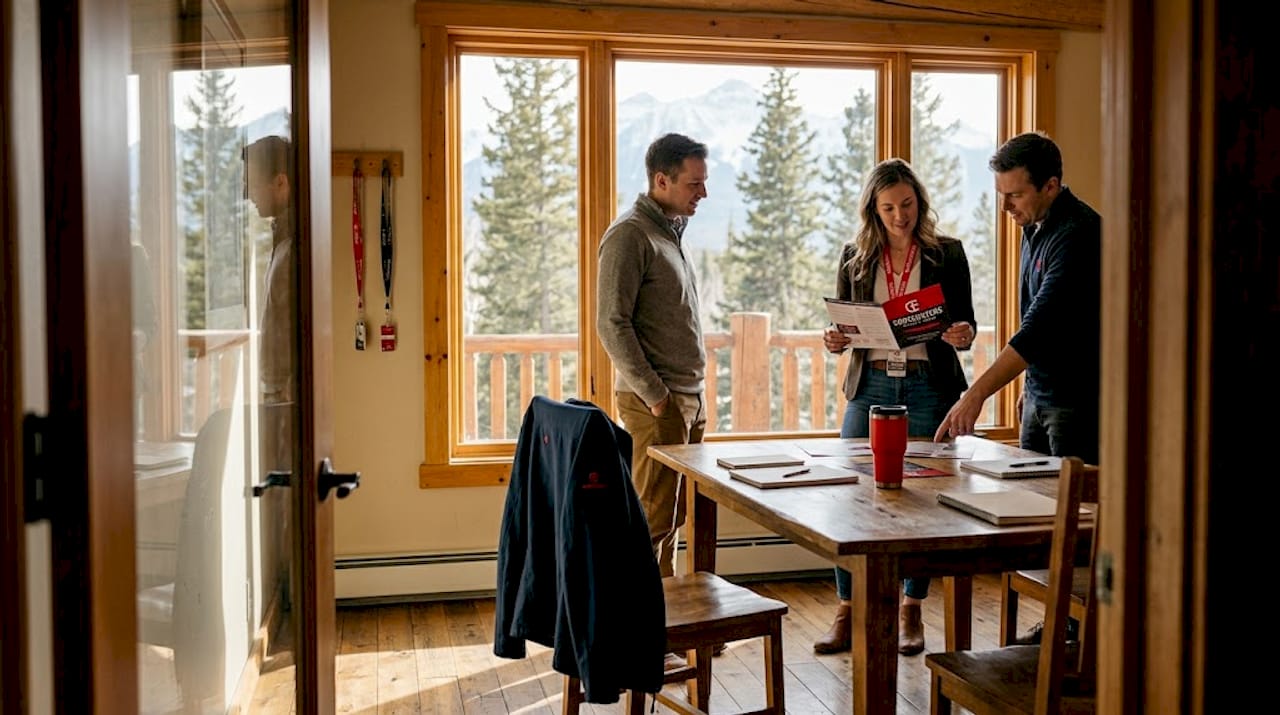
Colorado Springs escape rooms are frequently chosen by local businesses for retreats because they offer immersive team-building experiences that traditional conference rooms simply cannot replicate. Unlike a hotel ballroom, an escape room forces participants into active collaboration under time pressure, which accelerates trust-building in ways that passive seminars never achieve.
Use this comparison to evaluate your options:
| Venue type | Group size | Key activity types | Tech support | Catering options |
|---|---|---|---|---|
| Escape room | 4 to 30 per session | Problem-solving, collaboration | Minimal needed | Nearby restaurants |
| Mountain resort | 20 to 200 | Outdoor activities, workshops | Varies | Full catering |
| Conference center | 10 to 500 | Presentations, breakouts | Strong | Full catering |
| Outdoor park/trail | 10 to unlimited | Team challenges, hiking | None | Self-catered |
| Restaurant/event space | 10 to 100 | Networking, casual learning | Limited | Built-in |
Key factors to evaluate before booking:
- Accessibility: Can all team members reach the venue without significant hardship? Consider employees with disabilities or those without personal vehicles.
- Flexibility: Does the space allow you to rearrange layouts, add breakout areas, or modify programming last-minute?
- Proximity to accommodations: If your retreat spans multiple days, how far is the venue from hotels or lodging?
- Group size alignment: A space that’s too large creates disconnection; one that’s too small creates stress.
Pro Tip: Book venues with flexible room layouts well before your target dates, especially during spring and fall when Colorado Springs sees high conference traffic. Many venues offer early-booking discounts that can free up budget for higher-quality activities.
Design a memorable agenda
A retreat agenda should feel intentional, not overpacked. The most common mistake planners make is scheduling every hour, leaving no room for the informal conversations that often produce the best outcomes. Think of your agenda as a series of peaks and valleys, not a relentless march through activities.
Follow these steps to build your draft agenda:
- Identify your anchor events. These are the one or two activities your team will talk about afterward. They should align directly with your core objectives. If the goal is trust-building, an escape room session is a strong anchor because it generates natural debrief material.
- Structure transitions deliberately. The time between activities matters. A 15-minute buffer between an intense workshop and a group lunch lets energy normalize rather than carry forward as stress.
- Insert protected downtime. At least 60 to 90 minutes of unstructured time per day allows introverted team members to recharge and gives extroverts space for spontaneous networking.
- Layer activity formats. Alternate between high-energy and low-energy blocks. Follow an active escape room challenge with a reflective debrief. Follow a strategy workshop with an outdoor walk.
- End with clarity. Close each day with a short structured wrap-up that connects the day’s activities back to the retreat’s stated objectives. This prevents participants from leaving uncertain about what the day accomplished.
Here’s how agenda blocks can be structured across different retreat goals:
| Time block | Relationship focus | Skill development focus | Strategy focus |
|---|---|---|---|
| Morning opener | Icebreaker activity | Mini-workshop | Leadership presentation |
| Mid-morning | Escape room session | Role-playing scenarios | Working group breakouts |
| Afternoon | Outdoor challenge | Peer coaching pairs | Cross-team brainstorming |
| Late afternoon | Debrief and reflection | Skill practice review | Goal-setting workshop |
| Evening | Informal dinner | Networking mixer | Facilitated discussion |
Sample retreat agendas that incorporate escape room experiences show that structured collaborative puzzles can be slotted into a multi-activity day without disrupting overall flow, making them a versatile anchor for nearly any retreat format.
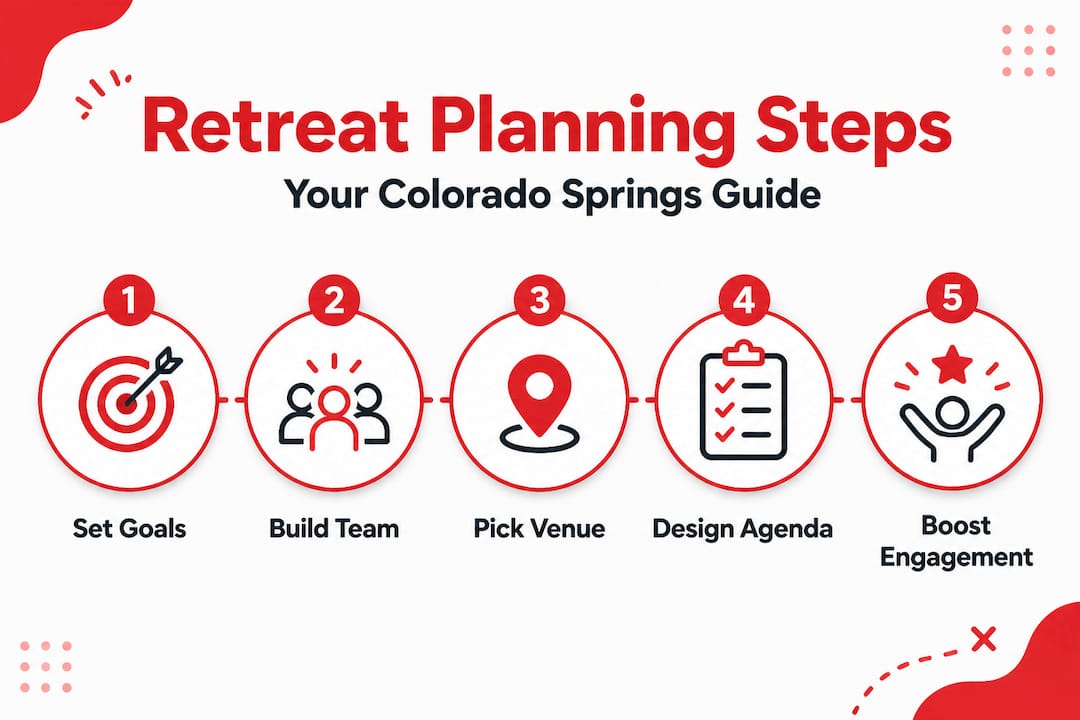
Prepare logistics and troubleshoot common challenges
Even a perfectly designed agenda collapses when logistics fall apart. A van showing up late, a dietary restriction that wasn’t communicated, or a venue double-booking can derail the entire experience before the first activity begins. Logistics planning deserves the same creative energy you give to the agenda itself.
“Clear roles and contingency plans keep the event running smoothly. Every vendor needs a single point of contact, and every activity needs a named backup plan in case something goes wrong.” — Local Colorado Springs event organizer
Your pre-retreat logistics checklist should include:
- Transportation: Confirm pickup times, routes, and backup options for every group, especially for multi-day retreats requiring airport transfers
- Meals and dietary needs: Collect dietary restrictions at registration, confirm with caterers at least one week in advance, and always have a vegetarian and allergen-free default option
- Supplies and equipment: Confirm that all activity materials, printed agendas, name tags, and presentation equipment are confirmed and tested before arrival day
- Accommodations: If team members are staying overnight, confirm room assignments and communicate check-in procedures well in advance
- Emergency contacts: Maintain a list of local emergency numbers, venue contacts, and medical facilities near your retreat location
Escape room logistical support is one advantage that often gets overlooked. Escape room operators frequently provide logistical support for group events, reducing planning complexity for corporate organizers who are already managing multiple moving parts.
Common mistakes to avoid:
- Over-scheduling: Filling every minute creates burnout and leaves no room for the organic conversations that build real relationships
- Unclear communication: Participants who don’t know what to wear, where to park, or what to bring show up stressed before anything has started
- Ignoring dietary restrictions: One team member who can’t eat the provided food becomes a visible reminder that the event wasn’t fully thought through
- Skipping the run-of-show document: This single-page timeline with named owners for every activity block prevents confusion on retreat day
Evaluate retreat impact and sustain momentum
The retreat ends, everyone returns to the office, and within two weeks it’s as if the event never happened. This is the most common failure mode in corporate retreat planning, and it’s entirely preventable with intentional follow-up.
Follow these steps to evaluate and build on your retreat outcomes:
- Distribute a feedback survey within 48 hours. Recency matters. Ask specific questions about which activities drove the most connection, what could have been cut, and whether participants feel the retreat met its stated objectives.
- Hold a leadership debrief within one week. Compare survey results against the original goals. Identify which activities produced measurable collaboration shifts and which ones filled time without purpose.
- Share a summary with the full team. Transparency builds trust. When employees see that their feedback was taken seriously and will influence future planning, they engage more honestly next time.
- Create a 30-60-90 day action plan. Identify two or three specific commitments that came out of the retreat and assign owners and deadlines. Abstract inspiration evaporates quickly without structured accountability.
Post-retreat team analysis is most effective when it ties activities back to observable behavior changes. Escape room facilitators help teams reflect on collaborative outcomes, which provides structured debrief material that supports post-retreat evaluation in your own workplace context.
Momentum-building strategies to implement after the retreat:
- Monthly follow-up check-ins: Brief 20-minute team conversations that reference retreat commitments keep the energy alive without requiring major time investment
- Peer recognition programs: Acknowledge team members who demonstrate behaviors that were reinforced during the retreat, connecting the experience to daily work culture
- New project launches: Channel the creative energy from brainstorming sessions into an actual initiative with a visible owner and timeline
- Rotating leadership roles: Give different team members ownership of weekly meetings or projects, continuing the leadership practice started during the retreat
- Activity callbacks: Reference specific retreat moments in team conversations to reinforce shared experience and sustained connection
What most corporate retreat guides miss: engagement is the real outcome
Here’s an uncomfortable truth that most retreat planning guides sidestep entirely: logistics are the floor, not the ceiling. You can nail transportation, catering, timing, and venue selection and still produce a retreat that leaves your team exactly as disconnected as when they arrived. The missing ingredient isn’t operational. It’s engagement.
Most retreats are designed around passive participation. Sit through a keynote. Watch a video. Complete a personality assessment. These formats have their place, but they produce information, not connection. Real collaboration happens when people are actively solving problems together, under mild pressure, with outcomes that feel genuinely uncertain.
This is exactly why escape rooms have become a serious corporate retreat tool rather than just a novelty add-on. When your team is locked in a themed room with 60 minutes on the clock and a puzzle that nobody can solve alone, the organizational chart disappears. The junior analyst who nobody listens to in meetings might be the one who cracks the key code. That moment of recognition builds a form of trust that no workshop can manufacture.
Escape room engagement strategies show that escape rooms are uniquely positioned to boost engagement beyond what traditional venues can offer. The reason is simple: the experience requires real-time communication, distributed problem-solving, and immediate feedback, which are exactly the skills you want your team to practice and carry back to work.
Pro Tip: Prioritize retreat elements that demand direct collaboration over those that merely suggest it. An activity where every person’s contribution is visibly necessary produces far stronger team bonds than one where individuals can coast through anonymously.
Engagement boosters worth prioritizing in any Colorado Springs corporate retreat:
- Hands-on problem solving: Activities where the outcome genuinely depends on team input, not individual expertise
- Real-time feedback loops: Experiences that immediately show the effect of each decision, teaching cause and effect in a low-stakes environment
- Rotating leadership roles: Structured moments where different people take the lead, building confidence and mutual respect across the team
- Debrief conversations tied to real work: Facilitated discussions that connect retreat experiences to actual workplace challenges your team faces
Take the next step: plan your team-building retreat with CodeBusters Escape Room
Planning a corporate retreat that actually moves the needle takes more than a venue and a schedule. You need experiences that create genuine connection, and that’s where CodeBusters Escape Room comes in.
As an award-winning, veteran and family owned business in Colorado Springs, CodeBusters offers a range of themed escape room experiences designed specifically for corporate groups. From the time-traveling puzzles of Past to the Future to the atmospheric challenges of Stranger 80’s and Flight of Deception, each room is built to push teams toward real collaboration under pressure. Private room bookings, flexible group scheduling, and hands-on logistical support make it straightforward to incorporate CodeBusters into your retreat agenda without adding planning stress. Explore your Colorado Springs retreat solutions and find out how easy it is to book an experience your team will actually talk about on Monday morning.
Frequently asked questions
What team-building activities are most effective for corporate retreats in Colorado Springs?
Escape rooms are among the most effective options because they require genuine collaboration to succeed. Immersive escape room experiences are frequently chosen by local businesses in Colorado Springs precisely because they generate the kind of active problem-solving that passive team-building formats can’t replicate.
How far in advance should you plan a retreat?
Planning at least three months ahead gives you enough runway for venue booking, agenda preparation, and logistics management. Working with providers who offer logistical support for groups can compress that timeline without sacrificing quality.
How do you measure the impact of a corporate retreat?
Post-retreat feedback surveys combined with structured team debriefs are the most reliable methods. Connecting what happened at the retreat to observable behavior changes at work gives you the clearest picture of actual impact. Collaborative outcome reflection facilitated by escape room operators can also generate strong debrief material for post-retreat evaluation.
What should be included on a corporate retreat checklist?
Start with venue confirmation, transportation logistics, meal arrangements with dietary accommodations, supplies, a detailed run-of-show document, and emergency contact information. Providers with group event support can often supply venue-specific logistics guidance that simplifies your checklist considerably.