How to solve escape room puzzles: expert tips for 2026
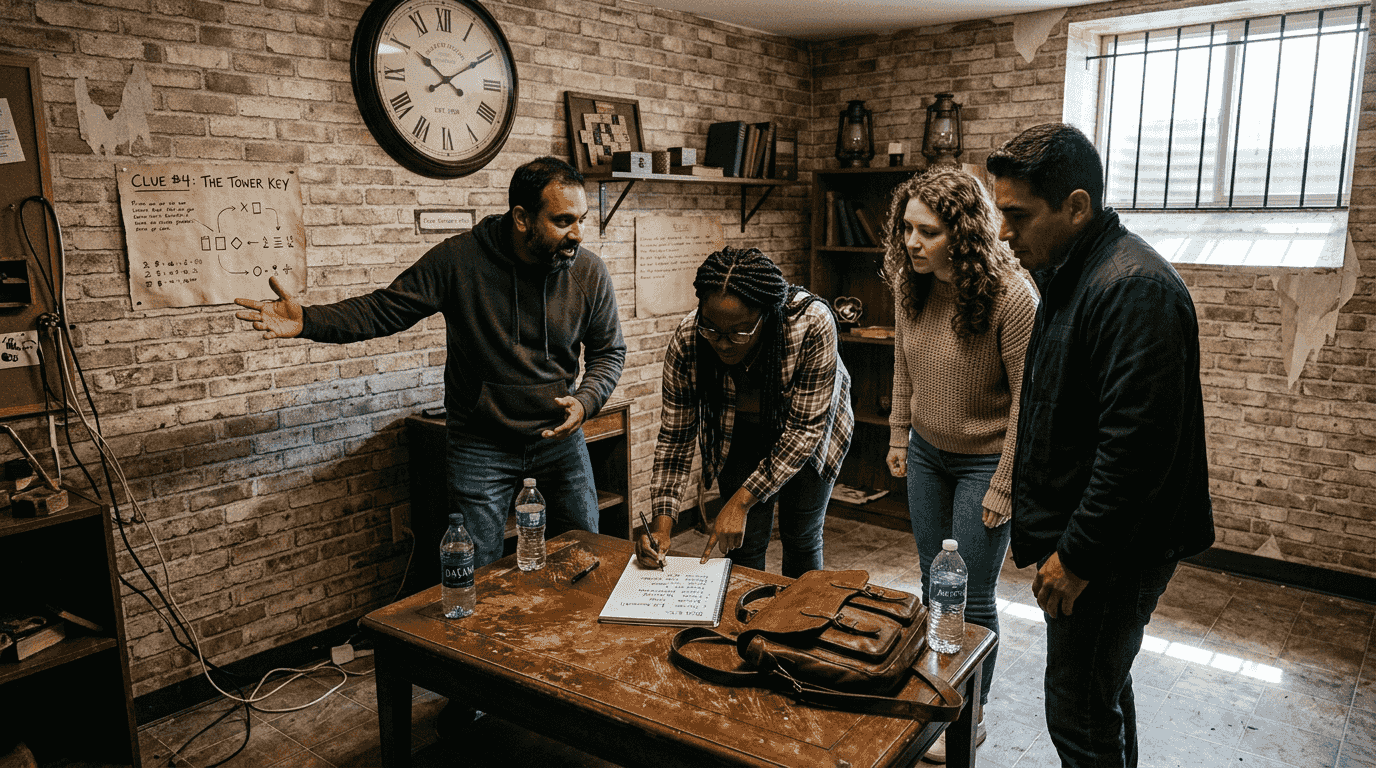
You’ve got 60 minutes on the clock, and your team is staring at a wall of cryptic symbols, mysterious locks, and scattered clues. Sound familiar? Escape rooms challenge even the sharpest minds, but success isn’t about luck or genius IQ. It’s about strategy, communication, and knowing how to approach each puzzle systematically. This guide equips you with proven techniques to decode puzzles faster, coordinate your team effectively, and escape before time runs out in 2026.
Table of Contents
- Preparing Your Team And Mindset For Escape Room Success
- Recognizing And Solving Common Escape Room Puzzle Types
- Time Management And Teamwork During Your Escape Room Challenge
- Learning From Japanese Escape Room Design To Elevate Your Gameplay
- Explore Immersive Escape Rooms At CodeBusters
- Frequently Asked Questions About Solving Escape Room Puzzles
Key takeaways
| Point | Details |
|---|---|
| Communication is critical | Effective escape room teams prioritize communication and organization to maximize efficiency and reduce escape times. |
| Puzzles use basic reasoning | Most escape room puzzles rely on basic reasoning skills rather than advanced knowledge or complex calculations. |
| Team roles boost performance | A balanced team should include an Analyst, a Creative, a Communicator, and an Organizer to cover all puzzle-solving angles. |
| Time management wins games | Using 5-minute check-ins and tracking solved items helps teams stay focused and avoid wasting precious minutes. |
Preparing your team and mindset for escape room success
Before you touch a single puzzle piece, your team needs a game plan. Walking into an escape room without defined roles is like starting a relay race without knowing who runs which leg. You’ll waste time, duplicate efforts, and miss obvious connections.
Start by assigning clear responsibilities based on natural strengths. A balanced team should include an Analyst, a Creative, a Communicator, and an Organizer. The Analyst tackles logic puzzles and patterns. The Creative thinks outside the box for unconventional solutions. The Communicator keeps everyone informed about discoveries and progress. The Organizer manages physical clues, tracks what’s been used, and maintains a mental inventory of unsolved items.
Once roles are set, conduct an initial room scan together. Spend your first two minutes walking the perimeter, noting locked containers, visible puzzles, and potential hiding spots. Don’t start solving yet. This overview prevents tunnel vision and helps you spot connections between different puzzle elements later.
Effective escape room teams prioritize communication and organization to maximize efficiency. Establish a simple protocol: when someone finds a clue, they announce it loudly and clearly. When a puzzle is solved, the team acknowledges it and moves the related items to a designated “used” pile. This prevents the common mistake of trying the same combination on multiple locks or overlooking a clue someone already discovered.
Create two physical zones in your workspace:
- Active clues: Items currently being worked on or awaiting solutions
- Used clues: Solved puzzles, opened locks, and exhausted materials
- Mysterious items: Objects with no clear purpose yet, kept visible for later connections
Pro Tip: Designate one team member as the “clue librarian” who maintains these zones and can quickly answer “Have we used this yet?” or “Where did we put that key?” This simple organization saves minutes of frantic searching.
Recognizing and solving common escape room puzzle types
Knowing what you’re looking at cuts your solving time in half. Common escape room puzzle types include Word Ciphers, Physical Manipulation, Logic Grids, Hidden Compartments, and Audio Cues. Each category has predictable patterns and solution approaches.
Most escape room puzzles rely on basic reasoning skills rather than advanced knowledge. You won’t need calculus or obscure historical facts. Instead, focus on observation, pattern matching, and simple logic.
Word ciphers transform letters or symbols into readable messages. Look for substitution patterns, number-to-letter conversions (A=1, B=2), or visual clues that suggest alphabetical ordering. If you see a series of numbers between 1 and 26, try converting them to letters immediately.
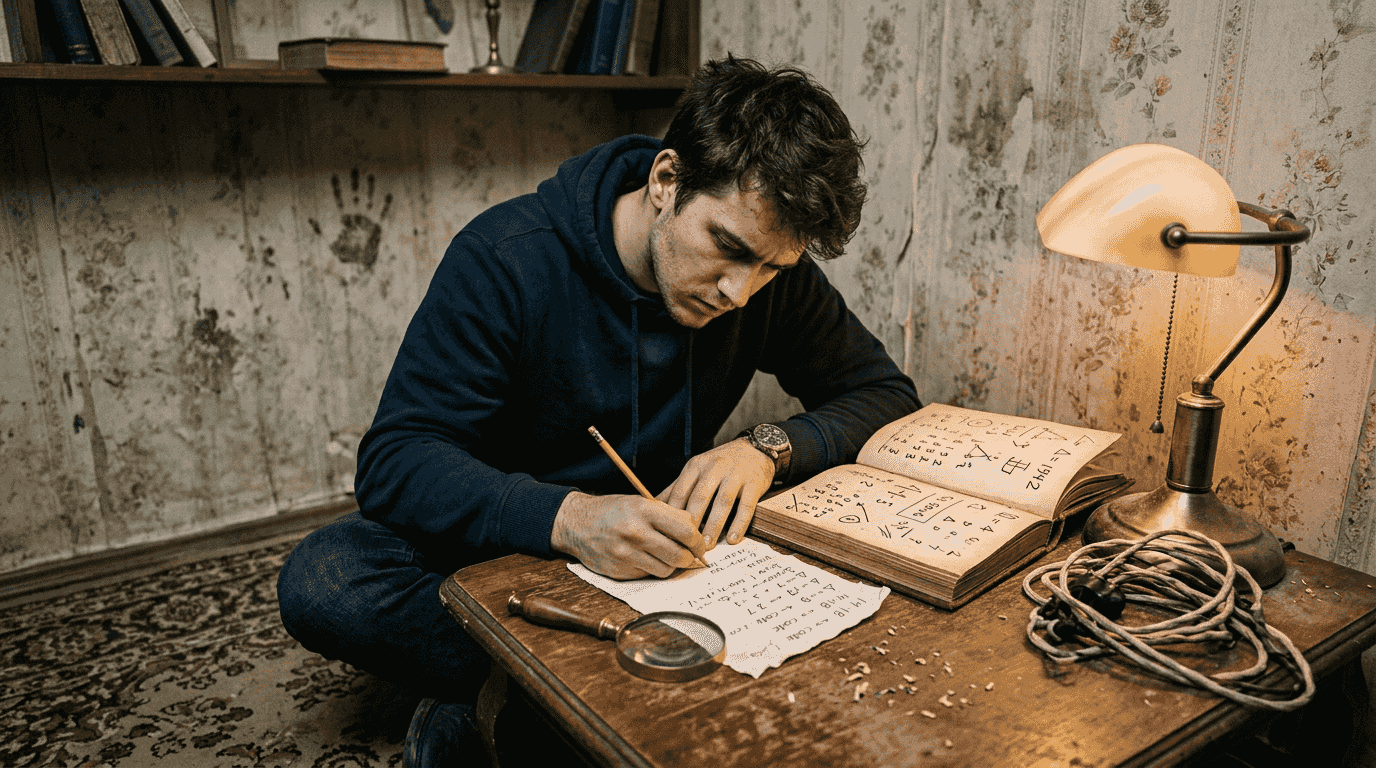
Physical manipulation puzzles require hands-on interaction. Rotate objects, align symbols, press buttons in sequence, or arrange items spatially. These puzzles reward tactile exploration. If something looks like it should move, twist, or open, try it. Just avoid forcing anything, genuine puzzles never require brute strength.
Logic grids and sequencing challenges present information that must be organized systematically. Create a simple chart or use process of elimination. If the puzzle states “The red key isn’t in box 3” and “Box 1 contains the blue key,” mark those facts and deduce the remaining options.
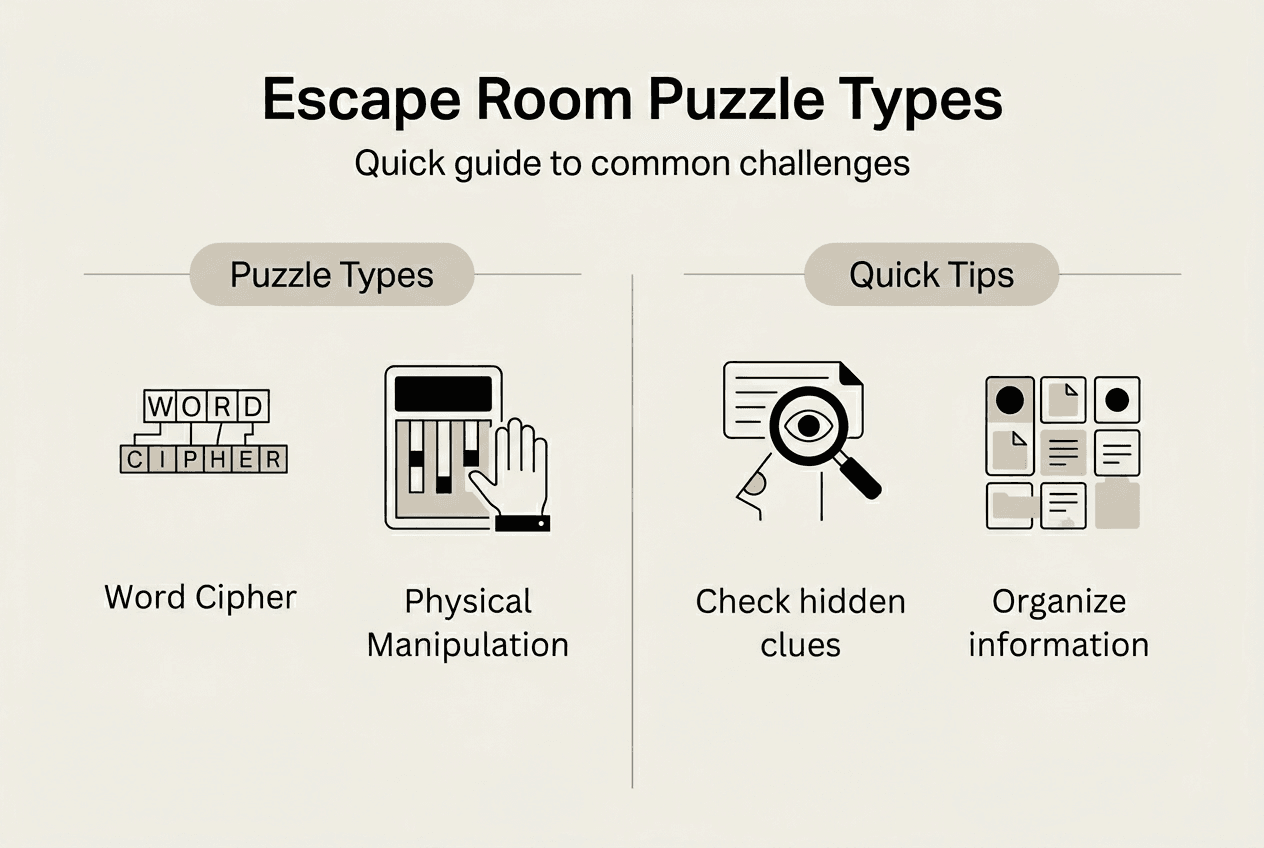
Hidden compartments test your observation skills. Check under furniture, inside books, behind paintings, and within decorative objects. UV flashlights reveal invisible ink. Mirrors might show reversed text. Magnifying glasses enlarge tiny print.
| Puzzle Type | Common Clue Format | Quick Solution Strategy |
|---|---|---|
| Word Cipher | Numbers, symbols, highlighted letters | Try number-to-letter conversion first, then look for substitution patterns |
| Physical Manipulation | Movable objects, alignable symbols | Rotate, arrange, or sequence items based on visual or tactile cues |
| Logic Grid | Statements, conditions, exclusions | Create a simple chart and use process of elimination |
| Hidden Compartment | UV marks, unusual objects, decorative items | Check all surfaces, use provided tools like flashlights |
| Audio Cues | Sounds, music, spoken words | Listen for patterns, counts, or specific words that match visual elements |
Audio puzzles embed clues in sounds, music, or spoken dialogue. Count beats, listen for repeated words, or match audio sequences to visual symbols. If you hear morse code, someone on your team likely has a reference sheet nearby.
Pro Tip: When stuck, match your clue format to the lock type. A four-digit code probably needs numbers from the room. A directional lock (up, down, left, right) likely connects to arrows or a map. A color sequence matches colored objects. This simple matching eliminates impossible solutions instantly.
Time management and teamwork during your escape room challenge
The clock is your biggest opponent. Without structure, teams waste 15-20 minutes on dead ends or redundant efforts. Time management strategies include setting 5-minute check-ins, keeping a visible list of solved and unsolved items, and using the last 10 minutes for a rapid sweep.
Implement these coordination techniques:
- Set 5-minute check-ins where everyone pauses and shares progress. This prevents individuals from silently struggling while others could help.
- Maintain a visible status board (mental or physical) listing all locks, puzzles, and their current state: unsolved, in progress, or complete.
- Rotate team members between puzzles every 10 minutes if progress stalls. Fresh eyes catch details the original solver missed.
- Delegate based on puzzle type and team strengths. Send your Creative to the abstract visual puzzle while your Analyst tackles the number sequence.
- Use the final 10 minutes for a systematic room sweep. Check every corner, re-examine “used” clues for secondary purposes, and try unused items on remaining locks.
Avoid these common time wasters. Don’t let one person monopolize a puzzle for more than 5 minutes without progress. Don’t ignore the Communicator when they announce a discovery. Don’t assume a clue has only one use; many items serve multiple puzzles. Don’t forget to actually try solutions; teams often solve puzzles mentally but forget to test the answer.
When you hit a wall, step back physically. Walk to the opposite side of the room and look at the puzzle from a distance. This perspective shift triggers new connections. Talk through your reasoning out loud. Explaining your thought process to teammates often reveals the flaw in your logic.
Pro Tip: In the last 10 minutes, assign one person to be the “hint requester.” Most escape rooms offer clues, and using one or two hints strategically beats running out of time completely. A well-timed hint on a stuck puzzle frees your team to finish the remaining challenges.
Learning from Japanese escape room design to elevate your gameplay
Want to level up your puzzle intuition? Study how Japanese escape rooms prioritize puzzle design over elaborate set design, leading to deeper gameplay experiences. These rooms strip away theatrical distractions and focus purely on the intellectual challenge and narrative integration.
Japanese escape rooms often integrate narrative directly into the puzzles. Instead of puzzles feeling like arbitrary obstacles, they reveal story elements as you solve them. A decoded message doesn’t just give you a number; it tells you why the room is locked or what happened to the character you’re helping.
This design philosophy teaches a valuable lesson: treat every puzzle as a story beat. Ask yourself, “What is this puzzle trying to tell me about the room’s narrative?” A puzzle involving photographs might reveal character relationships. A timeline puzzle could expose the sequence of events that led to the current situation. When you view puzzles as narrative devices, you start noticing thematic connections that lead to solutions.
Japanese rooms also emphasize the “aha moment” as a performance element. Puzzles are crafted to create that sudden flash of insight where everything clicks. To cultivate this experience, resist the urge to brute-force solutions. Instead, gather all related clues, lay them out visually, and let your brain make connections naturally. The satisfaction of genuine discovery beats randomly trying combinations.
Apply this mindset by looking for story logic in every room. If you’re in a detective’s office, clues will follow investigative reasoning. In a wizard’s tower, expect magical symbolism and mystical patterns. In a spy thriller, anticipate codes and surveillance themes. The room’s narrative framework guides the puzzle logic.
“The brilliance of Japanese puzzle culture lies in making the solver feel like a protagonist discovering truth, not a contestant racing against time.”
This approach transforms your escape room experience from a frantic race into an engaging story you actively uncover. You’ll solve puzzles faster because you’re thinking like the designer, not just randomly testing options.
Explore immersive escape rooms at CodeBusters
Ready to put these strategies into action? CodeBusters escape rooms in Colorado Springs offers meticulously crafted experiences where your new skills will shine. Each themed room, from time-traveling adventures to mysterious investigations, challenges you with the exact puzzle types covered in this guide.

Apply your team coordination techniques, pattern recognition skills, and time management strategies in a real environment. Whether you’re a puzzle enthusiast sharpening your abilities or a team looking for an engaging challenge, CodeBusters provides the perfect testing ground. The veteran and family-owned business designs rooms with both beginners and experienced players in mind, ensuring everyone gets that satisfying “aha moment” while racing the clock. Book your escape room adventure today and experience how preparation and strategy turn puzzle-solving from frustrating to exhilarating.
Frequently asked questions about solving escape room puzzles
How important is communication in escape rooms?
Communication is absolutely essential for escape room success. Teams that verbally share every clue discovery, puzzle solution, and dead end finish significantly faster than silent groups. Establish a protocol where players announce findings immediately and confirm when others have heard the information.
Can you use hints without ruining the experience?
Using hints strategically enhances rather than diminishes your experience. A well-timed clue on a puzzle where you’ve exhausted logical options keeps momentum going and prevents frustration from overshadowing fun. Most rooms offer 2-3 hints, save them for genuine roadblocks, not minor challenges.
What if I get stuck on a puzzle for too long?
Step away from the puzzle after 5 minutes without progress and let a teammate try fresh. Often you’ve overlooked something obvious that someone else will spot immediately. Use this rotation strategy to prevent tunnel vision and keep the team’s energy distributed across multiple challenges.
Do I need special knowledge to solve puzzles?
No, escape rooms are designed for general audiences without specialized expertise. Puzzles rely on observation, pattern recognition, and basic logic rather than advanced mathematics, obscure history, or technical knowledge. If a puzzle seems to require expert information, you’re probably overthinking the solution.
How to manage time when puzzles are challenging?
Implement 5-minute team check-ins to reassess priorities and redistribute effort. Keep a visible mental or physical list of unsolved items to prevent wasting time on completed puzzles. Reserve your final 10 minutes for a rapid room sweep to catch any missed clues or untried combinations.