How to solve escape puzzles: proven strategies for 2026
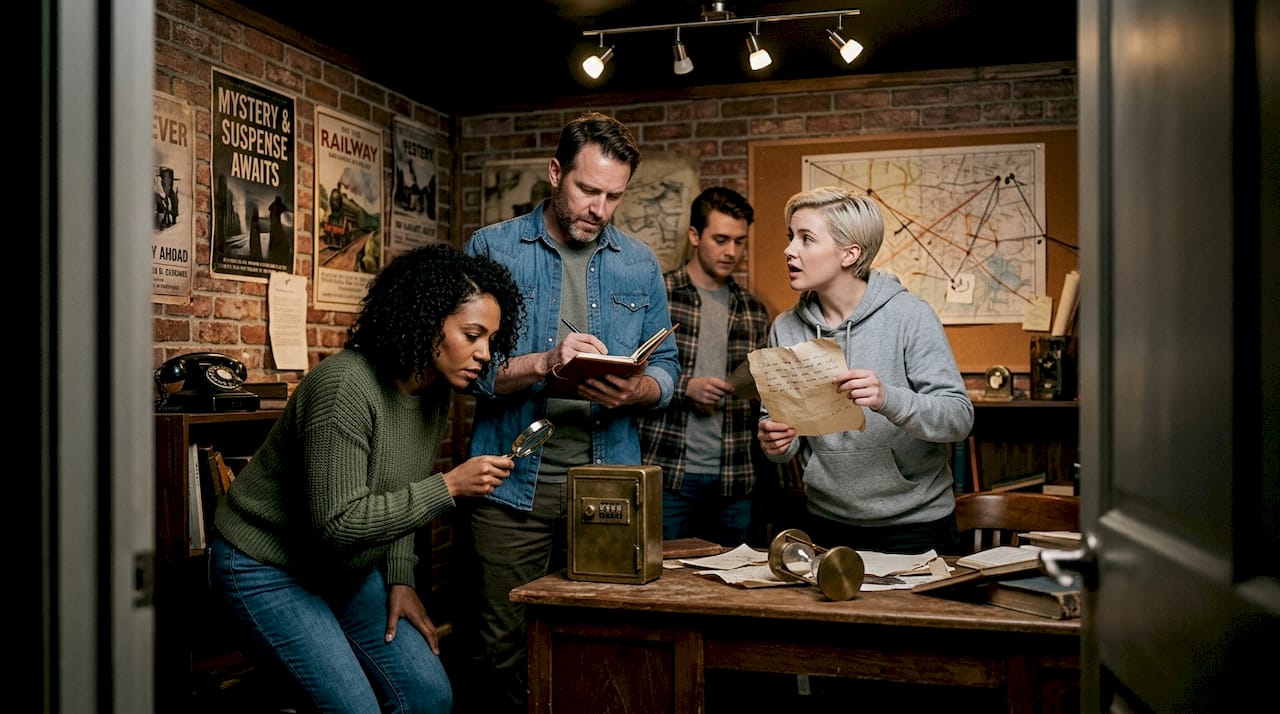
Escape rooms challenge players with diverse puzzles that can overwhelm even experienced groups. Without proper preparation and teamwork, many participants struggle to escape within the time limit. This guide provides proven strategies to tackle escape puzzles effectively, from understanding common puzzle types to executing solutions as a cohesive team. You’ll discover how to prepare mentally, communicate efficiently, avoid common mistakes, and maximize your success rate while enjoying every moment of the immersive experience.
Table of Contents
- Understanding Escape Room Puzzles And Essential Preparation
- Step By Step Execution: Strategies To Tackle Puzzles Effectively
- Common Pitfalls And Troubleshooting For Escape Puzzles
- Expected Outcomes And How To Maximize Your Escape Room Experience
- Discover Immersive Escape Rooms At CodeBusters In Colorado Springs
- FAQ
Key takeaways
| Point | Details |
|---|---|
| Diverse puzzle types | Escape rooms feature logic, cipher, pattern recognition, riddles, hidden objects, team coordination, and technology puzzles requiring varied approaches. |
| Teamwork drives success | Effective communication and role assignment boost escape rates by up to 30% and 15% respectively. |
| Strategic hint usage | Using hints when genuinely stuck increases success by 40% without diminishing the challenge. |
| Preparation matters | Practicing puzzles online and understanding common designs improves readiness and confidence. |
| Verification prevents errors | Double checking solutions before moving forward saves time and maintains progress momentum. |
Understanding escape room puzzles and essential preparation
Escape rooms present players with diverse puzzle categories including cipher, logic, pattern recognition, riddles, hidden objects, team coordination, and technology challenges. Each category demands different cognitive skills, from spatial reasoning to linguistic decoding. Understanding these puzzle types before your game helps you formulate effective strategies and assign roles based on team strengths.
Mental preparation starts with researching the escape room’s theme and reviewing common puzzle mechanics online. Many websites offer practice puzzles that simulate real escape room challenges. Spend 20 minutes practicing logic grids or cipher decoding to sharpen your skills. This preparation builds confidence and reduces the learning curve during the actual game.
Immersing yourself in the game’s narrative context helps spot thematic clues others might miss. A 1980s themed room might hide codes in song lyrics or movie references from that era. Read the room description carefully before entering and discuss potential connections with your team. This contextual awareness transforms random objects into meaningful puzzle pieces.
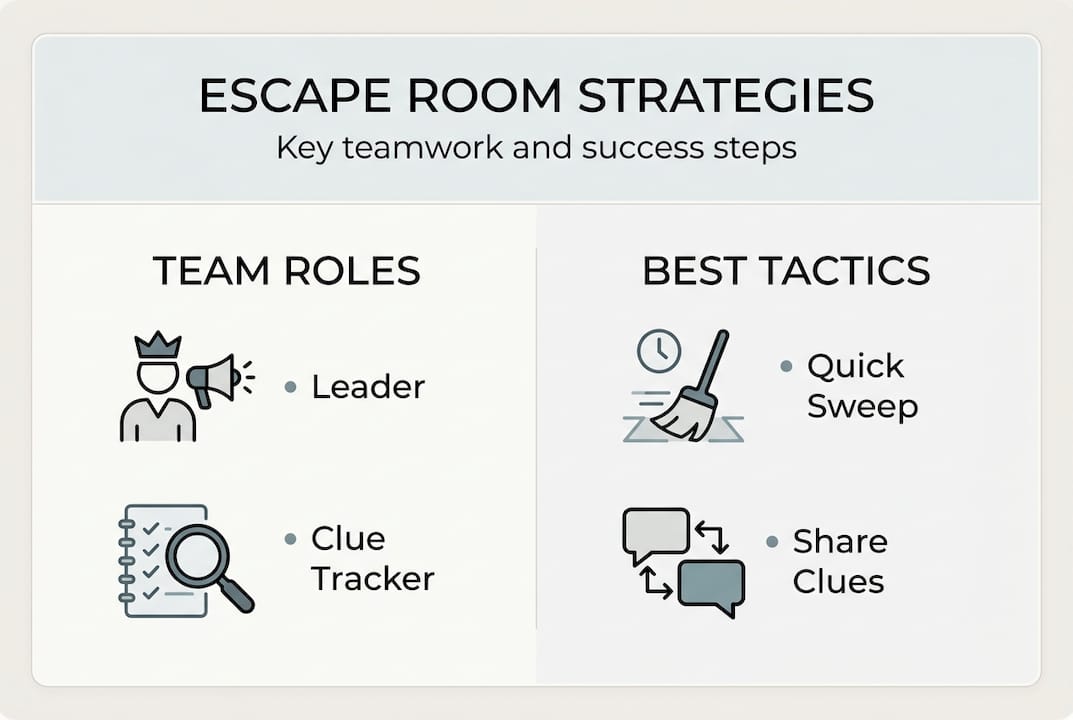
Teamwork planning should happen before the clock starts. Assign roles based on individual strengths: designate someone to organize discovered clues, another to communicate findings, and others to search specific areas. Clear role definition prevents duplicate efforts and ensures comprehensive coverage of the space.
Pro Tip: Arrive 15 minutes early to discuss team strengths and weaknesses, allowing you to assign roles strategically before entering the room.
Common escape room puzzle categories:
- Cipher puzzles requiring code breaking and pattern recognition
- Logic puzzles demanding sequential reasoning and deduction
- Physical puzzles involving manipulation of objects or mechanisms
- Riddles testing lateral thinking and wordplay comprehension
- Hidden object challenges requiring thorough environmental searching
- Team coordination tasks needing simultaneous actions or communication
| Puzzle Type | Primary Skill Required | Difficulty Level |
|---|---|---|
| Cipher decoding | Pattern recognition | Medium |
| Logic grids | Sequential reasoning | Medium to High |
| Hidden objects | Observation and attention to detail | Low to Medium |
| Riddles | Lateral thinking | Medium |
| Team coordination | Communication and timing | High |
Visit CodeBusters Escape Room to explore themed rooms that incorporate these diverse puzzle types, offering challenges suitable for beginners through advanced players.
Step by step execution: strategies to tackle puzzles effectively
Successful puzzle solving during the game requires systematic execution and constant team communication. Role assignment boosts success by 15%, good communication by 30%, and strategic hint usage by 40%. These statistics demonstrate that methodical teamwork outperforms individual brilliance every time.
Start by conducting a rapid initial sweep of the entire room. Spend the first three minutes identifying all visible elements without attempting to solve anything. Call out discoveries to your team: locked boxes, unusual decorations, written clues, or mechanical devices. This comprehensive overview prevents tunnel vision and reveals connections between distant elements.
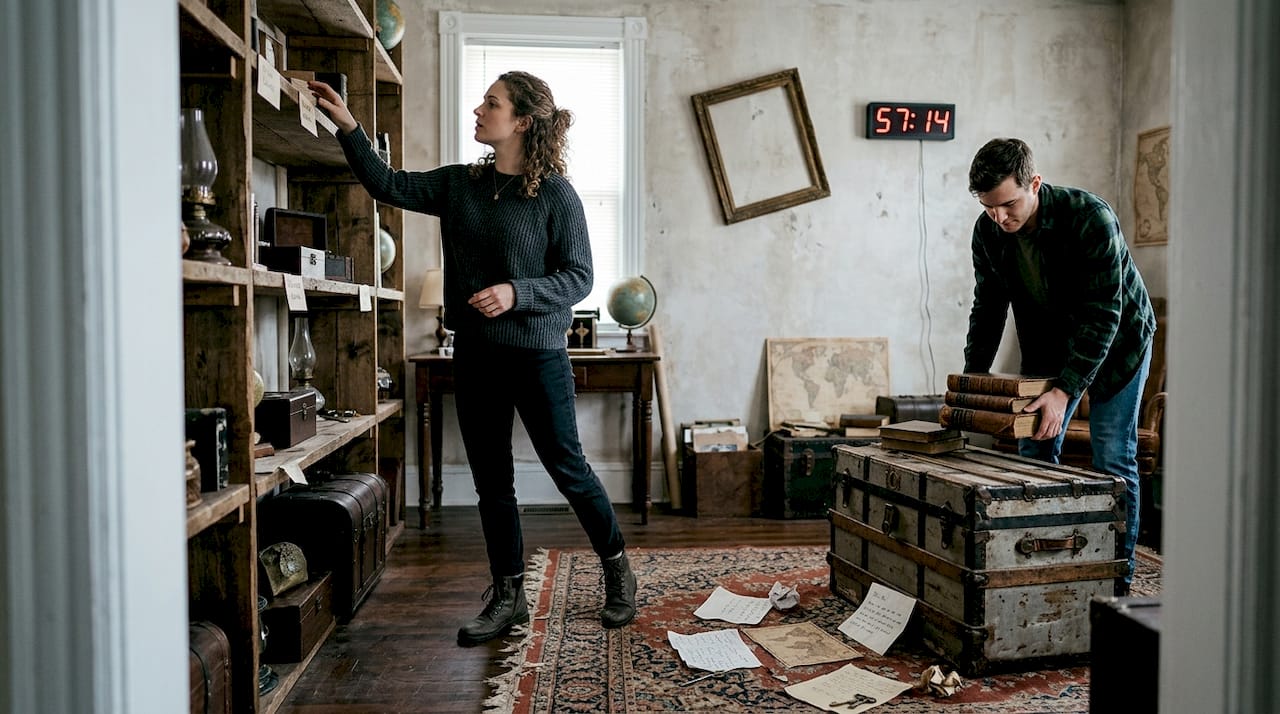
Maintain continuous verbal communication throughout the experience. When you find a clue, announce it immediately and describe it clearly. If you’re working on a puzzle, verbalize your thought process so teammates can contribute ideas or spot errors. Silence kills progress because it prevents collaborative problem solving and wastes your collective brainpower.
Organize discovered items in a central location where everyone can access them. Designate one person as the clue manager who tracks what’s been found and what remains unsolved. This prevents the common mistake of losing track of important elements or forgetting about clues discovered early in the game.
When facing a complex puzzle, break it into smaller components. A locked box with four dials might require four separate clues. Identify what information you need, then systematically search for those specific elements. This targeted approach proves more efficient than random trial and error.
Pro Tip: If your team gets stuck on a puzzle for more than five minutes with no progress, shift focus to a different challenge and return later with fresh perspective.
Systematic puzzle solving steps:
- Identify the puzzle type and required solution format (number code, word, physical action)
- Gather all potentially relevant clues from the room
- Test initial theories quickly without overthinking
- Communicate findings and partial solutions to the team
- Request a hint if stuck for more than seven minutes
- Verify the solution works before moving to the next challenge
Use hints strategically when genuine progress has stalled. Most escape rooms offer three hints, so don’t waste them on puzzles you’re close to solving. Save hints for moments when your team has exhausted all logical approaches and time is running short. A well timed hint can unlock an entire sequence of subsequent puzzles.
Explore proven teamwork strategies that enhance communication and role coordination during high pressure escape room scenarios.
Common pitfalls and troubleshooting for escape puzzles
Overthinking simple puzzles wastes precious minutes and creates unnecessary frustration. Puzzles are designed to be fair and solvable with observation and basic logic, where teamwork matters more than individual brilliance. If a solution seems impossibly complex, step back and look for simpler interpretations of the available clues.
Ignoring obvious clues represents another frequent mistake. Players often dismiss items that seem too simple or obvious, assuming escape rooms only contain elaborate puzzles. Check everything: books, pictures, furniture, decorations. The most straightforward object might hold the key to your next breakthrough.
Poor communication creates duplicate efforts and missed connections. When team members work in isolation, they might solve the same puzzle twice while ignoring others entirely. Establish a rhythm of constant updates: “I’m checking this bookshelf,” “I found a four digit code,” “This lock needs a key, not a combination.”
“Escape room design follows fundamental principles ensuring every puzzle has a logical solution discoverable through careful observation and teamwork. Nothing requires outside knowledge or impossible leaps of logic.”
Verify solutions before celebrating and moving forward. Test each code or key immediately after discovering it. If a lock doesn’t open, recheck your logic rather than assuming the mechanism is broken. Escape room equipment is tested regularly, so user error is far more likely than equipment failure.
Avoid fixation on a single puzzle when progress stalls. If you’ve spent eight minutes on one challenge without advancement, delegate it to a different team member and shift your attention elsewhere. Fresh eyes often spot solutions that eluded the original solver. This rotation keeps everyone engaged and prevents bottlenecks.
Common mistakes to avoid:
- Overthinking puzzles and ignoring simple, obvious solutions
- Working in silence without sharing discoveries or theories
- Fixating on one puzzle instead of rotating when stuck
- Failing to verify solutions before assuming correctness
- Ignoring the room’s theme and narrative context
- Rushing through clues without careful observation
| Mistake | Impact | Solution |
|---|---|---|
| Overthinking | Wastes 10+ minutes per puzzle | Look for simplest logical explanation first |
| Poor communication | Reduces success rate by 30% | Verbalize all discoveries and theories |
| Fixation | Creates bottlenecks | Rotate puzzles every 5 minutes if stuck |
| Skipping verification | Causes backtracking later | Test every solution immediately |
Keep a mental or physical checklist of solved versus unsolved puzzles. This tracking prevents confusion about which challenges remain and helps identify patterns connecting multiple elements. When you solve a puzzle, announce it clearly so everyone updates their mental model of remaining tasks.
Learn from common mistakes other players make and discover professional tips for maintaining momentum throughout your escape room experience.
Expected outcomes and how to maximize your escape room experience
Success rates vary significantly by difficulty level: beginner players escape 70% of the time while advanced rooms see 30 to 40% success rates. Understanding these statistics helps set realistic expectations and reduces pressure to escape at all costs. The goal is enjoying the challenge and bonding with your team, not just beating the clock.
Using hints effectively can dramatically improve your escape chances without diminishing satisfaction. Most game masters provide hints that nudge you toward the solution without revealing it completely. When you request help, listen carefully and discuss the hint’s implications with your team before acting. This collaborative interpretation maintains the challenge while preventing extended frustration.
Focus on team communication and collaborative problem solving rather than individual heroics. The most successful groups treat escape rooms as team building exercises where everyone contributes unique perspectives. Celebrate small victories together: finding a hidden compartment, cracking a cipher, or making an unexpected connection between clues.
Pro Tip: Schedule a 10 minute debrief after the game to discuss what worked, what didn’t, and how to improve for your next escape room adventure.
Remember that escaping isn’t the only measure of success. Many players report that their most memorable experiences came from rooms they didn’t escape because the puzzles were exceptionally clever or the narrative was deeply engaging. Appreciate the creativity and effort that went into designing the experience, regardless of whether you beat the timer.
| Experience Level | Average Success Rate | Recommended Approach |
|---|---|---|
| First time players | 60 to 70% | Choose beginner difficulty, use hints liberally |
| Intermediate players | 50 to 60% | Try medium difficulty, use 1 to 2 hints |
| Advanced players | 30 to 40% | Challenge yourself with hard rooms, minimize hints |
| Expert teams | 25 to 35% | Attempt expert level, no hints for maximum challenge |
Plan your next escape room experience to build on lessons learned. If your team struggled with cipher puzzles, practice those skills online before your next game. If communication broke down, discuss specific strategies for maintaining constant updates. This continuous improvement approach transforms escape rooms from one time entertainment into an evolving skill development activity.
Maximizing enjoyment and learning:
- Set realistic expectations based on difficulty level and experience
- Celebrate discoveries and breakthroughs, not just escaping
- Use hints to maintain momentum and prevent frustration
- Debrief after the game to identify improvement areas
- Book progressively challenging rooms to develop skills
- Focus on team bonding and shared experience
Apply these strategies during your next visit to discover how preparation, execution, and teamwork transform your escape room success rate and overall enjoyment.
Discover immersive escape rooms at CodeBusters in Colorado Springs
Ready to put these proven strategies into practice? CodeBusters Escape Room in Colorado Springs offers themed experiences designed for all skill levels, from beginners testing their first puzzle solving skills to advanced teams seeking ultimate challenges. Each room features carefully crafted puzzles that reward observation, teamwork, and creative thinking.

Our professional staff ensures every group enjoys a safe, immersive experience where your newly learned strategies can shine. Whether you’re planning a family outing, corporate team building event, or friends’ night out, our diverse room themes provide fresh challenges that keep you coming back. Book your escape room experience today and discover why CodeBusters maintains award winning status among Colorado Springs entertainment venues. Visit CodeBusters to explore our themed rooms, check availability, and secure your preferred time slot for an unforgettable adventure.
FAQ
What types of puzzles are most common in escape rooms?
Common puzzle types include logic puzzles, riddles, hidden objects, cipher puzzles, and team coordination challenges. Each category tests different cognitive skills, from pattern recognition to spatial reasoning. Most escape rooms combine multiple puzzle types to create varied, engaging experiences that prevent monotony and appeal to diverse player strengths.
How does teamwork impact escape room success?
Teamwork and communication improve success rates by up to 30%, and role assignment adds another 15%. Groups that maintain constant verbal communication, share discoveries immediately, and assign tasks based on individual strengths consistently outperform teams of silent individual workers. Collaborative problem solving allows multiple perspectives to tackle each puzzle, dramatically increasing the chances of finding solutions quickly.
When should you use hints during an escape room?
Using hints boosts success by 40% when used strategically to avoid excessive delays. Request a hint after your team has genuinely exhausted all logical approaches to a puzzle, typically after five to seven minutes of zero progress. Save your limited hints for moments when time pressure is mounting and a single nudge could unlock an entire sequence of subsequent puzzles.
How can you prepare before your first escape room experience?
Practicing with online escape room simulations and learning puzzle types improves readiness significantly. Spend time reviewing common cipher techniques, logic puzzle formats, and pattern recognition exercises. Research your chosen room’s theme to understand potential contextual clues. Discuss team roles and communication strategies before entering to establish clear expectations and maximize your limited game time.