How to Organize a Friends Outing Everyone Will Love

Organizing a friends outing means making clear decisions about timing, budget, activities, and communication before anyone shows up at the wrong place at the wrong time. The difference between a forgettable afternoon and a genuinely memorable group experience comes down to three things: a confirmed date, a shared budget ceiling, and an activity that works for everyone in the group. Tools like Doodle, When2meet, and Splitwise exist specifically to remove the friction from group coordination. Skip the open-ended “what does everyone want to do?” conversation and replace it with a concrete plan from the start.
How to organize a friends outing: start with the date
Locking in a date is the single most important step when planning a friends outing. Without a confirmed date, every other decision stalls.
The biggest mistake groups make is waiting for 100% availability. That number almost never happens. Instead, aim for 70–80% attendance and accept that some people will miss out. That standard keeps planning moving without holding the whole group hostage to one person’s schedule.
Use a scheduling tool to gather availability fast. Doodle and When2meet both let you propose multiple date options and collect responses in one place. Neither requires everyone to download an app or create an account, which removes a real barrier for less tech-forward friends.
Here is a step-by-step approach to nailing the date:
- Propose 3–4 specific date options rather than asking “when is everyone free?” Specific options generate real answers.
- Set a 48–72 hour response deadline. A strict response window prevents the coordination loop from dragging on for two weeks.
- Pick the date with the most votes once the deadline passes. Do not reopen the poll.
- Send a calendar hold immediately after announcing the date. A Google Calendar invite or even a simple text reminder locks it in people’s minds.
- Send a confirmation message 48 hours before the outing to reduce no-shows and last-minute confusion.
Pro Tip: Lock the date at least two weeks out. Groups that try to plan within a week consistently see lower turnout and more last-minute cancellations.
How to set a budget that nobody feels awkward about
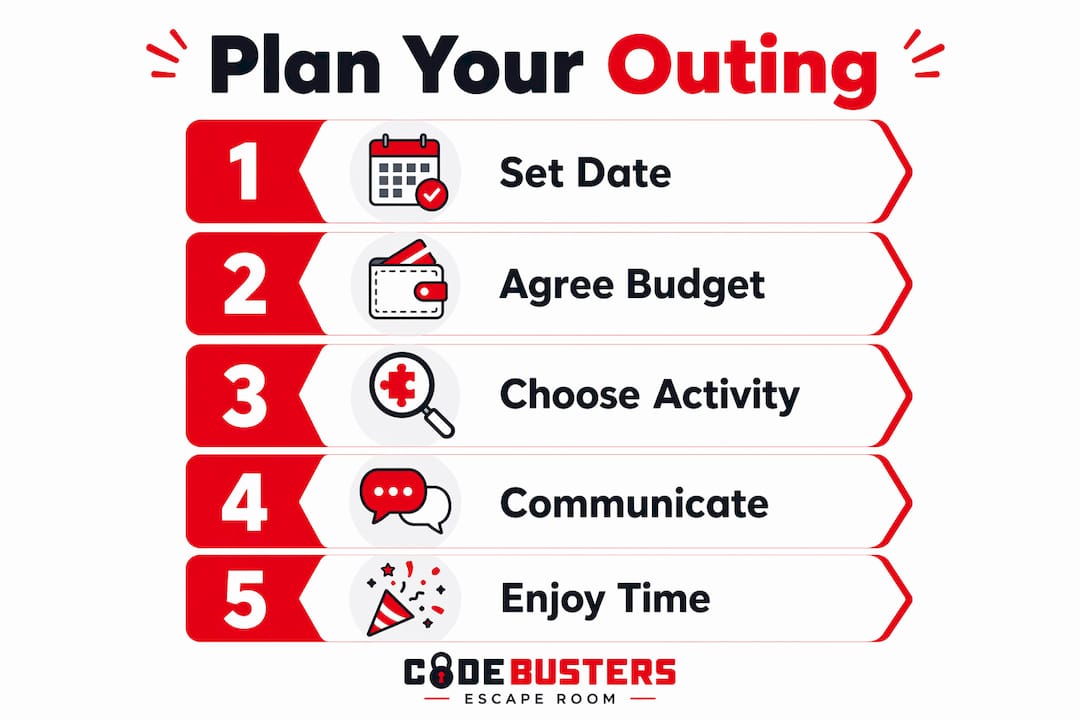
Budget conversations feel uncomfortable only when they happen too late. Bring the money discussion up first, not after you have already booked a venue.
The goal is to establish a maximum comfortable spend per person that covers everything: the activity, food, drinks, and transportation. Setting this ceiling early prevents the situation where one person assumes the outing costs $20 and another assumes it costs $80.
Here is what to include in your per-person budget estimate:
- Activity cost: Entry fees, tickets, or booking deposits
- Food and drinks: Whether that is a full dinner or just snacks
- Transportation: Gas split, rideshare costs, or parking fees
- Buffer amount: A small cushion (roughly 10%) for unexpected costs
Apps like Splitwise track shared expenses in real time and calculate who owes what at the end of the night. Monzo Pots works well for groups who want to pool money upfront. Both tools remove the awkwardness of chasing people for cash after the fact.
Transparent budget communication is the primary factor that prevents financial stress during group outings. When everyone knows the number upfront, people can opt in or out without pressure or embarrassment.
Pro Tip: Always give people a graceful exit. Say “we’re targeting $40 per person, let me know if that works for you” rather than announcing a price and assuming everyone is in.
What activities actually work for mixed friend groups?
The best group activities share one quality: skill gaps do not ruin the experience. Bowling, karaoke, and escape rooms all fit this standard. Nobody gets left out because they are not athletic or competitive enough.

Activities where skill differences don’t affect enjoyment keep the whole group engaged and prevent the quiet alienation that happens when one person dominates and everyone else watches. That is the core reason escape rooms work so well for friend groups. Everyone contributes differently, whether through puzzle solving, pattern recognition, or just moral support.
Here is a quick comparison of popular group outing options:
| Activity | Skill barrier | Group interaction | Typical cost per person |
|---|---|---|---|
| Escape room | Low | High | $25–$40 |
| Bowling | Low | Medium | $15–$25 |
| Karaoke | Low | High | $10–$20 |
| Axe throwing | Low | Medium | $25–$35 |
| Trivia night | Low | High | $5–$15 |
Escape rooms stand out because they force collaboration in a way that bowling and karaoke do not. Everyone is locked in the same space working toward the same goal. That shared pressure creates genuine bonding moments. If you want a deeper look at how to pick the right room for your group, the escape room selection guide at Codebustersescaperoom covers exactly that.
Apply the 70/30 planning rule when building your outing schedule. Plan roughly 70% of the time with a structured activity and leave 30% open for spontaneous conversation, extra drinks, or a walk. That unstructured time is often where the best memories actually happen.
What to avoid: Open-ended activity suggestions like “we could do anything, what does everyone think?” These questions create decision paralysis. Instead, propose specific options such as “escape room at 6 PM Saturday or bowling at 7 PM Saturday, which works better?” That framing gets real answers fast.
How to handle group communication without losing your mind
Group coordination falls apart when information lives in too many places. Fix that with one dedicated group chat used only for outing logistics.
Here is a step-by-step communication plan that keeps things organized:
- Create a dedicated group chat the moment the date is confirmed. Name it something specific like “Saturday Outing” so it does not get buried.
- Use polls inside the chat for any remaining decisions (restaurant choice, meeting point, carpool arrangements). Polls cut down on back-and-forth replies that go nowhere.
- Share one logistics message with the full details: venue name, address, parking info, dress code if relevant, and the exact start time.
- Build in buffer time. If you want everyone there by 6 PM, tell people 5:45 PM. Groups almost always run late.
- Prepare a backup plan before the day arrives. If the venue cancels or the weather turns, you need an alternative ready. Having a backup option keeps group energy positive instead of letting one problem derail the whole day.
Three to four hours is the ideal outing length for most friend groups. That window is long enough for meaningful connection but short enough that nobody checks their phone waiting for it to end.
Designating one organizer to drive the planning process is the single most effective way to keep momentum. Committees slow everything down. One person makes the calls, sends the updates, and follows up. Rotate the role to a different friend next time so the burden does not always fall on the same person.
Pro Tip: Send a “day-of” message the morning of the outing with the meeting time, location, and one reminder about parking or transport. This alone cuts down on “wait, where are we going?” texts by half.
Key takeaways
Successful friend group outings require one clear organizer, a confirmed date, a shared budget ceiling, and an activity where everyone can participate equally.
| Point | Details |
|---|---|
| Lock the date first | Use Doodle or When2meet with a 48–72 hour deadline and aim for 70–80% attendance. |
| Set a budget ceiling early | Name a per-person maximum upfront and use Splitwise to track shared costs transparently. |
| Choose low-barrier activities | Escape rooms, bowling, and karaoke keep everyone engaged regardless of skill level. |
| Apply the 70/30 rule | Plan 70% structured activity time and leave 30% open for spontaneous moments. |
| Designate one organizer | One point person makes decisions faster and keeps the group on track. |
What I have learned from organizing group outings
After running escape room experiences for hundreds of friend groups at Codebustersescaperoom, I have watched the same pattern play out repeatedly. The outings that go sideways almost never fail because of a bad venue or a boring activity. They fail because nobody took clear ownership of the plan.
The groups that show up energized and ready have one thing in common: someone made a decision and communicated it clearly. They did not ask “what does everyone want?” They said “here is the plan, here is the cost, here is the time, let me know if you are in.” That confidence removes anxiety from the group and replaces it with anticipation.
Budget transparency is the other thing most organizers get wrong. People feel awkward opting out of something that costs more than they expected, so they say yes and then resent it. Naming the number early gives everyone a clean choice. The outing becomes more fun because everyone who shows up actually wanted to be there at that price point.
The activity choice matters less than people think, as long as it passes the inclusion test. I have seen groups have a better time at a $15 bowling alley than at a $60 dinner because the bowling alley forced interaction. Pick something where everyone has a role to play, and the conversation takes care of itself.
— CodeBusters
Plan your next outing at Codebustersescaperoom
Codebustersescaperoom in Colorado Springs offers themed escape rooms designed specifically for friend groups who want more than just a night out. Rooms like “Stranger 80’s,” “Past to the Future,” and “Flight of Deception” are built for groups of different sizes and give everyone a role in solving the puzzle. Private room bookings mean your group gets the full experience without strangers. Codebustersescaperoom is veteran and family owned, award-winning, and consistently rated as one of the top group activities in Colorado Springs. Check out how group escape rooms build connection and book your group’s room today.
FAQ
How far in advance should I plan a friends outing?
Plan at least two weeks ahead for groups of six or more. This gives enough time to confirm availability, set a budget, and book venues without rushing.
What is the best tool for scheduling a group outing?
Doodle and When2meet are the most practical tools for coordinating group availability. Both allow you to propose multiple dates and collect responses without requiring everyone to create an account.
How long should a friends outing last?
Three to four hours is the ideal duration for most friend group outings. That length maintains energy and connection without tipping into fatigue.
How do I handle friends with different budgets?
Set a per-person maximum early and communicate it directly. Apps like Splitwise make cost-splitting transparent and give people a clear number to agree to or opt out of without awkwardness.
What are the best low-cost outing ideas for friends?
Trivia nights, karaoke bars, and bowling alleys offer strong group interaction at $10–$25 per person. Escape rooms run slightly higher but deliver a structured shared experience that most other activities do not.