How to Maximize Team Engagement for Managers

Most managers don’t have an engagement problem. They have a daily habits problem. Knowing how to maximize team engagement sounds straightforward until you realize that annual surveys, occasional team lunches, and motivational emails aren’t moving the needle. Research confirms that organizations with high engagement see 18% higher productivity and 24% higher profitability than their counterparts. The gap between those numbers and where your team sits right now? It closes through specific, repeatable leadership behaviors. This guide gives you exactly those behaviors, grounded in behavioral science and built for real-world managers.
Table of Contents
- Key takeaways
- How to maximize team engagement: the foundation
- Daily leadership habits that sustain engagement
- Common pitfalls that kill engagement efforts
- Measuring engagement and keeping momentum
- My perspective on what actually moves teams
- Take your team’s connection to the next level
- FAQ
Key takeaways
| Point | Details |
|---|---|
| Managers drive engagement | A team’s engagement is largely shaped by its direct manager’s daily practices, not company-wide programs. |
| Feedback frequency matters | Employees who receive weekly meaningful feedback are far more likely to be fully engaged in their work. |
| Recognition must be specific | Generic praise fades fast; timely, specific recognition of real contributions drives sustained motivation. |
| Measurement needs to be ongoing | Pulse surveys and behavioral KPIs give you real-time data to act on before problems compound. |
| Shared experiences build trust | Structured off-site activities like escape rooms create psychological safety that transfers directly into daily collaboration. |
How to maximize team engagement: the foundation
Before any specific tactic works, the environment has to be right. Think of it like soil before seeds. Engagement strategies planted in a culture of opacity or distrust produce nothing.
Start by defining what engagement actually means in your context. For a sales team, engagement might look like proactive problem-solving and open pipeline conversations. For a creative team, it might show up as willingness to share half-formed ideas without fear. Naming what “engaged” looks like in your specific setting gives you something measurable to work toward.
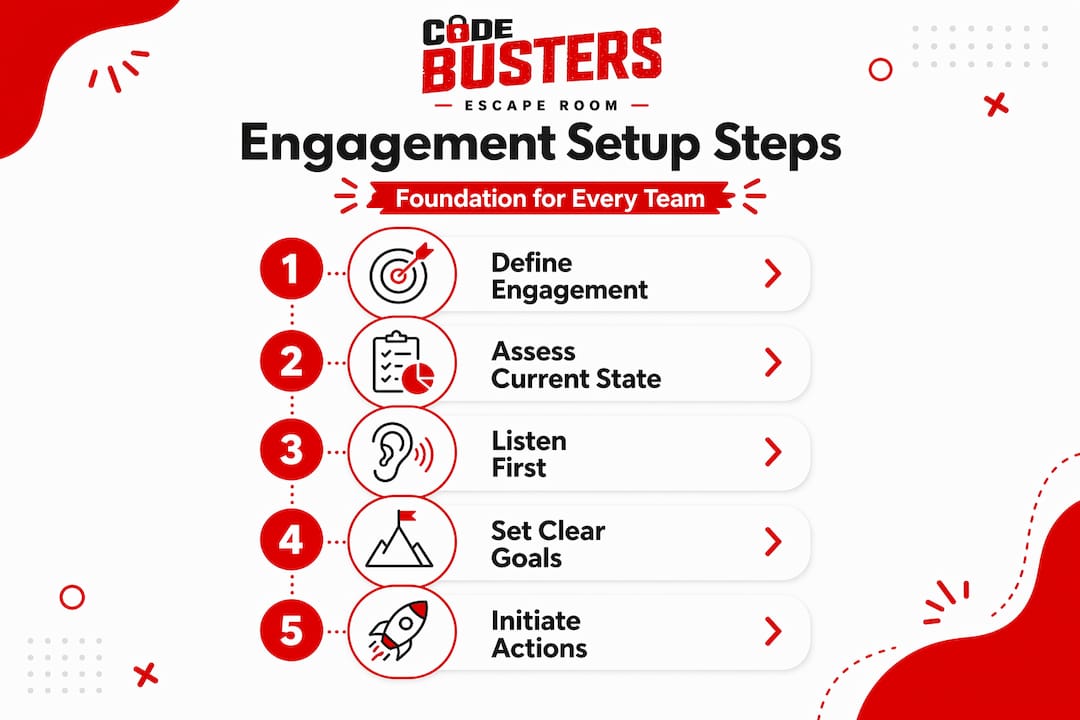
Open communication is the infrastructure everything else runs on. Teams where information flows freely, where leaders explain why decisions get made, not just what the decisions are, report significantly higher trust and motivation levels. You don’t need radical transparency. You need consistent transparency.
Here’s what the right environment looks like in practice:
- Feedback culture: Feedback flows in both directions and happens weekly, not at annual reviews. Employees who receive meaningful weekly feedback are fully engaged at an 80% rate.
- Communication platforms: Choose tools your team actually uses. Overcrowded tech stacks kill clarity. One messaging platform, one project tool, one place for async updates.
- Psychological safety: Google’s Project Aristotle research found that feeling safe to voice ideas and dissent is the single biggest predictor of team effectiveness.
- Supportive resources: Managers need tools that flag issues early. Feedback software, quick pulse check-ins, and simple recognition platforms work best when they support human judgment rather than replace it.
Pro Tip: Before rolling out a new engagement initiative, spend one week just listening. Run three informal one-on-one conversations and ask your team what’s getting in their way. What you hear will tell you more than any survey.
| Environment element | What to look for | Quick fix if missing |
|---|---|---|
| Communication clarity | Confusion about priorities or decisions | Weekly team brief with clear “why” |
| Feedback frequency | Feedback only at reviews | Schedule brief weekly check-ins |
| Psychological safety | People stay quiet in meetings | Publicly reward dissenting ideas |
| Tool simplicity | Multiple overlapping platforms | Audit and consolidate tech stack |
Daily leadership habits that sustain engagement
This is where most managers lose the game. They implement a framework, run one strong quarter, and then slip back into reactive mode. Sustainable engagement lives in what you do every single day, not what you plan once a year.
At least 70% of variance in team engagement is explained by the direct manager’s daily practices. That number puts the weight squarely on your shoulders. It’s uncomfortable. It’s also empowering.
Here’s a repeatable daily and weekly cadence that works:
-
Start with progress conversations. The most powerful engagement tool you have costs nothing. Brief, frequent conversations focused on small wins and removing blockers keep people moving and feeling seen. Ask two questions: “What’s going well?” and “What’s in your way?” Then act on the second answer.
-
Grant autonomy within clear boundaries. Tell people what needs to happen and by when, then step back and let them decide how. When people have ownership over their method, their investment in the outcome goes up substantially. Micromanagement is the single fastest way to kill that investment.
-
Recognize specifically and quickly. Effective recognition happens within 24 hours and focuses on a specific behavior, not a vague compliment. “The way you restructured that client presentation to lead with their budget concern saved the account” lands differently than “great job today.”
-
Set goals that account for capacity. Clear, measurable goals only motivate when they’re achievable given your team’s actual workload. Ignoring existing workload and seasonal demand causes burnout, not performance. Review goal load quarterly and adjust.
-
Build moments of genuine connection. Not forced fun. Genuine connection. This means acknowledging personal milestones, sharing relevant context about company direction, and making space for non-work conversation without making it a mandatory event.
-
Stay visible. Walking the floor and attending team milestones signals something no email can replicate: that you actually care what’s happening. Physical presence has a measurably stronger engagement impact than virtual communication alone.
Pro Tip: Pick one daily micro-ritual and protect it like a meeting with your CEO. It could be five minutes of recognition at the end of each day or a two-question check-in with one team member each morning. Consistency is what makes it matter.
Common pitfalls that kill engagement efforts
You can do everything right on paper and still watch engagement flatline. Here’s why that happens, and what to do about it.
-
Over-relying on technology. Platforms that automate recognition and track “engagement scores” are useful signals. They are not substitutes for human connection. Technology should support motivation efforts, not replace them. When everything is automated, recognition feels performative.
-
Treating engagement as an event. One offsite, one survey, one big initiative per year does not move annual engagement numbers. Daily micro-rituals outperform isolated events in sustaining long-term motivation. The team that gets together twice a year for a “culture day” and has disengaged managers for 363 other days will not trend upward.
-
Giving vague or inconsistent feedback. “Keep it up” tells someone nothing. Worse, inconsistent feedback creates confusion about what’s actually valued. Teams that receive conflicting signals from leadership disengage because the rules of success feel arbitrary.
-
Setting goals beyond team capacity. This one is particularly damaging because it looks like ambition. When people consistently miss goals not because of effort but because of overload, they stop believing the goals mean anything.
-
Ignoring cultural misalignment. If your stated values don’t match how decisions actually get made, your team notices. Fast. The fastest way to destroy trust is to say “we value transparency” and then make major changes without explanation.
Engagement is not a destination. It is a daily practice. The managers who build the most engaged teams are not the ones with the best annual plans. They are the ones who show up with intention every single day.
Measuring engagement and keeping momentum
If you can’t measure it, you can’t improve it. Most organizations measure engagement wrong. One annual survey captures a moment in time, not a trend. By the time you get results, the issues that drove the scores have already compounded.

Pro Tip: Run a three-question pulse survey every two weeks. Ask about clarity of expectations, feeling valued, and access to what’s needed to do the job. Three questions take 90 seconds to complete and give you directional data in real time.
Use a combination of leading and lagging indicators to track whether your engagement strategies for team engagement are working:
| Metric type | What to track | Why it matters |
|---|---|---|
| Leading indicator | Feedback frequency per week | Predicts future engagement before scores drop |
| Leading indicator | Manager check-in completion rate | Correlates directly with reported engagement levels |
| Lagging indicator | Pulse survey scores | Reflects current engagement state across the team |
| Lagging indicator | Voluntary turnover rate | Signals whether disengagement has reached breaking point |
| Behavioral KPI | Participation in optional initiatives | Shows discretionary energy and team spirit levels |
Pulse surveys and behavioral KPIs give you the real-time insight to course-correct before problems become exits. But measurement only works if you close the loop. When your team shares feedback, they need to see something change. Even a simple “you told us X, so we did Y” communication builds significant trust over time.
Build engagement into the entire employee lifecycle. Onboarding is where engagement begins, not after the 90-day mark. Exit interviews tell you what you missed. Everything in between is your daily opportunity to get it right.
My perspective on what actually moves teams
I’ve watched managers implement every framework in the book and still lead disengaged teams. And I’ve watched managers with no formal training build some of the most energized, loyal groups of people I’ve ever seen. The difference is never the tool or the program. It’s whether the manager genuinely gives a reason to care.
What I’ve found actually works, and what gets skipped most often, is the recognition of what I’d call “invisible plays.” The person who stays late to prep someone else for a presentation. The team member who quietly fixes a process no one asked them to fix. Specific, timely recognition of those invisible contributions matters more than any public award ceremony.
I’ve also learned that autonomy is the engagement lever leaders are most afraid to pull. Giving people real ownership means accepting that they’ll sometimes do things differently than you would. That discomfort is the price of a team that actually thinks.
The hardest lesson? Motivation grows through success in challenging but achievable work. If your team is consistently overwhelmed or chronically under-challenged, no amount of recognition patches that gap. Structure the work so people can actually win. Then celebrate when they do.
— CodeBusters
Take your team’s connection to the next level
The strategies in this article build engagement from the inside out. But sometimes, the fastest way to reset team dynamics and ways to enhance team morale is through a shared experience that requires real collaboration under pressure. At Codebustersescaperoom, that’s exactly what we do. Our immersive escape room experiences in Colorado Springs are purpose-built for corporate groups who want to build trust, sharpen communication, and actually enjoy doing it. Research consistently backs escape rooms for team building as one of the most effective ways to improve team dynamics outside the office. Book a private session for your team and give them a story worth telling at the next Monday standup.
FAQ
What is the biggest driver of team engagement?
The direct manager accounts for at least 70% of variance in team engagement scores. Daily management practices matter far more than company-wide programs or perks.
How often should managers check in with their teams?
Weekly check-ins tied to progress and blockers are the most effective cadence. Teams that receive meaningful weekly feedback show an 80% full engagement rate.
What are the best team building activities for engagement?
Effective team building activities create genuine collaboration under shared challenge, not passive participation. Escape rooms, problem-solving workshops, and structured peer learning sessions consistently outperform passive events like catered lunches.
How do you measure team engagement accurately?
Pulse surveys run every two weeks alongside behavioral KPIs like check-in frequency and participation rates give far more accurate data than annual surveys. Act visibly on the feedback you receive to keep the measurement loop meaningful.
Why do most engagement initiatives fail?
Most initiatives treat engagement as an event rather than a daily practice. Isolated events without daily reinforcement produce short-term spikes that fade within weeks, leaving teams more cynical than before.