How puzzles shape your escape room experience in 2026
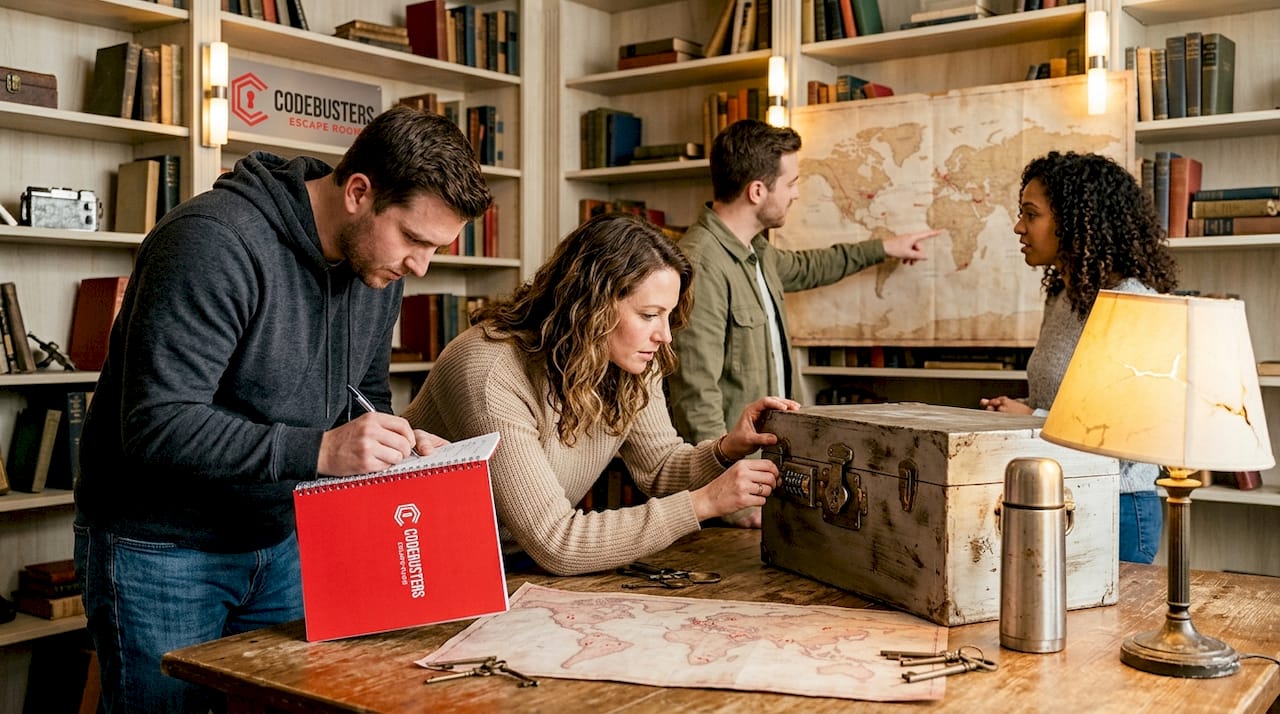
Escape rooms are not just themed obstacle courses where you fumble with random locks until time runs out. Every combination, hidden message, and coded cipher you encounter is deliberately placed to pull you deeper into the story and challenge your thinking in meaningful ways. Puzzle design is the beating heart of every great escape room, and understanding how it works transforms you from a confused participant into a confident, engaged player. This guide breaks down exactly why puzzle quality determines whether your group walks out triumphant or frustrated, and what to look for when choosing your next immersive adventure.
Table of Contents
- What makes a great escape room puzzle?
- How puzzles drive immersion and engagement
- Common pitfalls in puzzle and room design
- Integrating puzzles for cohesive escape room experiences
- Why trust and logic are the real secret to escape room enjoyment
- Explore expertly crafted puzzle rooms with CodeBusters
- Frequently asked questions
Key Takeaways
| Point | Details |
|---|---|
| Clarity and coherence matter | Well-designed puzzles feature clear information and logical connections that guide players. |
| Engagement boosts learning | Integrating puzzles into immersive stories improves enjoyment and knowledge retention. |
| Alignment prevents confusion | Room rules and puzzle mechanics must sync to maintain player trust and safety. |
| Story-driven integration | Linking puzzles to objectives and narrative creates memorable escape room experiences. |
| Player trust is essential | Consistent, fair puzzles build trust and keep gameplay rewarding for everyone. |
What makes a great escape room puzzle?
Not all puzzles are created equal. The difference between a puzzle that feels satisfying and one that feels arbitrary often comes down to a few core design principles that separate good rooms from truly exceptional ones.
The first principle is clarity. Every puzzle must give you all the information you need to solve it within the room itself. Puzzle design methodology commonly stresses information clarity and logical coherence: the puzzle should be solvable through observation and reasoning because the needed information is present somewhere in the room. You should never have to rely on outside knowledge, lucky guesses, or obscure trivia that the designer arbitrarily decided you would know.
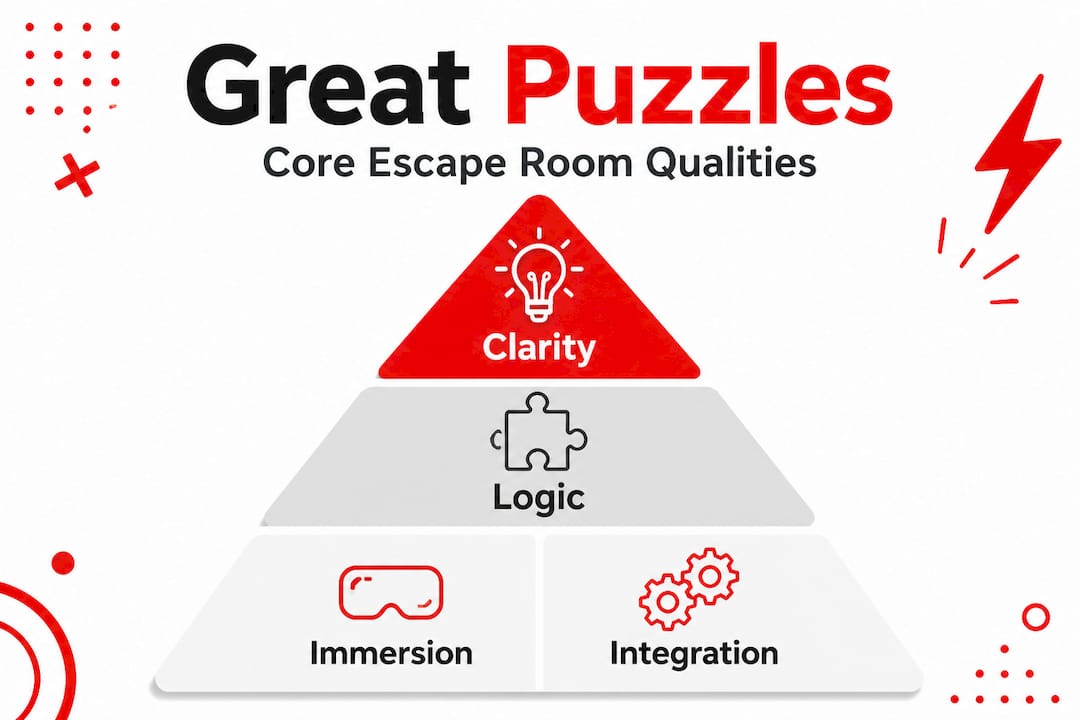
The second principle is logical coherence. Every step should make sense in sequence. If you find a cipher, you should also find the key to decode it. If a lock requires a four-digit number, something in the room tells you what that number is. The solution always follows a trail of reasoning, not a leap of blind faith.
The third is what designers call the “10-Team Rule.” If ten different groups all struggle with the same puzzle, that puzzle needs to be redesigned. This isn’t about making things easy. It’s about fairness. A puzzle can be challenging and still be solvable. The moment a puzzle crosses into genuinely confusing territory for most players, it has failed its purpose.
Here is a quick summary of the core qualities every great escape room puzzle should have:
- Clarity: All clues are present and distinguishable from decorative elements
- Logical flow: Reasoning connects the clue to the solution without guessing
- Detectability: The “key” to solving each lock is findable, not hidden unfairly
- Fairness: No puzzle should require knowledge players cannot access in the room
- Story connection: Each puzzle should feel like part of the narrative, not a detached brain teaser
“A puzzle that frustrates without reason destroys immersion. A puzzle that challenges with fairness creates a memory.”
When you are exploring entertaining escape room puzzles, take note of how naturally the clues appear. Are they part of the room’s story? Can you find the information you need by paying attention? That is the mark of intentional, well-executed design.
Pro Tip: If your group gets completely stuck, do not assume the puzzle is impossible. First, scan the room again carefully. Many players overlook clues that blend into the decor. Second, ask for a hint without guilt. Hints restore the intended progression and keep the experience fun rather than tedious.
With these foundational qualities in mind, let’s examine how puzzles actively drive player engagement.
How puzzles drive immersion and engagement
Puzzles are not just obstacles in your path. They are the mechanism through which the story unfolds. Each solved puzzle advances the narrative, reveals new information, and gives your group a genuine sense of progress. That forward momentum is what keeps energy levels high and collaboration tight throughout the session.
Puzzle-based story-structured gameplay has been shown in empirical research on educational escape rooms to improve learning outcomes and perceived engagement, including higher knowledge retention versus control groups. While most players are not in an escape room to study, this finding reveals something important: when puzzles are structured, purposeful, and linked to a narrative, the human brain engages more deeply and remembers the experience more vividly.
This is not a coincidence. Structured puzzle progression triggers a psychological loop of challenge, effort, and reward that keeps participants motivated. Here is how that cycle typically plays out in a well-designed room:
- Discovery: Players encounter a new element, object, or hidden clue that demands attention
- Analysis: The group examines the clue and connects it to previously found information
- Collaboration: Different players contribute different observations, creating organic teamwork
- Solution: The puzzle clicks, a lock opens, and the story advances
- Anticipation: The newly revealed narrative element generates excitement for the next challenge
Each stage in that cycle reinforces the players’ emotional investment. Skipping or breaking any link in that chain, say by making step two impossible because a clue is missing, can derail the entire experience.
The table below illustrates how puzzle structure affects key player experience outcomes:
| Puzzle quality | Player engagement | Collaboration level | Narrative immersion |
|---|---|---|---|
| Clear and logical | Very high | Strong and natural | Deep and sustained |
| Partially unclear | Moderate | Inconsistent | Interrupted |
| Random or arbitrary | Low | Frustrated and divided | Nonexistent |
| Well-integrated into story | Very high | Energized and focused | Immersive and memorable |
Notice the pattern. Engagement, collaboration, and immersion all rise and fall together based on puzzle quality. They are not separate outcomes. They are interconnected results of the same design choices.
When you experience lasting entertainment value in an escape room, it is because the puzzles were doing their job. They were not just keeping you busy. They were building something, carrying a story forward and making your group feel like genuine participants rather than passive observers.
Having seen how puzzles boost immersion, let’s explore what happens when design breaks down.
Common pitfalls in puzzle and room design
Even the most beautifully themed room can fall apart if its puzzles are misaligned with its rules. This is one of the most underappreciated problems in the escape room industry, and it is more common than most venues admit.
Edge-case quality issues arise when the room’s rules or affordances conflict with what players are instructed to do or are able to do, which undermines trust and can create unsafe or undesirable behavior. In plain terms, if the room tells you not to move the furniture but a key puzzle requires you to look under the couch, you have a design contradiction. Players either break the rule and feel guilty, or follow it and stay stuck forever.
Here are the most common pitfalls that damage escape room experiences:
- Conflicting instructions: Signs or game masters say one thing, but the puzzle demands another
- Missing visible keys: A lock exists without any in-room path to its solution
- Ambiguous clue placement: Decorative items look identical to puzzle items, causing confusion
- Difficulty spikes: One incredibly hard puzzle in an otherwise moderate room breaks flow and morale
- Rule violations built into solutions: Players must technically break stated rules to progress
The comparison table below shows how good and poor puzzle design differ in practice:
| Design element | Good design | Poor design |
|---|---|---|
| Instructions | Consistent with mechanics | Contradict required actions |
| Clue visibility | Clearly distinct from decor | Blends in confusingly |
| Solution path | Logical and traceable | Random or requires outside knowledge |
| Difficulty curve | Gradual and intentional | Sudden unexplained spikes |
| Player trust | Maintained throughout | Broken by contradictions |
When trust breaks down in a puzzle environment, the psychological impact is significant. Players stop believing the room is fair and start assuming every stuck moment is a design flaw rather than a solvable challenge. That shift in mindset makes everything harder, including puzzles that are actually perfectly fair.
Pro Tip: If a puzzle genuinely feels broken rather than just difficult, look for mixed messages. Is there a sign that says do not touch something your gut tells you to interact with? Are two objects suspiciously similar when one is a clue and one is decoration? Those are signals of a design conflict worth flagging with your game master.
To mitigate these pitfalls and maximize player experience, designers use puzzle integration strategies.
Integrating puzzles for cohesive escape room experiences
Great escape rooms do not just contain puzzles. They are built around them. Integration is the process of linking every puzzle to the room’s objectives and narrative so that no element feels out of place or arbitrary.
Puzzle integration is typically achieved across learning and entertainment escape rooms by mapping puzzles to clear objectives and then linking puzzles together into a story-driven progression. In a well-integrated room, every puzzle you solve reveals something about the story, unlocks the next stage of play, or deepens your understanding of the world you are inside.
Here is how designers typically build that integration:
- Define the objective: Each puzzle serves a specific purpose, whether it advances the plot, teaches a concept, or unlocks a physical space
- Sequence the challenges: Puzzles are ordered so early ones build the skills or knowledge needed for later ones
- Layer the narrative: Story elements are woven into puzzle solutions so players feel they are discovering the story, not just being told it
- Test iteratively: Designers run multiple groups through the room and revise puzzles that consistently break the flow
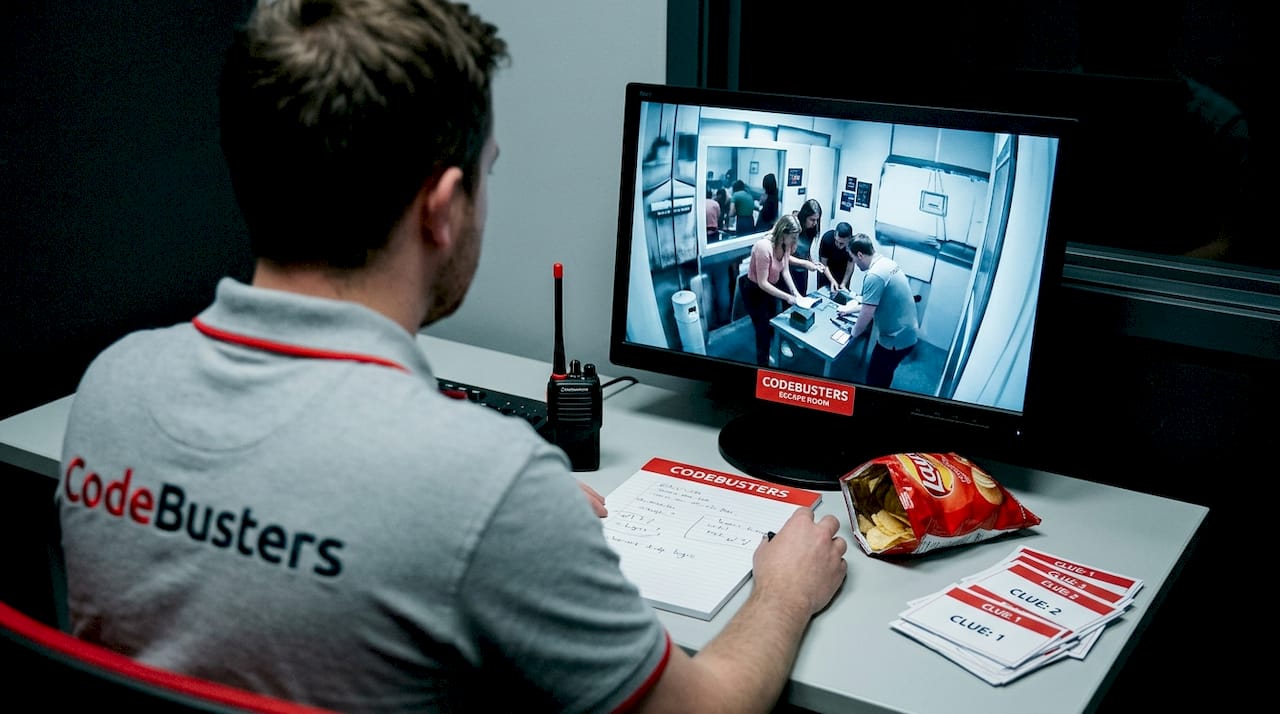
- Calibrate feedback loops: Hint systems and game master prompts are designed to restore progression without breaking immersion
“The best escape rooms feel inevitable in hindsight. Every clue was there all along, and solving the final puzzle feels like the story chose you.”
When this process is executed well, players leave with the feeling that everything made sense. That coherence is not accidental. It is the product of deliberate, iterative design that prioritizes the player experience at every step.
With integration strategies understood, let’s uncover unique perspectives not commonly discussed.
Why trust and logic are the real secret to escape room enjoyment
Here is a view you will not hear often: the difficulty level of an escape room matters far less than whether players trust the room is fair.
Most escape room enthusiasts obsess over difficulty ratings. They want to know if a room is challenging enough to be worth their time. That is an understandable instinct, but it targets the wrong variable. A brutally hard room built on clear logic and fair information is deeply satisfying. A moderately easy room built on contradictions and missing clues is maddening.
The real dividing line is trust. When you trust that the room is giving you everything you need to succeed, you engage fully. You search harder, think more creatively, and communicate better with your team. When you stop trusting the room, you disengage. You assume clues are missing, rules are arbitrary, and success is luck-based. That shift happens fast and it is very hard to reverse.
Protecting player trust means ensuring puzzle affordances and room rules align, and that every lock has an in-room, discoverable solution path. Misalignment creates confusion that feels like unfairness rather than challenge. Designers and players both need to understand this distinction deeply.
For players, this means you should actively evaluate rooms on trust and logic, not just theme and difficulty. Ask yourself after each room: did every puzzle have a findable solution? Were the rules consistent throughout? If yes, that room earned its rating regardless of how long it took you. If not, the rating is misleading regardless of how quickly you escaped.
For enthusiasts seeking better experiences, prioritize venues where the design philosophy centers on clarity and fairness. That is where you will find the experiences that stay with you long after the timer runs out.
Explore expertly crafted puzzle rooms with CodeBusters
If everything in this article resonates with you, then you already know what to look for in a genuinely great escape room experience. Logical puzzles. Consistent rules. Narrative-driven progression. Fairness built into every design choice.

CodeBusters Escape Room in Colorado Springs brings exactly that philosophy to life across multiple uniquely themed rooms, including “Past to the Future,” “Stranger 80’s,” and “Flight of Deception.” Each room is built around fair, logical puzzles that challenge your group without ever leaving you without the tools to succeed. Whether you are a first-timer or a seasoned enthusiast, you will find rooms calibrated for your skill level and designed to deliver that rare feeling of genuine, earned triumph. Book your next session and experience how intentional puzzle design transforms an hour into something you will talk about for weeks.
Frequently asked questions
Why are puzzles critical in escape rooms?
Puzzles drive the narrative and challenge, making the experience immersive and rewarding. Puzzle-based gameplay has been shown to improve engagement and knowledge retention compared to non-structured experiences.
How can I tell if an escape room puzzle is fair?
A fair puzzle always provides all the clues needed within the environment and follows a logical solution path. Information clarity and logical coherence are the standard markers of fair puzzle design.
What should I do if I get stuck on a puzzle?
Re-examine every clue, look for overlooked details in the environment, and ask your game master for a hint. Asking for a hint restores the intended progression without diminishing the experience or your accomplishment.
How do designers make puzzles fit the story of the room?
Designers map puzzles to specific game objectives and link them together in a sequential, story-driven progression. Puzzle integration ensures that every challenge feels purposeful and advances the narrative rather than interrupting it.