How Narrative Shapes Puzzle Games: A Player’s Guide

The role of narrative in puzzle games is to transform abstract logic challenges into emotionally resonant experiences that keep players invested far beyond the next correct answer. Without story, a puzzle is just a mechanism. With it, every solution carries weight. Games like The Witness, Storyteller, and Baba Is You prove that narrative impact in games reaches its peak when story and puzzle design grow from the same root. This guide breaks down exactly how that works, why it matters, and what it means for anyone who loves solving things.
How does narrative affect player engagement in puzzle games?
Narrative is not decoration layered on top of puzzle mechanics. It is the emotional engine that drives players forward. A study of 81 participants comparing high-narrative and low-narrative puzzle games found that narrative elements increase player enjoyment and create emotional demand beyond simple motivation to continue. That finding matters because it separates two distinct forces: the desire to finish a puzzle and the desire to feel something while doing it.

Player agency raises the emotional stakes
When you solve a puzzle in a narrative game, you are not just clearing an obstacle. You are co-authoring the story, which creates emotional investment that passive media like books or films cannot replicate. A reader follows a character. A player becomes one. That shift in agency is why narrative puzzle games generate stronger emotional memories than purely mechanical ones.
Narrative reduces frustration during hard puzzles
Difficult puzzles create friction. Without context, that friction becomes frustration and players quit. Storytelling mitigates frustration by giving players a sense of narrative progression even when they are stuck on a specific challenge. The story keeps moving emotionally, even when the puzzle logic temporarily stalls. Players stay because they want to know what happens next, not just because they want to prove they can solve it.
Pro Tip: If you find yourself rage-quitting a puzzle game, check whether the game has given you a narrative reason to care about the outcome. Games that do this well, like Portal or Outer Wilds*, almost never feel punishing even at their hardest.*
Here is what research tells us about narrative’s specific effects on player psychology:
- Narrative increases enjoyment as an emotional demand, not just a motivational tool
- Player agency in story-driven puzzles creates co-authorship and deeper emotional connection
- Contextually integrated narratives improve focused attention and reward metrics over non-integrated stories, based on a quantitative study of 80 participants
- Storytelling provides emotional continuity that sustains players through difficult puzzle sequences
What design strategies blend story and puzzle mechanics best?
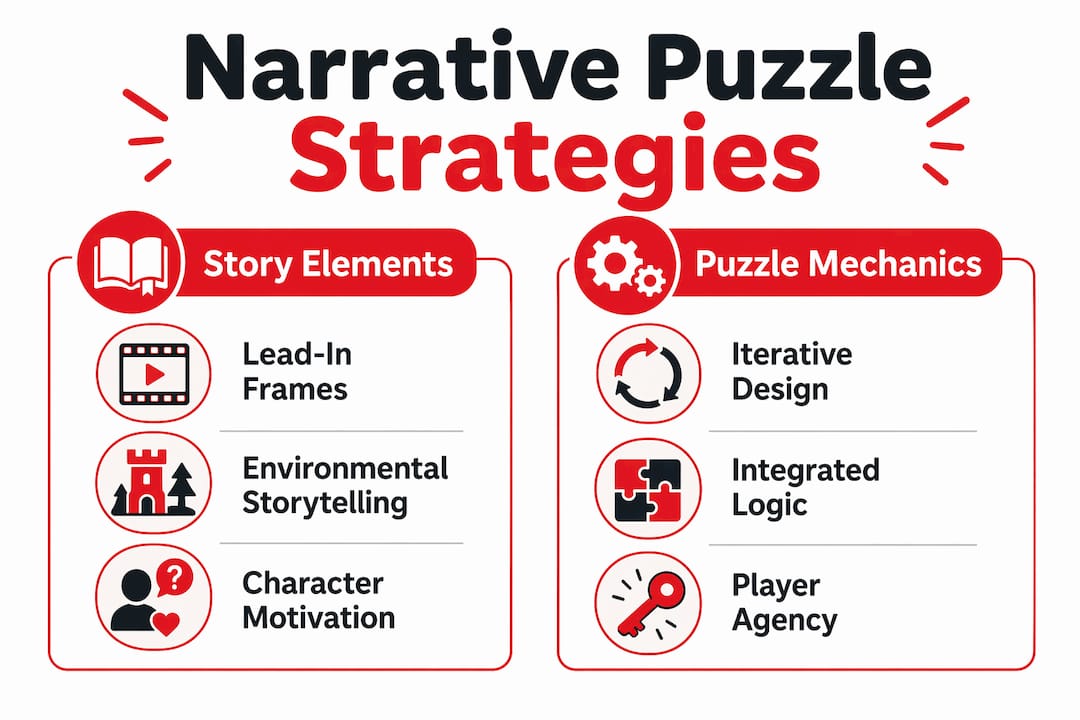
The best narrative puzzle games do not bolt story onto gameplay after the fact. They build both systems together from the start. Developers who get this right follow a few consistent principles.
Lead-in and lead-out narrative framing
The game Causal Loop uses a specific structure: lead-in and lead-out storytelling frames each puzzle with narrative tension before it begins and narrative resolution after it ends. This structure creates a rhythm. Players enter a puzzle with emotional stakes already established, and they exit with those stakes paid off. The puzzle itself becomes a meaningful act rather than a speed bump between cutscenes.
Environmental storytelling over heavy exposition
Environmental storytelling is more immersive than heavy dialogue or text dumps. Props, architecture, lighting, and spatial arrangement all communicate story without interrupting gameplay. A cracked photograph on a desk tells you more about a character than three paragraphs of backstory. Players reconstruct the narrative from physical clues, which makes them active participants rather than passive recipients.
Iterative design of narrative and puzzle logic
Puzzle logic and narrative logic must be developed at the same time. Simultaneous iterative design prevents the most common failure in this genre: puzzles that feel like arbitrary obstacles rather than natural story events. When a puzzle’s solution reflects the story’s internal logic, players feel clever for solving it. When it does not, they feel cheated.
Pro Tip: Pay attention to games where the puzzle solution reveals something about the story. In Storyteller*, rearranging panels to create a narrative outcome means the puzzle IS the story. That design philosophy is the gold standard.*
Here is a quick comparison of narrative integration approaches:
| Design Method | Story Delivery | Player Role | Example Game |
|---|---|---|---|
| Lead-in / Lead-out framing | Cutscenes before and after puzzles | Reactive | Causal Loop |
| Environmental storytelling | Spatial clues and props | Active reconstruction | The Witness |
| Narrative-as-puzzle | Story logic IS the puzzle mechanic | Co-author | Storyteller |
| Dialogue-driven exposition | NPC conversations and text | Passive listener | Many visual novels |
The numbered steps below reflect how strong narrative puzzle design actually gets built:
- Define the emotional arc of the story before designing a single puzzle
- Map each puzzle to a specific narrative beat or character revelation
- Build puzzle mechanics that reflect the story’s internal rules
- Test whether players understand the narrative context before attempting the puzzle
- Revise both story and puzzle together when either element feels disconnected
Physics puzzles vs. people puzzles: how story changes each type
Not all puzzle types respond to narrative the same way. The kind of puzzle you are solving shapes how story integrates and what emotional effect it produces.
Physics-based puzzles
Physics puzzles focus on spatial logic, weight, momentum, and cause and effect. Narrative in these games typically provides the why behind the physical challenge. In Portal, the story of GLaDOS transforms what would otherwise be a geometry exercise into a darkly comic power struggle. The physics do not change. The emotional context makes every chamber feel personal.
People puzzles and character motivation
People puzzles require players to understand character emotions and motivations to find solutions. These puzzles create deeper engagement than mechanical ones because the solution requires empathy, not just logic. Storyteller is the clearest example: you cannot solve a panel without understanding what a character wants, fears, or loves. The puzzle and the character study are the same thing.
Abstract narrative puzzles
Abstract narrative puzzles, like those in The Witness or Baba Is You, hide their story in the environment and the rule systems themselves. Players piece together meaning from scattered clues, which creates a sense of discovery that feels earned. Layered storytelling in these games enhances replayability because each playthrough surfaces new narrative details.
Here is how emotional impact varies across puzzle types:
- Physics puzzles: Narrative provides emotional stakes for spatial challenges; story context makes abstract mechanics feel personal
- People puzzles: Character motivation IS the puzzle mechanic; empathy replaces pure logic as the primary tool
- Abstract narrative puzzles: Story emerges through discovery; players feel like archaeologists uncovering meaning
- Hybrid puzzles: Combine multiple approaches; escape rooms are the real-world version of this design
Where is narrative-driven gameplay headed next?
The importance of narrative in gaming is growing, and the technology behind it is catching up fast. Two trends are reshaping what narrative puzzle experiences can do.
VR and emotional feedback loops
Virtual reality changes the relationship between player emotion and story response. VR and affective design now allow player emotional states to feed directly into narrative feedback loops, meaning the story can respond to how you feel, not just what you do. A puzzle that detects your stress level and adjusts its narrative framing accordingly is no longer science fiction. This development makes the role of story in puzzle design more dynamic than any previous medium has allowed.
Non-linear and layered storytelling
Non-linear narrative structures increase replayability by ensuring that no two playthroughs surface exactly the same story. Games built on this model reward curiosity. Players who explore thoroughly discover narrative layers that casual players miss entirely. This approach also means that the story feels personal, because your path through it is genuinely different from someone else’s.
The key directions shaping the future of narrative puzzle experiences include:
- Emotional state detection through VR biofeedback creating personalized story responses
- Non-linear narrative architecture rewarding exploration and multiple playthroughs
- Environmental storytelling becoming more sophisticated as game worlds grow denser
- Escape rooms adopting digital narrative layers to deepen physical puzzle experiences
- AI-generated narrative branches allowing story to adapt in real time to player choices
The shift here is fundamental. Narrative is moving from a fixed backdrop to a responsive system. Players are no longer just solving puzzles inside a story. They are shaping the story by how they solve puzzles.
Key takeaways
Narrative transforms puzzle games from logic exercises into emotionally meaningful experiences by giving players agency, context, and emotional stakes that pure mechanics cannot provide.
| Point | Details |
|---|---|
| Narrative increases enjoyment | A study of 81 participants confirmed story elements raise emotional demand beyond basic motivation. |
| Agency deepens investment | Players who co-author story through puzzle solutions form stronger emotional memories than passive audiences. |
| Design must be iterative | Puzzle logic and narrative logic built simultaneously prevent forced, disconnected story integration. |
| Puzzle type shapes story impact | People puzzles and abstract narrative puzzles create deeper engagement than physics-only challenges. |
| VR expands narrative response | Emerging affective design allows player emotional states to directly influence narrative feedback in real time. |
Why narrative puzzles leave a mark that pure logic games never do
I have spent years watching people walk into a themed room, face a wall of puzzles, and transform the moment a story clicks into place. The shift is visible. Their posture changes. They stop treating the room like a test and start treating it like a world they belong in. That is what narrative does that no amount of clever mechanics can replicate on its own.
The conventional wisdom in game design circles is that story and puzzle are separate disciplines that need to be carefully balanced. I think that framing is wrong. The best puzzle experiences I have seen do not balance story and mechanics. They make them the same thing. When the solution to a puzzle reveals something true about a character or a world, the player does not just feel smart. They feel moved.
Environmental storytelling is the tool I trust most for this. A room that shows you a story through objects, layout, and light does more emotional work than any amount of dialogue. Players who discover story through clues remember the experience differently than players who are told what to feel. The reconstruction process creates ownership. That ownership is what makes a puzzle experience stick.
The other thing I have noticed is that narrative puzzles encourage people to come back. Not because they want to beat their time, but because they want to see if they missed something. That is the real measure of good narrative design. It makes the world feel bigger than the puzzle.
— CodeBusters
Experience narrative puzzle design in person

Reading about the role of narrative in puzzle games is one thing. Feeling it work on you in real time is another. Codebustersescaperoom in Colorado Springs builds every room around a specific story, with puzzles that only make sense inside the world the narrative creates. Rooms like Stranger 80’s, Past to the Future, and Flight of Deception each use immersive escape room storytelling to make every clue feel like a plot point. Whether you are coming with friends, family, or a corporate team, the experience puts narrative puzzle design theory into practice in a way no screen can match. Book your room and find out what it feels like to solve a story.
FAQ
What is the role of narrative in puzzle games?
Narrative gives puzzles emotional context and stakes, transforming logic challenges into story-driven experiences. Research shows it increases player enjoyment and creates emotional demand beyond simple motivation to continue.
Do puzzle games need a story to be engaging?
Pure logic puzzles can be satisfying, but narrative puzzle games consistently produce stronger emotional investment and player retention. A study of 81 participants found that high-narrative puzzle games outperform low-narrative ones on both enjoyment and emotional engagement metrics.
What makes people puzzles different from physics puzzles?
People puzzles require players to understand character motivations and emotions to find solutions, while physics puzzles rely on spatial logic. Character-driven puzzles create deeper engagement because empathy, not just reasoning, is the primary tool.
How does environmental storytelling work in puzzle games?
Environmental storytelling delivers narrative through props, architecture, and spatial design rather than dialogue or text. Players reconstruct the story from physical clues, making them active participants who feel ownership over what they discover.
How does VR change narrative puzzle experiences?
VR and affective design allow player emotional states to feed into narrative feedback loops in real time. Emerging research from 2026 shows this creates more personalized and immersive storytelling than any previous puzzle game format.