How group size impacts escape room fun and success

Choosing how many people to bring to an escape room feels like a simple decision, but it shapes almost everything about your experience. The “more the merrier” assumption leads groups to book too large, leaving half the team standing around while two people solve every puzzle. On the flip side, showing up with just two people to a room built for six can feel like trying to lift a couch by yourself. Understanding how group size affects teamwork, communication, and puzzle dynamics helps you walk in prepared, stay engaged, and actually enjoy the challenge ahead.
Table of Contents
- Why group size matters in escape rooms
- Small vs. large groups: Comparison of escape room dynamics
- How escape room design adapts for different group sizes
- Tips for choosing your ideal group size
- What most escape room guides overlook about group size
- Ready to book your next escape room in Colorado Springs?
- Frequently asked questions
Key Takeaways
| Point | Details |
|---|---|
| Group size influences fun | The number of participants affects communication, enjoyment, and puzzle-solving success. |
| No single ideal number | Both small and large groups can succeed with the right preparation and room selection. |
| Choose rooms wisely | Match your group size to the escape room’s design and recommended capacity for the best experience. |
| Teamwork is key | Regardless of group size, clear communication and role assignment boost your chances of escaping and having fun. |
Why group size matters in escape rooms
Escape rooms are not passive entertainment. Every person in the room has to actively contribute, process information, and communicate clearly with the rest of the team. Group size directly shapes how well that process works, and the difference between a smooth, satisfying run and a frustrating one often comes down to how many people are in the space.
When groups are too large, a natural bottleneck forms. A few dominant personalities take over the puzzles while quieter team members drift to the edges. This is not just about fairness. Those unused team members miss the mental engagement that makes escape rooms worthwhile. They stop thinking critically and start watching, which removes the core appeal of the activity entirely.
Very small groups face the opposite problem. With only two people, every puzzle falls on a tiny team. There are no diverse perspectives to catch what one person misses, and the cognitive load builds quickly. Some puzzles are specifically designed to require multiple people working simultaneously, meaning a pair might hit a wall that a larger group would have cleared in seconds.
Here is a clear summary of what group size affects in practice:
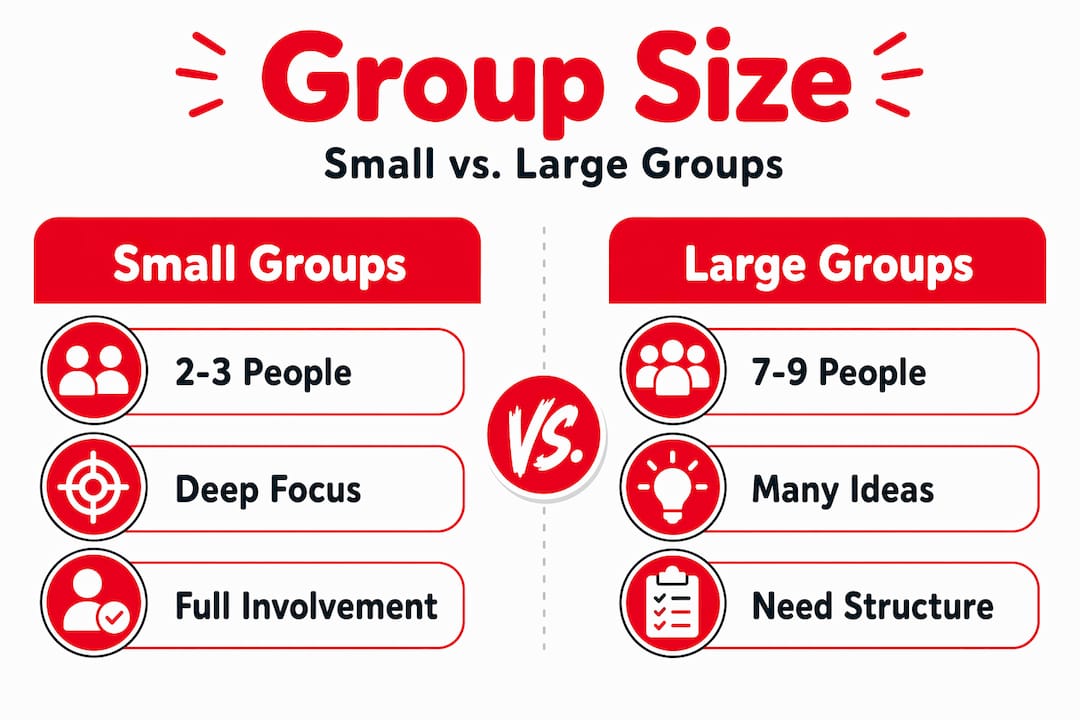
- Communication clarity: Smaller groups stay on the same page more easily. Larger groups need structure to avoid talking over each other.
- Puzzle coverage: More people can tackle more puzzles at once, but only if the room has enough parallel paths to justify it.
- Engagement levels: The right size keeps everyone actively involved. Too many or too few people creates dead time.
- Social dynamics: Escape rooms build bonds through shared challenge. Choosing the best group experience starts with knowing who thrives in what setting.
- Energy management: A group of three feels intimate and focused. A group of nine feels like a party that also has a padlock problem.
Research confirms that escape rooms produce high enjoyment and strong teamwork ratings in study settings, but these studies are not designed to isolate the causal effect of group size on outcomes. The enjoyment people report reflects many interacting factors, not just headcount.
The key takeaway here is that group size is a variable you can actually control before you arrive. Most groups cannot control the puzzle difficulty, the room design, or how much time pressure they will feel. But they can choose who and how many to bring. That makes group size one of the highest-leverage decisions in your pre-visit planning.
Now that we have established the impact of group size, let us compare small, medium, and large groups in action.
Small vs. large groups: Comparison of escape room dynamics
The differences between a group of three and a group of nine go far beyond just the number of people squeezing into a room. Each size range creates a fundamentally different social and cognitive environment, with distinct advantages and real drawbacks.
| Group size | Advantages | Drawbacks |
|---|---|---|
| Small (2 to 3) | High communication, deep engagement, everyone participates | Puzzle overload, fewer skill sets, physically exhausting |
| Medium (4 to 6) | Balanced teamwork, diverse thinking, manageable communication | Needs some organization, risk of one or two people going passive |
| Large (7 to 10) | Fast coverage, wide skill variety, high energy | Communication chaos, overcrowding, disengagement risk |
Small groups are intense. When there are only two or three people, there is nowhere to hide and no one else to carry the slack. That creates a heightened sense of personal responsibility and focus. Every clue feels important. Every idea gets heard. The trade-off is that you feel every gap in your knowledge and every moment of being stuck hits harder.

Medium groups tend to hit a sweet spot for most room types. Four to six people can divide and conquer across multiple puzzle stations while still checking in with each other regularly. There is enough diversity of thought that someone usually spots what another person missed. One escape room study found enjoyment rated at 84.9% with groups of two to five, though the study was not specifically designed to find the optimal group size. Still, the numbers suggest that smaller, engaged teams do genuinely enjoy the experience.
Large groups require strong internal structure to work well. Without someone stepping into a loose coordinator role, the group tends to fragment into clusters. Some clusters get absorbed in one puzzle while others spin their wheels somewhere else. Information rarely flows cleanly across a group of eight or nine people in a high-pressure environment.
Pro Tip: If you are bringing a corporate team of eight or more, assign informal roles before you enter the room. Designate someone as the communicator who calls out important finds to the whole group. This single habit prevents the communication breakdown that derails large groups most often.
The personality composition of your group matters almost as much as the count. A group of four who all want to lead will struggle more than a group of six with balanced personalities and a willingness to listen. An honest conversation about team strengths before you book goes a long way. Check out a solid escape room selection guide to match your group to the right room before you even arrive.
With the pros and cons of group sizes laid out, let us explore how escape room design and room selection adapt based on your group.
How escape room design adapts for different group sizes
Escape room designers do not create one-size-fits-all experiences. The best rooms are built with a specific group size range in mind, and the internal structure of the puzzles reflects that target. When you understand how rooms are designed, you can make much smarter booking decisions.
Escape room implementations commonly use groups of two to five people, but specific design choices around puzzle variety and room layout directly impact both enjoyment and teamwork. Two major design philosophies exist in the industry: linear rooms and multi-path rooms.
Linear rooms present puzzles in a sequence, where each solved puzzle unlocks the next. These rooms work best for small groups because there is only one active challenge at any given moment. A group of eight in a linear room means seven people are watching while one person opens a lock.
Multi-path rooms offer several simultaneous puzzle stations that all contribute to the final solution. These rooms were built for larger groups and reward the natural division of labor that happens with more people. When everyone has something to work on, engagement stays high throughout.
Here is a reference table showing how common room types align with group sizes:
| Room type | Best group size | Key feature |
|---|---|---|
| Linear puzzle room | 2 to 4 | Sequential challenges, tight focus |
| Multi-path room | 5 to 8 | Parallel tasks, collaborative breadth |
| Large immersive room | 6 to 10 | Wide exploration space, multiple subplots |
| Themed narrative room | 3 to 6 | Story-driven, requires full attention per clue |
Before booking, ask the venue these specific questions:
- What is the recommended minimum and maximum group size for this room?
- Are the puzzles linear or do multiple puzzles run at the same time?
- Does the room have physical space for everyone to move around comfortably?
- Is the difficulty level adjustable or fixed?
- Are there any puzzles specifically designed to require multiple people simultaneously?
Following solid escape room booking best practices before your visit saves you from showing up with five people to a room designed for two, or vice versa. Venues that take the time to answer these questions honestly are the ones most invested in your actual experience.
Understanding room design is half the battle. Now, let us see how to assemble the perfect team for optimal fun.
Tips for choosing your ideal group size
Selecting the right group size for your escape room visit is a skill, and like most skills, it improves when you think it through rather than improvising at the last minute. The goal is not just to escape the room. The goal is to enjoy the process and leave feeling like the team did something together.
Start by being honest about your group’s experience level. First-timers benefit from smaller groups where they can stay closely involved without feeling lost in the crowd. Experienced players who want to maximize efficiency might scale up to medium size to cover more ground quickly. Research consistently shows that high enjoyment and strong teamwork ratings occur even in small groups, which means you do not need to inflate your headcount to have an exceptional time.
Keep these factors in mind when deciding on your group size:
- Experience level: New players do better in smaller, more guided group sizes where each person can stay engaged.
- Group goal: Team building benefits from medium groups. Casual friend outings work at almost any size with the right room.
- Skill diversity: Include people with different strengths, analytical thinkers, creative problem-solvers, and detail-oriented observers. You do not need many people to get diversity if you choose deliberately.
- Communication style: Quiet groups can get lost in larger configurations. Groups that communicate naturally scale up more easily.
- Physical comfort: Some rooms are simply not large enough for ten people to move freely. Physical cramping reduces focus and patience quickly.
For family escape rooms, the dynamics shift further. Kids and adults engage differently with puzzles, so keeping the total headcount moderate (four to six) ensures every family member stays in the action without older participants carrying all the cognitive load.
Pro Tip: Before your booking, think of your group in terms of three roles: a searcher (finds physical clues), a thinker (works through logic puzzles), and a connector (links pieces of information together). If your group covers all three, size matters less. If everyone is a thinker and no one wants to search, size will not fix that gap.
Prioritize role assignment and clear communication over headcount every time. Groups that walk in knowing who does what tend to escape faster and enjoy themselves more, regardless of whether they have four people or eight. For deeper insight into maximizing fun and teamwork, role clarity is consistently one of the top factors separating great runs from frustrating ones.
Now that you know how to choose the right group size, let us reflect on what most guides miss about group dynamics in escape rooms.
What most escape room guides overlook about group size
Most articles on this topic offer a tidy formula. Bring four to six people, book a medium difficulty room, assign roles, and you will have a great time. That is fine advice, but it misses something real about how groups actually function under pressure.
Group personality matters more than group size. We have seen groups of three absolutely fly through rooms designed for six because the three people had complementary thinking styles and trusted each other completely. We have also watched groups of seven dissolve into confusion in the first fifteen minutes because two strong personalities immediately competed for control and everyone else stopped contributing.
The uncomfortable truth is that a smaller, well-connected group almost always outperforms a larger group with internal friction. You cannot fix social dynamics by adding more people. In fact, more people often amplify existing tensions because there are more competing voices and less clarity about who to follow.
Larger groups succeed when they are genuinely well-organized. Corporate teams that regularly work together and communicate effectively can leverage the full benefit of having more people. They split up naturally, share information efficiently, and check in without being prompted. But a group of ten coworkers who barely know each other will struggle even in a room specifically designed for that headcount.
This is why we recommend that groups focus on team collaboration as a goal in itself, not a bonus outcome. Choose your group size based on the personalities involved and the relational dynamics you already have, not based on a generic recommendation. Let the group’s natural strengths lead the decision. The number on your booking confirmation matters far less than the people behind it.
Ready to book your next escape room in Colorado Springs?
Planning your next group adventure becomes a lot more exciting when you know exactly what size team to bring and what to look for in a room.
At CodeBusters Escape Rooms in Colorado Springs, we offer a range of themed rooms built for different group sizes and experience levels, from tight two-player challenges to immersive adventures for larger teams. Whether you are organizing a corporate team-building event, a family outing, or a friends’ night out, our rooms are designed to keep every single person engaged from the first clue to the final lock. Browse our available rooms, check capacity recommendations, and book your private experience today. We would love to help you find the perfect match.
Frequently asked questions
Do smaller groups have a better chance of escaping?
Smaller groups can communicate and participate more easily, but may struggle if the room is designed for higher difficulty or more participants. Research does show high enjoyment and teamwork ratings in small groups, which suggests they can absolutely succeed and have a great time.
Is there an ideal escape room group size?
An ideal group size is often 4 to 6 people, balancing teamwork and participation, but it ultimately depends on the room design and group dynamics. One study using groups of two to five found strong success, but no direct comparison of optimal sizes was made.
How do escape rooms adjust for big groups?
Escape room venues may offer multi-path puzzles or split challenges to keep large groups engaged and involved throughout the experience. Design choices in escape rooms are directly tied to the expected group size, affecting both enjoyment and teamwork outcomes.