How clues shape your escape room experience
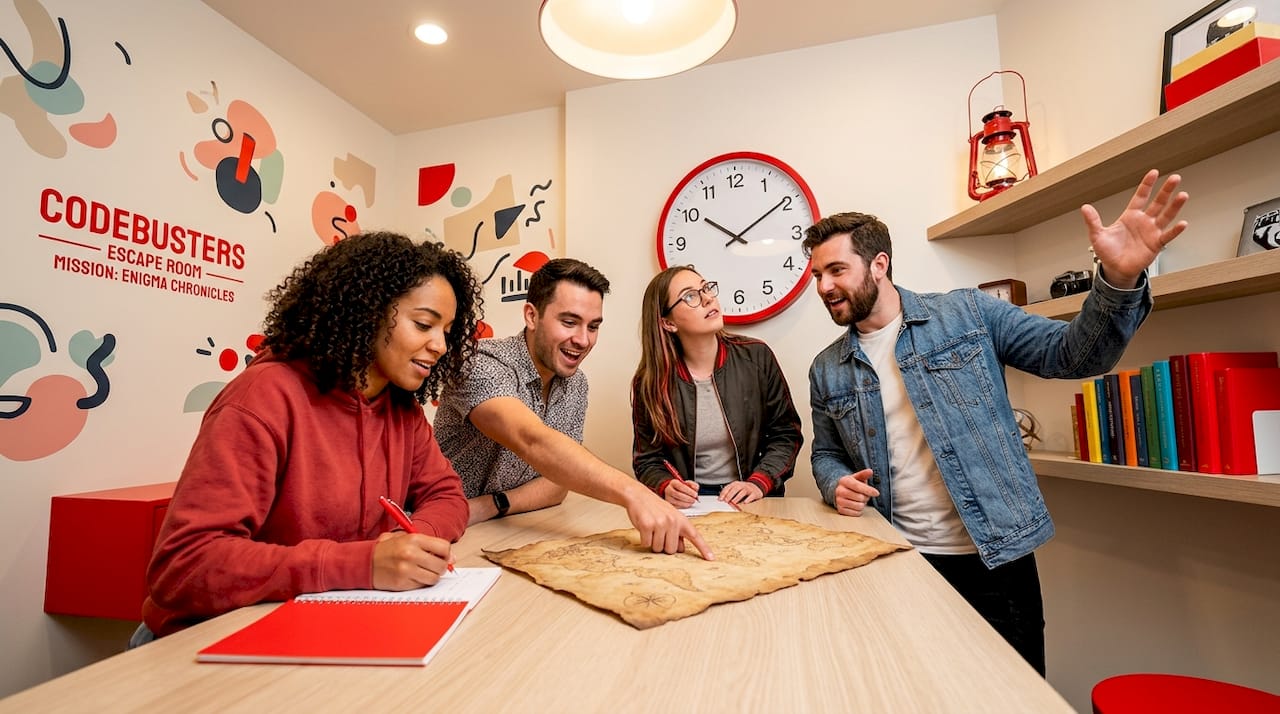
Most players walk into an escape room thinking clues are a backup plan, something you ask for when you’re completely stuck and out of ideas. That assumption quietly ruins a lot of otherwise great sessions. Clues aren’t a safety net. They are the architecture of the entire experience. According to escape room design research, clue design affects immersion as much as solvability, meaning the way puzzles surface information shapes how absorbed you feel every single minute you’re inside that room.
Table of Contents
- Why clues matter: The foundation of escape room gameplay
- Types of clues: From puzzles to narrative immersion
- Clue difficulty: Striking the right balance for fun and challenge
- The player experience: How clues fuel immersion and satisfaction
- Why the best escape rooms focus on clue journeys, not just answers
- Experience expertly crafted clues at CodeBusters Escape Room
- Frequently asked questions
Key Takeaways
| Point | Details |
|---|---|
| Clues drive progression | Well-designed clues are essential for moving the escape room story forward and keeping players engaged. |
| Balance impacts fun | Appropriate clue difficulty ensures both challenge and satisfaction for players of all experience levels. |
| Immersion depends on clues | The best escape rooms integrate clues seamlessly into puzzles and narrative for a fully immersive experience. |
| Effective design is tested | Playtesting and feedback help designers calibrate clue complexity and maintain enjoyment. |
Why clues matter: The foundation of escape room gameplay
People often talk about escape rooms in terms of winning or losing, escaping in time or not. But the real engine underneath every great session is how clues move you forward. Without thoughtful clue design, you’re not playing a story. You’re staring at a locked box with no context.
Clues provide the backbone of puzzle progression. They tell you what to pay attention to, what order to think in, and how each individual puzzle connects to the larger narrative. A room without strong clue architecture feels random. You might stumble into solutions without understanding why they work, and that hollow feeling sticks.
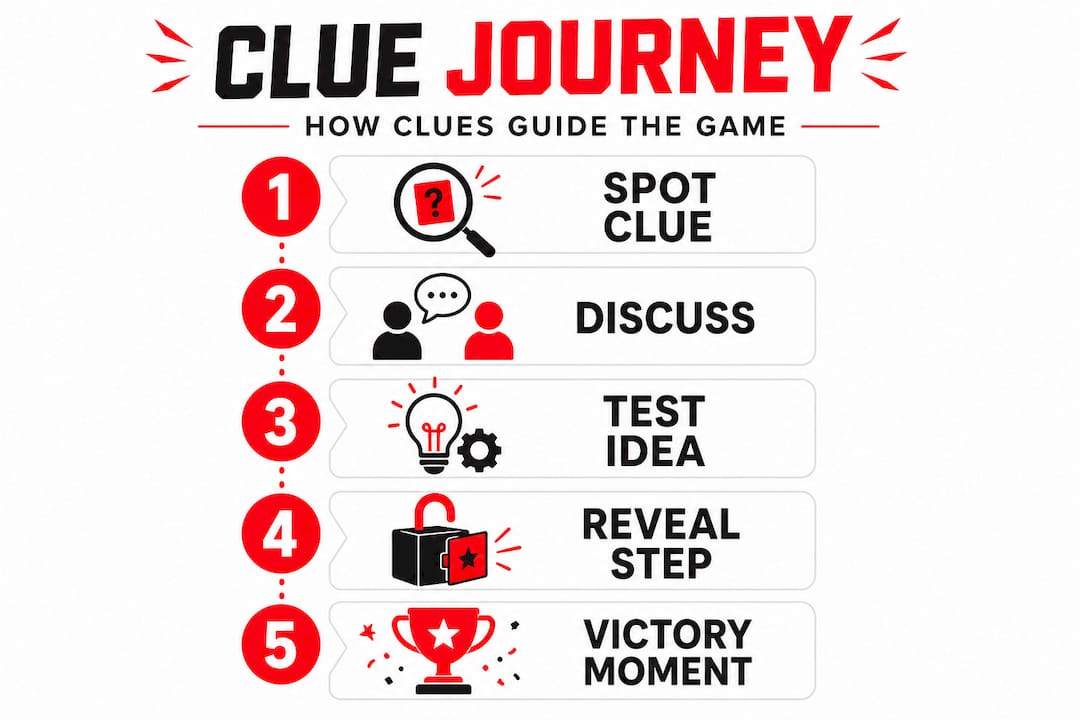
Here’s a key idea that most casual players miss: clues are active even when you don’t notice them. Clue-centric mechanics are a central expectation across the genre, meaning designers deliberately layer information into every corner of the room so that curious players are constantly discovering something useful.
There are three core types of clues that designers build around:
- Environmental clues: These are baked into the room’s physical space. A painting tilted at an odd angle, a flickering light, a book left open to a specific page. They reward observation without ever feeling like obvious handouts.
- Narrative clues: Delivered through story elements, dialogue, journals, or ambient audio. They feel like plot, not puzzle hints. When done well, you don’t even realize you’ve been guided.
- Explicit hints: These are the clues most people think of first. A monitor that flashes a message, a game master who steps in, a card you draw from a box. They’re direct, but they should always be the last resort in good design.
“The best rooms make you feel like a genius, not like you were led by the hand. That feeling comes entirely from how clues are layered and revealed.”
The difference between a forgettable room and an unforgettable one often comes down to this layering. When you visit escape rooms in Colorado Springs, you’ll notice how much deliberate thought goes into each environmental detail. Every object earns its place.
Types of clues: From puzzles to narrative immersion
With the foundation in place, it’s worth getting specific about the forms clues actually take. Not all clues look alike, and experienced players know how to read different formats almost instinctively.
Visual clues are the most common entry point. Colors, shapes, symbols, lighting, and spatial relationships all carry information. A UV light revealing hidden numbers is a classic visual clue. So is a grid of colored tiles where only certain ones are raised. These engage players visually and create satisfying “aha” moments.
Auditory cues are underused in many rooms but extraordinarily effective when deployed well. A ticking clock that changes rhythm when you’re near a key object. A sound effect triggered by stepping on a specific floor panel. Music that shifts in tone as you approach a solution. These clues demand active listening and reward players who stay fully present.
Tactile clues live in objects you can pick up, rotate, pull, and examine. A cipher wheel, a weighted envelope, a key with teeth filed in a specific pattern. These are particularly effective because they feel real in a way that screen-based puzzles never quite do.
Narrative clues are the most sophisticated form. Hidden clue design is directly linked to player engagement and immersion, and narrative clues are the clearest example of why. When the story itself tells you what to do next, you feel pulled forward rather than pushed. A character’s diary entry that mentions “the third drawer from the bottom.” A newspaper headline that doubles as a combination lock answer. Story and puzzle become one.
| Clue type | Delivery method | Immersion level | Difficulty to design |
|---|---|---|---|
| Visual | Props, lighting, symbols | High | Moderate |
| Auditory | Sound effects, music, voice | Very high | High |
| Tactile | Physical objects | Very high | High |
| Narrative | Story text, journals, dialogue | Extreme | Very high |
| Explicit hint | Monitor, game master | Low | Low |
Balancing these types is where puzzle design strategies really matter. Lean too hard on visual clues and the room feels like a scavenger hunt. Rely too much on narrative and less observant players fall behind. The best rooms blend all four types so that different players in the same group each contribute something based on their natural strengths.
Pro Tip: If you’re playing with a mixed group, assign roles early. Have one person focus on reading everything in the room, another handle all physical objects, and one person act as the narrator who tracks story logic. This informal division mirrors how good design intends clues to be discovered.
Clue difficulty: Striking the right balance for fun and challenge
The moment you understand that clue difficulty controls the emotional temperature of an escape room, everything changes. Too easy, and veterans feel underwhelmed. Too obscure, and newcomers feel alienated. Finding the band in between is both an art and a science.
Tricky clues are a central expectation for escape room enthusiasts, and for good reason. Players who have done dozens of rooms develop a kind of puzzle intuition. They recognize patterns, they know where designers tend to hide things, and they solve fast. Giving these players easy solutions feels like an insult. But the same clue that thrills a veteran can stop a first-timer cold.
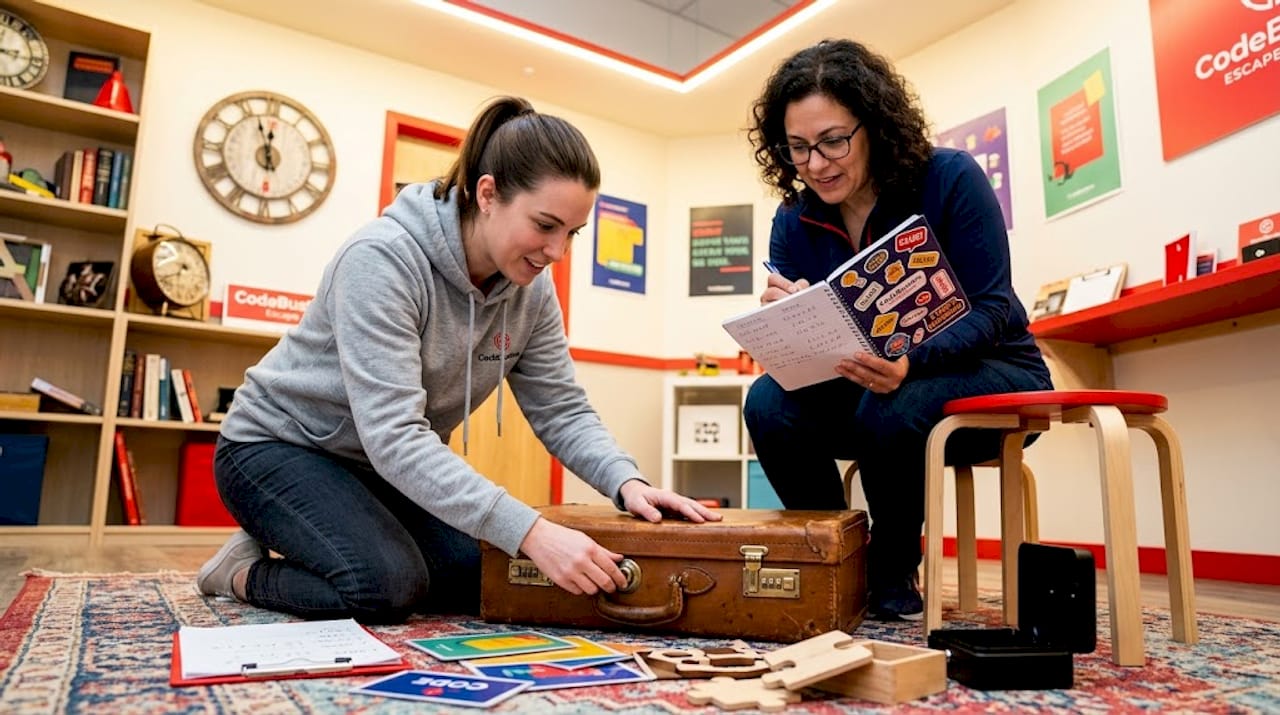
The most effective approach for designers is to build multi-layered clues. The first layer is accessible to anyone paying attention. The second layer rewards players who dig deeper. The third layer, if there is one, is reserved for the genuinely sharp or the return visitor.
Here’s how skilled designers approach calibrating clue difficulty:
- Write the intended solution path first. Know exactly what steps a player should take, in what order, and why each step makes logical sense within the story.
- Introduce the clue at 60% opacity. Start with a version that’s more visible than you think you need. The room’s atmosphere already adds cognitive load, so players are working harder than they would in a quiet environment.
- Playtest with strangers, not friends. Friends know your logic. Strangers reveal which steps feel arbitrary vs. which feel earned.
- Track where groups stall. If more than half of groups need an explicit hint at the same moment, the clue isn’t failing because players are bad. The clue needs adjustment.
- Iterate on context, not just clarity. Sometimes the problem isn’t that a clue is too hard. It’s that there isn’t enough surrounding story to make the clue feel meaningful. Adding narrative context often makes a “too hard” clue suddenly click.
Most rooms see increased immersion when clues integrate seamlessly with story elements. The point isn’t to make puzzles easier. It’s to make the logic feel inevitable. When players solve a clue and think “of course that’s how it worked,” the designer has done their job perfectly.
Understanding game design best practices helps both players and designers spot the difference between a clue that’s “hard because it’s meant to be” versus one that’s simply poorly communicated.
The player experience: How clues fuel immersion and satisfaction
Everything above is theory until you’re actually inside the room, clock ticking, teammates scattered across the space, each chasing a different thread. In that context, the way clues feel matters as much as the logic behind them.
The psychological shift that good clues create is remarkable. Frustration and satisfaction operate on a razor’s edge in escape rooms. A clue that takes eight minutes to crack feels either infuriating or triumphant, depending entirely on whether the solution makes retrospective sense. Embedded clues blend solvability with immersion, impacting player engagement by keeping that emotional balance intact.
Some hallmarks of clue moments that players remember long after the game ends:
- The physical reveal: A hidden compartment that springs open when the right sequence is entered. The visceral satisfaction of something clicking into place is unforgettable.
- The recontextualized clue: You found a piece of paper in the first minute that seemed irrelevant. Thirty minutes later it becomes the key to everything. That feeling of “it was in front of me the whole time” is genuinely electric.
- The collaborative solve: Two teammates each hold half of a clue without realizing it. The moment they put their information together is the kind of memory that makes people book a second room.
- The environmental shift: Solving a puzzle changes the room itself. Lights change, music shifts, a new door opens. The room responds to your intelligence, and that responsiveness is deeply satisfying.
| Experience element | Impact on player satisfaction | Tied to clue type |
|---|---|---|
| Physical reveal | Very high | Tactile |
| Recontextualized clue | Extreme | Narrative + visual |
| Collaborative solve | High | Any split information |
| Environmental shift | Very high | Environmental |
| First-time explicit hint | Low to moderate | Explicit hint |
What players report consistently is that they remember the journey through clues, not the moment the door opened. The impact of clues on engagement is most visible in reviews and repeat bookings. Rooms where players describe specific moments of revelation get recommended. Rooms where players describe “we just figured it out somehow” get forgotten.
Why the best escape rooms focus on clue journeys, not just answers
Here’s an uncomfortable truth about escape room design that most venues won’t say out loud: the answer to a puzzle doesn’t matter. What matters is whether finding it felt earned.
We’ve seen beautifully constructed rooms where players blasted through puzzles, hit the ending, and walked out feeling flat. We’ve seen rooms with modest production budgets where players laughed, argued, and gasped for sixty minutes and came out genuinely thrilled. The difference wasn’t budget or set design. It was whether the clues created a journey or just a sequence of tasks.
The temptation in clue design is to over-hint. If too many people are failing, the instinct is to make clues more obvious. But over-hinting kills something irreplaceable: the authentic struggle that makes the solution feel real. When you take away meaningful challenge, you take away meaningful victory.
The other trap is inconsistent clue logic. You can have wildly creative puzzles, but if the internal rules shift from room to room without signal, players don’t feel clever when they solve things. They feel lucky. Luck isn’t satisfying. Consistency in clue logic is as vital as creativity, because it builds the player’s trust that the room is playing fair with them.
What most players really remember is the “aha” moment, not whether they escaped in time. The best escape room designers know this, and they build entire rooms around manufacturing that feeling of revelation. The answer is almost beside the point. The moment you understand why the answer is what it is: that’s the experience.
Experience expertly crafted clues at CodeBusters Escape Room
Understanding clue design theory is one thing. Actually feeling it in action is something else entirely.

At CodeBusters Escape Room, every room in our Colorado Springs location is built around exactly the kind of clue journey this article describes. From the layered narrative clues in Stranger 80’s to the tactile reveals in Flight of Deception, we design for that specific feeling of earned revelation. Whether you’re bringing a corporate team looking for a genuine challenge or a group of friends ready for their first escape room experience, our rooms are built to deliver memorable “aha” moments, not just timed victories. Come see for yourself what Colorado Springs escape room adventures feel like when the clues are crafted with intention.
Frequently asked questions
What makes a clue effective in an escape room?
An effective clue guides players naturally toward a solution without breaking immersion, balancing subtlety and fairness. Good clue design ensures the solution feels inevitable in hindsight rather than arbitrary.
How do escape rooms prevent clues from becoming too easy or too hard?
Designers playtest puzzles extensively and adjust based on feedback to ensure most groups find clues challenging yet solvable. Tricky, well-calibrated clues remain a baseline expectation for enthusiasts and casual players alike.
Are clues the same as hints in escape rooms?
No, clues are embedded within the room itself to advance the story and drive puzzle progression, while hints are typically delivered by staff when players get genuinely stuck.
Do all escape rooms use the same types of clues?
No, rooms use a mix of visual, audio, physical, and narrative formats to create diverse puzzle experiences. Clue-centric mechanics vary widely across rooms but remain the core expectation of the genre.
Can well-designed clues make or break my experience?
Yes, immersive clue design keeps the game engaging from start to finish and directly shapes overall player enjoyment. Embedded clues that blend solvability with immersion are what separate forgettable rooms from ones players recommend to everyone they know.