Top group puzzle examples for fun team escapes

Finding an activity that genuinely engages every single person in your group is harder than it sounds. Board games leave some people bored, and dinner out rarely sparks real conversation. Group puzzles inside escape rooms are a different story. They demand participation from everyone, reward teamwork over individual brilliance, and create memories that stick long after the night is over. Whether you’re planning a friends’ night out, a family reunion activity in Colorado Springs, or a corporate team-building event, the right puzzle experience can bring your group closer together in ways most activities simply can’t match.
Table of Contents
- What makes a great group puzzle?
- Types of group puzzles you’ll find in escape rooms
- Side-by-side comparison of group puzzle types
- Situational recommendations for group puzzles
- What most people miss about group puzzles
- Ready to try group puzzles in Colorado Springs?
- Frequently asked questions
Key Takeaways
| Point | Details |
|---|---|
| Teamwork matters | The most engaging group puzzles are those that require active collaboration. |
| Choose by group type | Match the puzzle style and difficulty to your group’s size, skills, and interests. |
| Variety is key | Combining different puzzle types keeps everyone engaged and maximizes fun. |
| Learn from the experience | Debriefing after a group puzzle increases team growth and bonds. |
What makes a great group puzzle?
Not every puzzle deserves a group setting. Some are better tackled solo, while others only shine when multiple minds attack them at once. The best group puzzles share a few specific qualities that keep energy high and frustration low.
First, engagement is everything. A great group puzzle minimizes idle time, meaning no one is standing around watching someone else have all the fun. Every participant should feel like they have a role to play, whether it’s decoding a number sequence, spotting a hidden symbol, or physically holding something in place while another person reads a clue.
Second, diversity of skills matters more than raw intelligence. The strongest group puzzles pull from logic, observation, spatial reasoning, and communication. This means the person who’s great at noticing small details has just as much to contribute as the analytical thinker who loves patterns. Team-based puzzles reward a variety of abilities, which is exactly why mixed groups tend to outperform single-skill teams.
Third, scalability separates a good puzzle from a great one. The best challenges work whether your group has four people or ten. They naturally distribute roles without falling apart when group sizes shift.
Finally, a satisfying puzzle delivers that collective “aha” moment. When every person in the room suddenly sees the answer at the same time, the energy is electric. That shared realization is what makes group puzzles addictive.
Here’s a quick breakdown of what to look for:
- Everyone can participate, not just the loudest person
- Skills from different backgrounds are rewarded
- The difficulty feels challenging but achievable
- Solving it requires genuine cooperation, not just one person directing
- The payoff feels earned by the whole group
As group puzzle leaders consistently emphasize, puzzles should encourage teamwork and communication, not just clever thinking from one individual.
Pro Tip: Assign a rotating facilitator role during your escape room session. One person keeps track of clues, another manages the clock, and another coordinates communication. Swap roles between rooms to give everyone a moment to lead.
Types of group puzzles you’ll find in escape rooms
Escape rooms have become sophisticated enough to offer a wide range of puzzle formats. Each type challenges your group in a different way, and the best rooms combine several for a fully rounded experience.
Here are the five most common and effective group puzzle types:
-
Physical coordination puzzles. These require multiple people to act at the same time, like pulling two levers simultaneously or holding pressure plates in sync. No single person can solve these alone, which instantly forces cooperation.
-
Sequential logic puzzles. These are puzzles where each step only makes sense after a group discussion. One person might find a number, another spots a color code, and only together do they realize the combination for a lock. The solution is invisible unless everyone shares what they’ve discovered.
-
Multi-part riddles. In this format, clues are deliberately split across participants. Each person literally holds a piece of the answer. The group must communicate clearly and pool information to see the full picture. This format is especially powerful for building communication habits in corporate teams.
-
Pattern matching. Spread across a room, visual clues only make sense when someone steps back and sees how different pieces connect spatially or thematically. Observation-oriented players absolutely shine here.
-
Communication relays. Success depends entirely on how well your group passes information. One person sees something in one room, another has the cipher in a different location, and the relay between them is the puzzle itself.
Puzzle types at CodeBusters are deliberately varied because, as escape room designers know, diverse challenge formats improve engagement and keep the experience fresh from start to finish.
“The most satisfying moments in an escape room come when everyone contributes something only they noticed.”
Pro Tip: Use hint requests strategically. Instead of saving hints only for when you’re completely stuck, consider using one early to empower a quieter group member. Frame it as “let’s get a nudge so everyone can jump in” rather than an admission of defeat.
Side-by-side comparison of group puzzle types
With a clear picture of each puzzle type, it becomes much easier to choose which experience fits your group best. Here’s a direct comparison to guide your decision.
| Puzzle type | Key skills needed | Ideal group size | Best fit |
|---|---|---|---|
| Physical coordination | Timing, trust | 4 to 8 | Friends, corporate teams |
| Sequential logic | Analysis, sharing | 3 to 6 | Corporate teams, families |
| Multi-part riddles | Communication | 4 to 10 | Corporate teams |
| Pattern matching | Observation | 3 to 6 | Families, friends |
| Communication relays | Listening, clarity | 4 to 8 | Corporate teams |
A few things stand out when you look at this side by side. Physical coordination puzzles tend to work exceptionally well for corporate groups because they require trust and precise timing, both skills that translate directly to workplace dynamics. Pattern matching and sequential logic puzzles are friendlier for families with mixed ages, since observation skills are not tied to experience or job title.
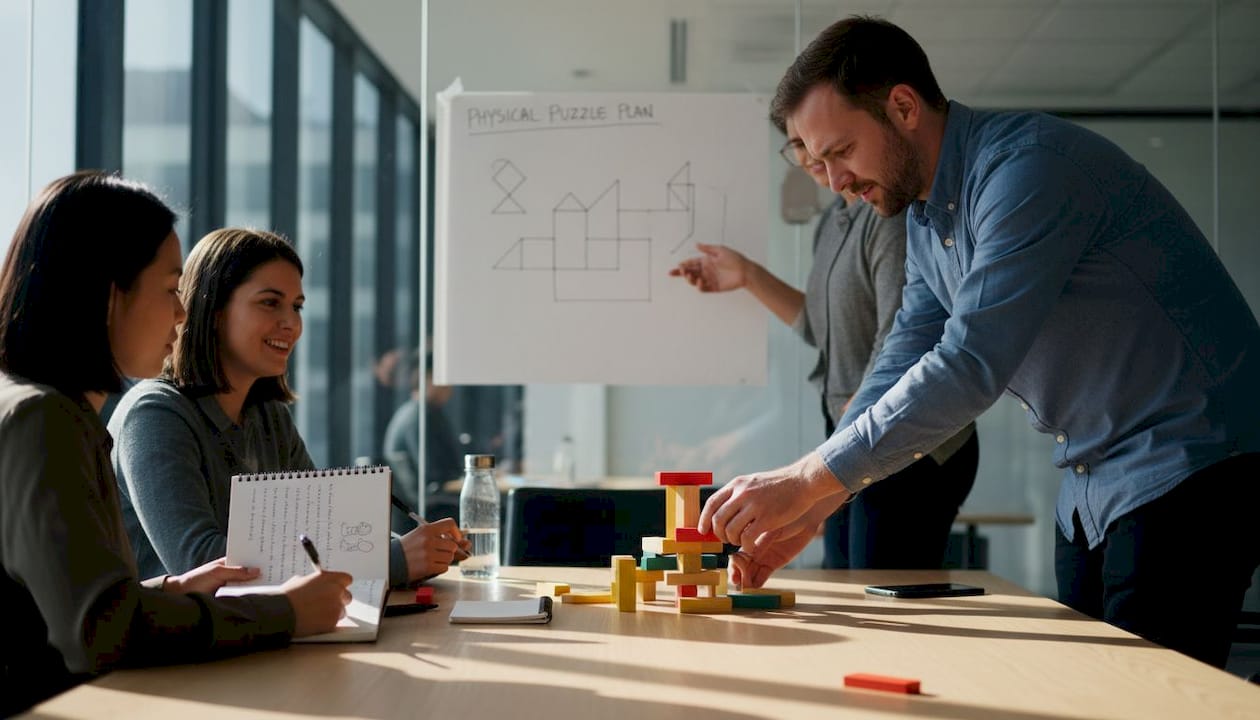
More group puzzle examples often show that diverse puzzle types improve both engagement scores and overall satisfaction for groups of all backgrounds.
70% of groups prefer a mix of logic and physical puzzles for a more balanced experience. This stat reinforces why the best escape rooms never rely on just one style. Variety keeps every personality type engaged and prevents one person from dominating the session.
For large corporate groups, multi-part riddles and communication relays deliver the most team-building value because they specifically expose gaps in information sharing. For family outings, a blend of pattern matching and sequential logic hits the sweet spot, challenging without alienating younger or less experienced players.
Situational recommendations for group puzzles
Knowing which puzzle type fits best in theory is useful. Knowing which one fits your specific group is better. Here’s how to match puzzle styles to your real-world group context.
For groups of friends: You want puzzles that feel experimental and a little unpredictable. Friends tend to have higher risk tolerance and enjoy surprises. Physical coordination and communication relays work beautifully here because the comedy of getting it wrong together is half the fun. Choose rooms with a higher difficulty rating to keep competitive friends genuinely challenged.
For families: Inclusivity is the priority. A 10-year-old and a 60-year-old should both have moments where they feel like the hero of the group. Pattern matching puzzles are ideal because sharp eyes matter more than life experience. Sequential logic is also strong when clues are written accessibly. Escape room puzzle ideas that incorporate observation-based challenges are consistently popular with mixed-age family groups.
For corporate teams: The goal shifts from pure fun to intentional learning. Multi-part riddles and communication relays are most effective because they expose real communication habits in a consequence-free environment. When a team realizes they’ve been talking over each other inside an escape room, that awareness carries back to the office in a meaningful way.
As puzzle design experts consistently note, puzzle difficulty and style should match group dynamics and experience levels to maximize both enjoyment and outcomes.
Here’s a quick-glance guide:
- Friends: High difficulty, physical + relay puzzles, competitive energy
- Families: Medium difficulty, pattern + logic puzzles, inclusive roles for all ages
- Corporate teams: Medium to high difficulty, riddle + relay puzzles, debrief afterward
Pro Tip: Before you arrive, ask your group to rate their puzzle experience on a scale from beginner to expert. Use that average to set difficulty expectations. A room that’s too easy kills momentum; one that’s too hard shuts quieter members out entirely.
What most people miss about group puzzles
Most guides focus on what puzzles to choose. Very few talk about what actually happens to your group when you’re inside the room. That’s the part worth paying attention to.
Group puzzles don’t just test your problem-solving. They reveal who steps up under pressure, who listens first and talks second, and who quietly holds the whole team together without anyone noticing. These are not small things. They’re the same dynamics that show up in your workplace, your family dinner table, and your friendships.
The most surprising thing we see at real escape room experiences is how often the person who leads the group to victory is someone who rarely speaks up in other settings. That hidden talent only surfaces when the environment demands participation from everyone.
“It’s not about the clock; it’s about how you work together.”
The clock creates urgency, but the real value is what you learn about your group. Who communicates under stress? Who panics and who steadies the ship? These insights last well beyond the hour you spend in the room.
Pro Tip: After your session, spend 10 minutes debriefing as a group. Ask what worked, what didn’t, and who surprised everyone. That conversation is often where the real team-building happens.
Ready to try group puzzles in Colorado Springs?
You now know what makes a group puzzle great, which types suit different groups, and how to match your experience to your team’s strengths. The next move is simple: get your group into a room and let it happen for real.
At CodeBusters Escape Room in Colorado Springs, you can book an escape room designed specifically for groups like yours. From themed adventures like “Past to the Future” and “Stranger 80’s” to corporate-friendly challenges with built-in teamwork demands, there’s a room that fits your group perfectly. Come see available group puzzles and find the experience your group has been waiting for. Private bookings are available, so your team gets the full room to yourselves.
Frequently asked questions
What are examples of group puzzles for escape rooms?
Examples include physical coordination puzzles, multi-step logic challenges, communication relays, and pattern assembly games. These group-focused puzzles are designed to require genuine teamwork at every stage.
How many people can participate in a group puzzle?
Most group puzzles work best with 3 to 8 participants, though many formats scale larger with the right structure. Escape room puzzles are designed with flexible group sizes in mind.
What type of group puzzle is best for team building?
Collaborative logic and communication relay puzzles consistently deliver the strongest team-building outcomes. These team-building puzzle formats expose real communication patterns in a safe, engaging environment.
Can children and adults enjoy group puzzles together?
Absolutely. Observation-based and pattern matching puzzles are especially well-suited for mixed-age groups. Puzzles for all ages ensure that younger participants can contribute just as meaningfully as adults.