Family Escape Room Planning Guide for Group Activities
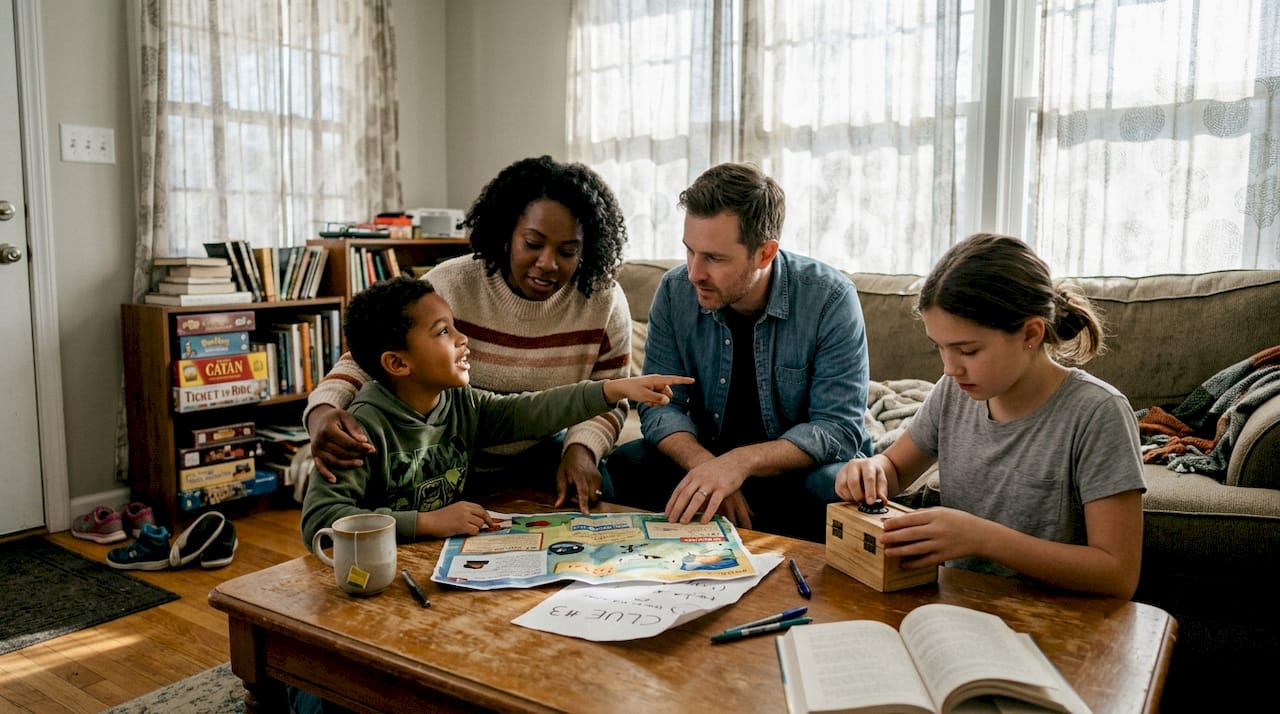
Planning a memorable family outing in Colorado Springs that truly engages everyone from young children to grandparents presents a genuine challenge. Traditional activities often leave some family members bored while others feel overwhelmed. Escape rooms solve this problem by offering interactive, team-based experiences where every person contributes meaningfully regardless of age or skill level. This comprehensive guide walks you through planning the perfect family escape room adventure, from selecting appropriate rooms to troubleshooting common challenges, ensuring your special occasion becomes an unforgettable bonding experience that brings your family closer together through shared problem solving and celebration.
Table of Contents
- Key takeaways
- Why choose family-friendly escape rooms?
- Deciding on your escape room format: commercial, DIY, or hybrid
- Step-by-step family escape room planning guide
- Common challenges and how to troubleshoot your family escape room
- Plan your unforgettable family escape room experience today
- FAQs about family escape room planning
Key Takeaways
| Point | Details |
|---|---|
| Family friendly choice | Choosing a family friendly escape room ensures all ages participate and makes the outing inclusive and engaging. |
| Prepare materials and format | Gather necessary materials and decide if your family prefers commercial, DIY, or hybrid formats to fit your plans and budget. |
| Emphasize teamwork over solving | Emphasizing communication and collaboration yields better results than focusing on individual problem solving. |
| Plan step by step | Following a clear step by step plan helps the group stay on track and creates a memorable shared experience. |
Why choose family-friendly escape rooms?
Selecting the right escape room makes the difference between a frustrating experience and a celebration your family talks about for years. Family-friendly rooms feature age-appropriate puzzles, engaging storylines, and difficulty levels that challenge without overwhelming younger participants. These carefully designed experiences recognize that families include members with vastly different cognitive abilities, attention spans, and physical capabilities.
The magic happens when rooms emphasize collaboration over competition. When you prioritize family-friendly rooms to ensure all ages contribute, success stems from communication over IQ. A seven-year-old might spot a visual clue an adult overlooks, while a teenager’s fresh perspective breaks through when parents feel stuck. This dynamic creates natural teaching moments where family members learn to value each other’s unique contributions.
Family-oriented escape rooms typically incorporate multiple puzzle types that appeal to different learning styles. Visual thinkers excel at pattern recognition challenges, while verbal processors shine during wordplay segments. Physical puzzles engage kinesthetic learners who need movement. This variety ensures every family member finds moments to lead and moments to support, building confidence across generations.
Assessing a room’s suitability requires examining several factors beyond marketing descriptions. Check minimum age recommendations, which typically range from 6 to 10 years for truly family-friendly options. Review difficulty ratings, aiming for beginner to intermediate levels that challenge without causing frustration. Examine time limits, as 60-minute sessions work well for most families, though some venues offer 45-minute options better suited to younger children’s attention spans.
Theme selection significantly impacts engagement levels. Adventure themes like treasure hunts or mystery investigations typically resonate across age groups better than horror or intense thriller scenarios. Fantasy settings spark imagination in younger players while providing nostalgic appeal for adults. Historical themes offer educational value that parents appreciate while maintaining entertainment value children crave.
Pro Tip: Call ahead to discuss your family’s specific age range and any special needs. Quality escape room operators gladly provide detailed information about puzzle types, scare factors, and physical requirements to help you make informed decisions.
Deciding on your escape room format: commercial, DIY, or hybrid
Families today enjoy three distinct approaches to escape room experiences, each offering unique advantages depending on your circumstances, budget, and planning preferences. Understanding these options helps you select the format that best matches your family’s needs and the nature of your special occasion.
Commercial escape rooms provide professionally designed experiences in dedicated facilities. These venues feature elaborate set designs, sophisticated props, and carefully tested puzzle sequences that create truly immersive environments. Staff members brief your group, monitor progress through cameras, and provide hints when needed. The main advantages include zero preparation requirements, guaranteed quality, and access to production values impossible to replicate at home. However, commercial rooms require advance booking, operate on fixed schedules, and typically cost $25 to $35 per person. Commercial rooms offer immersion but fixed schedules, making them ideal for families who value convenience and professional production quality.
DIY home escape rooms offer maximum flexibility and customization potential. Parents create puzzles, hide clues, and transform living spaces into temporary game environments. This approach works beautifully for families with irregular schedules, tight budgets, or children too young for commercial venues. DIY requires significant preparation time, creativity, and willingness to test puzzles before the actual event. Materials cost considerably less than commercial bookings, often under $50 for elaborate setups. The personal touch allows incorporating inside jokes, family history, and customized difficulty levels. However, production quality naturally falls short of professional venues, and parents sacrifice the experience of playing alongside children since someone must facilitate.
Hybrid approaches combine commercial and DIY elements, offering creative middle ground. Families visit a commercial escape room in Colorado Springs for the initial experience, then recreate simplified versions at home for future celebrations. This strategy provides professional immersion while building skills and inspiration for DIY attempts. Another hybrid option involves purchasing commercial escape room kits designed for home use, which provide professional puzzle design without venue costs.
| Format | Best For | Cost Range | Preparation Time | Immersion Level |
|---|---|---|---|---|
| Commercial | Convenience seekers, special occasions | $25-$35 per person | None | Highest |
| DIY | Budget-conscious, flexible schedules | $20-$50 total | 4-8 hours | Moderate |
| Hybrid | Balanced approach, repeat experiences | Varies | 2-4 hours | High to Moderate |
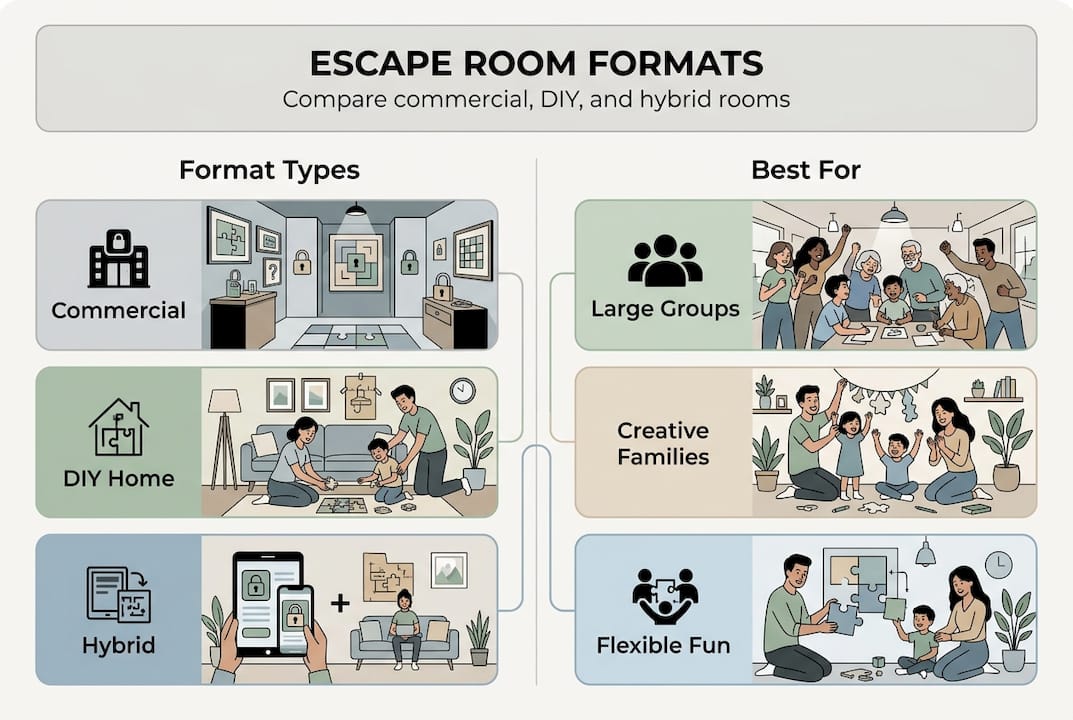
Your choice depends on several practical factors. Consider group size, as commercial rooms accommodate 6 to 10 players while DIY scales to any number. Evaluate available time, recognizing that commercial bookings require just travel time while DIY demands substantial preparation. Assess your creative confidence, since DIY success relies heavily on puzzle design skills. Factor in occasion significance, as milestone celebrations often warrant commercial experiences while casual family nights suit DIY approaches.
Step-by-step family escape room planning guide
Successful escape room experiences result from thoughtful preparation and clear execution strategies. Following this structured approach ensures your family maximizes enjoyment while minimizing potential frustrations that derail less organized attempts.
-
Research and select your room at least two weeks before your target date. Read reviews specifically mentioning families, paying attention to comments about age appropriateness and staff helpfulness. Contact venues directly to discuss your family composition, asking specific questions about puzzle types and physical requirements. Prioritize family-friendly rooms to ensure all ages contribute by confirming that success stems from communication over IQ.
-
Book your session during optimal time windows. Late morning or early afternoon slots work best for families with young children, avoiding nap times and late-day crankiness. Weekend mornings often provide quieter venue environments with less pressure from back-to-back bookings. Confirm your reservation 48 hours in advance and arrive 15 minutes early to complete waivers and use restrooms before your briefing.
-
Prepare your family mentally by setting appropriate expectations. Explain that escape rooms challenge groups to work together, not compete individually. Emphasize that getting stuck is normal and asking for hints demonstrates smart strategy rather than failure. For first-time players, watch a family-friendly escape room video together to visualize the experience without spoiling specific puzzles.
-
Establish team roles based on natural strengths before entering the room. Designate a timekeeper to monitor remaining minutes, a clue organizer to track solved and unsolved puzzles, and a hint requester comfortable communicating with staff. Rotate leadership as different puzzle types emerge, allowing each family member moments to guide the group.
-
Execute your game with focus on communication over speed. Gather everyone when someone discovers a new clue rather than working in isolation. Share observations aloud, as seemingly irrelevant details often connect to puzzles other team members tackle. When stuck, step back collectively to reassess rather than forcing solutions through brute force attempts.
-
Use hints strategically to maintain momentum and morale. Most venues provide three to five hints per session, either through walkie-talkies, screens, or staff visits. Request hints before frustration builds, typically after five minutes of genuine effort on a single puzzle. Frame hints as tools that professional players use rather than admissions of defeat.
-
Debrief together immediately after your session, whether you escaped or not. Discuss favorite moments, surprising solutions, and contributions each person made. Celebrate clever observations and teamwork instances rather than focusing solely on completion. This reflection reinforces positive memories and identifies lessons for future attempts.
Pro Tip: Assign one family member as photographer to capture pre-game excitement and post-game celebrations, but leave phones locked away during gameplay to maintain immersion and prevent distraction.
“The best escape room experiences happen when families remember they’re playing together, not racing against the clock. Communication transforms good teams into great ones.”
Troubleshooting during gameplay requires reading your team’s energy and adjusting approaches dynamically. If younger children lose focus, redirect them to visual or physical puzzles matching their abilities. When progress stalls completely, request a hint rather than letting frustration build. If team members work in isolation, pause to share discoveries and realign efforts. These mid-game adjustments prevent minor issues from derailing your entire experience.
Common challenges and how to troubleshoot your family escape room
Even well-planned escape room outings encounter predictable obstacles that, when anticipated, become manageable rather than experience-ruining. Understanding these challenges and their solutions helps families navigate difficulties smoothly.
Age disparities create the most common challenge, as wide age ranges within families lead to uneven engagement levels. Younger children may struggle with reading-intensive puzzles while teenagers find simple matching games boring. Prioritize family-friendly rooms to ensure all ages contribute, recognizing that success stems from communication over IQ rather than uniform skill levels. Address this by assigning age-appropriate sub-tasks, pairing older children with younger siblings as mentors, and celebrating contributions regardless of complexity. When a puzzle clearly exceeds a child’s ability, redirect them to search for physical clues or organize discovered items rather than forcing participation in frustrating tasks.
Time pressure affects families differently than adult groups, as parents often feel responsible for ensuring success while children may not grasp the urgency. This dynamic creates stress that undermines the fun factor. Combat time anxiety by reframing the experience as an adventure rather than a test. Remind everyone that most groups don’t escape on first attempts, and the journey matters more than the destination. If your venue offers adjustable difficulty or extended time for families, take advantage of these accommodations without guilt.
Communication breakdowns happen when family members work on separate puzzles simultaneously without sharing discoveries. This isolation wastes time and causes duplicate efforts. Implement a simple protocol where anyone finding a clue announces it loudly before investigating further. Create a central staging area where all discovered items and solved puzzles gather visibly. Designate check-in moments every 10 minutes where the team regroups to share progress and redistribute efforts based on current needs.
Puzzle difficulty mismatches occur when rooms marketed as family-friendly still include challenges too advanced for your group’s youngest members. When this happens, adult family members should resist the urge to solve everything independently. Instead, break complex puzzles into smaller components and assign age-appropriate pieces to younger players. A cipher might be solved by adults while children handle the physical task of locating encoded messages. This approach maintains engagement without sacrificing progress.
Physical limitations sometimes surprise families, as certain puzzles require reaching high spaces, reading small text, or manipulating tiny objects. Before booking, ask venues about physical requirements and mention any mobility concerns or visual impairments. During gameplay, adapt by having taller family members handle high elements while others focus on detail-oriented tasks. Quality escape rooms design puzzles with multiple solution paths, ensuring physical challenges never create absolute barriers.
Emotional responses vary widely, with some children becoming frightened by dim lighting or unexpected sounds while others grow frustrated by difficult puzzles. Prepare for these reactions by validating feelings without ending the experience prematurely. A scared child might feel braver holding a parent’s hand or carrying a small flashlight. A frustrated family member benefits from temporary reassignment to a different puzzle type, returning to the challenging one later with fresh perspective.
For families seeking escape room comedy entertainment that lightens the mood, remember that laughter and playfulness enhance problem-solving rather than distracting from it. Encourage silly theories, celebrate wrong guesses with humor, and maintain perspective that this is entertainment, not an exam.
Plan your unforgettable family escape room experience today
Now that you understand how to plan, execute, and troubleshoot family escape room adventures, it’s time to transform this knowledge into lasting memories. CodeBusters Escape Room in Colorado Springs specializes in creating exactly the kind of family-friendly experiences this guide describes, with themed rooms designed specifically for mixed-age groups and special occasions.
Their veteran and family-owned operation understands what makes family outings successful because they’ve lived it themselves. From the moment you arrive, professional staff ensure everyone feels comfortable and excited, providing age-appropriate briefings and monitoring your progress to offer perfectly timed hints. The immersive themed environments, from nostalgic adventures to mystery investigations, engage every family member while maintaining the collaborative spirit that makes escape rooms ideal for bonding. Private bookings mean your family plays together without strangers, creating intimate experiences where inside jokes and shared triumphs become cherished stories. Visit their website today to explore room options, check availability, and reserve your spot for an upcoming celebration or simply a memorable weekend adventure that brings your family closer together.
FAQs about family escape room planning
What age is suitable for family escape rooms?
Most family-friendly escape rooms welcome children ages 7 and up, though some venues offer experiences for kids as young as 5. The ideal age depends on the specific room’s reading requirements, puzzle complexity, and theme intensity. Always call ahead to discuss your youngest participant’s age and abilities, as staff can recommend the most appropriate room and suggest accommodations like simplified briefings or additional hints.
How long does a typical escape room session last?
Standard escape room sessions run 60 minutes of gameplay, with an additional 15 minutes for pre-game briefing and post-game debriefing. Plan for 90 minutes total at the venue. Some family-focused venues offer 45-minute sessions better suited to younger children’s attention spans. The entire outing, including travel and potential celebration meals afterward, typically consumes 2 to 3 hours.
Can we customize puzzles for our family?
Commercial escape rooms follow fixed puzzle designs to ensure quality and fairness, though many venues adjust hint frequency and difficulty based on group composition. For truly customized experiences, DIY home escape rooms offer complete control over puzzle types, themes, and difficulty levels. Some venues also offer private event packages where staff can modify certain elements for special occasions like birthdays.
What if someone gets stuck during the game?
Getting stuck is a normal part of escape room experiences, and venues provide hint systems specifically for these moments. Request hints without hesitation when your team spends more than five minutes on a single puzzle without progress. Staff monitor your game and can provide graduated hints that nudge you toward solutions without spoiling the satisfaction of solving puzzles yourselves.
Are escape rooms safe for children?
Reputable escape rooms prioritize safety with monitored cameras, easily opened exit doors, and staff trained in emergency procedures. Rooms never lock players in truly, and you can leave at any time. Discuss any specific fears or sensitivities with staff beforehand, as they can warn you about elements like dim lighting, sudden sounds, or tight spaces that might concern sensitive children.