How escape rooms build team collaboration in Colorado Springs
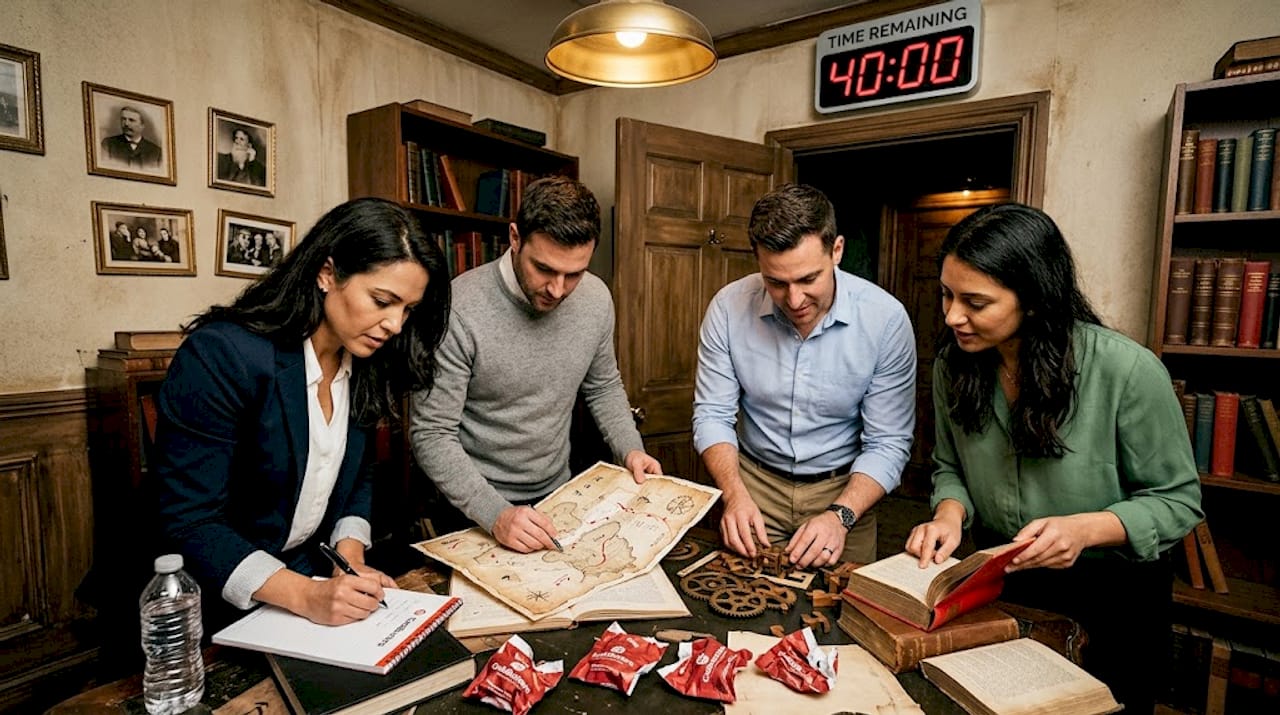
Most people assume that real collaboration skills come from boardrooms, workshops, or carefully designed HR seminars. But empirical data on collaborative learning tells a different story: 82% of participants report improved communication and 78% experience better problem-solving after completing an escape room together. That’s a result that most half-day corporate training events would struggle to match. If your team in Colorado Springs is looking for an experience that genuinely sharpens how people work together, escape rooms may be the most underrated tool in your toolkit.
Table of Contents
- Why collaboration matters for teams
- What makes escape rooms unique for team-building
- How escape rooms foster collaboration: The science and mechanics
- Navigating common challenges: What can go wrong?
- Maximizing impact: Actionable strategies for team success
- Our take: Moving beyond the hype of escape rooms for collaboration
- Ready to build your team’s collaboration?
- Frequently asked questions
Key Takeaways
| Point | Details |
|---|---|
| Escape rooms boost collaboration | Teams experience measurable gains in communication and teamwork after participating in escape room challenges. |
| Not all escape rooms are equal | Matching the room design to your team’s goals maximizes the collaborative benefits. |
| Be aware of pitfalls | Group pressure and unclear task distribution can diminish value unless teams address them after the experience. |
| Maximize with follow-up | A debrief session turns fun experiences into lasting improvements in collaboration. |
Why collaboration matters for teams
Collaboration is more than people working in the same room at the same time. True collaboration means sharing information freely, dividing tasks based on individual strengths, building on each other’s ideas, and holding each other accountable to a shared goal. For modern teams, whether they’re corporate departments, nonprofit crews, or project-based groups, these skills are not optional. They are the difference between a team that functions and one that excels.
The barriers to effective collaboration are stubbornly consistent. Miscommunication causes wasted effort and damaged relationships. Uneven participation, where a few loud voices dominate while others disengage, weakens the group’s creative output. And low trust makes people hesitant to share half-formed ideas or admit mistakes. These are not just soft-skills problems. They directly affect outcomes, timelines, and morale.
Here’s what effective collaboration actually delivers for teams:
- Stronger creativity through the collision of diverse perspectives
- Faster problem-solving because no single person bottlenecks every decision
- Greater accountability when everyone has a defined role and shared ownership
- Better communication habits that carry over into daily work interactions
- Increased psychological safety, making it easier for quieter team members to contribute
“Collaboration directly improves communication and problem-solving skills in professional and educational teams, with outcomes measurably superior to individual task completion.”
That kind of improvement doesn’t happen by accident. It requires experiences that genuinely force teams to practice these behaviors under realistic pressure. That’s exactly where real-world teamwork skills are forged. The most effective team-building activities don’t just teach concepts; they create the conditions where teams must either collaborate or fail.
What makes escape rooms unique for team-building
Walk into any typical team-building event and you’ll find a familiar pattern: a facilitator explains concepts, the group does a structured exercise, and everyone goes back to their desks with a workbook. The learning is passive, and the stakes are essentially zero. Escape rooms work differently from the very first minute.
The moment your team steps into a themed room and the clock starts, the environment demands immediate engagement. There’s no warm-up period. No opportunity to coast through while someone else takes notes. Every person in the room has to start observing, communicating, and contributing right away. This immediate immersion is one of the key reasons escape rooms produce results that more conventional activities often don’t.
Success in an escape room is structurally impossible without mandatory communication. Hidden clues must be shared. Puzzle solutions need to be discussed across the group. A detail noticed by one person becomes critical information for someone working on an entirely different challenge across the room. The game’s design forces information flow in a way that no lecture or role-play exercise can replicate organically.
Different puzzles also deliberately require different types of thinking. One challenge might reward sharp logical reasoning. Another demands careful observation or spatial awareness. A third might require creative lateral thinking that defies conventional logic. This variety means that every personality type on your team has a moment to shine, which is enormously valuable for group confidence and cross-team respect.
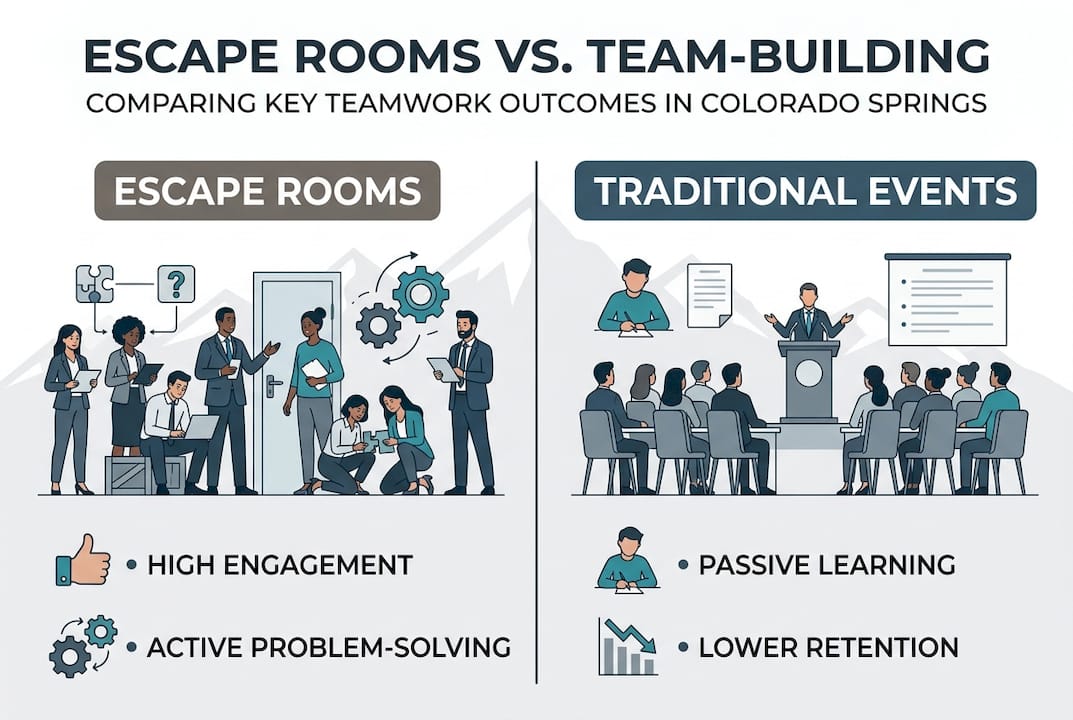
Consider how escape rooms stack up against more traditional approaches:
| Feature | Escape rooms | Traditional team-building |
|---|---|---|
| Engagement level | High, immediate, sustained | Often moderate, can drop off |
| Knowledge retention | Significantly higher | Lower, especially without follow-up |
| Group interaction | Mandatory and continuous | Structured but often artificial |
| Real-world skill transfer | Strong, especially communication | Variable, often theoretical |
| Adaptability to group size | Flexible, scalable | Can be rigid |
| Emotional investment | High, stakes feel real | Low to moderate |
Studies reveal escape rooms offer higher knowledge retention and superior learning outcomes compared to lectures and traditional workshops. That’s not a marginal improvement. It represents a fundamentally more effective method for embedding collaborative behaviors.
Pro Tip: When booking for a corporate group, look for escape room venues that offer customizable difficulty settings. A room that’s too easy won’t create enough pressure to activate real collaboration, but one that’s too hard can frustrate teams rather than unify them.
How escape rooms foster collaboration: The science and mechanics
The behavioral science behind why escape rooms work is both fascinating and practical. Escape rooms activate what researchers call group process elements: shared leadership, division of labor, real-time communication, and collective problem-solving under time constraints. These are the same dynamics that high-performing teams rely on during actual high-stakes projects.
Here’s how a team typically moves through a collaborative escape room experience:
- Initial assessment: The group enters, scans the room, and begins identifying what’s there. Someone naturally takes the lead in organizing the initial search.
- Role differentiation: Within minutes, individuals gravitate toward tasks that suit their instincts. Analytical thinkers decode puzzles. Observational thinkers scan for hidden details. Creative thinkers challenge assumptions.
- Information sharing: Discoveries get called out to the group. This is where communication habits become visible. Strong teams share everything immediately. Struggling teams hoard clues or assume others already know.
- Strategy adaptation: When an approach doesn’t work, the team must pivot. This is where emotional intelligence and psychological flexibility are tested in real time.
- Solving under pressure: As the clock counts down, the team must prioritize, delegate, and trust each other’s judgment. There’s no time for micromanagement or hesitation.
The data on outcomes is striking:
| Metric | Escape room participants | Control group (no escape room) |
|---|---|---|
| Communication improvement | 82% reported gains | 34% reported gains |
| Problem-solving improvement | 78% reported gains | 41% reported gains |
| Teamwork rating boost | Up to 100% in some cohorts | Minimal change |
| Knowledge retention at 30 days | Significantly higher | Noticeably lower |
These are not numbers generated from a single study on a narrow population. 82% of escape room players report improved communication, 78% experienced better problem-solving, and teamwork improvement reached 100% in paramedic student cohorts, which are groups whose real-world performance under pressure is genuinely life-critical. If the format works for that level of professional training, it can absolutely work for your Colorado Springs corporate team.
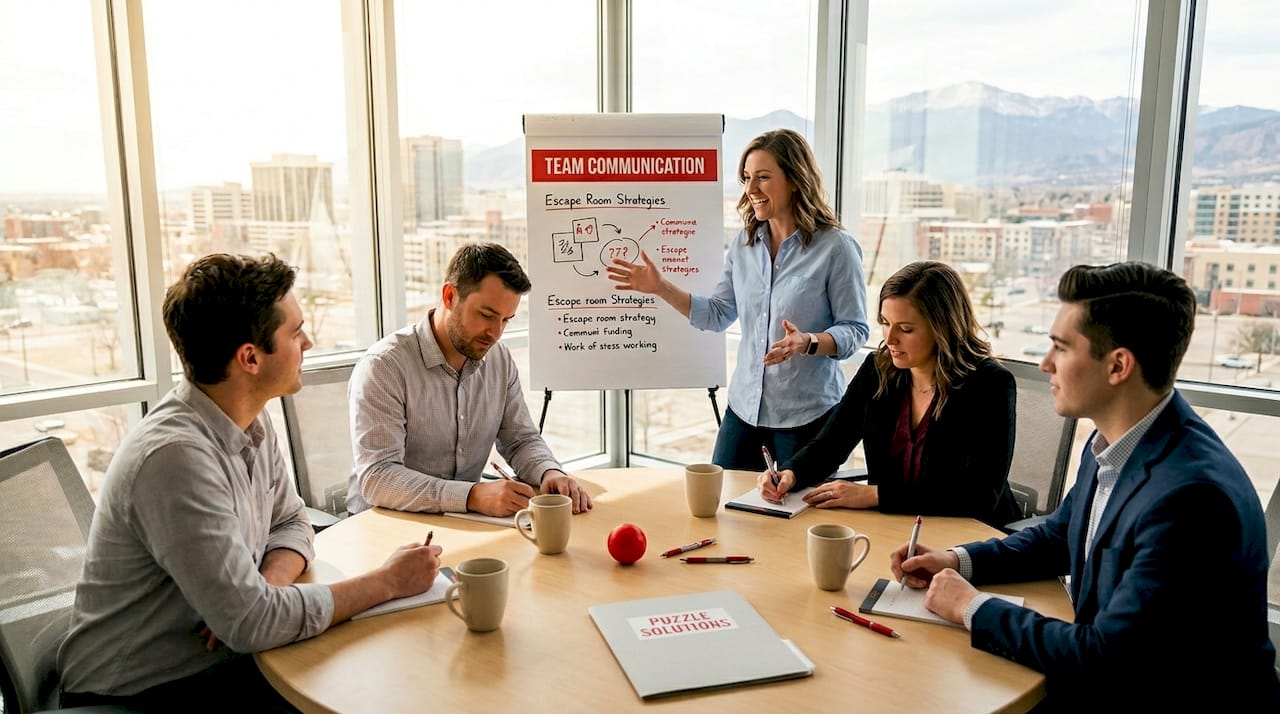
There are of course debates about team skill transferability from structured activities to real workplaces, but the weight of evidence favors experiences that simulate actual group pressure over passive learning environments.
Navigating common challenges: What can go wrong?
No team-building activity is perfect, and escape rooms are no exception. Understanding where these experiences can fall short is just as important as celebrating what they do well. Going in with clear eyes helps teams and organizers get the most out of the investment.
The most common pitfalls teams encounter inside an escape room include:
- Bottlenecking on a single puzzle while the rest of the team stands idle, losing momentum and time
- Competing leaders who both try to direct the group simultaneously, creating confusion instead of clarity
- Quieter members disengaging when the more assertive personalities take over every decision
- Misreading clues because the team didn’t pause to confirm everyone understood the information
- Panic-driven decision-making in the final minutes that undoes careful earlier work
These challenges are real, but they’re also mirrors. They reflect the same dynamics that show up in team meetings, project kickoffs, and client presentations. That’s actually part of what makes escape rooms valuable: they surface these behaviors in a low-stakes environment where nothing is truly on the line.
Escape rooms can present group pressure, task distribution issues, and over-complexity, and experts debate whether artificially constructed collaborative tasks transfer meaningfully to real workplace performance. Cognitive load theory suggests that when teams are overwhelmed by novel environmental demands, they may revert to individual thinking rather than genuine group collaboration.
Understanding these group activity challenges in advance allows organizers to prepare teams rather than leaving them to figure everything out on their own.
Pro Tip: Always schedule a structured debrief session immediately after the escape room experience. Ask your team three simple questions: What worked well in how we communicated? What slowed us down? What would we do differently next time? That 15-minute conversation is where the real learning solidifies into lasting behavior change.
Maximizing impact: Actionable strategies for team success
Knowing that escape rooms work is only useful if you set up the experience to deliver results. Here are five practical strategies that make the difference between a fun afternoon and a genuinely transformative team experience.
-
Pick the right challenge for your group. A team of experienced professionals with strong existing rapport needs a harder room to generate meaningful pressure. A newer team still building trust benefits more from a moderate challenge where early wins build confidence. Match the difficulty to where your team actually is, not where you’d like them to be.
-
Set clear goals before the game begins. Brief your team on what you’re hoping to observe or develop. Are you working on listening habits? Encouraging quieter voices? Practicing real-time decision-making? When people enter with a specific intention, they’re more likely to notice relevant behaviors during the experience.
-
Encourage cross-functional skill sharing. Before entering, remind the group that diverse strengths are an asset, not a complication. Someone from accounting may have a sharper eye for patterns. A creative director may approach logic puzzles from an unexpected angle. Frame different thinking styles as advantages.
-
Facilitate structured reflection afterward. Don’t let the energy dissipate in the parking lot. Use the debrief to name specific moments where collaboration either clicked or broke down. Make it concrete, not abstract. “When Maria called out the combination numbers immediately, it helped everyone move forward” is far more useful than “great teamwork today.”
-
Use the experience as a reference point going forward. The escape room becomes a shared story your team can reference in future situations. “Remember how we all talked over each other in the first ten minutes? Let’s not do that in this meeting.” Success in collaborative escape rooms is highest when activities are meaningfully aligned with the team’s actual working goals, not treated as a standalone entertainment event.
For teams in Colorado Springs ready to move from strategy to action, exploring the local escape room options available is the most direct next step.
Our take: Moving beyond the hype of escape rooms for collaboration
Here’s something most escape room articles won’t tell you: the room itself is not the magic. The room is just the container. What actually creates lasting collaboration improvement is what the team brings into it and what they carry out of it.
We’ve seen groups go through the same room with wildly different outcomes. One team uses every minute to communicate clearly, divides tasks instinctively, and leaves energized and connected. Another team spends the same 60 minutes talking past each other, lets one person make every call, and walks out relieved it’s over. The physical experience was identical. The collaborative behaviors were entirely different.
This is why facilitator quality and room design matter enormously. A well-designed escape room doesn’t just present puzzles. It creates natural decision points where leadership must be shared, where information must be distributed, and where trust is either built or broken. Not every venue invests in that level of design. Choosing an award-winning, thoughtfully designed experience over a generic option is not a small distinction.
The debrief, which many groups skip because they’re tired or pressed for time, is where the real payoff lives. Insights on escape room team-building consistently point to post-game reflection as the bridge between what happened during the experience and what changes in the actual workplace. Without that bridge, the adrenaline fades and the old habits return within a week.
Our honest perspective: use escape rooms as one powerful element within a broader team-building strategy. They’re not a substitute for clear organizational communication structures, good management, or a healthy team culture. But used intentionally, with the right room and a real debrief, they are one of the most effective single-session investments a team can make.
“The real learning begins once the final lock is opened.”
Ready to build your team’s collaboration?
If your team in Colorado Springs is ready to experience the kind of collaboration that actually sticks, Codebusters Escape Room offers escape room experiences in Colorado Springs specifically designed to challenge groups, expose communication patterns, and leave teams with a shared story worth talking about. From themed rooms like “Past to the Future” and “Flight of Deception” to private group bookings built for corporate events, the experiences are crafted to maximize both engagement and real skill development.
Group organizers can explore custom booking options, choose from multiple difficulty levels, and connect with a veteran and family-owned team that genuinely cares about the outcome of your event. Whether you’re organizing a department outing, a leadership retreat, or simply looking for a meaningful team activity that beats another lunch seminar, Codebusters is built for exactly that. Book your group session and give your team something they’ll actually remember.
Frequently asked questions
Do escape rooms actually improve collaboration skills?
Empirical studies show significant improvements in communication, problem-solving, and teamwork after escape room experiences, with 82% of participants reporting communication gains and teamwork scores jumping dramatically in professional cohorts.
What if some team members feel overwhelmed or left out?
Escape rooms present task distribution and group pressure challenges that can leave quieter members disengaged, which is why a structured debrief afterward is essential for surfacing those dynamics and turning them into growth conversations.
How should we choose the best escape room for our team?
Look for rooms aligned with your specific team development goals, with adjustable difficulty and experienced hosts. Success depends on design alignment with what your team is actually trying to develop, not just the most popular or highly rated option.
Are escape rooms suitable for remote or hybrid teams?
Many escape room providers now offer virtual formats. Virtual escape rooms are a strong option for distributed teams that need collaborative engagement without requiring everyone to travel to a physical location.