How escape rooms build stronger teams and boost collaboration
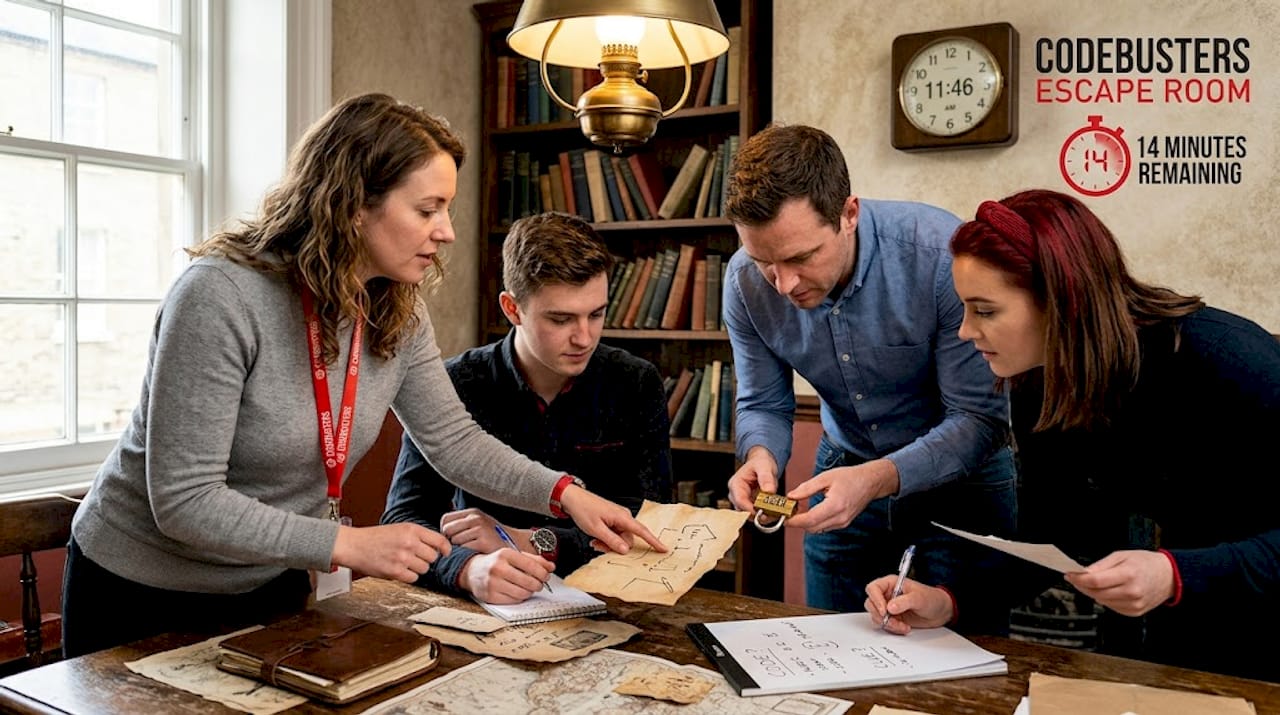
Most people book an escape room expecting fun, not a personal breakthrough. Yet research tells a very different story. Studies on escape rooms in professional training contexts show that nearly all participants report measurable improvements in teamwork and communication after a single session. That is not what you expect from a 60-minute puzzle game. So what is actually happening inside those locked rooms, and why do teams walk out different from how they walked in? This article explains the science, the structure, and the smart strategies behind using escape rooms to genuinely improve how groups of people work together.
Table of Contents
- The psychology behind teamwork in escape rooms
- How escape room challenges mirror real-world collaboration
- What can go wrong: Common team pitfalls and solutions
- Maximizing the teamwork benefits of escape rooms
- Why escape rooms work better than traditional team-building
- Experience teamwork in action at CodeBusters Escape Room
- Frequently asked questions
Key Takeaways
| Point | Details |
|---|---|
| Escape rooms boost teamwork | Studies show nearly all participants experience improved collaboration and communication after escape room activities. |
| Structure mirrors real life | Escape room challenges require the same skills as real workplace projects—making them ideal practice grounds for group cooperation. |
| Pitfalls can be managed | Potential teamwork breakdowns are avoidable with good facilitation, thoughtful design, and openness among participants. |
| Actionable team strategies | Leaders can maximize results by briefing teams, rotating roles, and debriefing after the escape room experience. |
The psychology behind teamwork in escape rooms
Teamwork sounds simple: people work together toward a shared goal. But genuine collaboration requires several overlapping skills, including active listening, role flexibility, clear communication, and trust under pressure. These skills are easy to talk about in a meeting room and surprisingly hard to practice there. Escape rooms change that equation entirely.
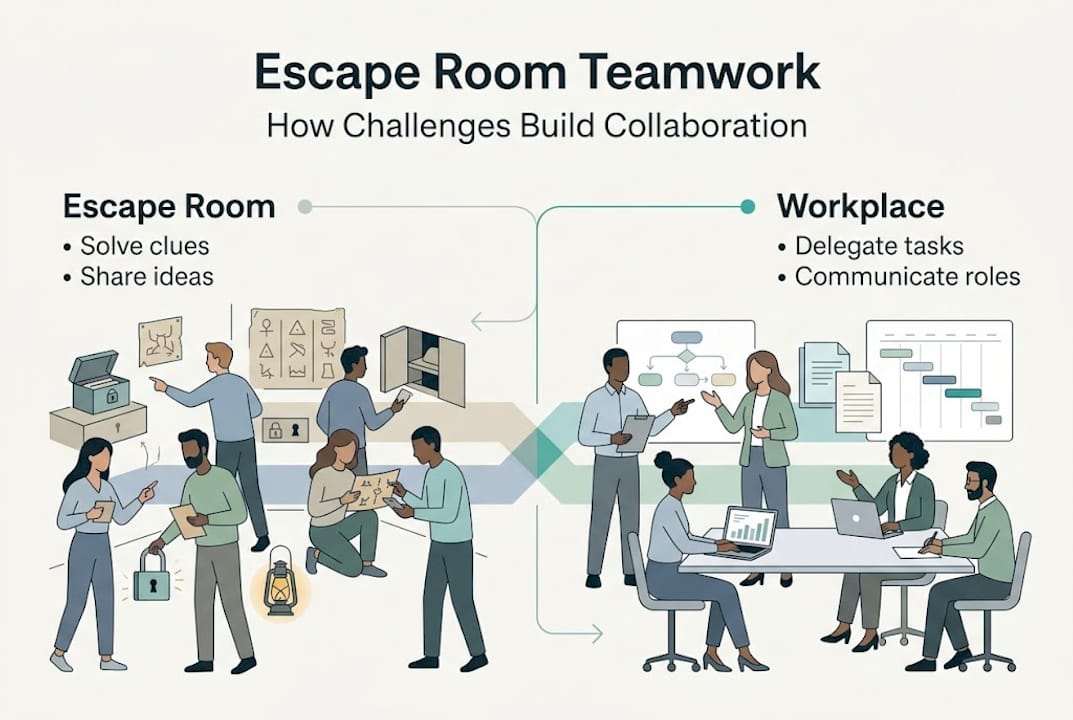
Inside an escape room, every element of the environment is built to force collaboration. The time limit creates urgency. The puzzles are deliberately varied so that no single person can solve everything alone. The shared goal is concrete and immediate: get out before the clock hits zero. This setup creates what psychologists call a high-stakes cooperative environment, a space where people must rely on each other because there is genuinely no other option.
The evidence backs this up. Studies on escape rooms in medical and educational training contexts found 100% of paramedic students agreed the experience reinforced teamwork, while 98% said it strengthened their communication skills. Those numbers are remarkable in any research setting. They suggest escape rooms are not accidentally building teamwork but are structurally designed to do so.
Here is why that matters psychologically. When a group faces a complex, ambiguous problem with a real deadline, individuals naturally begin to self-organize. Leaders emerge. Listeners step up. People who normally stay quiet in meetings suddenly speak because they noticed something others missed. The game rewards every contribution, which creates a feedback loop of psychological safety, the belief that it is safe to speak up without judgment.
“Escape rooms improve teamwork and communication, with nearly all participants in studies reporting these benefits, alongside higher knowledge retention and satisfaction compared to traditional training methods.” — Lancashire Knowledge Repository
Core teamwork skills activated during an escape room:
- Leadership — Someone naturally steps up to coordinate without being assigned to
- Active listening — Missing a clue costs time, so everyone learns to actually hear each other
- Adaptability — Approaches that fail must be dropped fast and replaced with new ones
- Conflict resolution — Disagreements need quick, productive resolution when the clock is ticking
- Shared accountability — Winning or losing belongs to the whole group, not one person
| Teamwork metric | Before escape room | After escape room |
|---|---|---|
| Self-reported communication clarity | Moderate | High |
| Willingness to share ideas | Low to moderate | High |
| Perceived team cohesion | Variable | Significantly improved |
| Comfort with leadership roles | Low for most | Noticeably increased |
These shifts happen because escape rooms are not simulations of teamwork. They are actual teamwork, compressed into a format where every skill gap becomes immediately visible and every strength gets rewarded in real time. For teams in Colorado Springs looking for a way to cut through the noise of traditional icebreakers, this is a fundamentally different starting point.
How escape room challenges mirror real-world collaboration
The structure of a well-designed escape room is not random. It is built around the same dynamics that determine whether a project team succeeds or a department falls apart. Once you see the parallels, it changes how you experience the game and how you apply the lessons afterward.
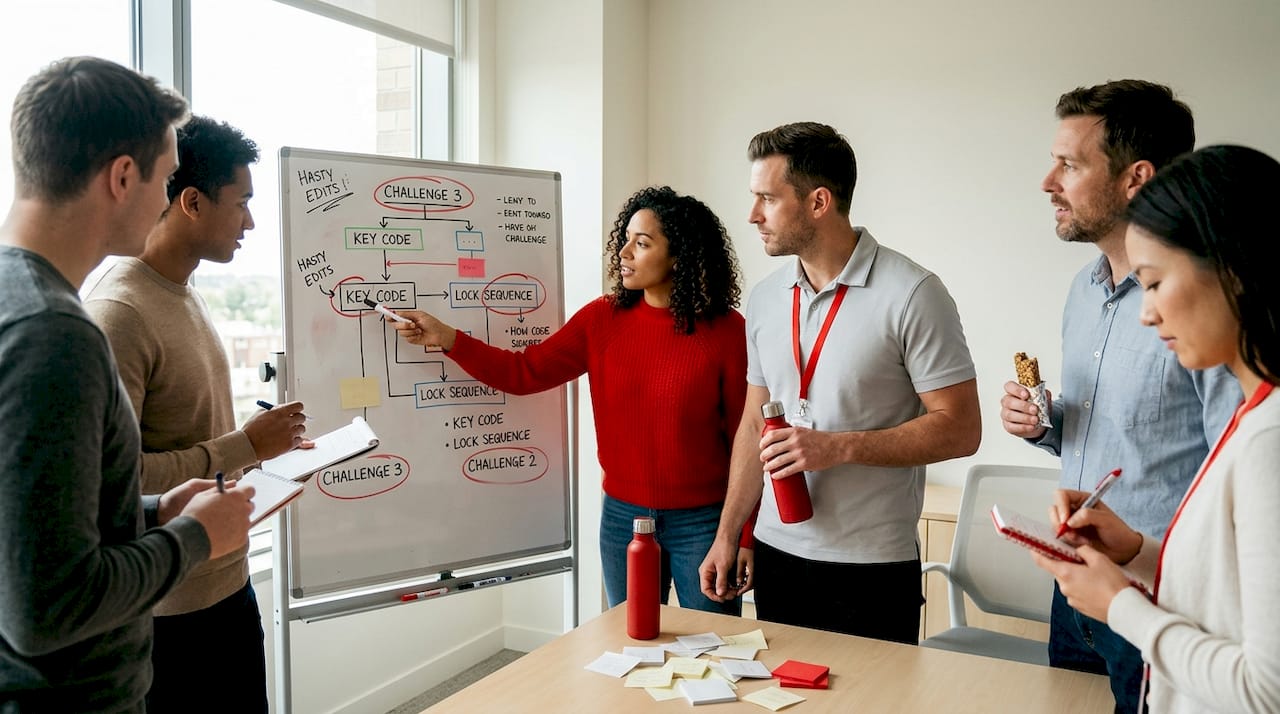
Consider puzzle distribution. In most escape rooms, multiple puzzles are available simultaneously. A team that clusters around one puzzle while ignoring others wastes time and creates bottlenecks, exactly the same problem that appears when a work team assigns too many people to one task while others stall. Effective teams in escape rooms intuitively learn to split up, tackle separate problems in parallel, and reconvene when they need each other. This mirrors the parallel workstreams that define successful project management in real organizations.
Role assignment follows a similar pattern. Early in the game, teams with no designated leader often flounder. Then someone takes charge, perhaps not the most senior person in the room, and momentum returns. This rotating leadership dynamic is exactly what escape room challenges are built to produce. Research on escape rooms in educational settings confirms higher knowledge retention in participants, which suggests the lessons from those leadership moments actually stick.
How a typical escape room session unfolds:
- Entry and orientation — The team absorbs the room’s theme and rules together, which forces early communication about what each person notices
- Initial exploration — Members scatter to search the room, and the first natural leaders emerge to coordinate findings
- First puzzle attempt — The group pools information and tries a solution; success or failure shapes how they communicate next
- Mid-game pivot — When the obvious path fails, the team must adapt its approach, which tests flexibility and willingness to listen
- High-pressure final phase — With time running short, communication sharpens, roles clarify, and trust either holds or breaks
- Escape or debrief — Win or lose, the experience is vivid enough that everyone remembers exactly what helped and what did not
| Escape room task | Workplace equivalent |
|---|---|
| Splitting puzzles among team members | Delegating tasks across a project team |
| Communicating clue findings to the group | Sharing updates in a team standup |
| Deciding when to ask the game master for a hint | Knowing when to escalate to a manager |
| Adapting after a wrong answer | Pivoting strategy after a failed initiative |
| Celebrating a solved puzzle together | Recognizing team wins publicly |
Pro Tip: If you are using an escape room specifically for leadership development, brief your team before the session. Tell each person they will play a leadership role at least once during the game. This small instruction shifts people from passive participants to active contributors and produces much richer post-game conversations about leadership style.
What can go wrong: Common team pitfalls and solutions
Escape rooms are powerful tools, but they are not magic. The same group dynamics that cause friction in a workplace can surface inside a locked room, sometimes more intensely. Understanding what can go wrong helps you prepare for it rather than be surprised by it.
The biggest risk is personality imbalance. When one or two people dominate the experience, quieter team members disengage. They stop sharing ideas, stop searching for clues, and essentially become spectators. The team loses their input entirely, which is both a real-time disadvantage and a missed learning opportunity. Research confirms that high narcissistic rivalry within a team actively reduces cohesion and overall performance, even in cooperative settings where you would expect people to work together.
Room design also plays a role. If an escape room has one dominant puzzle track with limited parallel tasks, some team members will find themselves with nothing meaningful to contribute. This creates frustration and reinforces existing power imbalances rather than challenging them.
“Design flaws like poor task distribution or excessive pressure can cause frustration and undermine the collaborative benefits escape rooms are meant to produce.” — Behavioral Sciences, MDPI
Top three teamwork pitfalls in escape rooms:
- One person takes over — A single dominant voice shuts down contributions from others and skews the experience toward individual achievement rather than team success
- Poor communication loops — Team members solve clues in isolation without sharing findings, creating duplicated effort and wasted time
- Inaction under pressure — When stress peaks near the time limit, some groups freeze rather than delegate quickly, collapsing their earlier coordination
Pro Tip: Before planning a team-building escape room session, assign someone in your group a specific role as a “communication anchor.” This person’s only job is to make sure everyone is heard and that solved clues get shared with the whole team. It is a simple intervention that prevents the most common collapse point.
You can also ask the game master or venue coordinator ahead of time whether the room has multiple parallel puzzles. Rooms with diverse, simultaneous challenges naturally distribute effort across a larger team and reduce the chance that one or two people dominate the whole session.
Maximizing the teamwork benefits of escape rooms
Getting the full value out of an escape room experience requires a little intentionality before, during, and after the session. Teams that treat it purely as entertainment walk away entertained. Teams that treat it as a practice ground for collaboration walk away with something they can actually use.
The preparation phase matters more than most people realize. Before the session, spend five minutes as a group setting a shared intention. This does not have to be formal. Simply asking “What is one thing we want to practice as a team today?” creates a frame that makes the experience significantly more purposeful. Brief every participant so no one feels blindsided by the format. Research on facilitated teamwork activities confirms that nuanced facilitation, including pre-activity setup, is essential to mitigate dominant personalities and ensure positive outcomes for the whole group.
During the session, rotate who is leading the coordination, especially if the group has a natural tendency to defer to one person. Encourage people to say their observations out loud, even if they seem uncertain. In an escape room, a half-formed idea shared openly is almost always more valuable than a fully formed idea kept private.
Three practical steps for maximizing teamwork gains:
- Pre-session intention setting — Ask each person to name one collaboration habit they want to practice, such as speaking up earlier, listening longer, or leading under pressure. Writing it down, even on a phone, increases follow-through.
- In-session role rotation — Assign a “puzzle lead” for the first 15 minutes, then rotate the role. This ensures multiple people experience coordination responsibility and prevents one person from carrying the whole session.
- Structured debrief afterward — Spend 10 to 15 minutes after the room asking three questions: What worked well? What did we miss? What would we do differently? This conversation transforms a fun experience into a genuine learning moment.
Pro Tip: After the session, ask the game master for specific observations about how your team communicated. Most experienced game masters watch dozens of groups each week and can offer direct, non-judgmental feedback about moments where your team’s communication broke down or excelled. This real-time professional perspective is something no boardroom exercise can replicate for team-building escape room activities.
The debrief step is where most teams leave the most value on the table. The experience inside the room generates vivid, shared memories. Talking about those memories immediately afterward, while they are still fresh, converts raw experience into transferable insight. Skip the debrief and you have had a good time. Include it and you have built a stronger team.
Why escape rooms work better than traditional team-building
Here is an honest observation after watching hundreds of groups walk through themed rooms: traditional team-building activities often feel like work dressed up as play. The trust falls, the personality assessments, the ropes courses, all of them signal that your organization wants you to bond on command. People go through the motions because they are supposed to, not because anything real is at stake.
Escape rooms are different because the stakes feel genuine, even though everyone knows it is a game. When you are three minutes from the time limit and your team is still missing one code, nobody is thinking about office politics or performance reviews. They are thinking about the puzzle in front of them. That psychological shift, from social performance to actual problem-solving, is where real collaboration lives.
We have seen teams in Colorado Springs arrive at our rooms as polite strangers and leave as people who genuinely know how each other thinks. That does not happen in a conference room. It happens when people share a real challenge, make real decisions under pressure, and either succeed or fail together. The experience is too vivid to forget and too honest to fake. That is the real reason escape rooms produce teamwork outcomes that stick long after the session ends.
Experience teamwork in action at CodeBusters Escape Room
You have seen what the research says. You understand how escape rooms train collaboration, what pitfalls to avoid, and how to get the most from every session. Now it is time to put that knowledge to work.
CodeBusters Escape Room in Colorado Springs offers themed rooms built for exactly this kind of experience. Whether your group is a corporate team looking to sharpen communication, a group of friends exploring something genuinely challenging, or an organization investing in real team development, our private room bookings give you the space to collaborate without distractions. From the immersive “Stranger 80’s” to the high-stakes “Flight of Deception,” every room is designed to activate the teamwork skills this article covers. Book a team-building escape room with us and see what your team is actually capable of.
Frequently asked questions
Do escape rooms really improve teamwork?
Research shows escape rooms significantly boost teamwork and communication skills, with approval rates reaching 100% among participants in professional training studies. The structured pressure of a shared puzzle environment accelerates real collaboration far faster than most traditional methods.
What kinds of teams benefit most from escape rooms?
Teams with open communication and genuine willingness to collaborate see the strongest improvements, while groups with high narcissistic rivalry or dominant personalities may see fewer benefits unless guided through the experience with intentional facilitation.
How can escape room experiences be made most effective for team building?
Using a facilitator, rotating leadership roles during the session, and running a structured debrief afterward all make the teamwork gains much more substantial, since nuanced facilitation is specifically shown to prevent dominant personalities from undermining the group experience.
Are escape rooms suitable for all group sizes?
Most escape rooms are ideal for small to medium teams, typically 3 to 8 people, to ensure every participant has puzzles to solve and meaningful involvement throughout the session.