Escape room terminology explained for Colorado Springs players

Walking into your first escape room, you hear terms like red herring, meta puzzle, and Game Master tossed around by staff and experienced players. These words sound mysterious, maybe even intimidating. But understanding escape room terminology transforms confusion into confidence, helping you solve puzzles faster and enjoy the experience more fully. Whether you’re a first-timer or a returning enthusiast at escape rooms in Colorado Springs, knowing the language of escape games gives you a strategic edge. This guide breaks down essential terms, explains how they affect gameplay, and shows you how to use this knowledge during your next adventure.
Table of Contents
- Key takeaways
- Understanding core escape room puzzle terms
- Escape room game roles and facilitation terms
- Escape room design styles and puzzle generations
- Maintaining game flow and puzzle logic in escape rooms
- Explore Colorado Springs escape rooms with CodeBusters
- Frequently asked questions about escape room terminology
Key Takeaways
| Point | Details |
|---|---|
| Puzzle term mastery | Understanding common terms like red herring, meta puzzle, and Game Master helps you navigate rooms more quickly and solve puzzles with confidence. |
| Room design impact | The layout and design types influence how teams interact with puzzles and with each other during play. |
| Hints and teamwork | Strategically using hints and coordinating with teammates boosts success rates and maintains game flow. |
| Game Master role | The Game Master role guides safety, pacing, and when to request clues, shaping your overall experience. |
Understanding core escape room puzzle terms
Escape rooms pack their experiences with specialized vocabulary that describes how puzzles function and interact. Red herrings are deceptive clues designed to divert players’ attention, testing your focus and decision-making under time pressure. These false leads might be random objects, misleading numbers, or props that look important but serve no purpose in solving the room. Recognizing red herrings quickly keeps your team from wasting precious minutes chasing dead ends.
The meta puzzle is a large puzzle composed of solutions from smaller puzzles, often signaling the room’s climax and requiring you to synthesize everything you’ve learned. Think of it as the final boss in a video game. You might collect letter fragments throughout the room that only make sense when assembled at the end, revealing a code or password. Meta puzzles reward teams who organize their discoveries and communicate effectively about patterns they’ve noticed.
Easter eggs add delightful surprises without affecting your escape success. These optional secrets reference pop culture, reward curiosity, or provide backstory details that enrich the narrative. You might find a hidden message behind a painting or discover a joke written inside a drawer. Easter eggs create memorable moments and give returning players fresh details to discover, even in rooms they’ve completed before.
Pro Tip: If your team spends more than three minutes on a single element without progress, it’s likely a red herring. Move to another puzzle and circle back if needed.
False leads differ slightly from red herrings because they might initially seem connected to a puzzle but ultimately lead nowhere productive. The key distinction lies in recognizing when to abandon a path. Experienced players develop instincts for spotting these traps by asking whether an item connects logically to the room’s theme or if it feels randomly placed. This discernment skill improves dramatically with practice across multiple expert escape room terminology encounters.
Escape room game roles and facilitation terms
The Game Master serves as your guide, safety monitor, and hint provider throughout the experience. This Game Master oversees the game, provides hints called nudges or clues, and monitors your progress through cameras and microphones installed in the room. They ensure you stay safe, follow rules, and don’t damage props while maintaining the delicate balance between letting you struggle productively and preventing total frustration. Good Game Masters read team dynamics expertly, knowing when to intervene and when to let you work through challenges independently.

Hints come in varying levels of specificity, from gentle nudges pointing you toward overlooked areas to direct solutions when time runs critically short. Some facilities offer unlimited hints, while others limit you to three or impose time penalties for each request. Teams using hints strategically have 40% higher success rates because they maintain momentum instead of hitting frustrating dead ends. The art lies in requesting help before your entire team loses morale, not after you’ve wasted fifteen minutes in confusion.
Communication forms the backbone of successful escape room experiences. Your team should constantly share discoveries, voice observations about potential connections, and update everyone on puzzle progress. When someone finds a key, they announce it immediately. When you solve part of a code, you tell the group. This constant information flow prevents duplicate efforts and ensures everyone contributes their unique perspective to challenges.
Pro Tip: Request your first hint around the 20-minute mark if you’re completely stuck. This timing maintains flow without giving up too early or waiting until escape becomes impossible.
The Game Master’s facilitation extends beyond hint delivery to creating atmosphere through lighting adjustments, sound effects, and theatrical elements timed to your progress. They might dim lights when you enter a spooky section or play ominous music as you approach the final puzzle. This invisible choreography at escape room facilitation venues enhances immersion without breaking the fourth wall. Understanding their role helps you appreciate the craftsmanship behind your experience and builds trust in asking for assistance when genuinely needed. The best Game Masters make you feel clever for solving puzzles while subtly steering you away from frustration through perfectly timed escape room glossary interventions.
Escape room design styles and puzzle generations
Room architecture dramatically affects how teams approach challenges and divide labor. Linear rooms have sequential puzzles unlocking the next, forcing your entire group to focus on one challenge before progressing. This design works beautifully for smaller teams or players who prefer unified problem-solving. You complete puzzle A to unlock puzzle B, which reveals puzzle C, creating a clear progression path with defined milestones. Linear structures prevent teams from feeling overwhelmed by too many simultaneous options.
Non-linear rooms offer multiple parallel paths, allowing team members to split up and tackle different puzzles simultaneously. This escape room design styles approach suits larger groups who want everyone actively engaged rather than watching one person work. You might have three people decoding a cipher while two others search for hidden compartments and another solves a mechanical puzzle. Non-linear designs require stronger communication because discoveries in one area often connect to puzzles elsewhere.
Room splitting takes non-linear design further by physically separating team members into different spaces. You might have players locked in separate chambers who must share information verbally to solve interconnected puzzles. This format creates exciting tension and forces clear communication since you can’t simply point at objects or show teammates what you’ve found. Room splitting works exceptionally well for corporate team building because it reveals communication strengths and weaknesses under pressure.
| Design element | Linear rooms | Non-linear rooms |
|---|---|---|
| Puzzle sequence | One at a time, sequential | Multiple simultaneous paths |
| Team size | Better for 2-4 players | Ideal for 5-8 players |
| Communication needs | Moderate, everyone sees progress | High, constant updates required |
| Difficulty perception | Clear progression markers | Can feel overwhelming initially |
| Replay value | Lower, same path each time | Higher, different strategies possible |
Puzzle technology has evolved significantly over escape room history. Gen 1 puzzles use mechanical locks and keys, creating satisfying tactile experiences with padlocks, combination locks, and physical keys hidden throughout the room. These classic mechanisms provide immediate feedback when you input correct solutions, with the rewarding click of a lock opening. Generation 1 designs feel intuitive because they mirror real-world security devices most people understand instinctively.
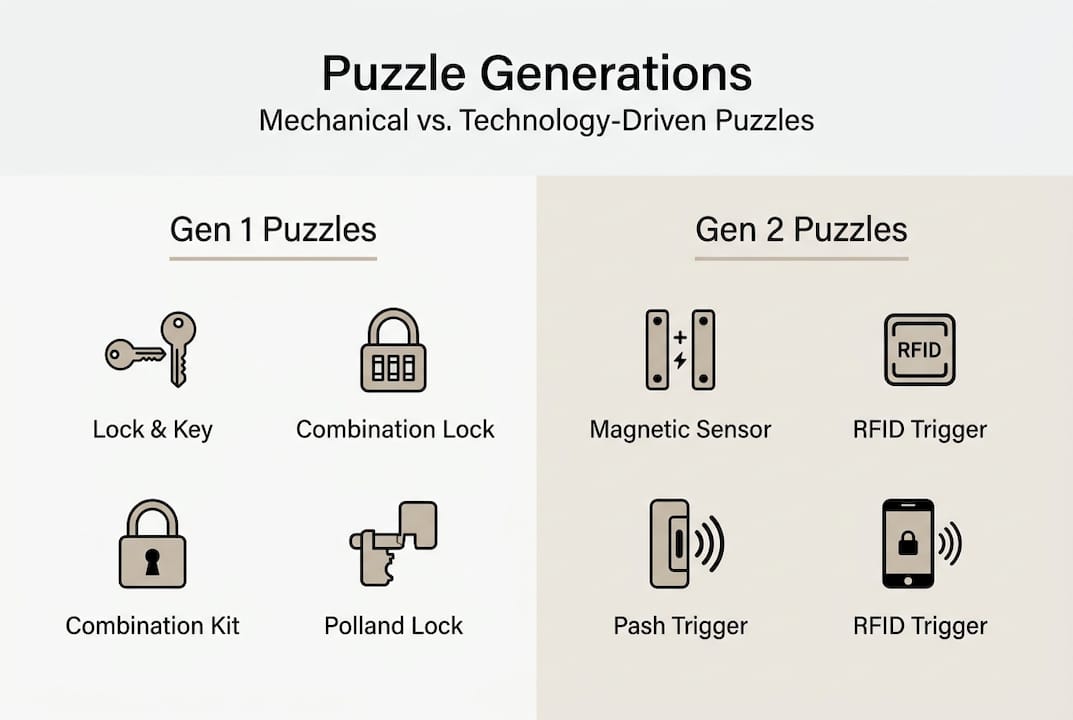
Generation 2 puzzles incorporate technology like magnetic sensors, RFID tags, and electronic triggers that respond to specific inputs. You might place objects on particular spots to activate mechanisms, use UV lights to reveal hidden messages, or trigger audio cues by solving digital interfaces. These puzzle generation differences create more theatrical moments and allow complex chain reactions impossible with purely mechanical systems. Technology enables designers to craft elaborate reveals, like walls sliding open or hidden compartments emerging from seemingly solid surfaces.
Pro Tip: Large groups should specifically request non-linear rooms when booking to ensure everyone stays actively engaged throughout the experience.
Most modern facilities blend both generations, using mechanical puzzles for tactile satisfaction and technological elements for dramatic reveals. This hybrid approach at escape room puzzle types venues delivers varied experiences that appeal to different player preferences. Some people love the straightforward logic of combination locks, while others thrill at discovering how electronic sensors respond to creative solutions. Understanding these distinctions helps you choose rooms matching your group’s interests and technical comfort levels.
Maintaining game flow and puzzle logic in escape rooms
Game flow describes the natural rhythm where puzzles and narrative advance without frustrating blockages. Flow is the natural rhythm of the game where puzzles and narrative advance smoothly, keeping players immersed in the story rather than stuck in confusion. Perfect flow feels like surfing a wave, with each solved puzzle naturally leading to the next challenge. You maintain momentum, experience steady dopamine hits from small victories, and reach the climax with time pressure that feels exciting rather than defeating.
Logical coherence ensures every puzzle’s solution path remains discoverable through observation and reasoning. Designers achieve this through the 10-Team Rule limiting hints needed per puzzle step, meaning if more than one in ten teams requires assistance on a particular element, the puzzle needs redesign. This standard ensures challenges remain fair while still difficult. Logical coherence requires visible keys or clear solution paths, even if they’re cleverly hidden. You should never need to guess randomly or try every possible combination without clues pointing toward the answer.
Well-designed rooms telegraph information through visual hierarchy, thematic consistency, and progressive difficulty. Important objects often appear in prominent positions, match the room’s aesthetic, or get highlighted through lighting. If you’re solving a Victorian-era mystery, the critical clue won’t be a modern smartphone unless the anachronism serves a deliberate narrative purpose. This coherence helps players distinguish meaningful elements from decorative props.
“The best escape rooms create flow states where players lose track of time, fully absorbed in puzzle-solving without hitting walls that break immersion. Every element should guide players toward solutions through discoverable logic, not arbitrary leaps.”
Players can actively maintain flow through several strategic approaches:
- Assign a team organizer who tracks which puzzles remain unsolved and prevents duplicate efforts on already-completed challenges.
- Establish a central staging area where you place all discovered items, codes, and clues so everyone can reference them easily.
- Verbally confirm when you’ve fully solved something and which elements you’ve determined are red herrings or decorative props.
- Set a mental timer for three to five minutes per puzzle attempt before moving to a different challenge or requesting a hint.
- Rotate team members between puzzles periodically so fresh eyes examine each challenge and prevent tunnel vision.
The relationship between flow and logical coherence creates the magic of great escape rooms. When designers craft escape room design principles that respect player intelligence while still challenging their skills, you experience that perfect balance of difficulty and achievement. Poor flow results from illogical leaps, hidden elements with no clues pointing toward them, or puzzles requiring specialized knowledge most people lack. Understanding these concepts helps you identify whether you’re missing something discoverable or facing a design flaw, informing when to push harder versus when to request assistance. Applying applying escape room strategies based on flow principles transforms your approach from random searching to methodical problem-solving.
Explore Colorado Springs escape rooms with CodeBusters
Now that you understand the terminology shaping escape room experiences, put your knowledge into practice at CodeBusters escape rooms in Colorado Springs. Our facility features diverse themed rooms spanning both generation 1 mechanical puzzles and generation 2 technology-driven challenges, giving you opportunities to experience every concept discussed in this guide. You’ll encounter meta puzzles that reward careful observation, work with expert Game Masters who understand perfect hint timing, and navigate both linear and non-linear room designs.

Our veteran-owned business takes pride in crafting logical, flow-optimized experiences where every puzzle follows discoverable solution paths. Whether you’re testing your skills in our Stranger 80’s room or unraveling mysteries in Past to the Future, you’ll recognize the terminology in action. Book your session today and experience firsthand how understanding escape room language enhances your puzzle-solving abilities, team communication, and overall enjoyment. Private bookings ensure your group gets dedicated attention from our Game Masters, and our award-winning rooms deliver memorable adventures for families, friends, and corporate teams alike.
Frequently asked questions about escape room terminology
What is a red herring and how should players handle it?
A red herring is a deliberately misleading clue or object placed to test your focus and decision-making skills. If you spend more than three minutes examining something without finding connections to other puzzles, it’s likely a red herring. Move on to other challenges and return later if you discover new context that makes it relevant.
How does the Game Master assist without giving away answers?
Game Masters provide hints ranging from gentle nudges pointing toward overlooked areas to more direct guidance when time runs short. They monitor your progress through cameras and microphones, intervening strategically to maintain flow without robbing you of the satisfaction of solving puzzles independently. Good Game Masters read team dynamics and adjust hint specificity based on your frustration levels and remaining time.
What makes a puzzle a meta puzzle, and why is it important?
A meta puzzle combines solutions from multiple smaller puzzles you’ve solved throughout the room, typically serving as the final challenge before escape. It’s important because it rewards teams who organize discoveries, communicate effectively, and recognize patterns connecting seemingly unrelated elements. Meta puzzles create satisfying climaxes where everything suddenly makes sense.
What differences should new players expect between Gen 1 and Gen 2 puzzles?
Generation 1 puzzles use mechanical locks, keys, and combination locks that provide immediate tactile feedback when solved correctly. Generation 2 puzzles incorporate electronic sensors, magnetic triggers, and digital interfaces that enable more theatrical reveals like walls sliding open or hidden compartments emerging. Most modern rooms blend both types for varied experiences.
How can teams maintain flow if stuck on a puzzle step?
Request a hint before your entire team loses morale, typically around the 20-minute mark if completely stuck. Rotate team members between puzzles so fresh eyes examine each challenge, establish a central area for discovered items, and set mental timers of three to five minutes per puzzle attempt before switching focus. Communication about what you’ve tried prevents duplicate efforts and maintains momentum.