How to unlock team building success with escape room workflows

Most team-building events end with a free lunch, a few awkward icebreakers, and zero lasting change. Your team sits through another offsite activity, nods politely, and returns to the same dynamics on Monday morning. The problem isn’t your team. It’s the format. Escape rooms, when used with a clear workflow, change the equation by putting people inside a challenge they genuinely have to solve together. This guide walks Colorado Springs corporate teams through every step: understanding the value, preparing smart, executing well, and reviewing results so each event builds on the last.
Table of Contents
- Understanding team building with escape rooms
- Preparing for your team-building workflow
- Step-by-step: Executing the team building workflow
- Review and troubleshoot: Maximizing your results
- Our take: When escape rooms work and when they don’t
- Ready to transform your next team event?
- Frequently asked questions
Key Takeaways
| Point | Details |
|---|---|
| Escape rooms boost engagement | Immersive challenges make escape rooms highly engaging for team collaboration. |
| Proper planning is crucial | Align your team goals with the right escape room setup for the best results. |
| Debrief for improvement | Review feedback after the event to maximize learning and future outcomes. |
| Consider team size | Escape rooms work best with small groups but can be scaled with adjustments. |
Understanding team building with escape rooms
Escape rooms are timed, puzzle-based experiences where groups work together to solve clues, find hidden objects, and complete a narrative challenge before the clock runs out. Unlike a workshop where someone lectures at your team, an escape room puts everyone in the same high-stakes moment. That shared pressure is exactly what makes collaboration visible.
The appeal is real. Escape rooms force people to communicate under pressure, divide tasks quickly, and trust each other’s instincts. You can’t fake participation when the clock is ticking. But the format also has documented limits. Only 30% of companies find escape rooms effective for team building due to engagement but also stress and limited scalability.
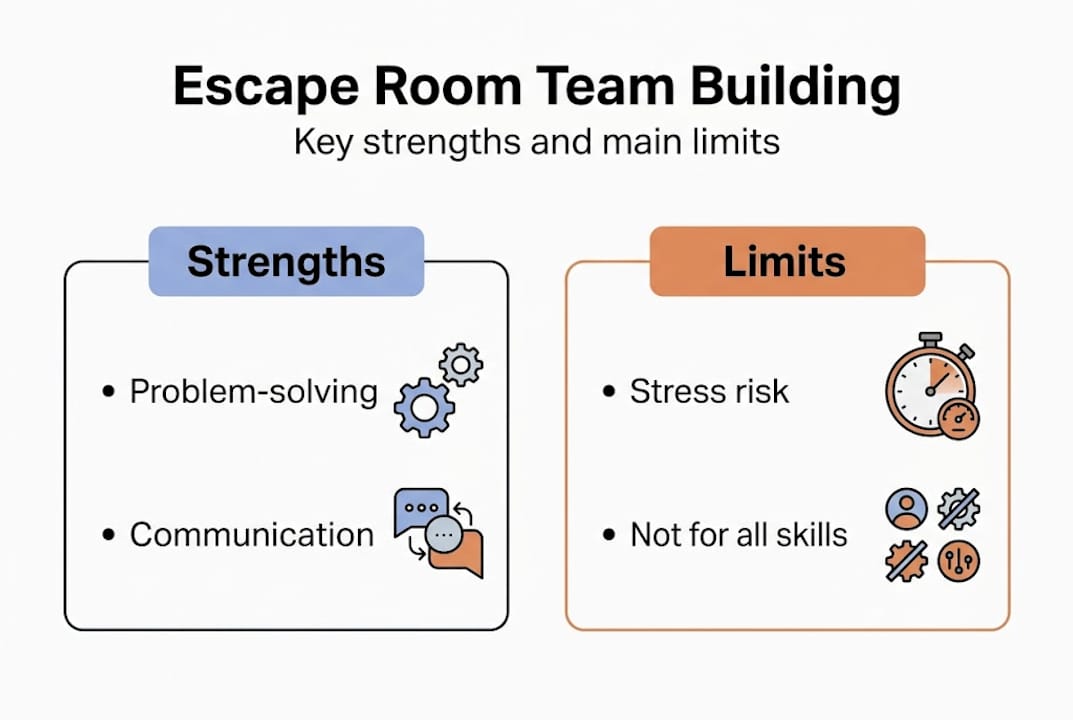
That stat is worth sitting with. It doesn’t mean escape rooms are a bad idea. It means they work best when the team-building goals are clearly matched to what escape rooms actually do well.
Where escape rooms excel vs. other formats
| Format | Best for | Limitations |
|---|---|---|
| Escape rooms | Problem-solving, communication under pressure | Stress, small groups, not for soft skills |
| Workshops | Interpersonal development, conflict resolution | Low engagement, passive learning |
| Volunteering | Culture, empathy, shared values | Hard to tie to business objectives |
| Creative challenges | Innovation, morale | Less structured outcomes |
When comparing escape rooms to other formats, the clearest wins come in problem-solving speed, cross-functional communication, and decision-making under time pressure. These are skills that directly translate to project deadlines, client crises, and fast-moving priorities.
Escape rooms work best when your goals include:
- Improving how quickly your team shares information
- Building trust between new team members or cross-department groups
- Identifying natural leaders and problem-solvers in an unscripted setting
- Creating a shared experience that generates real conversation afterward
They’re a poor fit when the goal is emotional intelligence training, conflict mediation, or building skills that require reflection over speed. Knowing this upfront saves you from a session that leaves people drained instead of energized.
Preparing for your team-building workflow
The difference between a forgettable escape room outing and a genuinely useful team-building event comes down almost entirely to preparation. Most companies skip this step and wonder why the energy fades by Tuesday.
Start by writing down your primary objective in one sentence. Is it about improving how your team communicates during high-pressure projects? Is it about integrating a new department? Is it about simply creating a shared positive experience that reinforces company culture? Your answer shapes every other decision.
Escape rooms may not suit all goals, particularly interpersonal skills, but proper planning can align experiences with objectives. That alignment starts with honest goal-setting before you book anything.
Key prep checklist
- Define your primary objective (problem-solving, communication, trust-building)
- Confirm group size and check room capacity limits
- Assess accessibility needs for all participants
- Choose a difficulty level that challenges but doesn’t overwhelm
- Set aside debrief time after the session
- Communicate the purpose to participants in advance
Matching room themes to corporate goals
| Corporate objective | Recommended room type | Reason |
|---|---|---|
| Cross-department collaboration | Complex narrative rooms | Require multiple roles to succeed |
| New team integration | Mid-difficulty, story-driven | Lowers anxiety, focuses on teamwork |
| Leadership development | High-difficulty rooms | Stress-tests decision-making |
| General morale boost | Fun, themed experiences | Low stakes, high enjoyment |
For Colorado Springs escape rooms, themed options like “Stranger 80’s” or “Flight of Deception” each offer different challenge profiles. Matching the narrative style to your team’s dynamic matters more than most HR guides admit.
Pro Tip: For groups between 6 and 10 people, split into two smaller teams and run simultaneous rooms if available. Smaller groups reduce social loafing, where team members unconsciously contribute less when surrounded by others, and generate richer debrief conversations when the groups compare experiences afterward.
Step-by-step: Executing the team building workflow
A well-run escape room session doesn’t just happen. It follows a sequence that sets the team up for success before, during, and after the clock starts.
Your execution workflow:
- Brief the team before entering. Spend 10 minutes explaining the purpose of the session. Not just “we’re doing an escape room today” but why this experience connects to real work goals.
- Assign roles before the session starts. Designate a team leader (decision-maker under pressure), a communicator (keeps information flowing), and a problem-solver (digs into puzzles). Rotate these roles if you’re doing multiple rooms.
- Set a collaboration intention. Ask each person to name one communication habit they want to practice. This primes the brain for reflection during the experience.
- Let the facilitator brief you. Listen carefully to room rules and objectives. Don’t rush this step.
- During the room, prioritize vocal communication. Encourage team members to say what they’re seeing out loud, even if it seems obvious.
- Debrief immediately after. Use the 15 minutes following the experience while impressions are fresh.
The escape room experience itself creates the raw material. Your facilitation turns it into learning.
Escape rooms are highly engaging but can create pressure, so leaders should actively reduce stress and support all team members. That means framing the session as exploration, not performance.
“The goal isn’t to escape the room. The goal is to notice how your team thinks together.”
Pro Tip: Designate one team member as the “pattern spotter” whose job is to connect clues across the room. This role naturally surfaces analytical thinkers who may not speak up in traditional meetings, giving managers a new data point about team strengths.
Debrief framework (use these four questions):
- What worked well in how we communicated?
- Where did we get stuck, and why?
- Who surprised you, and how?
- What would we do differently at work?
Keep the debrief conversational, not evaluative. You’re building awareness, not grading performance.
Review and troubleshoot: Maximizing your results
The session ended. Now the real work starts. Teams that skip the review phase lose most of the value the experience generated. A structured review turns a fun afternoon into a lasting shift in how people work together.
Some companies cite stressful experiences or limited scale as reasons escape rooms underperform. Reviewing group feedback directly addresses these problems and makes each future event sharper.
Signs your session worked:
- Participants referenced specific moments from the room in the debrief
- People mentioned behaviors they want to carry into work settings
- Laughter and energy remained high throughout the experience
- Cross-department pairs naturally collaborated without prompting
Signs your session needs adjustment:
- Team divided into cliques rather than working as one unit
- One or two people dominated while others disengaged
- Stress visibly derailed collaboration rather than focusing it
- Debrief felt forced or produced only surface-level answers
Adjustment guide based on common issues
| Problem observed | Likely cause | Adjustment for next time |
|---|---|---|
| Domination by one person | No role structure | Assign specific roles before entering |
| Low engagement from quieter members | Wrong difficulty level | Choose a gentler room theme |
| High stress, poor communication | Competitive framing | Reframe as exploration, not winning |
| No transfer to work behaviors | Weak debrief | Extend debrief time, use structured questions |
Collect simple written feedback right after the debrief, before people leave the building. Ask three questions: What did you enjoy most? What felt uncomfortable? What one behavior will you try differently at work? These answers are gold for planning your next session.
Adjust group composition if you’re running repeat events. Mixing departments, seniority levels, and personality types differently each time builds broader team cohesion over time. A single escape room event plants a seed. A recurring program grows the culture.
Our take: When escape rooms work and when they don’t
Here’s something most team-building guides won’t say out loud: the room itself is almost irrelevant. What actually drives team growth is what happens around the room, the framing before you enter, the facilitation during, and the reflection afterward.
We’ve seen groups with deep trust walk out of a hard room laughing, even after failing. We’ve also seen high-performing teams on paper completely fall apart under time pressure because nobody had ever given them a safe space to fail together before. The local escape room insights we’ve gathered consistently point to one truth: psychological safety matters more than puzzle difficulty.
Avoid escape rooms when participation is forced, when the team is already in conflict, or when the group exceeds 20 people without a parallel session structure. These conditions flip the experience from energizing to draining fast.
The teams that get the most from escape rooms are the ones who come prepared to be uncomfortable and curious, not competitive and anxious. Inclusive facilitation and a meaningful debrief aren’t nice extras. They’re the whole point.
Ready to transform your next team event?
If this guide gave you a clearer picture of how to actually run a team-building workflow that sticks, the next step is putting it into practice with an experience designed for exactly this purpose.
Code Busters Escape Room in Colorado Springs offers private bookings, multiple themed rooms, and experiences built for groups of all sizes and difficulty preferences. Whether your team needs a high-pressure challenge or a fun, low-stakes introduction to collaborative problem-solving, there’s a room that fits. Book your escape room in Colorado Springs and bring your workflow to life with an award-winning, veteran and family owned experience your team will actually talk about on Monday.
Frequently asked questions
Are escape rooms suitable for large corporate teams?
Escape rooms work best for small groups of 4 to 8 people, but larger teams can split into parallel sessions running simultaneously. Limited scalability for large groups is a common drawback, so planning parallel rooms in advance is essential for keeping everyone engaged.
What outcomes can we expect from an escape room team-building event?
Teams typically see gains in real-time communication and collaborative problem-solving. Results are strongest when the experience is matched to goals and followed by a structured debrief that connects the experience to actual work behaviors.
How can we reduce stress during escape room activities?
Set clear expectations before the session, form balanced teams, and frame the experience as exploration rather than competition. Supportive facilitation from team leaders significantly reduces pressure and helps quieter members contribute more freely.
Are there team-building alternatives to escape rooms?
Yes. Group volunteering, collaborative workshops, and creative challenges all have strong use cases depending on your team’s core needs. Escape rooms may not fit goals centered on emotional intelligence or interpersonal conflict resolution, where slower, reflective formats tend to deliver better results.