Escape room narrative design: Crafting immersive stories
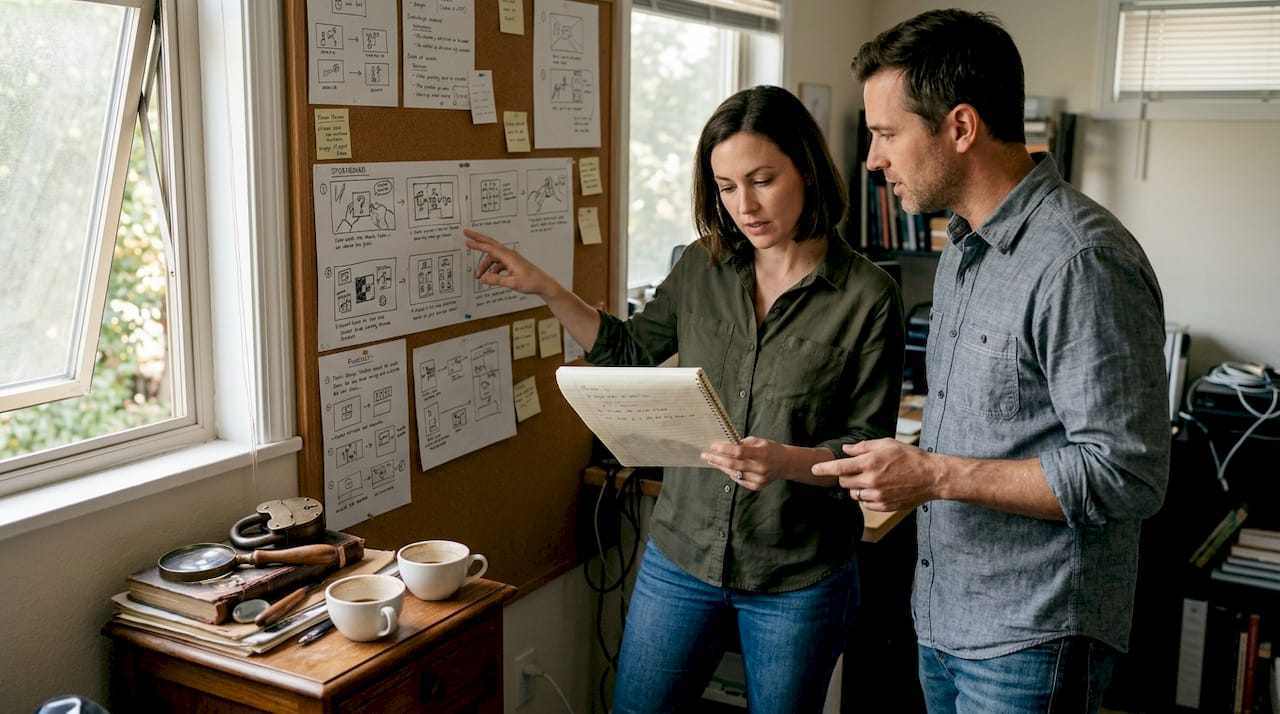
Most players think escape rooms are all about clever puzzles. They focus on locks, codes, and riddles, believing the challenge lies purely in solving mechanical problems. But the truth is, narrative design transforms an escape room into a fully immersive experience that players remember long after they leave. This article will help you understand and apply narrative techniques that turn a series of puzzles into a cohesive, emotionally engaging adventure.
Table of Contents
- Why narrative matters in escape room design
- Elements of escape room narrative design
- Building a difficulty curve for narrative impact
- Integrating puzzles and narrative: Practical techniques
- Common pitfalls and expert tips for narrative designers
- Boost your escape room narrative with expert design
- Frequently asked questions
Key Takeaways
| Point | Details |
|---|---|
| Narrative enhances immersion | Storytelling transforms escape rooms from simple puzzles to engaging adventures. |
| Theme consistency is crucial | Keeping props, puzzles, and context aligned maintains immersion and avoids confusion. |
| Meta-puzzles prevent bottlenecks | Meta-puzzles help converge parallel puzzle threads and keep the narrative flowing. |
| Balance difficulty for impact | A structured difficulty curve matches the emotional arc and keeps players engaged. |
Why narrative matters in escape room design
Narrative gives context and motivation to the puzzles. Without a story, players are just solving disconnected challenges in a decorated room. With narrative, every lock becomes a plot point, every clue advances the story, and every breakthrough feels like a meaningful victory.
Storytelling increases engagement, retention, and player satisfaction. When players care about the characters and outcome, they invest more emotionally in the experience. They work harder, communicate better, and leave with stories they want to share.
Player immersion depends on theme consistency. A well-crafted narrative creates a world players can believe in, even temporarily. Difficulty curves start easy, build to epic climax, engaging multiple cognitive types, ensuring that both the story and puzzle challenge rise together. This synchronization keeps players in flow state, where they’re challenged but not frustrated.
Consider these narrative benefits:
- Emotional investment: Players care about outcomes when story stakes are clear
- Natural pacing: Story beats provide rhythm and recovery moments
- Cognitive diversity: Different puzzle types match different story moments
- Memorable experiences: Stories stick in memory far longer than isolated puzzles
Diverse cognitive challenges matched to the story arc create accessibility. Some players excel at linguistic tasks, others at spatial reasoning. A strong narrative allows you to weave both types naturally into the experience, ensuring everyone contributes.
“The best escape rooms don’t feel like puzzle collections. They feel like living stories where you’re the protagonist making critical choices that matter.”
Clear difficulty curve matches the rise and fall of narrative tension. When your story builds to a climax, your puzzles should too. When your narrative offers a moment of revelation, your puzzle design should provide a corresponding breakthrough. This alignment creates the satisfying rhythm that keeps players engaged from start to finish. Explore meta-puzzle techniques to see how professional designers achieve this synchronization.
Elements of escape room narrative design
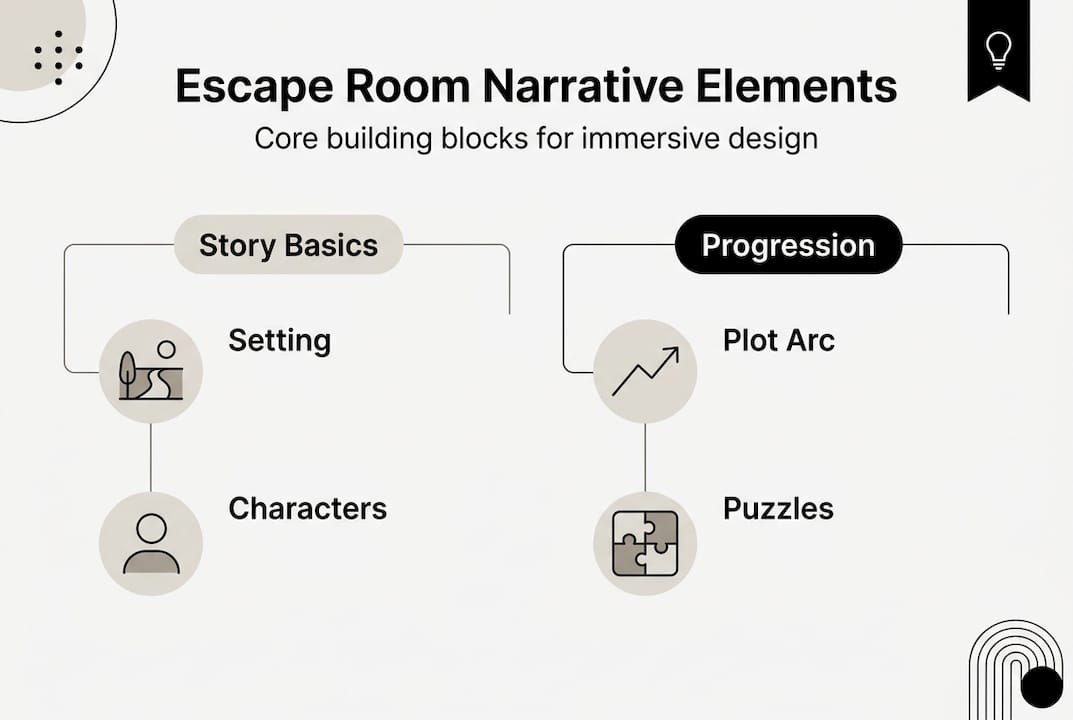
Every compelling escape room narrative starts with a clear setting. Time, place, and backstory establish the world players enter. Are they in a 1920s speakeasy, a futuristic space station, or a medieval castle? The setting determines everything from prop choices to puzzle mechanisms.
Theme creates consistency and mood. Your theme isn’t just decoration, it’s the lens through which players interpret every element. A horror theme demands different lighting, sound design, and puzzle pacing than a comedy adventure. Maintaining this consistency prevents jarring moments that break immersion.
Characters give players roles and relationships. Consider these character types:
- Host characters: The game master or video persona who introduces the story
- Player avatars: The roles players assume (detectives, scientists, thieves)
- Antagonists: The villain or force players work against
- Supporting cast: Characters revealed through notes, recordings, or environmental storytelling
Plot structure follows a proven arc: orientation, escalation, climax, and resolution. Orientation introduces the situation and stakes. Escalation raises tension through complications and discoveries. Climax presents the ultimate challenge. Resolution provides closure and emotional payoff.

Puzzle integration requires parallel threads converging via meta-puzzles. Avoid theme breaks and linear bottlenecks; use meta-puzzles for convergence. This approach lets multiple players work simultaneously on different story threads that eventually connect.
Pro Tip: Create a story bible before designing puzzles. Document your world’s rules, character motivations, and timeline. This reference prevents contradictions and helps you make consistent design choices.
Avoiding theme breaks means every element serves the story. A modern electronic keypad in a Victorian mansion disrupts immersion unless you justify it narratively. Perhaps it’s a time traveler’s device or an anachronistic element that’s part of the mystery. Check out this meta-puzzle overview for examples of how to integrate modern technology into period settings.
| Narrative Element | Purpose | Design Consideration |
|---|---|---|
| Setting | Establishes world rules | Must be immediately recognizable |
| Theme | Creates emotional tone | Consistency across all elements |
| Characters | Provides motivation | Clear roles and relationships |
| Plot Structure | Drives progression | Matches puzzle difficulty curve |
| Meta-Puzzles | Connects story threads | Reveals bigger picture |
Building a difficulty curve for narrative impact
Start easy, build tension, allow breakthroughs, and provide recovery. This wave pattern keeps players engaged without overwhelming them. Your opening puzzles should be accessible, building confidence and establishing the story’s baseline.
Difficulty curve maps onto narrative arc for a satisfying climax. As your story tension rises, puzzle complexity should increase proportionally. Wave pattern: tension, breakthrough, recovery with multiple intelligences ensures that different player strengths shine at different moments.
Parallel engagement means puzzles suit different cognitive strengths. While one player decodes a cipher, another assembles a mechanical device, and a third searches for hidden objects. This simultaneous engagement prevents bottlenecks and keeps everyone invested.
Meta-puzzles bring threads together for final resolution. After players solve individual challenges, they discover these solutions combine into a master puzzle that unlocks the climax. This convergence creates a powerful “aha” moment that feels earned.
Difficulty progression example:
- Minutes 0 to 10: Simple observation puzzles establish setting and rules
- Minutes 10 to 25: Moderate challenges introduce story complications
- Minutes 25 to 45: Complex puzzles with multiple steps raise stakes
- Minutes 45 to 55: Meta-puzzle convergence creates climactic breakthrough
- Minutes 55 to 60: Final revelation and escape provide resolution
AI research struggles hint at the challenge of effective design. Low AI success rates in complex design indicate challenges in balancing narrative and puzzle complexity. Even sophisticated algorithms struggle with the creative integration required for compelling escape room experiences. This underscores why human designers who understand storytelling remain essential.
| Difficulty Phase | Narrative Function | Player Experience | Cognitive Load |
|---|---|---|---|
| Opening | Orientation | Confidence building | Low |
| Rising Action | Complication | Growing challenge | Medium |
| Climax | Ultimate test | Peak engagement | High |
| Resolution | Payoff | Satisfaction | Decreasing |
Statistic: Research shows that escape rooms with clear difficulty curves matching narrative arcs achieve 40% higher player satisfaction scores than those with random puzzle distribution.
See escape room design examples for practical applications of these difficulty curve principles in professional settings.
Integrating puzzles and narrative: Practical techniques
Align puzzle mechanisms with story events. If your narrative involves decoding a spy’s message, use cipher puzzles. If players are archaeologists, incorporate artifact assembly challenges. This alignment makes puzzles feel like natural story progression rather than arbitrary obstacles.
Use meta-puzzles to converge narrative and parallel puzzle tracks. Meta-puzzles are effective for converging parallel threads and maintaining narrative flow. When players realize their separate discoveries combine into a bigger revelation, it creates a powerful narrative moment.
Minimize theme breaks for maximum immersion. Every visible element should support your story world. If you need modern technology for puzzle mechanics, disguise it or justify it narratively. A fingerprint scanner becomes a magical rune reader. A digital timer becomes a countdown device from the story’s era.
Pacing tips: Use brief narrative cues and milestones. Don’t interrupt puzzle solving with long story dumps. Instead, reveal story through:
- Environmental storytelling: Props, decorations, and set dressing that tell stories without words
- Brief audio cues: Short recordings or announcements that advance plot
- Discovery moments: Documents, photos, or objects that reveal backstory when found
- Progressive revelation: Each solved puzzle unlocks a new story fragment
- Milestone celebrations: Brief narrative payoffs after major breakthroughs
Pro Tip: Write your story first, then design puzzles to fit it. Many designers make the mistake of creating cool puzzles and forcing a story around them. This approach leads to disconnected experiences. Start with a compelling narrative, then ask what challenges would naturally arise in that story.
Practical workflow for narrative integration:
- Draft your complete story arc with clear beginning, middle, and end
- Identify key story beats where players need information or make progress
- Design puzzles that naturally occur at those story moments
- Ensure puzzle solutions reveal story information or advance the plot
- Playtest to verify that story and puzzles feel integrated, not separate
Explore meta-puzzle strategies to see how professional designers create seamless integration between narrative and puzzle mechanics.
Common pitfalls and expert tips for narrative designers
Theme breaks disrupt immersion instantly. Modern props in historical rooms pull players out of the story. A plastic water bottle in a medieval dungeon or a contemporary poster in a 1940s office destroys the carefully built atmosphere. Edge case: Avoid theme breaks and linear bottlenecks.
Linear bottlenecks slow group engagement. When only one puzzle is available at a time, most players stand around watching one person work. This creates frustration and disengagement. Design parallel puzzle tracks so everyone contributes simultaneously.
Ignoring multiple intelligences limits accessibility. Not everyone excels at the same puzzle types. Include variety:
- Linguistic puzzles: Word games, ciphers, reading comprehension
- Spatial puzzles: Physical manipulation, pattern recognition, assembly
- Logical puzzles: Deduction, sequencing, cause and effect
- Interpersonal puzzles: Team coordination, communication challenges
- Musical puzzles: Rhythm, tone recognition, audio cues
Pro Tip: Playtest frequently and tweak story-puzzle alignment. Your first design will have gaps where story and puzzles don’t quite mesh. Observe real players and note where they get confused about the narrative or where puzzles feel disconnected from the story. These observations guide your revisions.
Other common mistakes include:
- Overcomplicating the premise: Keep your core story simple and clear
- Hiding critical story information: Players can’t engage with a story they don’t understand
- Inconsistent tone: Mixing comedy and horror confuses emotional investment
- Neglecting the ending: A weak resolution undermines the entire experience
- Forgetting sensory design: Sound, lighting, and even scent contribute to narrative immersion
Learn from escape room design pitfalls to avoid these common mistakes in your own designs.
Boost your escape room narrative with expert design
Professional escape rooms demonstrate advanced narrative design in action. Experiencing well-crafted stories firsthand teaches you techniques that theory alone cannot convey. You see how props support narrative, how pacing feels in real time, and how players respond to story revelations.

Explore themed rooms for practical inspiration. Each professionally designed experience offers lessons in narrative integration, difficulty curves, and immersive storytelling. Notice how puzzles advance the plot, how theme consistency creates believability, and how meta-puzzles bring story threads together. These observations inform your own design work, helping you understand what makes narrative design truly effective. Visit Colorado Springs escape rooms to experience award-winning narrative design that demonstrates these principles in immersive, memorable adventures.
Frequently asked questions
What is an escape room narrative?
An escape room narrative is a storyline that gives context and meaning to the puzzles, creating a cohesive and immersive experience. It transforms disconnected challenges into a unified adventure with emotional stakes.
How can I avoid theme breaks in escape room design?
Choose props and technology that fit your theme, and use meta-puzzles to bring modern elements into the story when needed. Justify any anachronistic elements through narrative rather than ignoring them.
What is a meta-puzzle, and why is it important?
A meta-puzzle links or converges parallel puzzle threads, helping maintain narrative flow and avoiding bottlenecks. It creates satisfying moments when players realize their separate work connects into a bigger picture.
Why do AI studies struggle with escape room narrative design?
AI has low success rates in escape room narrative tasks, showing the complexity and creativity required for effective design. This demonstrates that human storytelling intuition remains essential for crafting compelling experiences.