Escape room history: From puzzles to immersive worlds

The escape room industry is not a passing trend. It is a global phenomenon with over $6.66 billion in market value and a trajectory that keeps climbing. Most people who book a session think about themes, difficulty, and how fast they can solve puzzles. But understanding where escape rooms came from, how the design philosophy shifted, and what forces shaped the industry changes everything about how you play. Once you see the layers underneath the locks and timers, every room becomes a richer, more rewarding experience.
Table of Contents
- From early roots to Japan’s breakthrough
- The escape room boom: Rise and industry transformation
- How escape room design philosophies evolved
- Player impact: How understanding history shapes your escape experience
- What most escape room articles miss: Behind the locks and legends
- Experience the evolution at CodeBusters Escape Room
- Frequently asked questions
Key Takeaways
| Point | Details |
|---|---|
| Japan’s 2007 breakthrough | The modern escape room explosion began with the first commercial game in Japan. |
| Global growth and resilience | Escape rooms have become a $6.66B industry by adapting to new tech and audience trends. |
| Evolving puzzle design | Rooms now emphasize story-driven, fair, and non-linear puzzle experiences. |
| Player awareness matters | Understanding history helps players pick and appreciate top-quality escape experiences. |
From early roots to Japan’s breakthrough
Before the first timer ever counted down in a purpose-built escape room, the seeds of the format were already growing across multiple entertainment traditions. Point-and-click adventure games from the 1980s and 1990s trained players to think in terms of inventory, environmental clues, and logical sequences. Immersive theater productions asked audiences to participate rather than observe. Haunted attractions added physical stakes and spatial storytelling. Each of these traditions contributed something essential to what escape rooms would eventually become.
The debate over the true origin of escape rooms is more interesting than most people realize. 5 Wits opened an early interactive puzzle attraction in 2004, but it was replayable and not focused on escape. That distinction matters enormously. A replayable attraction is entertainment. A one-shot, timed escape challenge is a game with real psychological stakes. The pressure of failure, the non-repeatable nature of the experience, and the social dynamic of a group racing against a clock are what define the format.
“The escape room format is not just about puzzles. It is about the feeling of being genuinely trapped and the satisfaction of earning your freedom.”
Consensus places the first true escape room in Japan in 2007, created by Takao Kato of the company SCRAP. His design introduced the core mechanics that still define the format today: a locked room, a countdown clock, physical puzzles embedded in the environment, and a group of players who must collaborate to escape. From Japan, the format spread rapidly to Hungary, then across Europe, and eventually to North America.
Here is a quick comparison of the two most cited early formats:
| Feature | 5 Wits (2004) | SCRAP Japan (2007) |
|---|---|---|
| Replayable | Yes | No |
| Escape mechanic | No | Yes |
| Timed countdown | No | Yes |
| Group collaboration focus | Partial | Core mechanic |
| Considered a true escape room | No | Yes |
The key milestones in global spread followed a clear pattern:
- Japan (2007): SCRAP launches the first true escape room format.
- Hungary (2011): Parapark opens, sparking European expansion.
- United States (2012): First US facilities appear in San Francisco and Seattle.
- Global saturation (2015 to 2019): Thousands of venues open worldwide.
- Post-pandemic stabilization (2021 to 2025): Industry matures and consolidates.
The escape room boom: Rise and industry transformation
Once the modern escape room blueprint emerged, its proliferation sparked a boom and a transformation. The numbers tell a compelling story. US facilities stabilized at around 2,000 by December 2025, with estimated annual revenue of $300 million, and the global market is projected to double by 2032.
The global escape room market is currently valued at over $6.66 billion. That figure puts it in the same conversation as other major leisure industries, and it did not happen by accident.
Several factors explain the industry’s resilience:
- Group experience demand: Escape rooms fill a gap that streaming and solo gaming cannot. They require physical presence and real-time collaboration.
- Technology integration: Magnetic locks, RFID puzzles, projection mapping, and app-connected clue systems have raised production values dramatically.
- Hybrid and VR formats: Industry growth has been driven by new immersive tech, franchise chains, and hybrid models that blend physical and digital elements.
- Corporate adoption: Team-building bookings now represent a significant revenue stream for many venues.
| Year | Estimated US Facilities | Key Trend |
|---|---|---|
| 2014 | ~22 | Early adopter phase |
| 2017 | ~2,300 | Peak growth period |
| 2020 | ~1,800 | Pandemic contraction |
| 2025 | ~2,000 | Stabilization and quality focus |
The arcade industry parallels are striking. Both sectors experienced explosive growth, contraction, and then a quality-focused renaissance. The venues that survived the shakeout were the ones that invested in experience quality rather than just volume. You can see the same pattern playing out in Colorado Springs escape rooms and across the country, where the best operators distinguish themselves through design, storytelling, and repeat-worthy experiences.
How escape room design philosophies evolved
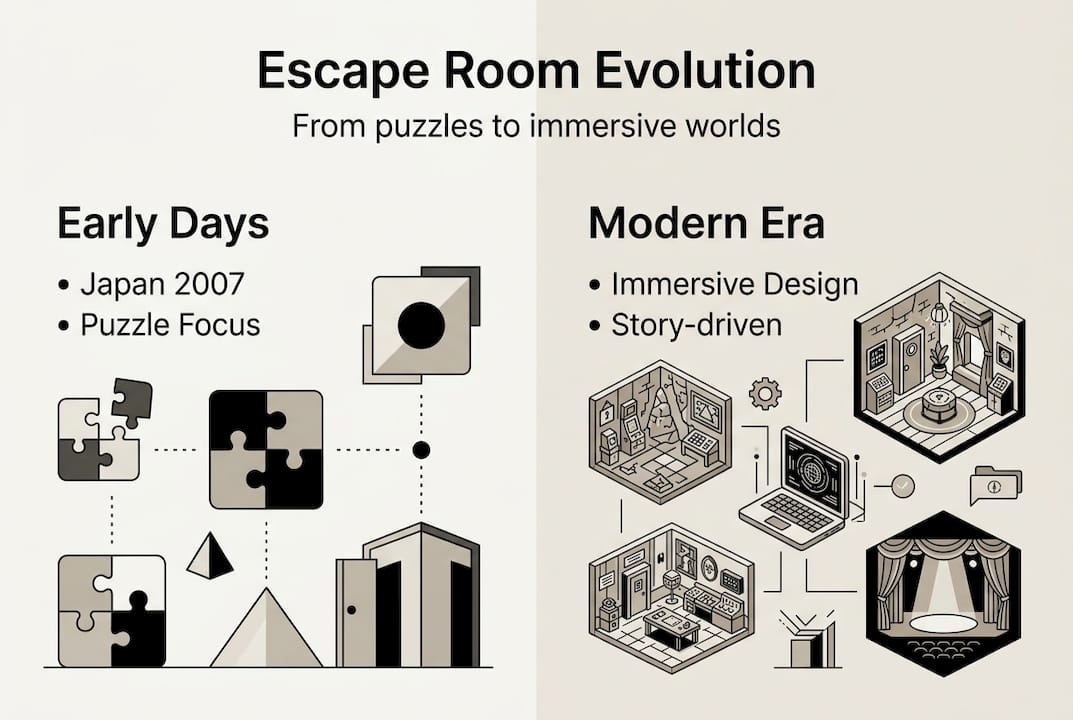
Industry numbers matter, but the real magic comes from how the design of escape rooms has grown more sophisticated. Early rooms were often collections of padlocks, combination codes, and arbitrary puzzles that had no connection to each other or to any story. Solving them felt more like completing a checklist than living inside a narrative.
The shift toward environmental storytelling changed everything. Designers began asking a different question: not “what puzzle can we put in this room” but “what story does this space tell, and how do the puzzles emerge from that story?”
This led to the concept of diegetic design. Diegetic puzzles live within the logic of the story world, while non-diegetic puzzles feel imported from outside it. A combination lock on a safe that a character in the story would logically have locked is diegetic. A random number cipher taped to a wall with no narrative reason to exist is non-diegetic. The best modern rooms are almost entirely diegetic.
Other major design shifts include:
- Non-linear flow: Players can work on multiple puzzles simultaneously, reducing bottlenecks and keeping everyone engaged.
- Difficulty progression: Rooms now often build from accessible early puzzles to complex final challenges, mimicking the theming in games that keeps players in a state of productive challenge.
- Flow state design: The best rooms are calibrated so that players feel challenged but never stuck for too long without a path forward.
- Sensory layering: Sound design, lighting, scent, and tactile elements now work together to reinforce immersion.
“A legendary escape room is not the one with the most impressive technology. It is the one where you forget you are in a game at all.”
Pro Tip: When evaluating a room, ask yourself whether each puzzle feels like it belongs in the story. If you can imagine a character in the narrative actually creating that puzzle, you are in a well-designed room. If the puzzle feels like it was dropped in from a puzzle book, the design philosophy is still catching up.
Understanding difficulty curves in escape rooms is one of the most practical skills you can develop as a player. It helps you pace your team, recognize when to push forward, and know when a hint is the smart move rather than a defeat.
Player impact: How understanding history shapes your escape experience
With the behind-the-scenes evolution revealed, what can players actually do differently? Quite a lot, it turns out. Recognizing the design era of a room gives you immediate insight into how to approach it. Older-style rooms reward methodical searching and code-tracking. Modern rooms reward narrative attention and lateral thinking.
Fair puzzle design is directly linked to player satisfaction, flow state, and the kind of multiplayer engagement that makes people want to come back. Knowing the difference between a fair challenge and an arbitrary one helps you calibrate your frustration appropriately.
Here is a practical framework for reading any escape room you enter:
- Scan the environment first. Before touching anything, take 60 seconds to observe the space. What is the story? What props feel significant? What feels out of place?
- Identify the puzzle type. Is this a diegetic room or a collection of standalone puzzles? Your approach should differ.
- Assign roles based on strengths. Someone who notices visual patterns, someone who tracks information, and someone who tests physical mechanisms make a balanced team.
- Track what you have used. The single biggest source of wasted time is re-examining solved puzzles. Mark them clearly.
- Calibrate your hint strategy. Multiplayer escape room strategies work best when the team agrees upfront on when to ask for a hint rather than debating it mid-game.
Understanding puzzle evolution in games more broadly also sharpens your instincts. The logic structures that appear in escape rooms share DNA with decades of game design, and recognizing those patterns gives you a genuine edge.
Pro Tip: Before your next session, ask the venue which design philosophy they follow. A good operator will be happy to tell you whether their room is linear or non-linear, story-driven or puzzle-focused. That single piece of information can completely change how your team prepares.
What most escape room articles miss: Behind the locks and legends
Most writing about escape rooms focuses on themes, difficulty ratings, and whether a room is scary or family-friendly. Those things matter, but they are surface-level. What actually separates a forgettable room from one you talk about for years is pacing and player psychology, and almost nobody discusses it openly.
Designers spend enormous energy on the first five minutes and the final puzzle, but the middle section of a room is where most groups either find their rhythm or fall apart. Pacing in that middle section, keeping energy up, providing micro-rewards, and preventing any single player from disengaging, is the hardest design problem in the industry.
Most players, even experienced ones, fixate on story quality or production value. Veterans know that clarity is more important than spectacle. A puzzle that is visually stunning but logically ambiguous is a design failure. A simple, clear puzzle that clicks satisfyingly into place is a design success.
The other thing most articles miss is that the best escape room experiences are fundamentally about teamwork, not individual cleverness. The rooms that generate the most positive memories are the ones where every person on the team contributed something meaningful. Designers who understand this build rooms that distribute cognitive load across the group rather than centering everything on one dominant problem-solver.
Experience the evolution at CodeBusters Escape Room
If you are inspired to put your knowledge of history and design to the test, your adventure awaits. CodeBusters Escape Room in Colorado Springs has built its rooms with exactly the design principles covered in this article: diegetic puzzles, immersive themes, and carefully calibrated difficulty curves that keep every player engaged from start to finish.

As a veteran and family owned business with award-winning rooms like “Stranger 80’s,” “Past to the Future,” and “Flight of Deception,” CodeBusters delivers the kind of experience that reflects the best of where escape room design has arrived. You now know what to look for. Go play at CodeBusters and see the craft in action. Book your private room today and bring everything you know.
Frequently asked questions
What was the first real escape room in the world?
Consensus places the first true escape room in Japan in 2007, created by SCRAP, though 5 Wits in 2004 was a significant precursor that lacked the core escape mechanic.
How big is the escape room industry today?
As of late 2025, there are about 2,000 US facilities with annual revenue of roughly $300 million, and the global market is valued at over $6.6 billion.
What makes modern escape rooms different from earlier formats?
Modern rooms use diegetic puzzle design, non-linear flow, and immersive environmental storytelling rather than collections of arbitrary standalone challenges.
Do escape rooms still use traditional puzzle types?
Yes, classic puzzle types like combination locks and cipher codes still appear, but they are now layered within narrative themes and interactive sets to create a more immersive and satisfying experience.