Escape Room Difficulty Levels Explained for Every Group
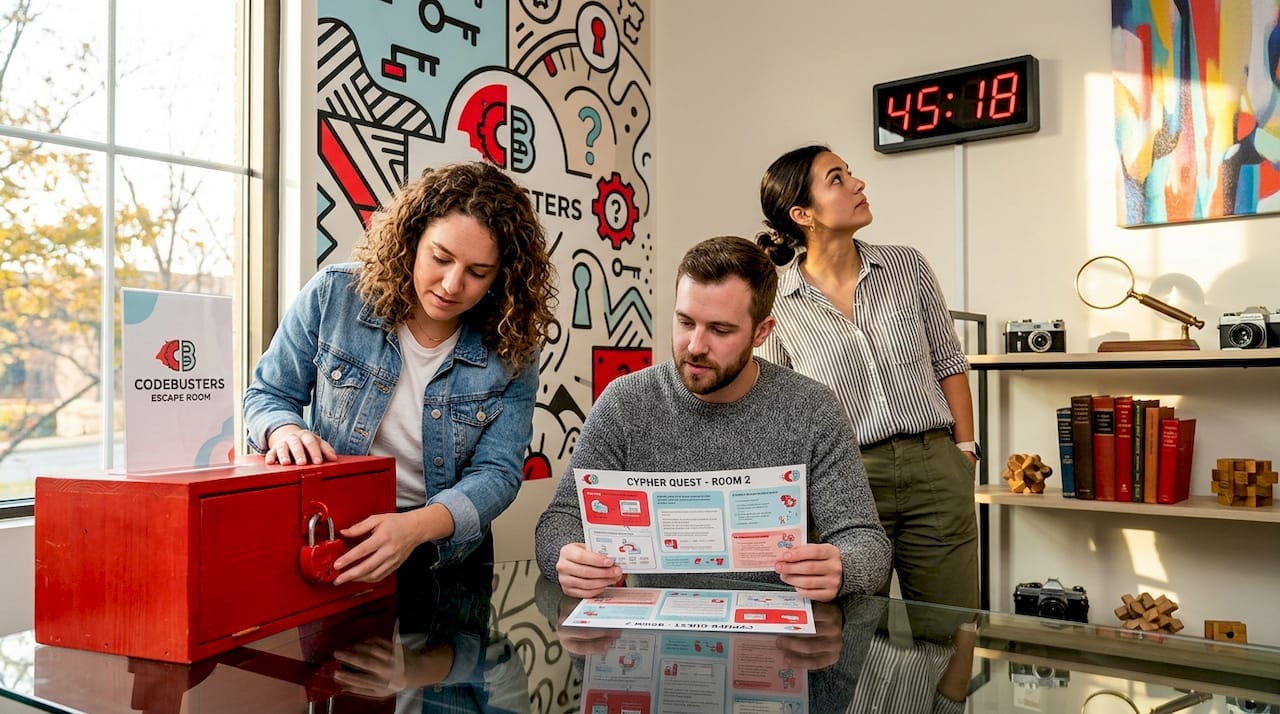
You walk up to the booking counter, scan the difficulty options, and wonder what “Hard” actually means at this particular venue. Does it mean unsolvable for newcomers, or just tricky enough to be fun? This confusion is more common than you’d think, and it costs groups real enjoyment. Getting escape room difficulty levels explained properly before you book changes the whole experience. This guide breaks down what difficulty ratings actually mean, why they vary so wildly between venues, and how to pick the right challenge level for your group every single time.
Table of Contents
- Key takeaways
- Escape room difficulty levels explained: how ratings actually work
- What actually makes a room feel hard
- The three main difficulty tiers and who they suit
- Nuances worth knowing before you book
- How to choose and prepare for the right challenge
- My take on what difficulty labels actually cost you
- Find your perfect challenge at Codebustersescaperoom
- FAQ
Key takeaways
| Point | Details |
|---|---|
| Labels aren’t universal | Difficulty ratings are each venue’s internal estimate, so “Hard” at one place may equal “Medium” at another. |
| More than puzzle complexity | Time limits, hint policies, and physical demands all shape how hard a room truly feels. |
| Match level to your group | Consider experience, age, and frustration tolerance when choosing, not just how adventurous you feel. |
| Ask specific questions | Clarify hint rules, success rates, and adaptive features before you book to avoid surprises. |
| Start lower, scale up | Beginning one level below your group’s ceiling builds confidence and leads to more satisfying visits. |
Escape room difficulty levels explained: how ratings actually work
Here’s the thing most players never find out before they book: there is no universal standard for escape room difficulty ratings. Difficulty labels are each venue’s own internal estimate, shaped by their target audience, their room design philosophy, and sometimes just gut feeling. An “Easy” room at a family entertainment center and an “Easy” room at a hardcore puzzle venue are genuinely different animals.
Most venues use one of three systems to assign difficulty.
Descriptive label systems are the most common. These use familiar terms like Easy, Medium, Hard, or sometimes creative variations like Beginner, Intermediate, and Expert. They feel intuitive, but they are based entirely on the venue’s subjective read of the room.
Performance-based systems pull from real player data. Performance-based difficulty ratings that rely on success rates and average completion times offer more objective insight. If a room has a 20% success rate, that tells you far more than the word “Hard” ever could. These systems are less common, but when a venue publishes them, pay attention.
Feature-based systems describe specific characteristics, such as the number of padlocks, the type of logic required, or whether puzzles run sequentially or in parallel. These are the most transparent because they let you judge difficulty on your own terms.
The practical takeaway is this: always treat a difficulty label as a hypothesis, not a guarantee. Two rooms labeled “Hard” can feel completely different depending on how the venue designed its puzzles and who typically plays there.
What actually makes a room feel hard
Puzzle complexity is only one piece of the difficulty puzzle. The operational and physical setup of a room can push difficulty up or down in ways that have nothing to do with how clever the riddles are.
Time is the most underrated factor. The standard escape room session runs about 60 minutes, and that clock creates its own pressure. A room with puzzles you could solve easily in 90 minutes feels significantly harder when you only have 60. Some venues adjust this window by difficulty level, giving beginners more time or tightening it for advanced players.
Beyond the clock, consider these practical difficulty drivers:
- Hint availability. Some rooms offer unlimited hints with no penalty. Others give you three total and stop there. Hard rooms sometimes restrict hints or add gating bottlenecks, turning a complex puzzle into a time management crisis.
- Puzzle gating. If the room requires you to solve Puzzle A before accessing Puzzle B, one wrong turn can stall your entire group.
- Physical and sensory demands. Rooms that rely on fine motor skills, audio-based clues, or low-light environments add a layer of challenge that purely intellectual ratings never capture. Sensory constraints can raise difficulty beyond puzzles alone, and they can also create accessibility barriers for some players.
- Group size dynamics. A room designed for six players that your team of three attempts creates a completely different challenge than the rating suggests.
Pro Tip: Ask the venue specifically how many hints are included and whether you can buy more. This single piece of information changes your read on a room’s real difficulty more than any label.
The three main difficulty tiers and who they suit
Understanding what each tier typically looks like helps you match your group to the right challenge. Here is a breakdown of the typical difficulty tiers and who fits each one.
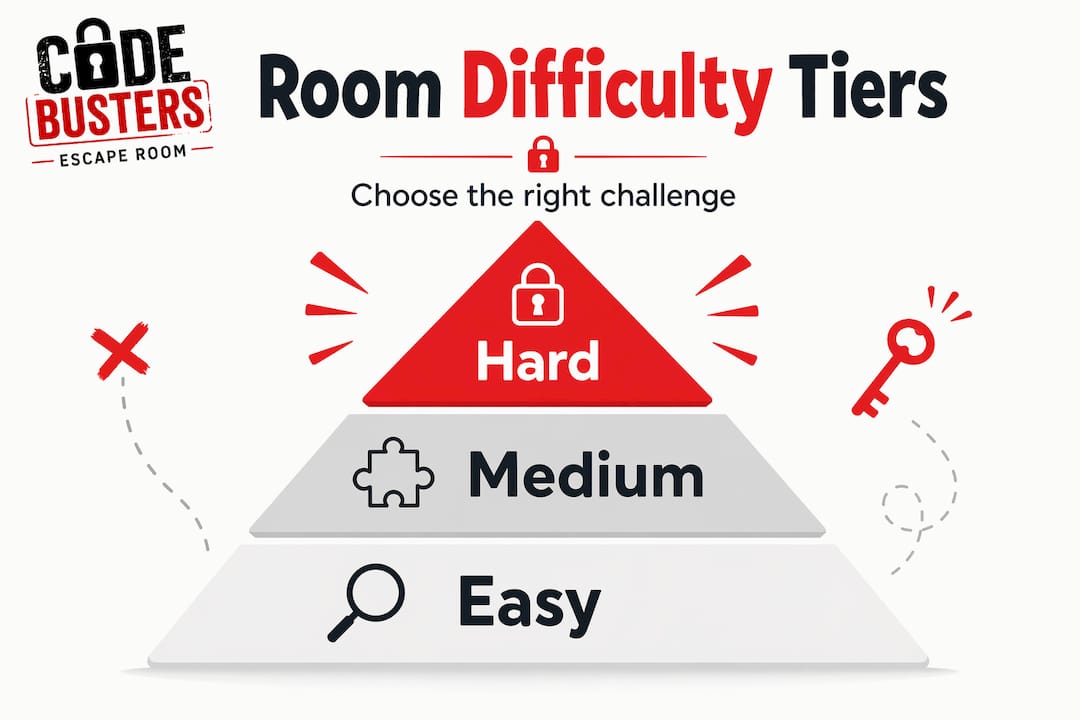
| Difficulty | Typical puzzle style | Best suited for | Average success rate |
|---|---|---|---|
| Easy | Straightforward, step-by-step logic | First-timers, families, mixed ages | 60–80% |
| Medium | Requires creativity and some lateral thinking | Groups with 1–2 prior escapes | 40–60% |
| Hard | Complex strategy, ambiguity, fewer hints | Experienced players, enthusiast groups | 15–35% |
What is an easy escape room? Think of it as a well-lit path with clear signposts. Puzzles follow predictable logic, clues are obvious, and the flow from one challenge to the next feels natural. These rooms are perfect for families with kids, first-time players, or groups that want a fun outing without the stress of getting stuck.
Medium rooms introduce ambiguity. You will need to make logical leaps, combine clues from different parts of the room, and think outside the obvious answer. Groups with a couple of escapes under their belt tend to find this level genuinely satisfying rather than frustrating.
Hard rooms are a different experience entirely. Difficulty is relational and personal, and what makes hard rooms hard is often the combination of puzzle complexity plus operational friction. Strict hint limits, overlapping puzzle threads, and time pressure all compound on each other. These rooms reward groups that communicate well, divide tasks efficiently, and stay calm under pressure.
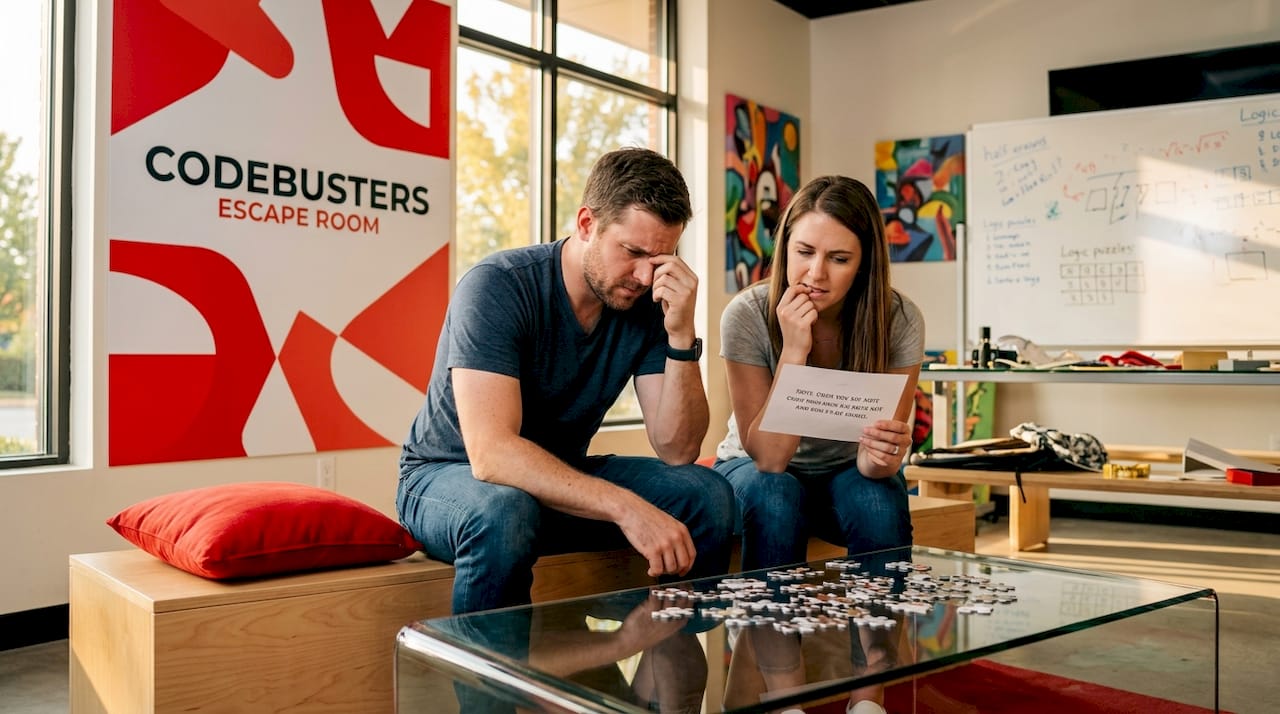
One critical note: difficulty is subjective. A group of engineers who escape rooms every month will find a “Hard” room very different from a group doing their second escape ever. Factor in who is in your group, not just the label on the room.
Nuances worth knowing before you book
Some escape rooms do not operate on a fixed difficulty scale at all. Adaptive difficulty features can unlock extra tasks or puzzle branches based on how quickly your group progresses. If you blow through the first half in 20 minutes, the room might introduce additional layers. This is exciting for experienced groups but can genuinely surprise players who expected a fixed experience.
Before you finalize your booking, get specific answers to these questions:
- Does the room have a published success rate or average completion time?
- How many hints are allowed, and can you earn or buy more?
- Are puzzles sequential (gated) or can the group split up and work in parallel?
- Does the room involve any physical activity, loud sounds, or low lighting that might affect any member of your group?
- Does the difficulty adjust based on group progress?
These questions separate a well-matched experience from a frustrating one. Venues that answer them confidently and clearly are worth trusting.
Pro Tip: When booking your escape room, mention your group’s experience level directly to the staff. A good venue will recommend a specific room rather than just pointing you at the difficulty chart.
Using difficulty information alongside other factors matters too. Theme interest, group size, and accessibility needs all feed into what makes an experience truly enjoyable. Escape rooms build teamwork and interpersonal connections, and a well-matched difficulty level is what lets that happen naturally rather than forcing everyone into survival mode.
How to choose and prepare for the right challenge
Getting the difficulty right is less about picking the hardest room you think you can handle and more about setting your group up for genuine fun. Here is a practical approach.
- Assess your group’s collective experience. Count how many escapes everyone has done. If half the group is new, treat the whole group as beginners. The weakest link sets the ceiling for enjoyment.
- Start one level below your group’s ceiling. If your most experienced member has done five rooms and considers themselves solid at Medium, book Medium rather than Hard. Escape room selection should prioritize everyone finishing with a smile, not just the veterans.
- Prioritize rooms with performance data. When you can find a room that publishes success rates, use that number over the label. A room with a 25% success rate labeled “Medium” is harder than a “Hard” room with a 40% success rate.
- Account for accessibility and sensory needs. Review room descriptions for physical activity, audio clues, or visual demands. Communicate any relevant needs to the venue upfront.
- Set communication expectations before entering. Agree that anyone can call out when they feel stuck, and that nobody hoards clues. Good teamwork in escape rooms matters more than any individual’s puzzle-solving skill.
- Use difficulty as one filter, not the only one. Theme, room size, group size, and the overall vibe of the venue all contribute to the experience. A perfectly matched difficulty in a theme nobody cares about still underdelivers.
My take on what difficulty labels actually cost you
I’ve watched a lot of groups walk into rooms that were objectively wrong for them. Not because they chose badly, but because nobody explained to them that the escape room difficulty scale is not a single consistent system. A couple books “Hard” because they want to feel challenged. They get stuck 15 minutes in, burn through hints, and leave feeling defeated rather than thrilled. The room was not poorly designed. The match was just off.
What I’ve learned is that players almost always overestimate how difficulty translates to fun. The most memorable runs I’ve seen happen in Medium rooms where the group clicks, communicates well, and escapes with two minutes to spare. That feeling is better than finishing a Hard room with five minutes left and a headache.
The other thing worth saying honestly: difficulty ratings are marketing tools as much as they are technical assessments. A venue calling its flagship room “Extreme” is creating excitement and setting expectations. That is fine, but you should read it with some skepticism.
My advice is to care less about the label and more about your group’s shared experience. Ask the venue real questions. Pick a room where the theme genuinely interests everyone. And if you are trying escape rooms for the first time, start somewhere you will actually finish. Winning your first escape feels incredible. It makes you come back. That is worth more than bragging rights.
— CodeBusters
Find your perfect challenge at Codebustersescaperoom

At Codebustersescaperoom in Colorado Springs, every room comes with honest difficulty information so you can book with confidence. Whether your group is stepping into their first escape or looking for something that will genuinely test your skills, the lineup covers all experience levels. Rooms like Stranger 80’s and Past to the Future offer distinct puzzle styles and clear challenge ratings, and the staff is ready to help you match your group to the right experience. Private room bookings mean your group gets the full experience without outside pressure. Book your next escape at Codebustersescaperoom and walk in knowing exactly what you signed up for.
FAQ
What do escape room difficulty levels actually mean?
Difficulty levels are a venue’s internal estimate of how challenging a room is based on puzzle complexity, time limits, and hint availability. There is no universal standard, so ratings vary significantly between venues.
How do I choose the right escape room difficulty for my group?
Start by considering your group’s collective experience and tolerance for frustration. For most groups, booking one level below your perceived ceiling leads to a more satisfying experience than pushing for the hardest available option.
What makes a hard escape room different from an easy one?
Hard rooms typically combine complex puzzles with operational friction like limited hints and strict puzzle gating. Easy rooms offer straightforward logic with clearer clues and fewer bottlenecks.
Are escape room success rates a better guide than difficulty labels?
Yes. A room’s published success rate reflects real player performance rather than a subjective label. When a venue shares this data, it gives you a much clearer picture of true challenge than words like “Hard” or “Intermediate.”
Can escape rooms adjust difficulty mid-game?
Some venues use adaptive difficulty features that unlock extra puzzles or branches based on how quickly your group progresses. Ask the venue before booking if this applies to your chosen room.