Before You Book: Escape Room Ciphers to Ask About at CodeBusters
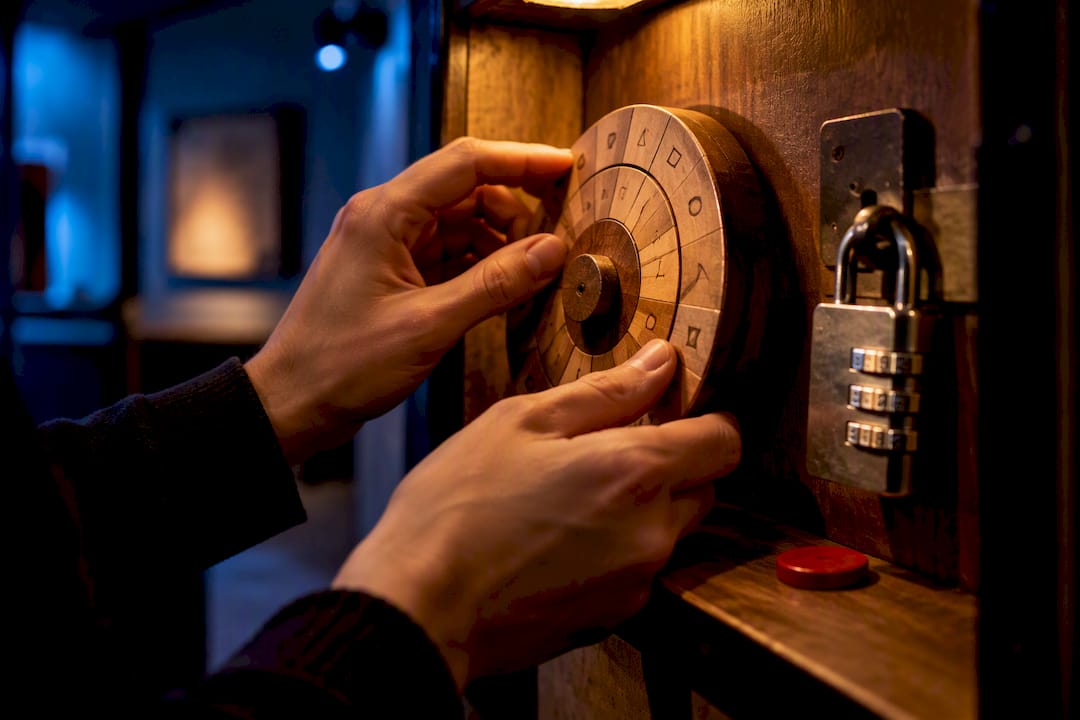
Escape room ciphers fall into a handful of predictable families: letter shifts like Caesar and ROT13, symbol systems like Pigpen, Morse and light signals, number-to-letter indexing, and keyed ciphers like Vigenère. Whatever the type, expect the decoded result to be short: a word, a number, coordinates. That output almost never solves the room by itself. It feeds the next lock, the next clue, or the next layer of the same puzzle.
Table of Contents
- What Kinds of Escape Room Ciphers Will You Actually Encounter?
- How Do Designers Build Ciphers Into a Working Puzzle?
- What Team Tactics Actually Work Under Time Pressure?
- What Should You Ask a Venue Before Booking?
- What Makes a Cipher Puzzle Fair for Casual Groups?
- What Mistakes Do Players Make With Ciphers, and How Do You Avoid Them?
- Where Did These Ciphers Actually Come From?
- How Do Designers Balance Cipher Difficulty?
- Which Digital Tools Help You Practice Before You Play?
- Our Take on Cipher Puzzles at Codebusters Escape Room
- Ready to Test Your Cipher Skills in Person?
- Sources
- FAQ
What Kinds of Escape Room Ciphers Will You Actually Encounter?
Most commercial rooms lean on a short list of proven cipher types because they’re fast to teach and satisfying to crack under a countdown clock. Here’s what shows up most often, and how to spot each one before you waste minutes guessing.
- Caesar and ROT13 shifts. Every letter moves a fixed number of spots down the alphabet. Rooms usually hint the shift amount through a portrait’s age, a dial position, or a number scrawled nearby. Output is short, often a single word.
- A1Z26 and simple numeric indexing. Numbers stand in for letters (A=1, B=2, and so on). It’s the easiest cipher to verify yourself, since a wrong guess produces gibberish instantly.
- Pigpen and other symbol alphabets. Geometric shapes replace letters, drawn from a grid-and-dot system. Props often work double duty as the cipher key, appearing as wallpaper patterns or carved into furniture.
- Morse code, tap codes, and blinking lights. These arrive as audio pulses, flashing bulbs, or knock patterns. A reference chart nearby (or one you’re handed) makes decoding straightforward; without one, memorization becomes the bottleneck. Printed dot-dash sequences tend to be gentler under pressure than live audio unless the room slows the signal down.
- Vigenère and other keyed ciphers. These only work fairly when the keyword and the tableau (or wheel) are both discoverable in the room. If a designer expects you to guess a keyword, that’s a fairness failure, not a puzzle.
- Polybius squares, Playfair grids, and the scytale. Physical props map coordinates or wrapped strips to letters. You’ll usually find a numbered grid on the wall or a cylinder that only reveals text when paper is wound around it correctly.
- Book and page-indexing ciphers. A string of numbers points to a page, line, and word position in a specific book supplied in the room. If the venue expects you to bring your own copy of a book, that’s a red flag worth asking about beforehand.
- Null ciphers, semaphore, and Bacon’s cipher. Less common, but effective for theme rooms where pattern recognition (every third letter, flag positions) fits the story. A practical cipher guide from Eleven Puzzles lists these alongside Caesar and A1Z26 as the types that translate best to group play, since they reward observation over specialist knowledge.
How Do Designers Build Ciphers Into a Working Puzzle?
A cipher is never just a code. It’s a small machine with moving parts, and most rooms present those parts in one of a few physical formats.
- Printed notes and cipher wheels. Two rotating discs, one alphabet on each, let you dial in a shift and read off the substitution. Free cipher wheel templates show just how many variants exist, from alphabet-only wheels to ones mixing letters and numbers.
- Engraved props and physical alignment devices. Scytales, gear mechanisms, and carved dials require you to physically manipulate an object before the message appears.
- Audio and light signals. Speakers or LED strips deliver Morse or tap code, often looping so you can catch what you missed the first time.
- The player workflow. First you find the reference (the grid, wheel, or book). Then you transcribe the raw symbols or sounds exactly as they appear. Only then do you apply the rule. Skipping straight to guessing the plaintext is the single most common way teams waste time.
- Layering. A Morse signal might decode to a Caesar-shifted word. That word might name a location that unlocks a book cipher. The letter-to-number mapping from step one might become the digits for a physical lock. An ACM report on educational escape rooms documented a room built around 23 separate layered tasks, underscoring how rarely a single cipher stands alone in practice.
Label every intermediate result as you go. Rooms built around layering expect you to track short outputs, not just the final answer.
What Team Tactics Actually Work Under Time Pressure?
Splitting jobs beats everyone crowding around the same clue. Assign one person to search for keys and reference materials, one to transcribe symbols or audio exactly as seen or heard, one to apply the decoding rule, and one to verify results and log what’s confirmed versus still guesswork.
- Keep every key, wheel, and partial answer visible on a shared surface, not buried in someone’s pocket.
- Mark confirmed answers clearly apart from tentative guesses so nobody re-solves the same clue twice.
- Photograph symbol charts with a phone camera when the venue allows it, rather than trying to memorize a Pigpen key.
- Bring a mental checklist: pen or marker, scratch paper, and a simple grid for tallying letters against numbers.
- Ask for a nudge on the category of encoding, not the full solution, when you request a hint. “Is this a shift cipher?” gets you further than “what’s the answer?”
Teams that naturally divide these roles manage layered ciphers more smoothly, since no single person becomes a bottleneck for finding, transcribing, and solving all at once.
Pro Tip: If a decoded string looks almost readable but not quite, don’t scrap it. Check whether you’re reading it backward, whether letters should be grouped differently, or whether the alphabet wheel is one notch off. A near-miss is usually a small alignment error, not a wrong cipher.
What Should You Ask a Venue Before Booking?
If cipher variety matters to your group, a few questions before you book will save frustration on game day.
- Ask what general cipher types the room uses (broad categories, not spoilers) so you know if it leans toward Morse, symbol substitution, or indexing.
- Ask how the hint system works and whether staff can adjust hint frequency for a group with mixed experience levels.
- Ask whether keys and charts, like a Morse chart or alphabet wheel, are provided inside the room or if players need outside knowledge.
- Ask if any puzzles rely on audio or flashing lights, and whether alternative formats exist for players with hearing or vision limitations.
- Ask for a difficulty rating and whether the room rewards careful observation or strict step-by-step decoding, since that affects which teammates should take the lead.
A venue that answers these clearly, without giving away the story, is usually one that designed its ciphers with fairness in mind.
What Makes a Cipher Puzzle Fair for Casual Groups?
Good cipher design rewards deduction, not prior cryptography training. Look for rooms where keys and worked examples sit somewhere in the environment rather than requiring outside knowledge, and where a themed prop, like a decorative wall hanging, doubles as the actual cipher key.
- High-contrast printing and larger symbols help under dim, moody lighting.
- Printed transcriptions of audio puzzles give players who struggle with sound a fair shot.
- Short decoded outputs that immediately test against a lock or clue give players quick feedback instead of leaving them guessing blind for ten minutes.
- A solid debrief after the game helps players understand what they missed and why, turning confusion into a genuine takeaway.
Peer-reviewed research on escape-room gameplay found that unfamiliar solving conventions can confuse players who don’t already know cipher basics, which is exactly why discoverable keys and clear hint systems matter more than raw puzzle difficulty.
What Mistakes Do Players Make With Ciphers, and How Do You Avoid Them?
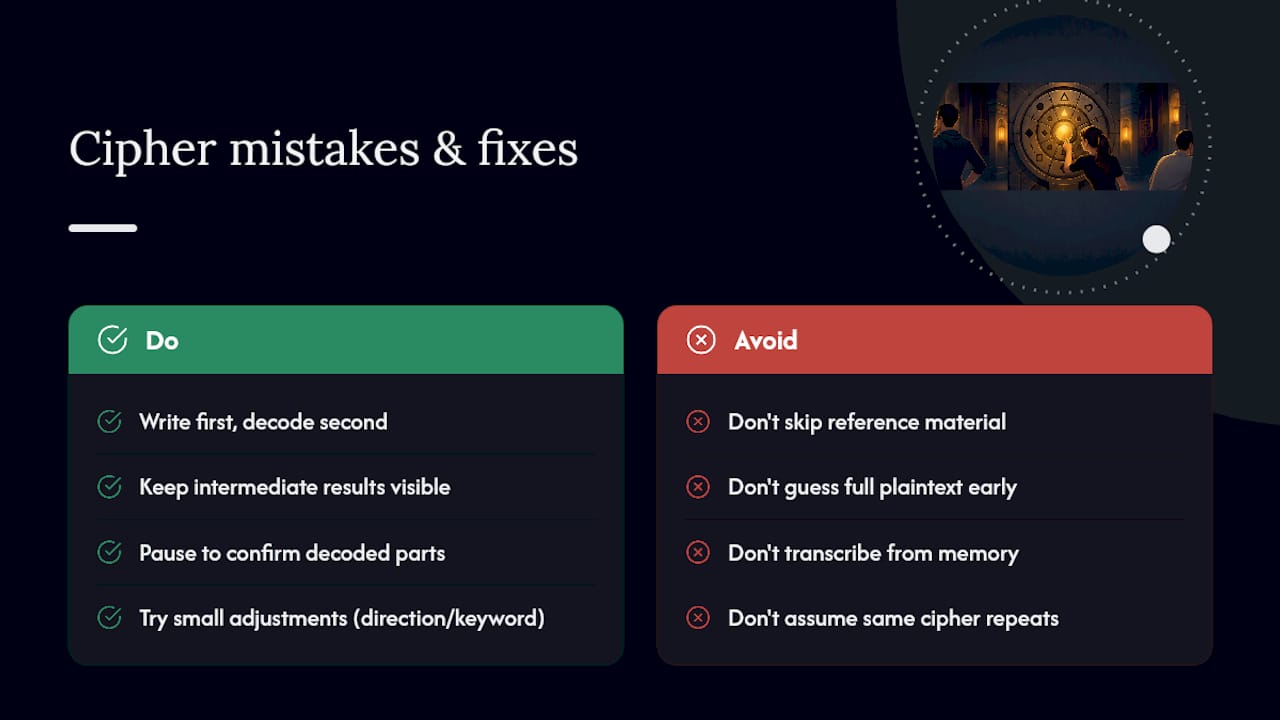
The most common mistake is skipping the reference material entirely and trying to guess the plaintext from a handful of decoded letters. It sometimes works on a five-letter word. It almost never works on a full phrase, and it burns minutes you don’t get back.
A close second: transcribing sloppily. Copying Morse dots and dashes, Pigpen symbols, or grid coordinates from memory instead of writing them down exactly introduces errors that compound by the time you apply the cipher rule. Write first, decode second.
Teams also tend to abandon a nearly correct answer too fast. If a decoded phrase produces something close to readable but not quite, the instinct is to assume the whole approach is wrong. Usually it’s a smaller issue: reading a grid top to bottom instead of left to right, or missing that a keyed cipher needs the keyword applied twice.
Another frequent stumble is treating every strange symbol as the same cipher. Rooms that layer puzzles often switch systems mid-chain, so a set of numbers that solved one lock as A1Z26 might be page and line numbers for a book cipher in the very next step. Finally, groups sometimes forget to keep intermediate results visible, so two people accidentally re-solve the same clue while a third teammate sits idle. Slowing down for thirty seconds to confirm what’s already been decoded usually saves several minutes later.
Where Did These Ciphers Actually Come From?
The Caesar cipher takes its name from Julius Caesar, who reportedly shifted letters by three positions to protect military messages, according to accounts from Roman historians. It’s one of the oldest documented substitution methods still in casual use nearly two thousand years later.
Morse code dates to the 1830s and 1840s, developed by Samuel Morse and Alfred Vail for telegraph transmission, long before anyone imagined it flashing from an escape room prop. Pigpen cipher history traces back to Freemason record-keeping in the 1700s, where the geometric grid system kept internal notes private. The Vigenère cipher, often misattributed to Blaise de Vigenère alone, actually built on earlier work by Giovan Battista Bellaso in the 1500s, and stayed unbroken by cryptographers for roughly three centuries.
The Polybius square goes back even further, credited to the ancient Greek historian Polybius, who designed it to transmit messages using torch signals across distances. Semaphore flags emerged much later, in the late 1700s in France, built for exactly the kind of long-range visual signaling that makes it a natural fit for themed adventure rooms today.
Knowing the backstory doesn’t make a cipher easier to crack. It does make the puzzle land better once you realize the prop in front of you has a genuine, centuries-old pedigree behind it.
How Do Designers Balance Cipher Difficulty?
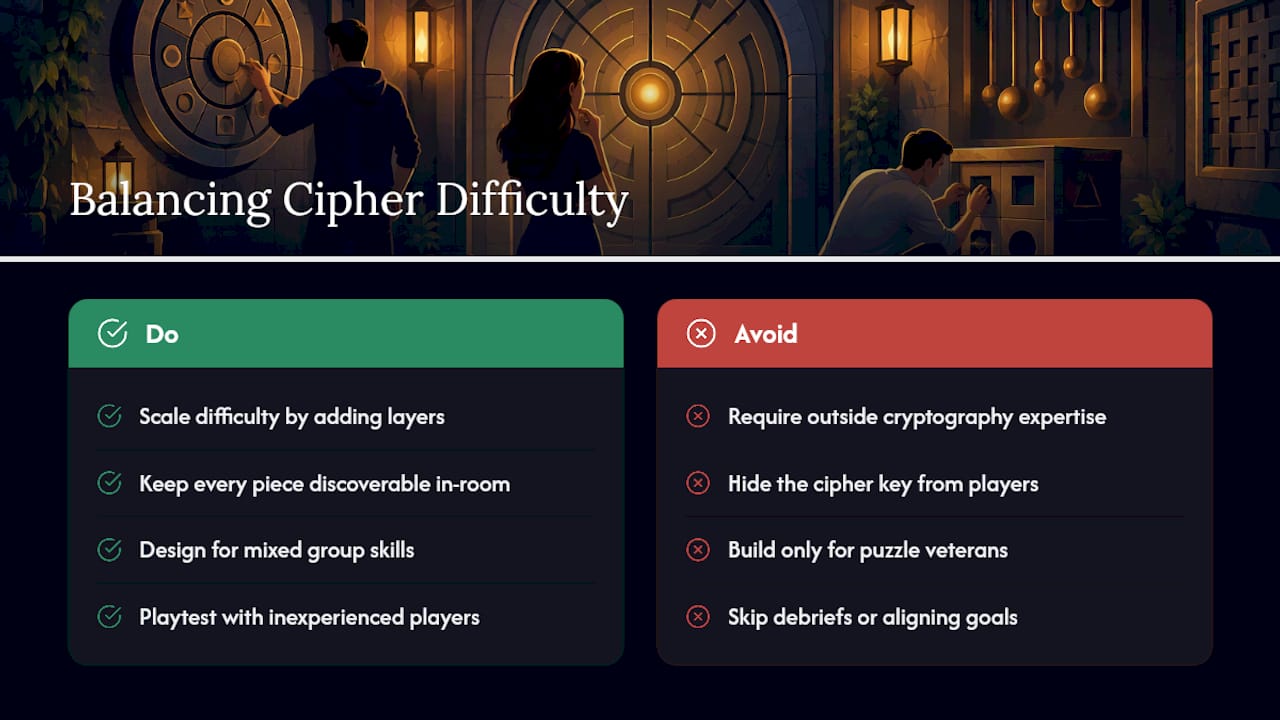
Balanced cipher design starts with a simple test: can someone with no cryptography background solve this using only what’s physically present in the room? If the answer requires outside expertise, the puzzle isn’t hard, it’s broken.
Good designers scale difficulty by adding layers, not by hiding the key. A single Caesar shift with a visible dial is beginner-friendly. Chaining that shift into a Vigenère cipher, where the keyword itself has to be found elsewhere in the room, raises the ceiling without punishing newcomers unfairly, as long as every piece of the chain stays discoverable.
Group size and mix matter too. A room built for corporate teams with mixed puzzle experience benefits from ciphers that reward collaboration, where one person’s strength (pattern recognition) complements another’s (methodical transcription). A systematic review of educational escape room design recommends aligning game mechanics with clear goals and building in debrief moments, advice that applies just as well to entertainment-focused rooms aiming for repeat visits. Designers who test with genuinely inexperienced players, not just puzzle veterans, catch the gaps that make a cipher frustrating instead of fun.
Which Digital Tools Help You Practice Before You Play?
You don’t need an app to solve a cipher inside a room, but a little practice beforehand sharpens the instincts that matter most: recognizing a cipher type on sight and transcribing quickly under pressure.
Morse code trainer apps and websites let you practice listening to and transcribing dots and dashes at different speeds, which is directly useful since live audio Morse puzzles are typically harder than printed versions unless the signal is slowed down. General cipher-solving reference sites help you memorize the look of Pigpen grids and Polybius squares so you spot them instantly instead of puzzling over what kind of symbol system you’re even looking at.
For groups that enjoy the cipher-hunting mindset outside a booked room, geocaching communities lean on similar deduction skills. A guide to mystery cache puzzles walks through recognizing puzzle rules and narrowing down which cipher system applies, a transferable skill for anyone who wants sharper instincts before their next room booking.
Our Take on Cipher Puzzles at Codebusters Escape Room
This escape room business is veteran and family owned and runs themed rooms in multiple locations, building cipher puzzles around one rule: the key has to be findable. We design difficulty around group size and experience level rather than assuming everyone walks in knowing Morse or Pigpen cold, because a puzzle that only rewards prior cryptography knowledge isn’t a puzzle, it’s a filter.
Private bookings allow tuning the balance of puzzle difficulty to suit different groups, such as corporate teams, families with children, or experienced players seeking a harder challenge. For more on how we think about puzzle pacing and player experience, our blog covers how puzzles shape your escape room experience in detail.
— CodeBusters
Ready to Test Your Cipher Skills in Person?
Reading about Caesar shifts and Morse charts only gets you so far. The real test is standing in front of a locked box with a decoded number in your hand, wondering if you copied the last digit right. This escape room builds that experience into every themed room across its locations, always as a private booking, so groups do not race strangers for the same clues.

The room lineup includes a variety of themed experiences, each with its own mix of cipher types, prop-based puzzles, and difficulty pacing suited to different group sizes. For guidance on rooms that emphasize codes and indexing versus physical search and observation, the staff can assist before booking. A full room list and difficulty notes are available for browsing and private sessions can be reserved.
Sources
Cipher type breakdowns and difficulty notes referenced here draw on Eleven Puzzles’ guide to common escape room puzzles and peer-reviewed escape-room gameplay research. For more on how puzzle design shapes the player experience, see our posts on diverse puzzle challenges and how clues shape your experience.
- Popular puzzle types (cipher list) — Eleven Puzzles
- Peer-reviewed research on escape-room gameplay (2022)
- ACM report on Educational Escape Rooms (2024)
FAQ
What Is the Easiest Cipher Type for Beginners?
Caesar and ROT13 shifts are generally the easiest, since the rule stays consistent and errors are easy to spot once the output turns to gibberish. Guides to common escape room puzzles also flag A1Z26 numeric indexing as beginner-friendly because you can verify your work as you go.
Do Escape Rooms Expect You to Know Morse Code Already?
No, well-designed rooms provide a reference chart for Morse or tap codes rather than expecting memorization. Printed charts under time pressure tend to be easier to work from than live audio signals unless the audio is deliberately slowed down.
What Do Decoded Cipher Outputs Usually Look Like?
Decoded results are typically short: a single word, a number sequence, or a set of coordinates. That output almost always feeds directly into another puzzle, like a lock combination or a hint toward the next clue.
How Many Cipher Types Might One Escape Room Use?
It varies by room and theme, but layered rooms commonly chain two or three cipher types together rather than relying on just one. One documented educational escape room built its entire structure around 23 separate connected tasks.
Does Codebusters Escape Room Design Its Puzzles for Mixed-Experience Groups?
Yes, this escape room builds difficulty around group size and experience level, featuring discoverable keys rather than puzzles requiring outside cryptography knowledge. Current room details and booking options are listed on the rooms page.