Escape room awards explained: what makes an experience great?

Not every escape room award means the same thing, and that gap matters more than most players realize. Some accolades come from algorithm-driven platforms crunching hundreds of data points, while others reflect the votes of seasoned enthusiasts who have played hundreds of rooms across the country. According to the US Escape Room Industry Report, escape room awards are benchmarked differently across sources, which means “award-winning” is not a single, comparable metric unless the award’s methodology actually matches what you value. For Colorado Springs enthusiasts looking to make smart booking decisions, understanding what’s behind those plaques is where the real advantage begins.
Table of Contents
- The main types of escape room awards
- How award methodologies impact what “award-winning” means
- Are awards worth considering when choosing your next escape room?
- Spotting and verifying award claims in Colorado Springs
- Why smart enthusiasts don’t just chase award plaques
- Experience Colorado Springs’ award-recognized escape rooms
- Frequently asked questions
Key Takeaways
| Point | Details |
|---|---|
| Award systems vary | Not all escape room awards mean the same thing; check who gives and how they judge them. |
| Methodology matters | Transparent criteria make an award claim far more trustworthy for enthusiasts. |
| Awards aren’t everything | Look for awards but also consider personal preference, reviews, and group fit when booking. |
| Verify award claims | Check the source’s legitimacy and published details before trusting an award label. |
The main types of escape room awards
Now that you’re curious about what “award-winning” actually means, let’s break down the main methods behind these accolades. There are three dominant frameworks operating in the industry right now, and each one measures quality using a completely different lens. Knowing how each works gives you a meaningful filter before you step through any door.
Algorithm-based awards are generated by platforms like Morty, which pulls together signals such as recency of reviews, quantity of ratings, regional representation, current operating status, and variety of experience types. The platform uses thresholding to ensure that a room with fifty old reviews doesn’t automatically outrank one with twenty recent, glowing ones. This approach is scalable and consistent, but it can miss the nuanced magic of a room that doesn’t photograph well or doesn’t generate volume because it operates in a smaller market.
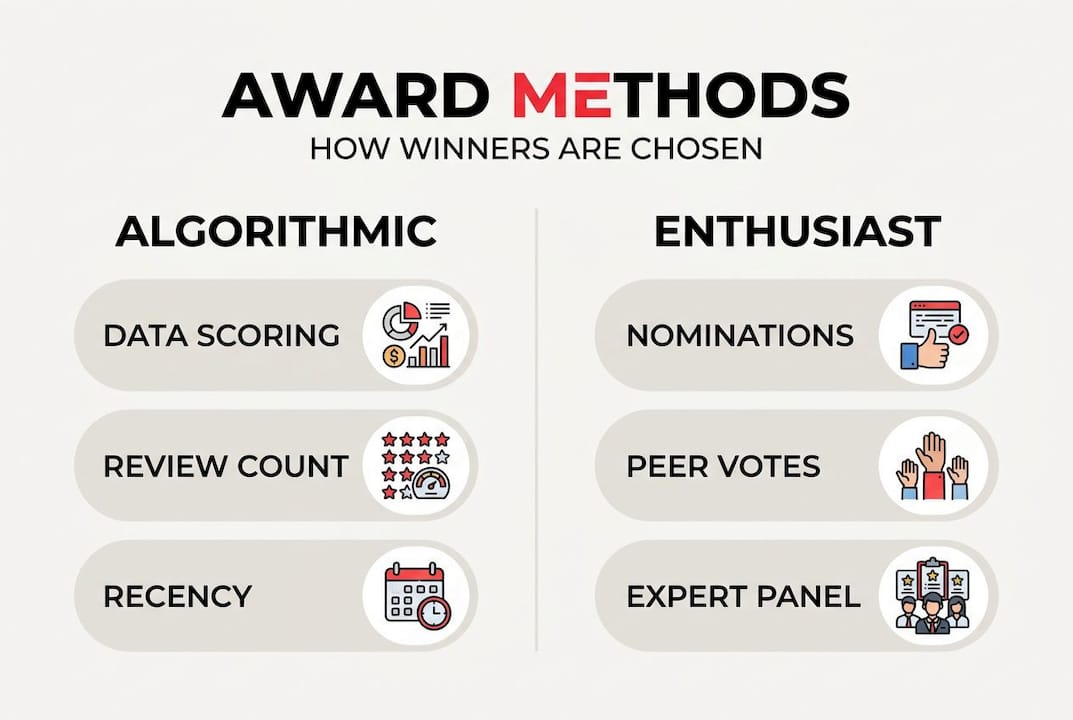
Enthusiast-driven ranking systems, most notably TERPECA (Top Escape Rooms Project Enthusiast Choice Awards), rely on nominations and voting from verified high-volume players. These are people who have personally completed dozens or even hundreds of rooms. The platform uses pairwise comparisons and relative ranking methods, meaning participants rank rooms against each other rather than scoring them in isolation. The result is a list that reflects the tastes of the most experienced players in the hobby, which makes it authoritative but somewhat niche.
Editorial and curated awards, like the Golden Lock recognition from Room Escape Artist, come from industry journalists and reviewers who have built deep, firsthand knowledge of escape room design. These outlets track award-winning games and feature them within their reports, as industry analysis confirms. Editorial recognition tends to weight creativity, puzzle logic, narrative cohesion, and overall production value. It’s qualitative by nature, which is both its strength and its limitation.
Here’s a quick comparison to anchor these differences:
| Award type | Primary method | Who decides | Best at measuring |
|---|---|---|---|
| Algorithmic (Morty) | Data scoring | Platform algorithm | Volume, recency, variety |
| Enthusiast (TERPECA) | Pairwise voting | High-volume players | Expert appeal, repeat play |
| Editorial (Golden Lock) | Curated review | Professional critics | Design, narrative, craft |
Each approach has genuine merit. The algorithm is objective and hard to game at scale. Enthusiast voting reflects the standards of people who really know what great design looks like. Editorial review digs into the “why” behind an experience in ways that data alone cannot.
A few important trade-offs to keep in mind:
- Algorithm-based awards can over-reward rooms in high-density urban markets simply because they generate more review traffic.
- Enthusiast voting can reflect trends and group dynamics within a specific community, which may not align with your tastes as a first-time or casual player.
- Editorial awards are slower to update and can lag behind major renovations or ownership changes that dramatically improve a room.
Pro Tip: Before you decide how much to weight an award, look up the actual award system being cited on the venue’s website or marketing material. If the methodology isn’t described anywhere, that’s a signal worth noticing.
Checking out Colorado Springs escape rooms that openly describe their recognition gives you a concrete starting point for applying this framework locally.
How award methodologies impact what “award-winning” means
Understanding the major award types, let’s see how the underlying criteria shape what these awards actually communicate. The same room could earn high marks in one system and go completely unnoticed in another. That’s not a flaw in the process. It’s a feature of specialization, but it means you need to read award labels with more precision than most players currently apply.
Consider the criteria breakdown across systems:
| Criteria | Algorithmic | Enthusiast | Editorial |
|---|---|---|---|
| Public ratings volume | High weight | Low weight | No weight |
| Expert review quality | Not considered | Moderate | High weight |
| Regional diversity | Yes (thresholded) | Partial | Rarely formalized |
| Design innovation | Indirect | High | Very high |
| Business status (open/active) | Yes | Not tracked | Informally |
| Recency of recognition | Strong | Annual cycle | Varies |
A room that wins an algorithmic award has demonstrated something valuable: it consistently generates positive responses from a broad audience over time. That’s real. But the same room might have a fairly conventional puzzle structure that enthusiast voters have seen dozens of times, so it never appears on a TERPECA list. Conversely, a deeply creative room that operates in a smaller Colorado Springs neighborhood may fly under the algorithmic radar simply because fewer people know it exists yet.
Here’s what an award actually tells you, depending on the source:
- Morty-style algorithmic award: Broad public satisfaction, good review volume, currently operating, solid regional presence.
- TERPECA ranking: Strong performance among players who take the hobby seriously and have real context for comparison.
- Golden Lock or editorial recognition: Exceptional design, creative puzzle integration, strong narrative quality.
- Generic “best of” local rankings: Often based on local voting with little methodology transparency, so treat with caution.
As the industry report notes, no two award platforms are directly comparable unless their metrics match. This is the core insight. When you see “award-winning” on a venue’s signage, your first question should be: “Award from whom, using what method?”
This distinction matters enormously for Colorado Springs enthusiasts because the local market includes a mix of independent operators, franchise locations, and locally awarded escape rooms with different types of recognition. Knowing which award type applies helps you predict whether the experience aligns with what you personally value in a room.

Are awards worth considering when choosing your next escape room?
Now that you understand award systems and their meanings, let’s talk about how to use these insights when picking your next adventure. The short answer is yes, awards are worth considering. But they work best as one signal in a larger decision-making process rather than the final word.
Here’s a practical step-by-step approach to using awards well:
- Identify the award source first. Is it algorithmic, editorial, or enthusiast-voted? Each type signals something different about the room’s strengths.
- Check the award date. A room that won recognition two years ago may have changed significantly. New ownership, staff turnover, or even a single broken prop can shift the experience meaningfully.
- Cross-reference with recent reviews. Look at reviews from the last three months on platforms like Google or Yelp. Are they consistent with the award-level praise? If recent reviews drop sharply, trust the reviews over the award.
- Match the award type to your group. If you’re bringing a group of first-timers, an enthusiast-voted award signals a high difficulty experience that may not be ideal. An algorithmic award with broad positive sentiment might be a better fit.
- Consider your priorities. Are you looking for great narrative? Challenging puzzles? Strong production value? Different award systems weight these factors differently, so match the award type to your goal.
- Ask the venue directly. A confident, transparent operator will tell you exactly what the award is, who gave it, and when. Hesitation or vagueness around this question is informative in itself.
Editorial platforms like Room Escape Artist explicitly track and highlight award-winning games in their curated reports, which makes them a reliable cross-reference when you want to verify what a venue is claiming.
The biggest limitation is that awards inherently reflect a point in time. A room that earned recognition in 2023 was evaluated under conditions that may no longer exist. Staff energy, maintenance quality, and even room updates shift the experience month to month.
Pro Tip: Combine any award signal with at least five recent reviews from real players. If both the award and the recent reviews align positively, that’s a much stronger confidence signal than either one alone.
You can start exploring escape room options in Colorado Springs with this framework already in hand, so you walk in knowing what each distinction means.
Spotting and verifying award claims in Colorado Springs
Ready to put this knowledge into action? Here’s how to check the validity of award claims for your next Colorado Springs escape room outing.
Some award claims are specific and verifiable. Others are vague gestures toward credibility that don’t hold up under five seconds of scrutiny. Knowing the difference protects your time, your money, and your group’s experience.
Signs of a reputable award claim:
- The name of the awarding organization is clearly stated, not just “award-winning.”
- A year or time period is attached to the claim.
- The venue can point you to where the results are publicly published.
- The award has its own website, published methodology, or annual announcement that you can find independently.
- The award is referenced by third-party sources (industry blogs, news outlets, escape room review sites).
Signs of a questionable award claim:
- Language like “voted best escape room” with no source listed.
- Awards from platforms you cannot find with a basic search.
- A claim that has been on the website for years with no update.
- Inability of staff to explain what the award is when asked directly.
- Award certificates that look self-generated or lack institutional backing.
“Only awards with transparent, published methodologies are fully trustworthy benchmarks for enthusiasts,” as the industry report confirms. If the criteria and results aren’t publicly available, treat the claim with appropriate skepticism.
The fastest way to verify any claim is to search the award name plus the venue name together. Legitimate awards generate independent documentation. If your search turns up nothing except the venue’s own website, that’s a clear signal. Asking the staff directly is also completely reasonable behavior. A well-run venue will welcome the question because it gives them a chance to explain something they’re genuinely proud of.
When you find verifiable award-winning rooms, the difference in confidence you feel walking in is real. Transparency about recognition is one of the clearest signals that an operator takes quality seriously.
Why smart enthusiasts don’t just chase award plaques
Here’s the honest take that most award-focused content skips over: the best escape room experience you’ve ever had probably wasn’t the highest-ranked room on any formal list. It was the one where your group was perfectly sized, the theme hit you in exactly the right way, and something unexpected made the whole room click. Awards can’t measure that.
Awards are excellent at filtering out genuinely poor experiences. They raise the floor of your decision-making in a crowded market. But they don’t predict the ceiling of what you’ll personally feel when the clock hits zero. Group chemistry, the specific host you get that night, your own mood walking in, the combination of people in the room with you, all of these matter more than the plaque on the wall.
There’s also something worth noting about editorial and enthusiast awards specifically. The people casting those votes have played so many rooms that their calibration is set to a level most casual players will never reach. A room they rate as “good but not great” might be the most impressive thing your group has ever done. Their high standards can make excellent rooms seem unremarkable in comparison, which is genuinely misleading for the average enthusiast.
The most interesting rooms we’ve encountered are often the ones that haven’t won anything yet. A newer operator with a creative concept, working out the final polish on their first room, can deliver a more memorable two hours than a franchise location with a shelf full of trophies but a staff that’s running the same script for the hundredth time. Use awards as a starting point for your research, not the finish line for your decision.
The real skill is building a personal rubric alongside the award signals. What themes excite you? What group size brings out your best problem-solving? Do you prefer linear puzzles or open search? When you layer your own preferences over the award data, you end up somewhere much more useful than a ranking ever gets you on its own.
Experience Colorado Springs’ award-recognized escape rooms
Inspired to try an award-worthy adventure? Here’s where to start in Colorado Springs.
CodeBusters Escape Room is a veteran and family owned operation that takes recognition seriously, and they’re transparent about what their awards actually mean. Whether you’re planning a night out with friends, a team-building session, or a family adventure, knowing that the rooms have earned genuine recognition adds real confidence to your booking decision.

Rooms like “Past to the Future,” “Stranger 80’s,” and “Flight of Deception” each bring a distinct atmosphere and puzzle style, and they’re designed for a range of group sizes and experience levels. Before you book, you can ask the team directly about their award-recognized rooms and exactly what that recognition reflects. Transparent operators welcome that conversation, and CodeBusters is built on exactly that kind of straightforward credibility. Check availability, browse the room themes, and bring the right group for a genuinely memorable experience.
Frequently asked questions
What is the most recognized escape room award system?
TERPECA is among the most recognized systems, using expert enthusiast nominations and pairwise ranking comparisons to generate its annual lists.
How do I know if an escape room’s award is legitimate?
Check whether the award’s criteria and results are publicly documented. Only awards with transparent published methodologies are fully trustworthy benchmarks.
Do awards guarantee the best escape room experience?
Awards are useful guides but not guarantees, because awards reflect past quality and personal preferences often lead players to enjoy lesser-known rooms just as much.
Can local Colorado Springs escape rooms be included in major awards?
Yes, local rooms absolutely qualify for national and international platforms because regionality is a factor in both algorithmic and enthusiast-driven award systems.