Top Employee Engagement Ideas for HR Leaders in 2026

Prioritize manager coaching, consistent relational recognition, and a measurable 90-day pilot. Those three levers, according to Gallup’s 2026 engagement research, account for more engagement variance than any single perk, platform, or annual survey ever can. If you only have time to act on one thing this week, pick one of the quick wins below and brief your managers on it by Friday.
Quick wins you can launch in the next 30 days:
- Start a weekly peer shout-out channel in Slack or Teams (zero budget, five minutes to set up)
- Schedule 30-minute stay interviews with your top five retention risks this month
- Add one “what do you need from me this week?” question to every manager’s one-on-one template
- Block a no-meeting window on Fridays for deep work (announce it company-wide)
- Send a values-based recognition note to one employee per team, per week, from their direct manager
Immediate next step: Brief your managers on the stay-interview format before anything else. Track one metric in week one: the percentage of employees who received direct, specific recognition from their manager. That number tells you more about engagement trajectory than any annual survey score.
Key Takeaways
| Point | Details |
|---|---|
| Manager coaching is the highest-ROI lever | Gallup links ~70% of engagement variance to manager capability; develop this before any platform. |
| Start with $0 quick wins | Peer shout-outs, stay interviews, and no-meeting blocks cost nothing and show signal within 30 days. |
| Measure two pulse questions monthly | Track engagement score and recognition frequency; connect both to retention cost for CFO buy-in. |
| Run a 90-day pilot before scaling | Pick one idea, assign an owner, set a baseline, and brief leadership on results at week 12. |
| Codebusters Escape Room for team connection | Private corporate bookings in Colorado Springs offer a structured immersive event with debrief potential. |
Table of Contents
- What changed for employee engagement ideas in 2026?
- Practical engagement ideas organized by theme
- How do you measure engagement and prove ROI in 2026?
- What does engagement actually cost, and how long does it take?
- A 90-day pilot checklist you can run starting Monday
- How Codebusters Escape Room illustrates immersive team-building that works
- What HR should actually prioritize first in 2026
- Codebusters Escape Room offers private corporate bookings in Colorado Springs
- Sources
What changed for employee engagement ideas in 2026?
The biggest shift is structural, not motivational. High-engagement organizations now treat flexibility as a permanent feature, not a post-pandemic courtesy, and they protect it with hard rules: no-meeting blocks, defined response-time windows, and explicit communication norms. Teams that skip this step find that autonomy quietly becomes ambiguity, and ambiguity kills morale faster than a bad policy.
The second shift is about who drives engagement day to day. Gallup’s data shows managers explain roughly 70% of the variance in team-level engagement, yet most organizations still treat manager development as an optional line item. That gap is where engagement budgets go to die.
The five trends shaping 2026 engagement strategies:
- Flexibility as infrastructure. Gartner recommends redesigning flexibility around outcomes, not schedules. Clear norms are what make autonomy work.
- Relational recognition. Peer-to-peer, values-based appreciation that reaches frontline and deskless workers is now a top-priority tactic for inclusive engagement, not a nice-to-have.
- Manager capability gap. Coaching skills, expectations-setting, and timely feedback are the highest-ROI development investments available.
- AI and reskilling anxiety. Employees uncertain about their roles disengage. Connecting L&D directly to role clarity reduces that drift.
- Wellbeing as operations. The APA’s workplace mental health research confirms that operationalized supports, including employee assistance programs (EAPs) and manager-normalized time off, are core to sustained engagement, not supplemental.
Practical engagement ideas organized by theme
High-performing organizations pull from multiple levers simultaneously, rather than betting everything on one program. Use this section as a menu: pick two or three ideas per quarter, not ten.
Recognition
- Manager-sent values notes. Each manager writes one specific, values-tied recognition message per week. Owner: direct managers. Metric: recognition frequency per employee per month. Effort: low.
- Peer shout-out board. A dedicated Slack channel or physical board where anyone can post a public thank-you. Cadence: ongoing. Budget: $0.
- Spotlight weeks. Rotate a team or individual into a company-wide spotlight (newsletter, all-hands mention) tied to a specific contribution. Works for deskless workers when delivered via SMS or posted on-site.
- Relational recognition programs that let peers nominate each other for small rewards (gift cards, extra PTO) consistently outperform top-down award ceremonies for frontline teams.
Pro Tip: Frequency beats size. A $5 coffee card given the same week as the achievement lands harder than a $200 award given three months later at an annual banquet.
Flexibility and work design
- No-meeting Fridays (or afternoons). Block recurring deep-work time and protect it. Owner: HR + leadership. Metric: employee-reported focus time in pulse surveys.
- Async-first communication norms. Publish a one-page guide defining expected response times by channel. Microsoft’s flexible-work model pairs autonomy with explicit role expectations, and the combination is what sustains productivity.
- Outcome-based check-ins. Replace status-update meetings with written weekly summaries. Frees 30–60 minutes per employee per week.
Learning and growth
- Micro-L&D stipends. A $200–$500 annual budget per employee for self-directed learning (Coursera, LinkedIn Learning, industry conferences). Low admin, high perceived value.
- Internal skill-share sessions. Monthly 45-minute sessions where an employee teaches a skill to peers. Owner: L&D or team leads. Budget: $0.
- Role clarity conversations. Quarterly manager-led discussions connecting each employee’s current role to a 12-month growth path. Directly counters AI-related reskilling anxiety.
Wellbeing
- EAP promotion campaigns. Most employees don’t know what their EAP covers. A quarterly reminder from a senior leader normalizes use and signals psychological safety. Owner: HR + CHRO.
- Manager-modeled time off. When managers visibly take PTO and disconnect, usage rates across their teams rise. No budget required.
- Mental health days. Designate two to four company-wide mental health days per year, separate from PTO. Signals that wellbeing is operational, not aspirational.
Team connection and events
Short, recurring actions outperform episodic high-budget events for sustained engagement. That said, well-designed immersive events do move the needle when paired with a structured debrief.
- Monthly team lunches. In-person or virtual. Budget: $15–$25 per person. Owner: team manager.
- Hackathons or innovation sprints. Half-day cross-functional problem-solving sessions. Works for hybrid teams with a shared virtual whiteboard.
- Immersive escape-room experiences. Structured team-building activities drive stronger outcomes when paired with a learning debrief that connects behaviors to daily work. See the case example in a later section.
- Creative team bonding activities matched to a specific goal (trust, communication, creativity) outperform generic social events. Match the format to the objective before booking anything.
Purpose, DEI, and belonging
- Employee resource groups (ERGs). Provide a small operating budget ($500–$1,000/year per group) and executive sponsorship. Metric: active membership rate.
- Transparent pay and promotion criteria. Publish the criteria. Ambiguity about advancement is one of the fastest drivers of disengagement, particularly among underrepresented groups.
- Volunteer time off (VTO). Two to four hours per month for community service, on company time. Connects individual values to organizational purpose.
How do you measure engagement and prove ROI in 2026?
Measurement is where most engagement programs fall apart. Teams launch an initiative, feel good about participation, and then can’t connect it to anything the CFO cares about. Fix that with five core KPIs tracked from day one.
Core KPIs for a 90-day pilot:
- Engagement pulse score: 1–5 scale, asked monthly (“How engaged do you feel at work this week?”)
- Recognition frequency: percentage of employees who received specific recognition from their manager in the past 30 days
- Manager one-on-one quality: self-reported usefulness score (1–5) from direct reports
- Pilot participation rate: percentage of eligible employees who completed the activity
- Retention signal: voluntary turnover rate in the pilot group vs. a control group
Sample pulse questions (monthly, two items max):
- “On a scale of 1–5, how connected do you feel to your team’s goals this week?”
- “Did you receive meaningful recognition from your manager or a peer in the past two weeks? (Yes/No)”
Keep pulse surveys to two questions. Longer surveys get ignored after the first cycle.
What does engagement actually cost, and how long does it take?
Budget and timeline are the two questions HR leaders ask most often, and the answer depends entirely on which bucket you’re working in.
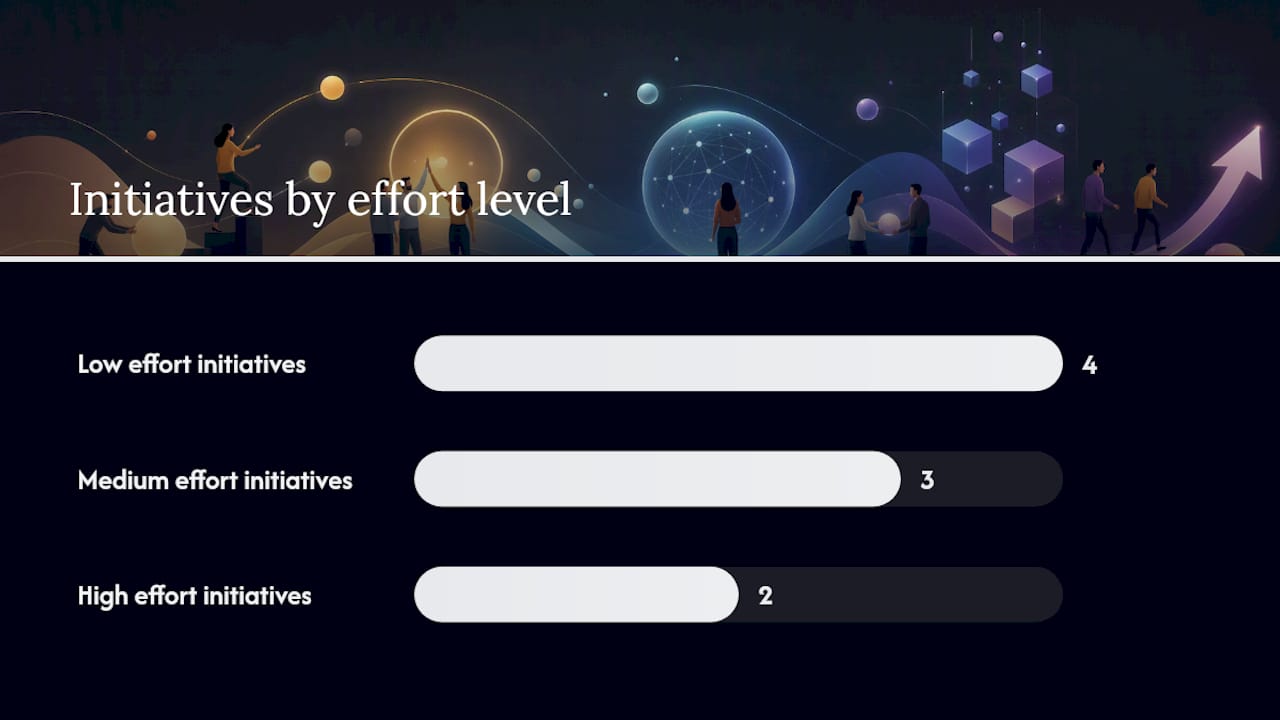
| Initiative | Budget range | Timeline | Effort level |
|---|---|---|---|
| Peer shout-out channel | $0 | 1–2 days | Low |
| Stay interviews | $0 | 1–2 weeks to schedule | Low |
| No-meeting blocks | $0 | 1 week to announce | Low |
| Micro-L&D stipends | $200–$500/employee/year | 30–60 days to set up | Medium |
| EAP promotion campaign | $0–$500 (design) | 30 days | Low |
| Immersive team event (escape room) | $15–$25 per person | 30–60 days to plan | Medium |
| Manager coaching program | $1,000–$2,000 per cohort | 60–90 days | High |
| ERG launch with budget | $500–$1,000/group/year | 60–90 days | Medium |
| Formal recognition platform | $3–$8/employee/month | 90 days | High |
Pro Tip: Start with the $0 quick wins and run them for 30 days before spending a dollar on a platform. If peer shout-outs and stay interviews don’t move your pulse score, a $10,000 recognition software license won’t either. Spend money on what already shows signal.
A 90-day pilot checklist you can run starting Monday
Pick one idea. Run it for 90 days. Measure it. Brief leadership on the result. That cycle, repeated quarterly, builds more durable engagement than any annual initiative.
Weeks 1–2: Planning
- Select one idea from the theme sections above (peer recognition or manager one-on-ones are the fastest to launch).
- Identify your pilot group (one team or department, 10–30 people).
- Assign an owner (HR business partner or team manager).
- Set your baseline: run a two-question pulse survey before launch.
- Draft a one-paragraph communication explaining the pilot to participants.
Weeks 3–6: Launch
- Launch the activity and send the communication.
- Manager sends the first recognition note or conducts the first stay interview.
- Track participation weekly in a shared spreadsheet.
- Send a brief mid-point check-in message to participants at week four.
Weeks 7–10: Mid-pilot review
- Run the pulse survey again (same two questions).
- Compare participation rate to the 75% target.
- Identify one blocker and remove it (usually a manager who hasn’t participated yet).
Weeks 11–12: Analysis and briefing
- Run the final pulse survey.
- Calculate recognition frequency and compare to baseline.
- Write a one-page summary: what you did, who participated, what the pulse score changed by, and what you recommend next.
- Present to your CHRO or leadership team with a go/no-go recommendation for scaling.
Minimum team for a pilot: one HR owner, manager buy-in from the pilot team, and 15 minutes per week of tracking time. No dedicated budget required for the quick-win options.
How Codebusters Escape Room illustrates immersive team-building that works
The theory behind escape rooms as a team-building tool is straightforward: put a group under mild time pressure, remove their usual hierarchy, and watch how they actually communicate. What surfaces in 60 minutes often takes months to observe in a standard office setting.
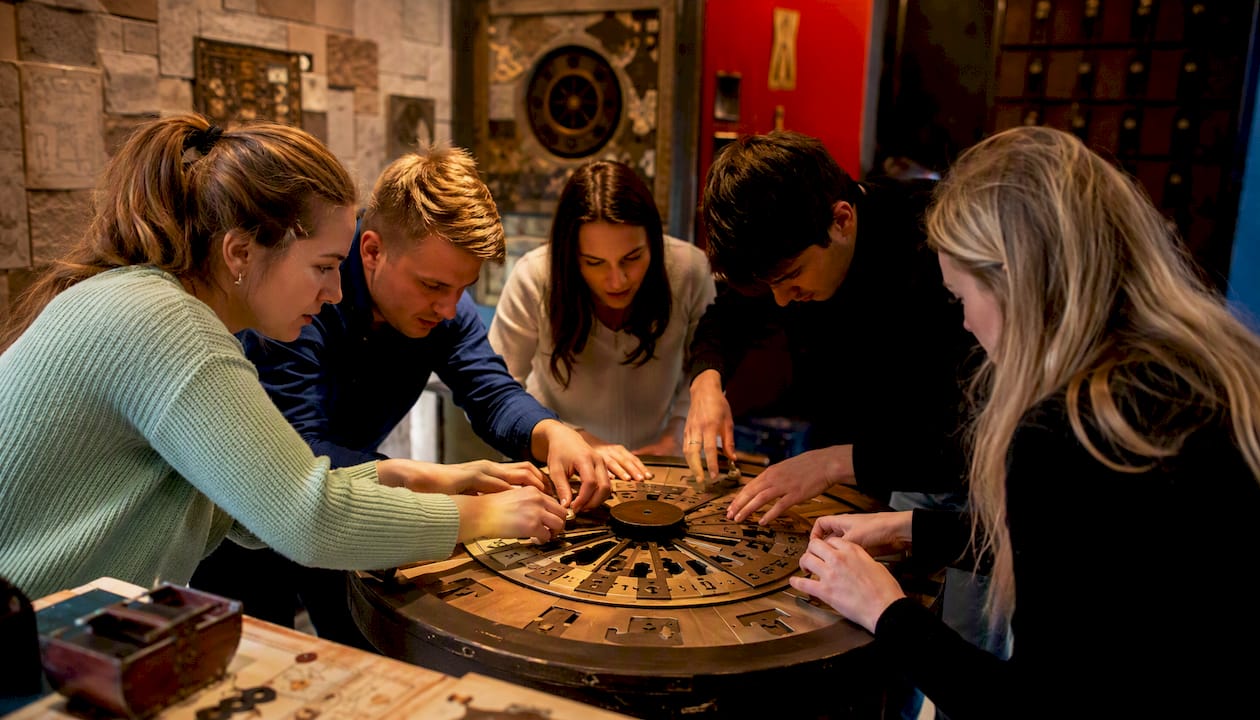
Here’s how a corporate team might structure this with Codebusters Escape Room in Colorado Springs:
Objective: Surface communication gaps between a newly merged cross-functional team of 8–12 people.
Setup: Book a private room (Codebusters offers private bookings across multiple themed rooms, including “Flight of Deception” and “Past to the Future,” each designed for different group sizes and difficulty levels). Brief the team in advance: this is a structured learning exercise, not just entertainment.
During the event: Assign one observer (the manager or HR partner) who watches rather than plays. Note who takes initiative, who goes quiet, and where the team gets stuck.
Outcomes to capture:
- Participation rate (did everyone engage, or did two people dominate?)
- Qualitative debrief responses (see below)
- One behavioral observation the manager can reference in the next one-on-one
Debrief template (five questions, 20 minutes post-event):
- What role did you naturally take on, and was it different from your usual work role?
- Where did the team get stuck, and what unblocked you?
- Who did you rely on that you don’t usually collaborate with?
- What’s one communication habit from today you want to bring back to the office?
- What’s one thing we should do differently as a team next week?
For hybrid teams: Run the in-person session with your local group at Codebusters Escape Room, then hold the debrief on video call so remote teammates can join and respond to the same five questions based on a written summary of what happened. The debrief, not the room, is the transferable part.
Pro Tip: Matching the activity to a specific goal before you book makes the debrief twice as useful. “We want to improve cross-functional communication” gives you a lens. “We want to have fun” gives you a party.
Codebusters Escape Room’s award-winning escape room experiences are specifically designed to surface collaboration patterns under pressure, which is exactly what makes them useful for HR-led team diagnostics, not just entertainment.
What HR should actually prioritize first in 2026
Most engagement frameworks present every idea as equally worth pursuing. That’s not how limited HR bandwidth works.
Here’s a simple prioritization grid. Place each initiative on two axes: impact (how much it moves engagement scores and retention) and effort (time, budget, and change management required).
The four quadrants:
- Low effort, high impact: Start here. Peer recognition, stay interviews, no-meeting blocks.
- High effort, high impact: Plan and resource properly. Manager coaching programs, formal L&D stipends.
- Low effort, low impact: Do these only if they’re already running. Team lunches, newsletter shout-outs.
- High effort, low impact: Cut these. Annual engagement surveys with no follow-up action, one-off motivational speakers.
For 2026 specifically, the recommended sequence is:
- Manager coaching (highest leverage per Gallup, hardest to skip)
- Peer recognition program (fastest to launch, visible signal to employees within two weeks)
- Micro-L&D stipend (addresses reskilling anxiety directly, low admin overhead)
- Immersive team event with debrief (one per quarter, tied to a specific team objective)
The temptation is to launch everything at once. Resist it. Consistency beats spectacle: a manager who does a five-minute check-in every week for six months will move engagement scores more reliably than a company that throws a $20,000 offsite once a year and then goes quiet.
Codebusters Escape Room offers private corporate bookings in Colorado Springs
Corporate teams looking for a ready-to-run, off-the-shelf team-building experience don’t need to build one from scratch. Codebusters Escape Room handles the logistics, the themed narrative, and the group-size planning so your HR team can focus on the debrief and the outcomes.
Private bookings are available for corporate groups across multiple themed rooms, each calibrated for different difficulty levels and group sizes. Pricing is per group, making it straightforward to budget per-head before the event. Gift vouchers are also available for teams that want to offer the experience as a recognition reward rather than a scheduled event.
To inquire about a corporate package or check availability, book your team session directly on the Codebusters Escape Room website. Veteran-owned, award-winning, and based in Colorado Springs with two locations, it’s a practical choice for any Front Range team that wants an immersive experience backed by real operational credibility.
Sources
These are the primary research sources used throughout this article. Each one is worth bookmarking if you’re building or refreshing an engagement program this year.
- 3 Employee Engagement Strategies for 2026 - Gallup
- Employee Engagement Ideas 2026
- 26 employee engagement ideas for 2026 and beyond
- The secret to productive employees: a radical shift in work flexibility
- Flexible work (Microsoft Careers)
- APA report on workplace mental health support
- Harvard Business Review (relevant team-building coverage)