Effective Communication Tips for Escape Room Teams
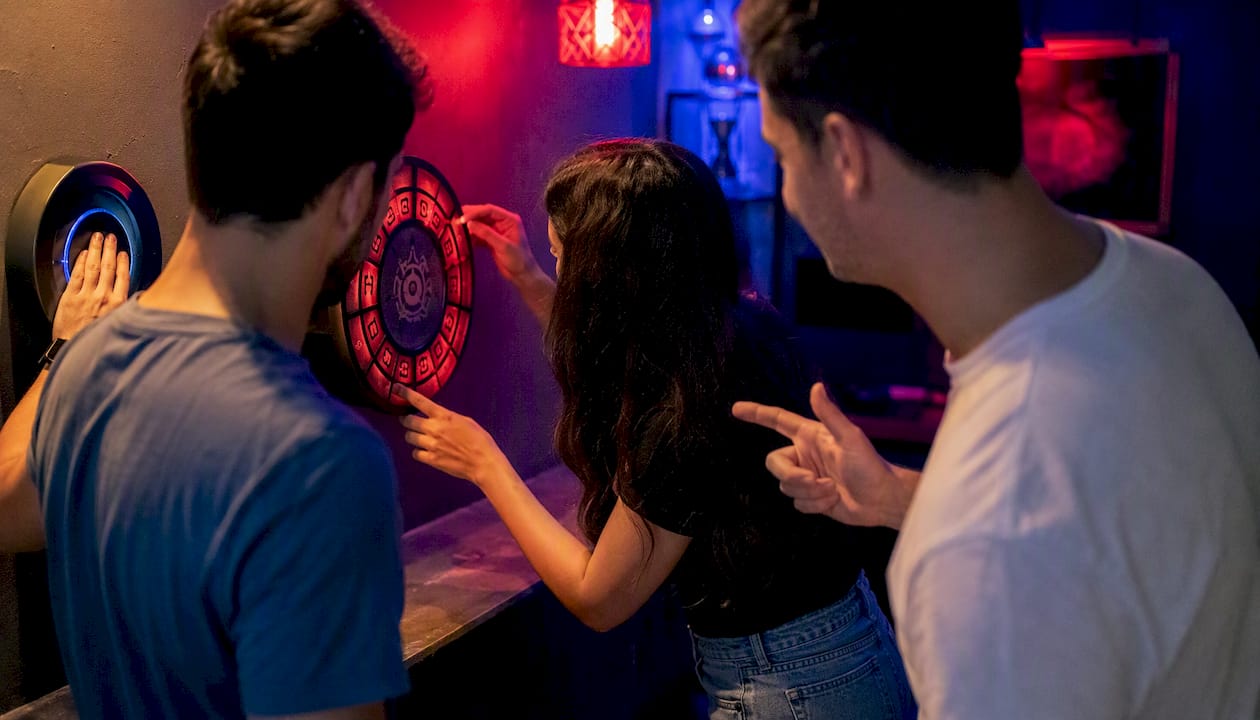
The fastest way for any group to improve escape-room results is to communicate constantly and systematically. Call out every find, assign quick roles, and check the clock every 10 minutes. Teams that stay organized and share discoveries consistently post the highest escape rates — not because they’re smarter, but because they waste less time.
Your minute-one checklist (read this before the door closes):
- Assign a timekeeper — one person owns the clock and calls it out at minutes 10, 30, and 45
- Pick a coordinator — one voice makes final calls when the group splits
- Agree on a callout format — item, color, location, status (more on this below)
- Designate a recorder — someone tracks solved puzzles and used items
- Decide where used items go — a corner, a shelf, anywhere consistent
- Commit to one rule: say everything out loud, no exceptions
That’s it. Six decisions, under 60 seconds, and your team enters with a shared plan instead of six individual ones.
Key Takeaways
Clear, structured communication is the single highest-impact change any escape-room team can make before and during a timed session.
| Point | Details |
|---|---|
| Say everything out loud | Unannounced finds are the top reason teams fail; verbalize every discovery immediately. |
| Assign roles before entering | Timekeeper, coordinator, searcher, solver, and recorder reduce overlap and idle time. |
| Check the clock at fixed points | Call time at minutes 10, 30, and 45 to pace decisions and trigger hint requests. |
| Use hints as a strategy | If stuck for more than 5–10 minutes, ask for a hint — early use preserves momentum. |
| Codebusters Escape Room | Colorado Springs’ award-winning, veteran-owned operator offers private bookings built for these tactics. |
Table of Contents
- What are the most effective communication tips before the clock starts?
- How should you assign roles inside the escape room?
- How do you share clues quickly and accurately with your team?
- How do you manage time and decide when to ask for a hint?
- What tactics work best for families, friend groups, and corporate teams?
- How do you fix communication breakdowns when momentum stalls?
- How do you run a five-minute post-game debrief?
- How does active listening improve your escape-room performance?
- How do you stay calm and communicate clearly under time pressure?
- How do nonverbal cues help your team inside the escape room?
- What Codebusters Escape Room sees on the floor every week
- Private group bookings and team-building events at Codebusters Escape Room
- Sources
What are the most effective communication tips before the clock starts?
Agree on roles and rules before you walk through the door. The pre-game window — usually two to three minutes while the game master runs the briefing — is the only quiet moment your team gets.
Listen to the game master. This is non-negotiable. Game masters routinely embed clues and context in the briefing that teams miss because they’re chatting. One missed detail can cost five minutes of in-room confusion.
Decide three things before the door opens:
- Who is the timekeeper?
- What’s the rule on touching props? (Most rooms allow it; confirm.)
- How will you ask for hints — and does everyone agree to use them?
Pro Tip: Have the group leader read the minute-one checklist above aloud during the pre-game wait. It takes 30 seconds and gets everyone on the same page before adrenaline kicks in.
How should you assign roles inside the escape room?
Assign functional roles immediately. Clear roles reduce overlap, prevent three people from staring at the same lock, and keep quieter teammates engaged. Designating roles ahead of time avoids duplication of effort and keeps the group moving as a unit.
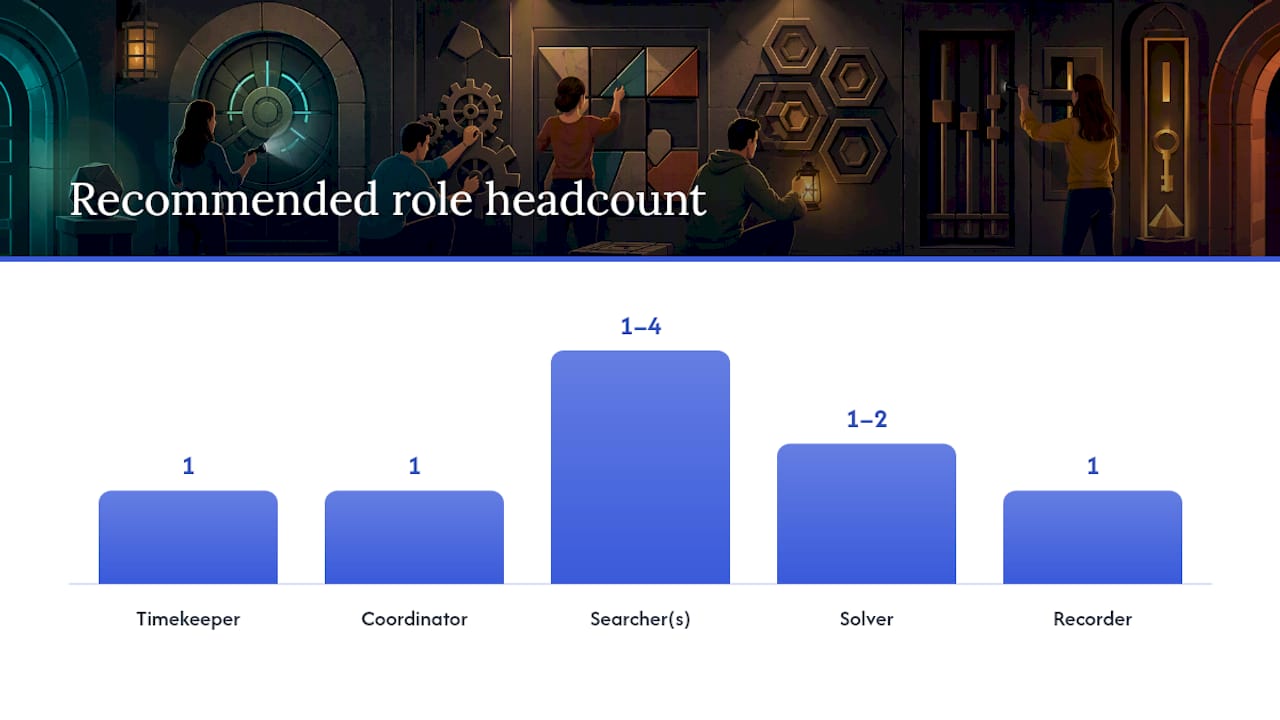
| Role | Core task | Best headcount |
|---|---|---|
| Timekeeper | Calls time at checkpoints, tracks urgency | 1 (any size group) |
| Coordinator | Directs traffic, makes final calls | 1 (groups of 4+) |
| Searcher(s) | Sweep the room, surface new clues | 1–4 |
| Solver | Works active puzzles | 1–2 |
| Recorder | Tracks used items, solved puzzles, codes | 1 |
2–3 players: Everyone searches and solves. One person doubles as timekeeper and recorder. Rotate the solver role every puzzle so no one burns out.
4–6 players: Split into two searchers and one solver. The coordinator floats. This is the sweet spot — four to six players covers most rooms without creating clutter. Swap solver and searcher roles at the 30-minute mark if progress stalls.
7–10 players: Two search pairs, two solvers, one coordinator, one recorder. Rotate pairs every 15 minutes. Without rotation, the back half of the group goes idle and morale drops fast.
Assigning searcher and recorder roles to quieter teammates keeps everyone contributing — not just the loudest voices in the room.
How do you share clues quickly and accurately with your team?
Use a three-part callout every time: what it is, where you found it, what to do with it. That format cuts the back-and-forth that eats minutes.
Sample callout protocol:
- “Brass key — under the left chair leg — holding, someone check the cabinet.”
- “Four-digit code — written on the mirror — recorder, log it.”
- “Lock open — padlock on the trunk — moving it to the used pile.”
Do/don’t rules for clue sharing:
- Do say everything you find, even if it looks irrelevant
- Do repeat critical numbers twice (“Seven-two-four-one. Seven-two-four-one.”)
- Do physically separate used items from unused ones — reusing spent keys and codes is one of the most common time-wasters
- Don’t give cryptic hints (“I think this might go with that thing over there”)
- Don’t hold a clue while you puzzle it out alone — call it out first, think second
- Don’t announce a find and then walk away without confirming someone heard you
How do you manage time and decide when to ask for a hint?
Check the clock at fixed intervals: minutes 10, 30, and 45. At each checkpoint, the timekeeper calls the time and the coordinator does a quick status sweep — how many puzzles solved, how many open, where people are stuck.
The hint decision is simple: if your team has been stuck on a single puzzle for more than five to ten minutes, hand it off or ask for a hint. Teams that use hints early often finish with time to spare. Teams that treat hints as failure tend to run out the clock on one stubborn lock.
Hint request script: “We’ve been on [puzzle] for about eight minutes. We’ve tried [X] and [Y]. Can we get a nudge?” That phrasing tells the game master exactly where you are and gets a targeted hint instead of a vague one.
Pro Tip: Frame hints as a strategy, not a surrender. Tell the group before you start: “We get three hints. Using them smart is part of the plan.”
What tactics work best for families, friend groups, and corporate teams?
Different groups need different emphasis. The roles and protocols above apply to everyone, but the delivery changes.
- Families with kids: Keep roles simple and age-appropriate. Give younger players the searcher role — they’re often better at spotting small details. Use encouragement over correction. Avoid competitive framing; keep it collaborative. Mixed-age group tips from Codebusters Escape Room cover this in more depth.
- Friend groups: Friends tend to joke and socialize, which is great until minute 40. Designate a “focus caller” — someone who can say “okay, back to it” without killing the vibe. Agree on this role before you enter.
- Corporate teams: Assign roles by actual workplace strength where possible (the project manager as coordinator, the detail-oriented analyst as recorder). Use the post-game debrief deliberately — it doubles as a team-building moment. Step-by-step team coordination guides from Codebusters Escape Room are built specifically for this context.
- Mixed-age or mixed-experience groups: Pair a first-timer with an experienced player in each search pair. Brief the group that no idea is a bad idea — this keeps newer players vocal instead of deferring to the veterans.
How do you fix communication breakdowns when momentum stalls?
The three most common in-game breakdowns: not sharing finds, multiple people working the same task, and ignoring time checks. Each has a fast fix.
Not sharing finds: Call a 15-second “table check” — everyone holds up what they’re holding and says it aloud. Nothing stays private.
Multiple people on one puzzle: The coordinator calls “reassign” — one person stays on the puzzle, everyone else moves. Splitting into small groups and rotating as needed prevents clutter and confusion.
Ignoring time checks: The timekeeper physically moves to the center of the room and calls the time. Standing still and saying “guys, it’s been 30 minutes” gets ignored. Moving gets attention.
Pro Tip: When momentum completely stalls, call a 30-second regroup. Everyone stops, stands together, and the coordinator asks: “What do we know? What’s still open?” That reset often surfaces a clue someone forgot to announce.
How do you run a five-minute post-game debrief?
Do it immediately after the session ends, while the room is still fresh. Winning is primarily about teamwork, organization, and a calm attitude — a debrief makes those lessons stick for the next booking.
- What worked? Name one specific thing the team did well (a smooth role handoff, a fast callout, a good hint decision).
- What wasted time? Identify one moment where communication broke down and what the fix would have been.
- One change next time? Each person names a single adjustment — keep it concrete, not vague.
Close by collecting one piece of positive feedback from the group. For corporate teams, the manager can capture this in a shared note. For families, it becomes the story everyone retells on the drive home.
How does active listening improve your escape-room performance?
Active listening in an escape room means processing what your teammates say before reacting. When someone calls out a clue, repeat it back: “Brass key under the left chair — got it.” That confirmation loop takes two seconds and prevents the most common failure mode: someone announces a find and nobody acts on it.
Resist the urge to talk over teammates. When two people speak at once, both messages get lost. The coordinator role exists partly to manage this — one voice at a time when the group is comparing notes.
How do you stay calm and communicate clearly under time pressure?
Calm, encouraging teams outperform frustrated ones even when they’re behind schedule. Pressure makes people louder and faster, but not clearer. The fix is deliberate slowdown: take one breath, use the three-part callout format, and speak at a pace your teammates can actually process.
When someone makes a wrong call, skip the correction and move forward. “That didn’t work — here’s what’s next” keeps energy positive. Blame and frustration are the two fastest ways to lose five minutes.
Assign a timekeeper and team leader specifically to manage urgency. When those roles are filled, the group has a built-in pressure valve — someone whose job is to stay calm and redirect.
How do nonverbal cues help your team inside the escape room?
Rooms get loud. Nonverbal signals cut through noise and speed up coordination without adding to the verbal clutter.
Point and nod: When you find something, point to it and make eye contact with the nearest teammate. That’s a wordless “come look at this” that works across a crowded room.
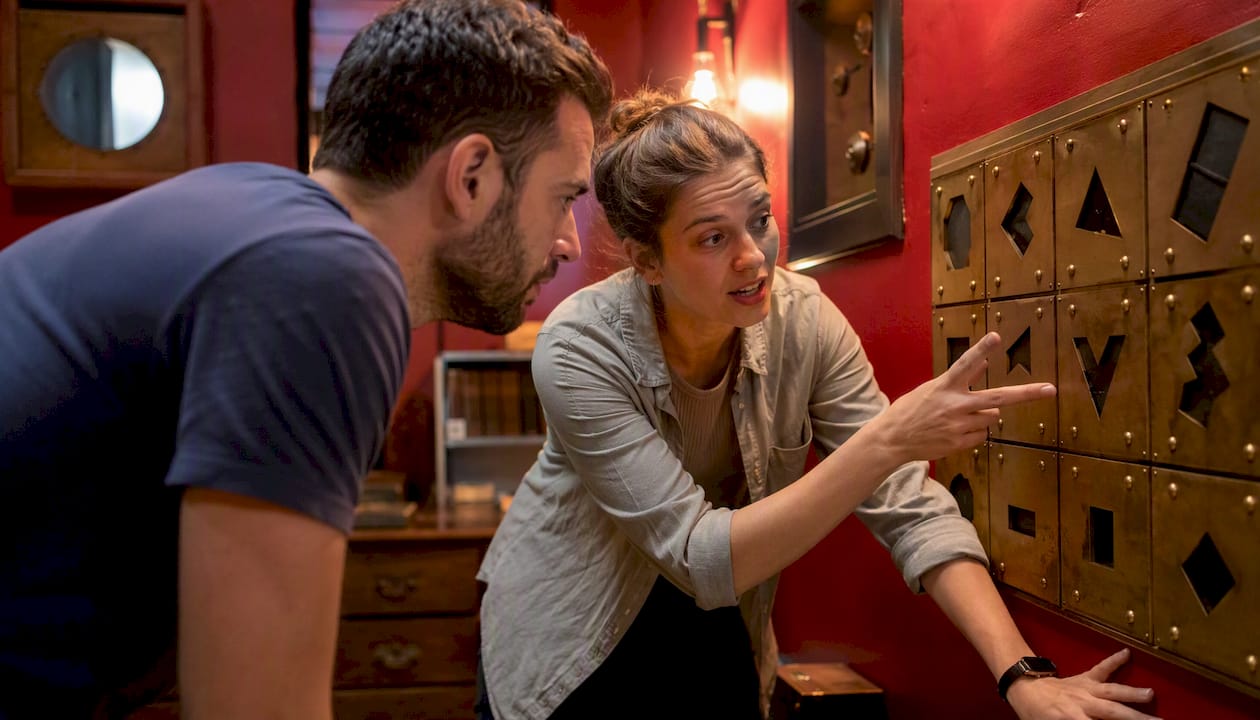
Thumbs up/thumbs down: Use these for quick status checks — puzzle solved, puzzle failed, need help. Faster than shouting across the room.
Physical placement: Putting a solved item in the designated used-items area is itself a nonverbal signal. Anyone who glances over knows that item is done.
Proximity: Moving to stand next to someone signals “I want to work on this with you.” Moving away signals “I’m going to search elsewhere.” Teams that read proximity well naturally divide and conquer without constant verbal negotiation.
What Codebusters Escape Room sees on the floor every week
Teams that follow these rules escape faster. That’s not a theory — it’s what Codebusters Escape Room observes in every session at its Colorado Springs locations. The groups that struggle almost always share one trait: they work in parallel silos, each person solving their own puzzle without broadcasting finds to the room.
The single rule that changes outcomes most is the simplest one: say everything out loud. A team that verbalizes every find, every failed attempt, and every open question gives every member the information they need to contribute. Silent teams leave clues on the table.
Codebusters Escape Room is a veteran- and family-owned, award-winning operator. The game masters here treat the briefing as part of the experience, not a formality. Listen to it. The hints are part of the design, not a penalty. Use them. The role of communication in escape rooms is something Codebusters Escape Room has written about extensively — because it’s the variable that separates a frustrating session from a memorable one.
Private group bookings and team-building events at Codebusters Escape Room
Private escape room sessions give your group the room to yourselves — no strangers, no awkward merges, just your team and the clock. Codebusters Escape Room’s Colorado Springs locations offer private bookings for families, friend groups, and corporate teams, with themed rooms designed for groups of two to ten players.
For corporate teams, the private format doubles as a structured team-building session. Pair it with the debrief template above and you have a complete 90-minute team exercise with a built-in debrief. Gift vouchers are available for event organizers who want to pre-purchase experiences for their groups.
Booking checklist for managers and event organizers:
- Confirm group size and choose a room difficulty that fits your team’s experience level
- Select a private booking to keep the session focused
- Brief your team using the minute-one checklist before you arrive
- Reserve your session at Codebusters Escape Room — availability fills quickly on weekends
Sources
- How to Beat an Escape Room: 13 Expert Tips from Game Masters | Escape Experience Blog
- 10 best escape room tips | Escape Reality
- What are the best ways to communicate with your team in Escape Rooms NYC? - Mission Escape Games
- How To Win an Escape Room? | Fourth Wall Escape