Explore diverse puzzle challenges for escape room success
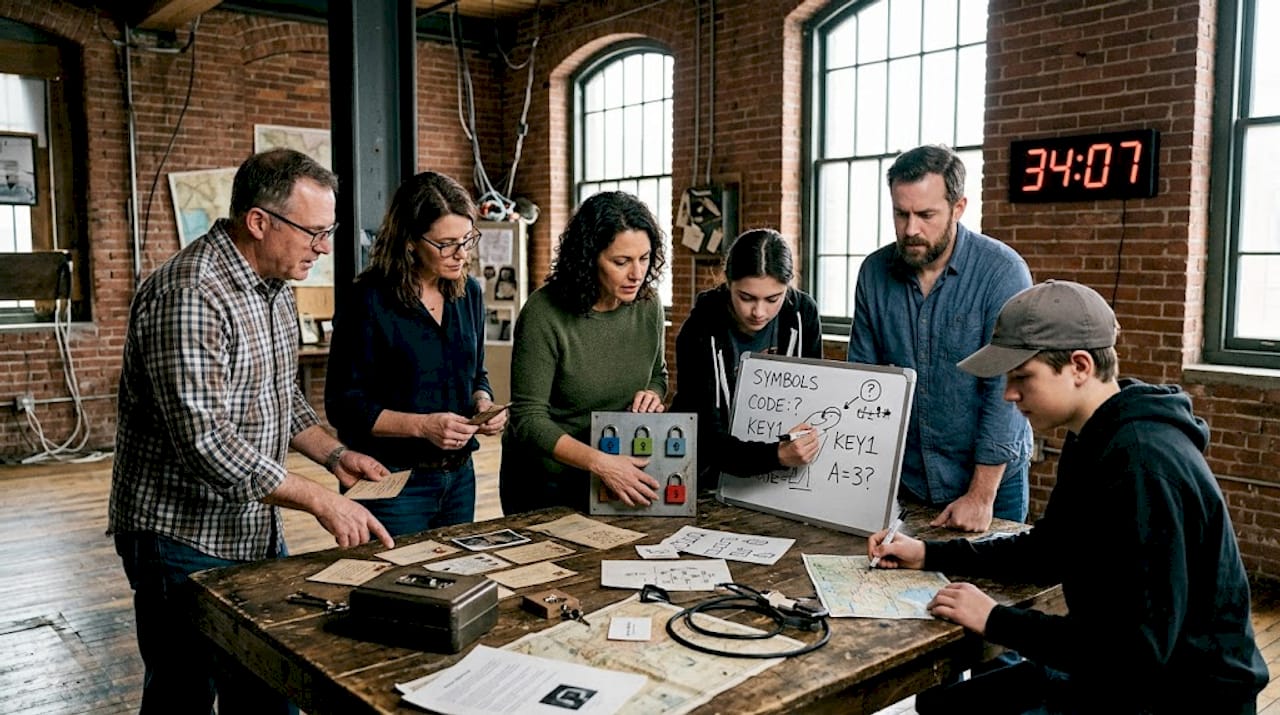
The right mix of puzzle challenges can mean the difference between a group that clicks and communicates like a well-oiled team and one that stalls after the first locked box. Escape rooms pack logic sequences, physical manipulation, and observational hunts into a single timed experience, and every group brings a completely different set of strengths. Families with young kids need accessible, hands-on fun. Corporate teams want puzzles that expose natural leaders. Friend groups just want a hard fight and bragging rights. Understanding which puzzle types suit your group before you book gives you a massive advantage, and this guide breaks it all down.
Table of Contents
- Evaluating puzzle challenge types: A framework for your group
- Observation and physical challenges: Engaging families and kids
- Logic, team, and communication puzzles: Boosting group engagement
- Comparing puzzle challenge types: Which is best for your group?
- Our take: The real secret to escape room success
- Ready for your next puzzle adventure?
- Frequently asked questions
Key Takeaways
| Point | Details |
|---|---|
| Pick puzzle types by group | Choose puzzles that match the interests and skills of your family, friends, or team for maximum engagement. |
| Balance leads to success | Mixing observation, physical, logic, and teamwork challenges keeps everyone involved and increases escape rates. |
| Communication trumps skill | Teams using clear communication and role assignment outperform solo experts in escape rooms. |
| Parallel puzzles prevent bottlenecks | Rooms with multiple puzzles running at once keep teams active and help avoid idling. |
| Expert staff enhance experience | Venues that offer hints and facilitate role assignment support higher success and more memorable escapes. |
Evaluating puzzle challenge types: A framework for your group
Choosing the right puzzle mix starts with understanding two core design philosophies. Puzzle mechanics emphasize balance for pacing, teamwork, and diverse skills, using methodologies like diegetic (story-integrated) versus non-diegetic puzzles, narrative gating, environmental storytelling, and flow state design. Diegetic puzzles feel like a natural part of the story world. A locked journal that hides a cipher, or a painting that conceals a combination, pulls players deeper into the narrative. Non-diegetic puzzles, like standalone logic grids placed on a table, are intellectually satisfying but can occasionally break immersion.
Pacing is the other critical variable. Escape rooms use two main structures:
- Linear progression: Teams solve puzzles in sequence, one unlocking the next. Great for building tension, but risky if one player bottlenecks the group.
- Parallel progression: Multiple puzzles are available simultaneously, letting players split up and tackle challenges that suit their strengths.
For large groups or mixed-skill families, parallel structure almost always produces a more satisfying experience. It prevents that dreaded moment when everyone crowds around one puzzle while two people in the back have nothing to do.
Another useful lens is Howard Gardner’s theory of multiple intelligences. Strong escape rooms address several of them:
- Linguistic: Wordplay, riddles, narrative clues
- Logical-mathematical: Sequences, deduction, number grids
- Spatial: Maps, hidden object searches, directional puzzles
- Bodily-kinesthetic: Physical manipulation of objects, tactile locks
You can find escape room team performance data that shows groups with diverse skill sets outperform same-skill groups, largely because varied puzzles reward different thinkers. The key is booking a room that intentionally mixes types rather than defaulting to all logic or all physical.
For pacing with puzzles, difficulty curves matter enormously. Rooms that ramp up gradually keep players in a “flow state,” where challenge and skill feel perfectly matched. Rooms that open with an overwhelming puzzle dump cause frustration fast.
Pro Tip: When booking for a group, ask the venue specifically whether the room uses parallel or linear puzzle progression. The answer tells you more about the experience than the theme description ever will.
Observation and physical challenges: Engaging families and kids
Observation puzzles are exactly what they sound like: spotting a clue hidden in plain sight, recognizing a color pattern on the wall, or finding a symbol that repeats across three different props. These puzzles reward attention and patience over academic knowledge, making them genuinely accessible to players of all ages. Kids often excel here because they haven’t yet learned to overlook the obvious.
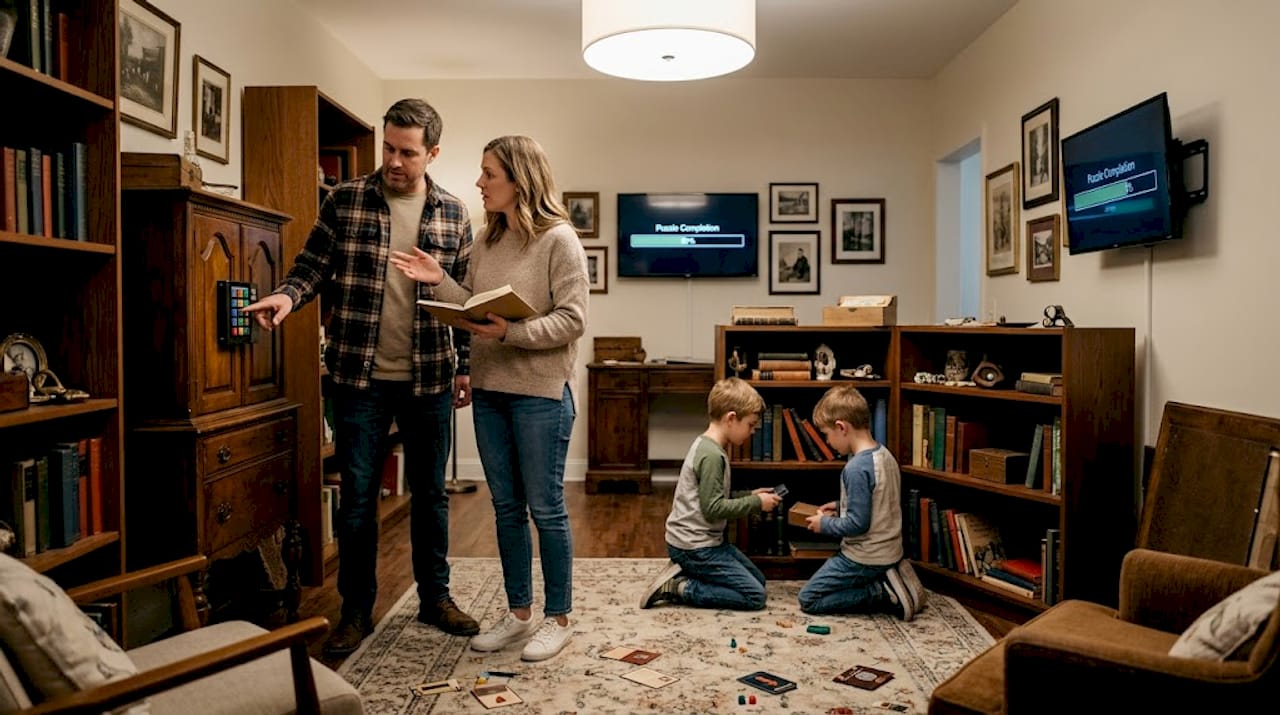
Physical puzzles take engagement one step further. They require players to actually manipulate objects, whether sliding panels, turning dials, repositioning magnets, or threading a rope through a specific path. The tactile satisfaction of physically solving something is a core part of puzzle diversity in entertainment and keeps younger players fully invested.
For family groups, these two puzzle types are the foundation of a great run. Here’s why they work:
- Low barrier to entry: No specialized knowledge required
- Immediate feedback: Success or failure is obvious right away
- Shared participation: Kids can lead, not just watch adults solve things
- Visual engagement: Props, colors, and shapes hold short attention spans
Parallel puzzle design is especially important for family rooms. When observation clues and physical challenges are available at the same time, a parent can work a combination lock while a child searches for hidden symbols. Nobody waits. Nobody gets bored. That shared momentum is what makes families book again.
Beginner escape rooms, which typically feature these accessible puzzle types, see 50-70% success rates, making them the right starting point for groups new to the format. Advanced rooms can drop that number dramatically, so matching the puzzle style to your group’s experience level is not optional; it’s the difference between a fun memory and a frustrating one.
Family-friendly venues that blend observation and physical puzzles with thematic storytelling create experiences where adults and children both feel genuinely useful. When your eight-year-old spots the clue that unlocks the next stage, that’s the moment that gets retold at dinner for weeks.
Pro Tip: Before entering a family room, encourage kids to look low. Props and clues placed at kid eye level are intentional design choices by experienced room builders. Adults walking right past them is more common than you’d think.
Logic, team, and communication puzzles: Boosting group engagement
Logic puzzles are the backbone of escape room design and the type most people picture first. Deduction grids, sequence locks, cipher wheels, and binary codes all fall into this category. They reward methodical thinking and the ability to hold multiple variables in mind at once. For friend groups or corporate teams, these puzzles are where natural problem-solvers shine.
But here’s what the data actually says: individual logic skill matters far less than you’d expect. Teams using hints, roles, and communication boost their escape rate by 15 to 40 percent. That’s a staggering margin. A group of average puzzle-solvers who communicate constantly will beat a group of brilliant individuals who each work in silence almost every time.
Communication puzzles are specifically built around this truth. They require one player to relay information to another player who can’t see the same thing. Roles are mandatory, not optional. These puzzles include:
- Mirroring tasks: One player reads clues while another enters combinations
- Divided information: Each player holds half the answer and must share
- Relay challenges: Instructions passed verbally through a physical or visual barrier
Role assignment before entering a room is a consistently underused strategy. Designating a note-taker, a searcher, a puzzle-solver, and a communicator gives each person ownership. The puzzle storytelling benefits of role-driven play extend beyond the room itself; teams that practice structured communication in a fun setting often notice the same skills improving in real work environments.
“Success in escape rooms hinges more on communication and role clarity than individual puzzle skill. The best teams talk constantly, delegate deliberately, and ask for hints without ego.”
Puzzle success benchmarks consistently show that rooms incorporating teamwork-required puzzles produce higher satisfaction scores, not just higher escape rates. Groups feel the win more deeply when everyone contributed.
Pro Tip: Assign a “hint caller” before the clock starts. This person’s only job is to decide when five minutes have passed without progress on a single puzzle. Taking hints is not failure. Burning ten minutes on one stuck point is.
Comparing puzzle challenge types: Which is best for your group?
Now that you understand each type individually, direct comparison makes your booking decision much simpler. Empirical benchmarks show that hint usage, teamwork structure, and puzzle type all measurably affect escape success. Here’s how the major types stack up:
| Puzzle type | Core skill | Best group fit | Difficulty range | Success boost |
|---|---|---|---|---|
| Observation | Attention, pattern recognition | Families, mixed ages | Beginner to medium | High with parallel design |
| Physical manipulation | Dexterity, spatial reasoning | All ages, especially kids | Beginner to medium | High with tactile props |
| Logic and deduction | Analytical thinking | Friend groups, enthusiasts | Medium to expert | Moderate, skill-dependent |
| Team and communication | Coordination, role clarity | Corporate teams, events | Medium to expert | Very high, up to 40% boost |
For difficulty benchmarks by group type, rooms that combine at least three of these puzzle categories consistently outperform single-type rooms in both escape rates and satisfaction scores. The best experiences blend them intentionally.
Here’s a practical decision guide based on group profile:
- First-timers and families: Prioritize observation and physical puzzles. Choose beginner or intermediate rooms with parallel puzzle layouts.
- Friend groups of experienced players: Lean into logic and deduction rooms. Look for expert difficulty with a reputation for fair, not frustrating, challenge design.
- Corporate teams and event groups: Communication and teamwork puzzles are your core goal. Choose rooms that require role division and active information sharing.
- Mixed groups (some veterans, some new): Book combination rooms that offer variety. Everyone gets a moment to lead, and nobody gets left out.
For competitive puzzle comparisons between room formats, the consensus is clear: variety beats specialization for most group types. A room that only offers logic puzzles will alienate players who think spatially or physically. The best rooms are intentionally diverse.
Our take: The real secret to escape room success
Here’s the uncomfortable truth we’ve learned after watching hundreds of groups move through escape rooms in Colorado Springs: the groups that struggle most are rarely the ones with the lowest puzzle IQ. They’re the ones who stopped talking.
Players who go quiet when they’re stuck, who don’t share clues, who assume someone else is handling a puzzle, those are the groups that time out. Every time. The rooms that produce the most memorable wins are the ones with genuine parallel puzzle structures that force people to stay active and communicate continuously. Picking a room solely because it sounds the most challenging is the wrong metric.
Picking a room because its puzzle design forces your specific group to work together? That’s the move. We’ve seen real escape room experiences prove again and again that the post-room conversation, the debrief of who spotted what and when, is often just as valuable as the escape itself. Choose the room that creates that conversation.
Ready for your next puzzle adventure?
If this guide has you thinking about which puzzle types your group would genuinely thrive in, now’s the time to stop planning and start playing. At CodeBusters Escape Room in Colorado Springs, every room is built around a deliberate mix of puzzle types, from tactile physical challenges to layered logic sequences and team-driven communication tasks.
Whether you’re planning a family outing, a friend group challenge, or a corporate team-building event, our Colorado Springs escape rooms offer themed experiences designed to engage every kind of thinker. Our expert staff can help match your group to the right room before you even walk in the door. Book your session today and put everything you’ve learned here to the test.
Frequently asked questions
What types of puzzles are best for family escape rooms?
Observation and physical puzzles are most accessible for families, offering hands-on, low-stress engagement suitable for all ages. Family-friendly puzzle types enhance engagement and keep younger players just as involved as adults.
How does teamwork affect escape room success?
Teams that communicate and assign roles achieve up to 40% higher escape rates, regardless of puzzle type. Structured communication matters more than individual puzzle skill in almost every room format.
Should I prioritize themed rooms or puzzle difficulty?
Rooms blending immersive story themes and varied puzzle types provide the most engaging experience, especially for group events. Story-driven puzzles enhance immersion and make teamwork feel meaningful rather than mechanical.
Are advanced puzzles suitable for first-time players?
Beginner rooms offer 50 to 70 percent success rates while advanced rooms drop to 10 to 40 percent, so first-timers should start with beginner or mixed-difficulty experiences to build confidence and skills.
What is the most common mistake in puzzle challenge rooms?
Overthinking simple puzzles and waiting too long to ask for hints instead of using systematic search are the most frequent pitfalls. Experts recommend constant communication, role assignment, and requesting hints after five minutes without progress.