Corporate escape room events unlock team success in 2026

Most corporate teams view escape rooms as fun diversions, but these timed puzzle challenges actually compress months of team observation into sixty focused minutes. When groups race to solve clues under pressure, they reveal communication patterns, leadership instincts, and decision-making habits that stay hidden in normal office settings. For Colorado Springs companies seeking meaningful team-building activities, escape rooms provide diagnostic insights that transform how teams collaborate. This guide explains what corporate escape room events deliver and why they build stronger, more cohesive workplace teams.
Table of Contents
- Understanding Corporate Escape Room Events
- How Escape Rooms Reveal And Improve Team Dynamics
- Integrating Escape Room Events Into Corporate Team-Building Programs
- Benefits And Outcomes Reported From Corporate Escape Room Participation
- Explore Corporate Escape Room Events In Colorado Springs
- Frequently Asked Questions
Key takeaways
| Point | Details |
|---|---|
| Diagnostic power | Escape rooms reveal communication, leadership, and decision-making patterns within minutes of play |
| Shared experiences | Teams create memorable moments that serve as reference points for future feedback and accountability |
| Skill development | Activities build non-technical skills that reduce workplace errors and improve collaboration |
| Proven outcomes | 100% of participants recommend escape rooms, reporting improved teamwork and communication |
| Structured learning | Pre-briefings and debriefings transform experiences into actionable workplace improvements |
Understanding corporate escape room events
Corporate escape room events are interactive puzzle experiences where teams solve challenges within strict time limits inside themed environments. Unlike casual entertainment, these activities simulate workplace pressure and time constraints that mirror real project deadlines and crisis situations. The compressed timeline creates an intense environment where team dynamics become visible, showing exactly how groups communicate, delegate, and problem-solve when stakes feel high.
These events function as behavioral laboratories. Teams enter themed rooms filled with puzzles, codes, and hidden clues that require collaboration to solve. The sixty-minute countdown creates genuine urgency without real consequences, allowing natural behaviors to surface. You see who takes charge, who listens, who gets frustrated, and who keeps the group focused. These patterns directly mirror workplace dynamics but become visible in ways that months of observation might miss.
The diagnostic value comes from how quickly authentic behaviors appear. Escape rooms develop non-technical skills that reduce errors and improve collaboration across all workplace contexts. Communication clarity, active listening, constructive disagreement, and adaptive leadership all emerge naturally when teams face novel challenges together. The experience provides concrete examples that make abstract feedback tangible and memorable.
Corporate escape room events typically include several key components:
- Timed puzzle sequences requiring diverse skills and perspectives
- Collaborative tasks where individual success depends on group coordination
- Themed settings that create immersive, memorable experiences
- Structured facilitation with pre-briefings and post-event debriefs
- Observable behaviors that reveal authentic team dynamics
The overview of corporate escape rooms shows how these elements combine to create powerful learning experiences. Teams leave with shared stories that become shorthand for communication patterns and collaboration challenges. When someone later says “remember when we got stuck on that lock,” everyone recalls the specific dynamic that created the bottleneck. This shared reference makes future feedback more concrete and less abstract.
How escape rooms reveal and improve team dynamics
Escape rooms create a compressed microcosm where team interaction patterns become immediately visible. The pressure of a ticking clock and unfamiliar puzzles strips away professional polish, revealing how people actually work together when uncertainty runs high. Communication patterns emerge clearly within the first ten minutes. You see who shares information freely, who hoards clues, who listens actively, and who talks over teammates.
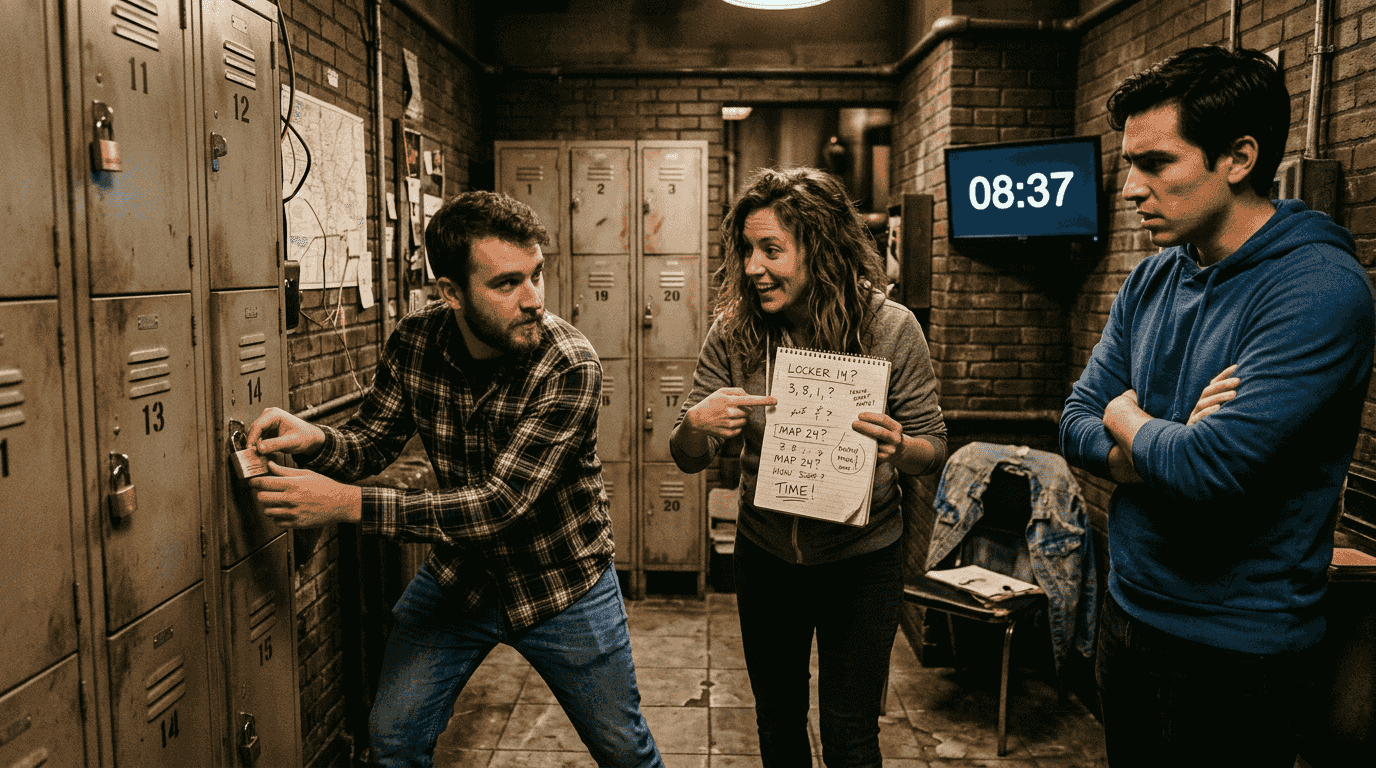
Leadership often emerges situationally based on who excels at synthesizing scattered information and maintaining group focus rather than formal titles. The person who leads your marketing team might defer to someone with stronger spatial reasoning or pattern recognition. This reveals valuable insights about hidden strengths and shows how rigid hierarchies can block effective problem-solving. Teams discover that leadership should flow to whoever has relevant expertise for each challenge.
Decision bottlenecks expose trust issues and control dynamics that slow workplace productivity. When teams get stuck debating puzzle solutions, you see whether members trust each other enough to test ideas quickly or whether excessive caution paralyzes action. Some groups waste precious minutes seeking consensus on every small decision. Others move too fast without gathering input. Both patterns directly mirror workplace behaviors around project decisions and resource allocation.
The memorable nature of escape room moments creates lasting feedback anchors. Teams recall specific instances when communication broke down or when someone’s insight unlocked progress. These concrete examples make abstract concepts like “active listening” or “psychological safety” tangible and discussable. Instead of vague feedback about improving collaboration, managers can reference the exact moment when the team succeeded by combining different perspectives.
Common behaviors that surface during escape room activities include:
- Natural leadership emergence based on situational skills rather than authority
- Communication breakdowns when information stays siloed instead of shared
- Problem-solving approaches ranging from methodical to chaotic
- Trust signals shown through willingness to test ideas and risk being wrong
- Stress responses that either enhance or diminish team effectiveness
Pro Tip: Watch who takes initiative during confusion and how emerging leaders manage their own stress while guiding others. These behaviors predict leadership effectiveness under workplace pressure far better than interviews or assessments.
The corporate team building insights gained from these observations extend far beyond the game itself. Teams develop shared language around their dynamics and build awareness of patterns that need adjustment. The experience becomes a reference point that makes future coaching conversations more productive and less defensive.
Integrating escape room events into corporate team-building programs
Escape rooms deliver maximum value when integrated thoughtfully into broader team development programs rather than treated as standalone entertainment. The experience works best when framed with clear objectives during pre-event briefings that explain what teams should notice about their collaboration patterns. This priming helps participants observe their own behaviors instead of just racing to finish puzzles.
Structured programs include observation where facilitators note specific behaviors without disrupting the activity. An outside observer captures communication breakdowns, leadership shifts, and decision-making patterns that teams miss while absorbed in solving puzzles. This objective documentation provides rich material for post-event discussions and prevents the selective memory that often clouds self-assessment.
Debriefing sessions transform raw experience into practical improvements. Teams reflect on what happened, why certain patterns emerged, and how those same dynamics appear in workplace projects. The facilitator guides conversations toward actionable insights rather than letting discussions stay abstract. What specific communication habit caused that ten-minute delay? How does that same pattern slow down your product launches? What will you do differently starting Monday?
Shared memories create feedback anchors that make future coaching more effective. When a manager later notices the team falling into familiar patterns, referencing the escape room moment makes feedback concrete and less threatening. The shared experience provides common ground that builds receptivity to difficult conversations about trust and accountability.
Comparing escape rooms to traditional team-building methods highlights their unique advantages:
| Approach | Engagement Level | Insight Depth | Retention | | — | — | — | | Escape rooms | Very high, full immersion | Deep behavioral observation | Strong shared memories | | Workshop seminars | Moderate, passive learning | Theoretical understanding | Fades quickly | | Outdoor challenges | High physical engagement | Limited behavioral insight | Moderate recall | | Trust exercises | Variable, depends on buy-in | Surface level dynamics | Weak without follow-up |
Integrating escape rooms into corporate retreats follows a clear sequence:
- Define specific team development objectives before booking the activity
- Conduct pre-briefings that frame what participants should observe about collaboration
- Assign an impartial facilitator to document behaviors during the escape room
- Run the activity with minimal intervention to allow authentic dynamics
- Lead structured debriefs that connect experience to workplace applications
- Create action plans for applying insights to current projects and challenges
Pro Tip: Include someone outside the immediate team as facilitator during the activity to capture behavioral patterns without disrupting natural flow. Internal team members miss critical dynamics when they are absorbed in solving puzzles.
The escape room team programs that deliver lasting impact treat the activity as a diagnostic tool rather than just entertainment. Teams gain awareness of their patterns, develop shared language for discussing dynamics, and commit to specific improvements grounded in concrete examples everyone remembers.
Benefits and outcomes reported from corporate escape room participation
Research on corporate escape room effectiveness shows remarkably strong outcomes. All participants recommended escape rooms for team-building, reporting measurable improvements in teamwork and communication skills. This universal endorsement reflects how the experience combines engagement with practical skill development in ways that traditional training methods rarely achieve.
The benefits extend beyond immediate enjoyment to lasting behavioral change. Teams report enhanced communication clarity, with members more conscious of sharing information and checking for understanding. The pressure-cooker environment reveals communication gaps that feel abstract in normal workplace discussions but become concrete and memorable during escape room challenges. Participants recognize their own patterns and commit to adjustments based on direct experience rather than theoretical training.
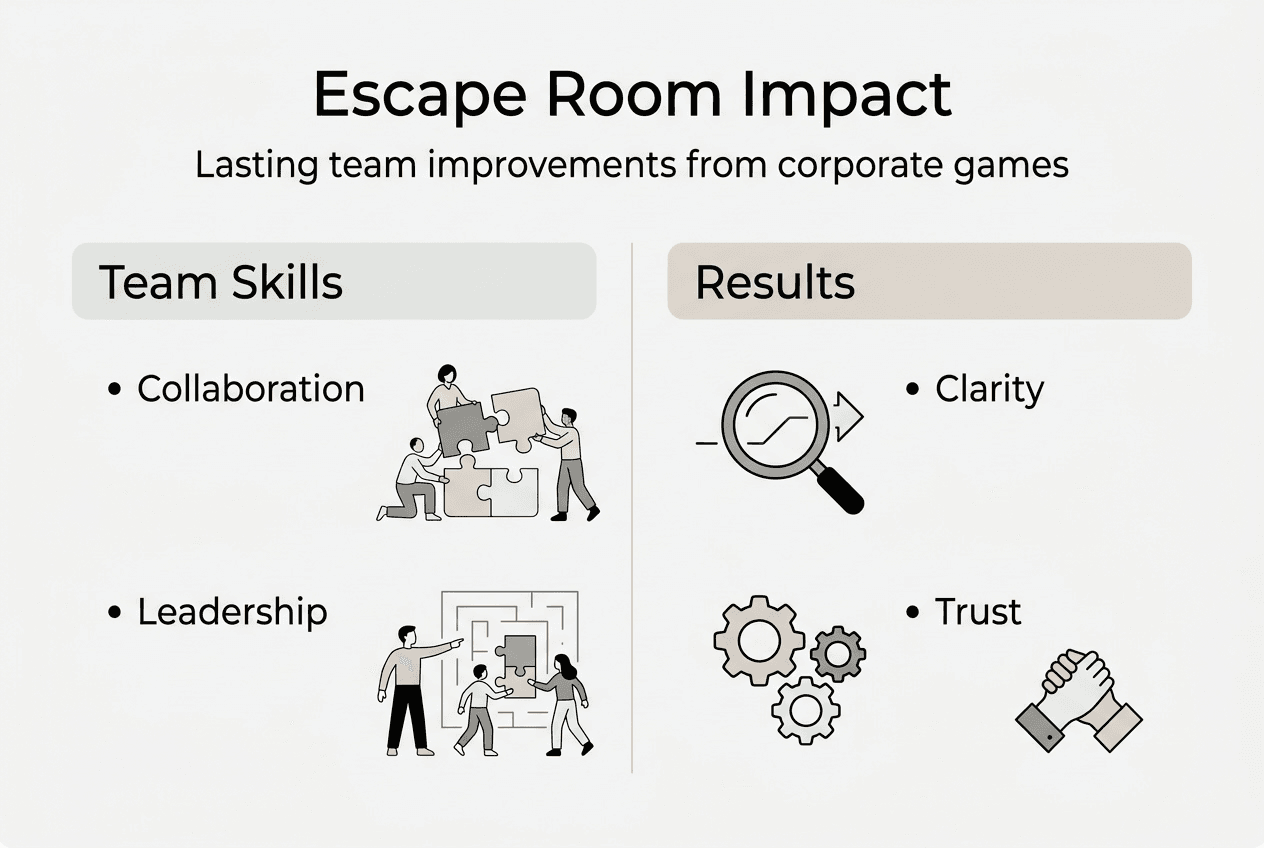
Escape rooms achieve high engagement and satisfaction while reinforcing prior learning effectively. The active problem-solving format creates stronger retention than passive learning methods. Teams apply existing knowledge in novel contexts, strengthening neural pathways and building confidence in their collective capabilities. The challenge of unfamiliar puzzles under time pressure creates the productive struggle that deepens learning.
Key metrics from escape room team-building studies:
| Metric | Result | Impact |
|---|---|---|
| Recommendation rate | 100% of participants | Universal endorsement for team building |
| Teamwork improvement | Significant gains reported | Enhanced collaboration in workplace projects |
| Communication skills | Measurable enhancement | Clearer information sharing and active listening |
| Engagement levels | Very high throughout | Full participation and sustained focus |
| Learning reinforcement | Strong knowledge retention | Better application of prior training |
Secondary benefits that teams report include:
- Trust building through shared vulnerability and mutual support
- Accountability improvements as members recognize their impact on group success
- Problem-solving creativity from exposure to unfamiliar challenge types
- Stress management skills developed through high-pressure collaboration
- Recognition of diverse strengths that might stay hidden in normal work
These outcomes matter because they translate directly to workplace performance. Teams that communicate more clearly make fewer costly errors. Groups with stronger trust move faster on decisions and take smarter risks. Organizations where members recognize diverse strengths deploy talent more effectively. The escape room benefits compound over time as improved dynamics become habitual rather than requiring conscious effort.
The measurable nature of these improvements makes escape rooms attractive for organizations seeking evidence-based team development. Unlike vague claims about improved morale, the specific behavioral changes teams report provide concrete justification for investment in these activities.
Explore corporate escape room events in Colorado Springs
Colorado Springs companies seeking powerful team-building experiences can access specialized corporate escape room programs designed specifically for workplace development. CodeBusters Escape Room offers customizable challenges that align with your team development objectives, whether you need to improve communication, build trust, or identify hidden leadership potential. The veteran and family-owned business understands corporate needs and tailors experiences accordingly.
Local providers offer distinct advantages over generic team-building vendors. You gain convenient access without travel logistics, flexible scheduling that accommodates business calendars, and facilitators who understand Colorado Springs corporate culture. The ability to customize puzzle difficulty, room themes, and group sizes ensures the experience matches your team’s specific needs rather than forcing a one-size-fits-all approach.
CodeBusters provides several options for corporate groups:
- Private room bookings that ensure your team works without outside distractions
- Multiple themed environments matching different group sizes and preferences
- Facilitation support for pre-briefings and structured debriefing sessions
- Flexible scheduling for corporate retreats and team development days
- Award-winning room designs that create memorable, immersive experiences
Pro Tip: Book corporate events at least two weeks in advance to allow for program customization and pre-event briefings that maximize learning outcomes. Early planning ensures the experience aligns with your specific team development goals.
Explore available room themes and book your corporate team-building experience through the website. The combination of engaging puzzles, time pressure, and collaborative challenges creates the ideal environment for revealing team dynamics and building stronger workplace relationships.
Frequently asked questions
What are corporate escape room events?
Corporate escape room events are team-building activities where groups solve interconnected puzzles within themed rooms under time constraints. Unlike casual entertainment, these events serve as diagnostic tools that reveal communication patterns, leadership dynamics, and decision-making behaviors. Facilitators often include structured debriefings that help teams apply insights to workplace challenges.
How long do corporate escape room events typically last?
Most escape room experiences run 60 minutes for the actual puzzle-solving activity. When integrated into corporate programs, the full event spans 90 to 120 minutes including pre-briefings that set objectives and post-event debriefings that extract actionable insights. This extended format maximizes learning value beyond just the entertainment aspect.
What team size works best for corporate escape rooms?
Optimal team sizes range from four to eight participants per room. Smaller groups ensure everyone contributes actively rather than some members staying passive. Larger teams can split across multiple rooms and compare experiences during debriefing sessions. This approach reveals how different groups within your organization approach identical challenges.
Do escape rooms really improve workplace performance?
Research shows all participants recommend escape rooms for team building, with measurable improvements in communication and collaboration. The shared experience creates reference points for future feedback and builds awareness of behavioral patterns. Teams report applying insights to project work, leading to faster decisions and clearer communication. The key is proper facilitation that connects experience to workplace application.
How do we choose the right escape room for our team?
Consider your team development objectives first. If communication is the focus, choose rooms requiring extensive information sharing. For leadership development, select challenges with diverse puzzle types that let different strengths emerge. Discuss goals with the provider to match room difficulty and theme to your group’s experience level. Visit corporate escape room events to explore options that fit your team size and development needs.