Benefits of Team Building Activities for Corporate Teams

Team building activities are structured interventions designed to improve communication, trust, collaboration, and performance within workplace groups. The benefits of team building activities extend well beyond morale. Research from Gallup, BetterUp, and multiple meta-analyses confirms that well-designed programs drive measurable gains in profitability, retention, and employee engagement. The distinction between casual bonding events and targeted team building matters enormously. Managers who treat these activities as strategic tools rather than perks see the strongest returns. This article breaks down what the research actually shows, how to choose the right activity type, and what separates programs that stick from those that fade by Monday morning.
What measurable benefits do team building activities provide?

The business case for team building is grounded in hard numbers, not feel-good assumptions. Top-quartile engagement teams outperform bottom-quartile teams by 23% in profitability and show 41% lower absenteeism. That gap represents real dollars in productivity and reduced hiring costs, not just a survey score.
Retention is where the financial impact compounds fastest. Gallup’s Q12 meta-analysis across 96 countries links high engagement to 43% lower turnover. For a mid-sized company replacing even a handful of employees per year, that reduction alone can justify an entire annual team building budget.
The belonging dimension is equally striking. A BetterUp study of 1,789 U.S. workers, published in Harvard Business Review, found that high belonging correlates with a 56% increase in job performance and a 50% drop in turnover risk. Belonging is not a soft metric. It predicts whether people show up, stay, and give discretionary effort.
Here is what consistent team building delivers across corporate teams:
- Improved communication habits that reduce misunderstandings and meeting inefficiency
- Stronger trust between team members, which accelerates decision-making
- Clearer role understanding, reducing duplication and friction
- Higher morale and discretionary effort, meaning people do more than the minimum
- Lower absenteeism and turnover, with direct cost savings for the organization
The team building advantages listed above do not appear automatically. They require the right activity type, delivered consistently, matched to the team’s actual gaps.
How do different types of team building activities influence outcomes?
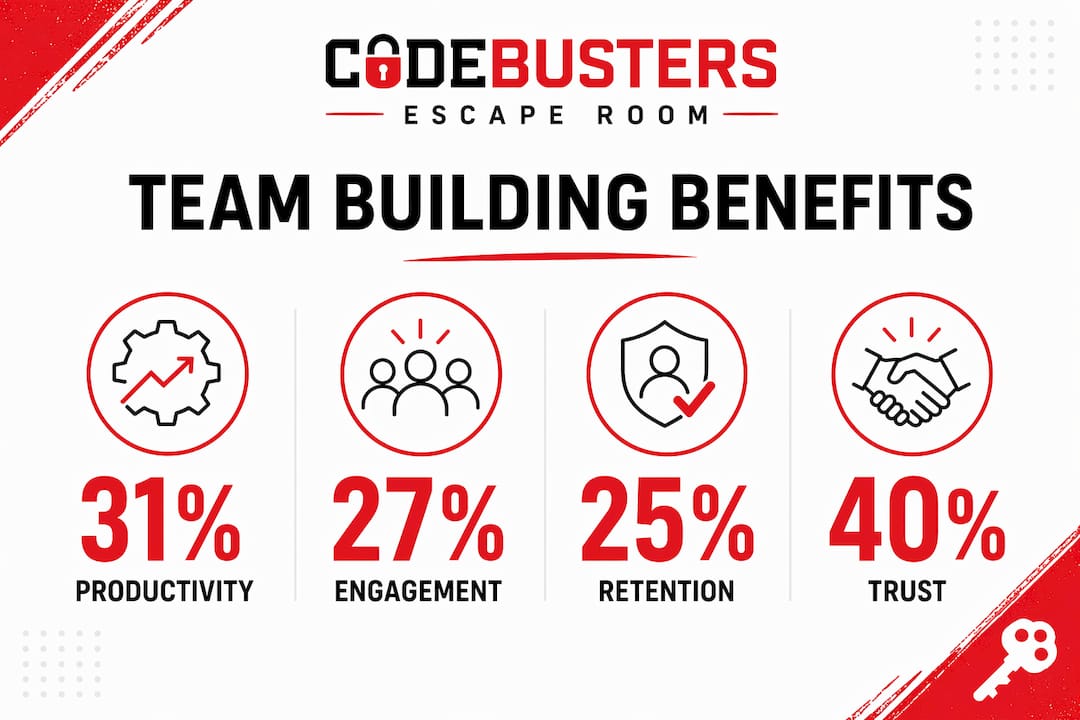
Not all team building is the same, and confusing the categories is the most common reason programs underdeliver. There are three distinct types: team bonding, team training, and team building proper. Each serves a different purpose, and misaligned interventions waste effort. Social bonding cannot resolve role confusion, and skills training will not fix a trust problem.
| Activity type | Primary purpose | Best used when |
|---|---|---|
| Team bonding | Build social connection and morale | Team is new or morale is low |
| Team training | Develop specific skills or knowledge | Skill gaps are clearly identified |
| Team building | Improve collaboration, roles, and trust | Conflict, confusion, or poor communication exists |
Team bonding covers activities like group lunches, escape rooms, and social outings. These build familiarity and goodwill, which is genuinely valuable. But they do not address structural problems like unclear accountability or unresolved conflict. Team training, such as communication workshops or conflict resolution sessions, targets specific skill deficits. True team building combines diagnosis with intervention, using exercises like goal setting, role clarification, and structured debriefs to change how the team actually operates.
A meta-analysis of 60 effect sizes confirms that well-structured team building yields a mean effect size of .31 on team outcomes. That is a moderate to strong effect in organizational research, comparable to many pharmaceutical interventions in medicine. The same research shows that interactive, simulation-based formats outperform passive classroom instruction. Watching a presentation about communication is far less effective than practicing communication under pressure in a shared challenge.
Pro Tip: Before choosing any activity, ask three diagnostic questions: Does the team lack trust, lack clarity about roles, or lack specific skills? The answer determines whether you need bonding, building, or training. Choosing the wrong type is worse than doing nothing, because it signals to the team that leadership does not understand the actual problem.
Why does consistency matter more than the activity itself?
One-off team building events are the corporate equivalent of a single gym session. They feel productive in the moment and produce almost no lasting change. Consistent, deliberate programs tied to business goals increase retention and discretionary effort. Sporadic events, especially purely social ones, are often perceived by employees as costs rather than investments.
The most underused tool in team performance is the regular debrief. Team debriefs boost performance by 20 to 25% by building psychological safety and shared mental models. They cost nothing and require no external facilitator. Yet most managers skip them entirely, moving from project to project without structured reflection.
“The teams that improve fastest are not the ones with the biggest budgets for off-sites. They are the ones that debrief consistently, adjust quickly, and treat every project as a learning opportunity.” This pattern holds across military units, surgical teams, and corporate project groups.
A program built for lasting impact includes these structural elements:
- Quarterly or monthly structured activities aligned to current team challenges
- Weekly or bi-weekly debriefs after significant projects or milestones
- Clear metrics tracked before and after each intervention
- Manager reinforcement of behaviors practiced during activities
The importance of team building is not realized in a single afternoon. It accumulates through repeated, intentional practice. Teams that debrief regularly develop shared language, faster conflict resolution, and stronger psychological safety over time. Those that rely on annual retreats see temporary boosts that evaporate within weeks.
What steps should managers take to design effective team building?
Effective team building starts with diagnosis, not activity selection. Most managers do the opposite. They pick an activity they have heard about, schedule it, and hope for the best. That approach produces inconsistent results and erodes trust in the program itself.
Follow these steps to design activities that actually move the needle:
- Assess the team’s current state. Survey team members or hold one-on-one conversations to identify whether the primary issue is trust, communication, role clarity, or skill gaps. Use the answers to determine which activity type fits.
- Set a specific, measurable goal for the activity. “Improve collaboration” is too vague. “Reduce handoff errors between design and development by 20% over the next quarter” gives you something to track.
- Choose an interactive format. Goal setting and role clarification show the strongest effects in meta-analyses. Simulations, escape rooms, and structured problem-solving exercises outperform lectures and passive workshops.
- Facilitate, do not just observe. Assign a facilitator who can draw out quieter team members, manage dominant personalities, and connect the activity back to real work challenges.
- Debrief immediately after. Ask three questions: What went well? What would we do differently? What one behavior will we change starting tomorrow?
- Measure and report back. Share results with the team within two weeks. Visible follow-through signals that the activity was serious, not performative.
Pro Tip: The debrief is where the learning actually happens. A mediocre activity with an excellent debrief outperforms a brilliant activity with no debrief. Build at least 20 minutes of structured reflection into every session, no exceptions.
How team activities improve teamwork depends heavily on this follow-through. The activity creates the shared experience. The debrief converts that experience into changed behavior.
How do remote and hybrid teams benefit from team building?
Distributed teams face a specific set of challenges that in-person teams do not. Physical distance reduces spontaneous communication, weakens social bonds, and makes conflict harder to detect and resolve. The positive effects of team bonding are harder to generate over video calls, but they are not impossible.
Physical signals like branded gear used alongside structured virtual activities strengthen cohesion in remote teams. Social identity theory explains why. Visible in-group markers accelerate the sense of belonging that drives engagement and performance. Sending a team a shared physical item before a virtual session creates a tangible connection that a Zoom background cannot replicate.
Effective approaches for remote and hybrid teams include:
- Virtual escape rooms and simulation games that require real-time collaboration and communication under pressure
- Structured virtual debriefs using shared documents or tools like Miro or MURAL to capture team reflections visibly
- Asynchronous team challenges that accommodate different time zones while still building shared identity
- Conflict management workshops delivered via video, since distributed teams often let interpersonal friction fester longer than co-located teams
The teamwork enhancement strategies that work best for remote teams share one feature. They create shared stakes. When every team member must contribute to a common outcome, engagement rises and the social distance of remote work shrinks. Escape rooms as team development tools are particularly effective here because the format demands real-time communication, role distribution, and collective problem-solving in a compressed timeframe.
Key takeaways
Team building activities deliver lasting business results only when they are matched to specific team gaps, delivered in interactive formats, and reinforced through consistent debriefs and follow-through.
| Point | Details |
|---|---|
| Match activity to team gap | Diagnose whether trust, roles, or skills are the issue before selecting any activity. |
| Interactive formats outperform passive ones | Simulations and escape rooms produce stronger outcomes than lectures or passive workshops. |
| Debriefs drive 20 to 25% performance gains | Regular post-activity reflection is the highest-ROI, zero-cost team building practice available. |
| Consistency beats intensity | Ongoing programs tied to business goals outperform one-time events in retention and effort. |
| Belonging has a measurable financial impact | A 56% performance increase and 50% turnover drop are linked to high team belonging. |
Why I stopped believing in the annual retreat model
After years of watching corporate teams invest in elaborate off-sites and return to the same dysfunctional patterns within a month, I have a clear opinion. The annual retreat is largely theater. It feels productive. It generates goodwill. And then the calendar resets and nothing changes.
The teams I have seen improve consistently share one habit. They treat team building as a practice, not an event. They debrief after projects. They revisit role clarity when new members join. They run structured problem-solving exercises when tension rises, not after it explodes. The activity itself matters less than the discipline of returning to it.
The other misconception worth naming directly: fun is not the same as effective. A team that laughs together at a cooking class has not necessarily built the communication habits that will help them navigate a product launch crisis. Fun activities have real value for morale and bonding. But managers who substitute fun for structured team building are solving the wrong problem.
The research on why team building is essential points consistently toward one conclusion. Diagnosis first, activity second, debrief always. Teams that follow that sequence see compounding returns. Teams that skip it see temporary boosts and long-term frustration.
— CodeBusters
Experience real team building at Codebustersescaperoom
Codebustersescaperoom in Colorado Springs offers corporate teams an experience that checks every box the research identifies. The themed rooms, including “Flight of Deception,” “Past to the Future,” and “Stranger 80’s,” put teams inside high-pressure, time-limited scenarios that demand real communication, role distribution, and collective problem-solving. These are not passive activities. Every participant must contribute, and the team dynamics under pressure reveal strengths and gaps that managers rarely see in a conference room. Private room bookings are available for corporate groups, and the veteran and family-owned operation brings a level of care to facilitation that chain venues cannot match. Book your team’s next session at Codebustersescaperoom and give your team a challenge worth debriefing.
FAQ
What are the main benefits of team building activities?
Team building activities improve communication, trust, role clarity, and morale while delivering measurable business outcomes including higher profitability, lower absenteeism, and reduced turnover. Gallup research links high engagement, driven partly by team building, to 23% higher profitability and 43% lower turnover.
How often should corporate teams do team building activities?
Quarterly structured activities combined with regular debriefs after major projects produce the strongest results. One-time annual events rarely generate lasting behavioral change and are often perceived as costs rather than investments.
What type of team building activity is most effective?
Interactive, simulation-based activities like escape rooms and structured problem-solving exercises outperform passive formats. A meta-analysis of 72 interventions covering 8,439 participants confirms that active participation drives significantly better team outcomes than lectures or presentations.
How do you measure the ROI of team building?
Set a specific, measurable goal before the activity, such as reducing handoff errors or improving meeting efficiency, then track that metric over the following quarter. Pair this with retention data and engagement scores to build a complete picture of program impact.
Can remote teams benefit from team building activities?
Remote teams benefit significantly from structured virtual activities and physical in-group signals like branded gear. Social identity theory shows that visible shared markers accelerate cohesion, and virtual escape rooms or simulation games create the shared stakes that distributed teams often lack.