Unlock the Top Benefits of Puzzle Games for Your Mind

Puzzle games have a reputation for being casual fun, but the science behind them tells a more compelling story. Finding activities that genuinely sharpen your thinking, rather than just pass the time, is harder than it sounds. Not every game delivers real cognitive rewards, and not every player walks away measurably better at problem-solving or memory. The research, however, is clear: puzzle games enhance cognitive skills including memory, problem-solving, spatial reasoning, and executive function. This article breaks down the most significant, evidence-backed benefits of puzzle gameplay and helps you figure out which formats deliver the biggest payoff for your brain and your team.
Table of Contents
- Boosting memory and executive function
- Sharpening problem-solving and pattern recognition
- Enhancing teamwork, communication, and social skills
- Who benefits the most, and what puzzles work best?
- Why the real value of puzzle games goes beyond the hype
- Experience the benefits of puzzle games firsthand
- Frequently asked questions
Key Takeaways
| Point | Details |
|---|---|
| Boosts memory and focus | Regular puzzle gameplay strengthens memory, focus, and attention skills. |
| Enhances problem-solving | Puzzles develop logical thinking, pattern recognition, and creative strategy abilities. |
| Fosters teamwork | Cooperative puzzles encourage communication, collaboration, and social skills. |
| Best for all ages | Players of all ages benefit, with especially strong effects for older adults and cognitive training. |
| Practical brain workout | Mixing puzzle types and difficulty offers the most well-rounded mental fitness routine. |
Boosting memory and executive function
With a foundation in research-backed benefits, let’s start with one of the most impactful advantages: your brain’s core skills.
When you regularly play puzzles, you’re not just entertaining yourself. You’re training your brain’s ability to hold information, filter out distractions, and switch between tasks without losing your place. These are the building blocks of executive function, the mental toolkit that governs planning, attention, and decision-making in everyday life.
Memory improvements are among the most documented effects of puzzle play. Word games, crosswords, and logic challenges require you to store and retrieve information rapidly, reinforcing neural pathways tied to recall. Regular puzzle play keeps the brain functioning as if it were 10 years younger, a finding that should genuinely surprise anyone who assumes mental aging is inevitable.
The clinical data is equally striking. The COG-IT trial found that crossword puzzles outperformed computerized cognitive training programs on standardized cognitive assessments, specifically the ADAS-Cog11 scale. That means your grandmother’s newspaper crossword might outperform an expensive brain-training app.
Key memory and executive benefits you can expect from consistent puzzle play:
- Improved short-term recall from working memory exercises built into most puzzle formats
- Stronger attention control, especially in tasks requiring sustained focus
- Faster task-switching, which is the ability to move between mental demands without losing accuracy
- Enhanced learning speed, since puzzles train your brain to build and use mental models
- Cognitive protection in older adults and those with Mild Cognitive Impairment (MCI), a condition marked by noticeable but not disabling memory changes
For players interested in cognitive skill enhancement, the format matters almost as much as frequency. Crosswords build vocabulary-based recall. Sudoku strengthens number pattern memory. Logic puzzles stress-test your working memory by forcing you to hold multiple conditions in mind simultaneously.
Pro Tip: Don’t stick to one puzzle type. Rotating between word puzzles, number games, and visual logic challenges prevents your brain from getting comfortable, which is exactly when mental gains slow down. The sweet spot is doing puzzles that feel slightly hard but not impossible.
Sharpening problem-solving and pattern recognition
Beyond core memory skills, puzzle games stand out for their ability to develop sharp problem-solving and logical thinking.
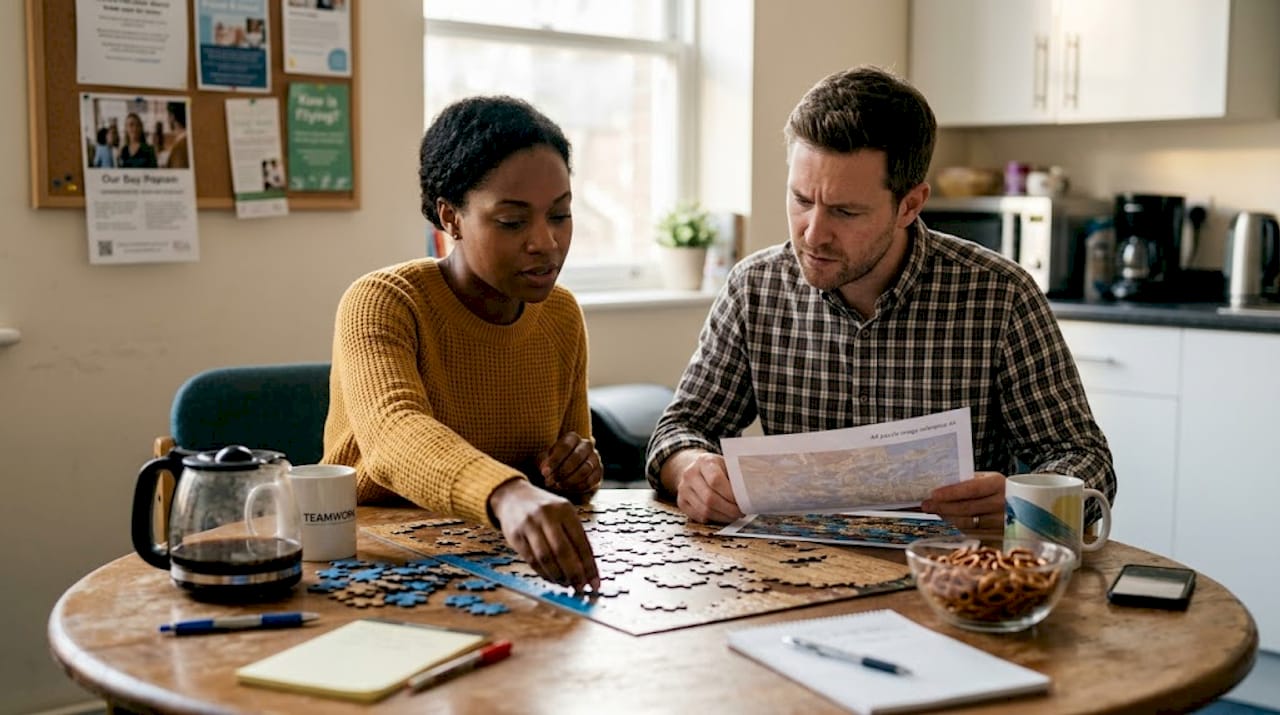
Problem-solving is not a single skill. It’s a bundle of abilities: forming a hypothesis, testing it, recognizing when it fails, adjusting, and trying again. Puzzles train this entire sequence in a low-stakes environment where failure is just information, not a consequence.
Pattern recognition is closely tied to problem-solving. When you notice that a certain clue structure in a crossword hints at a specific word length, or that a sequence of numbers follows a predictable rule, you’re building the same mental muscle used to spot trends in data, read social dynamics, or troubleshoot technical problems at work.
The research here is especially interesting. Portal 2 players gained more in problem-solving and spatial skills compared to participants who used Lumosity, a commercial brain-training platform. A well-designed puzzle game beats a product marketed specifically for brain training. And in educational settings, an ethnomathematics puzzle approach showed high N-gain scores and large effect sizes for student problem-solving, suggesting that culturally grounded puzzles are particularly powerful.
| Puzzle type | Primary cognitive skill | Secondary skill |
|---|---|---|
| Crosswords | Verbal memory | Vocabulary retrieval |
| Sudoku | Numerical logic | Attention to detail |
| Logic grid puzzles | Deductive reasoning | Working memory |
| Spatial/3D puzzles | Spatial reasoning | Mental rotation |
| Co-op escape rooms | Strategy formation | Team communication |
To maximize your problem-solving improvements, follow these steps:
- Start with puzzles just above your current comfort level, not so hard you give up, not so easy you coast.
- Resist looking at hints immediately. Let yourself sit with uncertainty for a few minutes before seeking help.
- After completing a puzzle, review what strategy worked and why.
- Introduce timed elements gradually once you’ve mastered the basic puzzle format.
- Try puzzle game strategies in cooperative settings, where verbalizing your logic to teammates further reinforces your own reasoning process.
Enhancing teamwork, communication, and social skills
While cognitive gains are vital, puzzle games also bring people together for social and communication benefits.
Solo puzzle play is rewarding, but cooperative puzzles introduce an entirely different layer of mental and social challenge. When two or more people are working toward the same goal, someone has to take the lead on certain steps, someone else manages the overview, and everyone has to communicate clearly enough to avoid duplication and confusion.
This role specialization happens naturally in group puzzle environments. Research in medical education found that team-based puzzle activities enhance collaboration and role specialization, skills directly transferable to professional and personal group dynamics.
“Cooperative puzzle games consistently generate high cooperation and communication ratings among participants, making them one of the most effective formats for building social cohesion in group settings.” Cooperative puzzle games research
| Game format | Cooperation level | Communication demand | Social benefit |
|---|---|---|---|
| Solo word puzzle | None | None | Individual focus |
| Two-player logic game | Moderate | Low to moderate | Perspective sharing |
| Multiplayer co-op puzzle | High | High | Role clarity, trust |
| Escape room experience | Very high | Very high | Full team dynamics |
Beyond formal research, the practical benefits show up in measurable ways. Teams that puzzle together tend to develop shorthand communication, trust each other’s judgment faster, and learn how to disagree productively under pressure.
Puzzle formats that work especially well for team building:
- Escape rooms, which require dividing attention across multiple simultaneous challenges
- Cooperative board games with hidden information mechanics
- Multiplayer digital puzzle games with asynchronous clue-sharing
- Live-action puzzle hunts, which blend physical movement with intellectual challenge
For groups seeking immersive puzzle experiences, the combination of time pressure, narrative, and shared problem-solving creates a level of engagement that office trust falls or team lunches rarely match.
Who benefits the most, and what puzzles work best?
The payoffs of puzzle play depend on who’s playing and the formats they choose, so what’s the best fit for you?
Not everyone experiences the same gains from the same puzzles. Age, cognitive baseline, and puzzle type all influence how much benefit you extract. Research shows moderate to large effect sizes for cognitive improvement from puzzle-based games, with especially strong results in older adults and individuals with MCI.
Younger players, while already at peak processing speed, still benefit substantially from puzzles, particularly in areas like strategic planning, creative thinking, and social coordination. For them, the gains are less about protection and more about pushing cognitive performance to a higher ceiling.
Matching puzzle type to your goal makes the practice far more effective. Here’s how to think about it:
- Memory and recall: Crosswords, word searches, and memory matching games target verbal and visual memory pathways directly.
- Logic and reasoning: Sudoku, logic grid puzzles, and deduction games build structured analytical thinking.
- Spatial skills: 3D puzzles, tangrams, and spatial rotation games train the mental imagery systems used in navigation, engineering, and design.
- Social and communication skills: Cooperative escape rooms, group puzzle hunts, and team-based board games sharpen how you listen, delegate, and adapt.
- Creative problem-solving: Open-ended puzzle games without a single correct answer push divergent thinking, which is your brain’s ability to generate multiple solutions.
Benefits are consistently greater for skills directly practiced in the puzzles than for unrelated cognitive tasks, so choose formats that mirror the real-world skills you want to improve. Puzzle difficulty matters too. Staying in the challenge zone, where the puzzle feels genuinely difficult but solvable, is where the most growth happens.
Pro Tip: For puzzle format selection, think about what cognitive gap you’re trying to close, not just what you enjoy most. Enjoyment keeps you consistent, but intentional format choice determines where the growth lands.
Why the real value of puzzle games goes beyond the hype
With the core benefits laid out, it’s worth stepping back for a more nuanced perspective on what actually makes puzzle games so valuable.
There’s a lot of noise around brain training. Apps promise to raise your IQ. Marketers package cognitive exercises as daily supplements for a sharper mind. The research, however, tells a more honest story: the gains from puzzle play are real, but they’re specific. You get better at what you practice, and transfer to unrelated tasks is limited.
But here’s what most brain-training conversations miss entirely. The most durable benefits of puzzle games aren’t measured on a cognitive test. They show up in how you handle frustration when a problem doesn’t yield immediately. They show up in how you collaborate when the solution isn’t obvious and your teammate sees something you don’t. Persistent engagement with hard puzzles builds mental resilience, the kind that carries over into real decisions and real relationships.
A playful attitude toward difficulty, trying something new, failing at it, adjusting, and trying again, is the real engine behind puzzle game value. Chasing a high score or a brain-age number misses what the practice is actually building: a mind that stays curious and flexible under pressure.
Experience the benefits of puzzle games firsthand
Ready to put these advantages into practice? Here’s how you can experience puzzle game benefits for yourself.
Reading about cognitive gains is one thing. Feeling them in real time, under pressure, with your team scrambling to crack a code before the clock runs out, is something else entirely. That’s the kind of experience that turns theory into skill.

CodeBusters Escape Room in Colorado Springs offers themed rooms like Past to the Future, Stranger 80’s, and Flight of Deception, each designed to push your problem-solving, memory, and teamwork to the limit. Whether you’re building corporate team skills or just want to test yourself against a genuinely hard puzzle, CodeBusters delivers the immersive, socially rich experience that research consistently links to the biggest cognitive and social rewards. Book your room and find out what your brain is actually capable of.
Frequently asked questions
Do puzzle games really make you smarter?
Puzzle games can improve specific cognitive skills like memory, problem-solving, and executive function, making your mind sharper in those targeted areas. Puzzle games enhance cognitive skills including spatial reasoning and executive function, according to published research.
Which puzzle games are best for the brain?
Word puzzles, crosswords, logic puzzles, and multiplayer cooperative formats show the strongest cognitive impacts across studies. The COG-IT trial confirmed that crosswords outperformed computerized training on standardized cognitive measures.
How do puzzle games improve teamwork?
Cooperative puzzle games require real-time communication, coordinated strategy, and diverse perspectives, making them highly effective for social skill development. Teams consistently report high cooperation and communication ratings after cooperative puzzle experiences.
Are there age limits for puzzle game benefits?
People of all ages benefit from puzzle play, but the effects are especially strong for older adults and those with early cognitive decline. Research shows moderate to large effects for cognitive improvements in older adults and MCI populations.
How often should you play puzzle games to see benefits?
Consistent practice over time produces the best results, and rotating puzzle types prevents mental plateauing. Cognitive benefits are greater for skills directly practiced, so regular, varied play is the most effective approach.