What Is a Private Booking? Your Complete Guide

A private booking is defined as an exclusive reservation of a space or service for a specific party, with no sharing with strangers during that time. Whether you are planning a corporate retreat, a milestone birthday, or a group escape room session, understanding how private reservations work saves you money, prevents surprises, and guarantees the experience you actually want. This guide covers the full picture: what private bookings are, how they differ by venue, what they cost, and how digital platforms manage them behind the scenes.

What is a private booking and how does it work?
A private booking means reserving a space or service exclusively for your group, blocking all outside bookings during your contracted time. The venue commits to sole occupancy for your party. No strangers walk in, no tables are shared, and no other groups overlap with your experience.
The industry term for this concept varies by context. In hospitality, you will hear “exclusive use” or “buyout.” In restaurants, it is a “private dining reservation.” In entertainment venues like escape rooms, it is simply a “private room booking.” All of these describe the same core arrangement: your group gets the space, and nobody else does.
Private bookings differ from standard group reservations in one critical way. A group reservation holds seats or rooms for your party but does not prevent the venue from selling remaining capacity to the public. A private booking closes that capacity entirely. That distinction drives both the experience and the price.
How do private bookings differ across venues and experiences?
Private reservations look very different depending on the setting. The table below maps the most common venue types against their defining features.
| Venue type | Exclusivity level | Typical terms |
|---|---|---|
| Hotel buyout | Full property | All rooms and common areas blocked |
| Private dining room | Single room | Minimum spend, dedicated staff |
| Escape room (private) | Single room | Per-session flat rate, no public players |
| Exclusive use villa | Full estate | No public lobbies or shared signage |
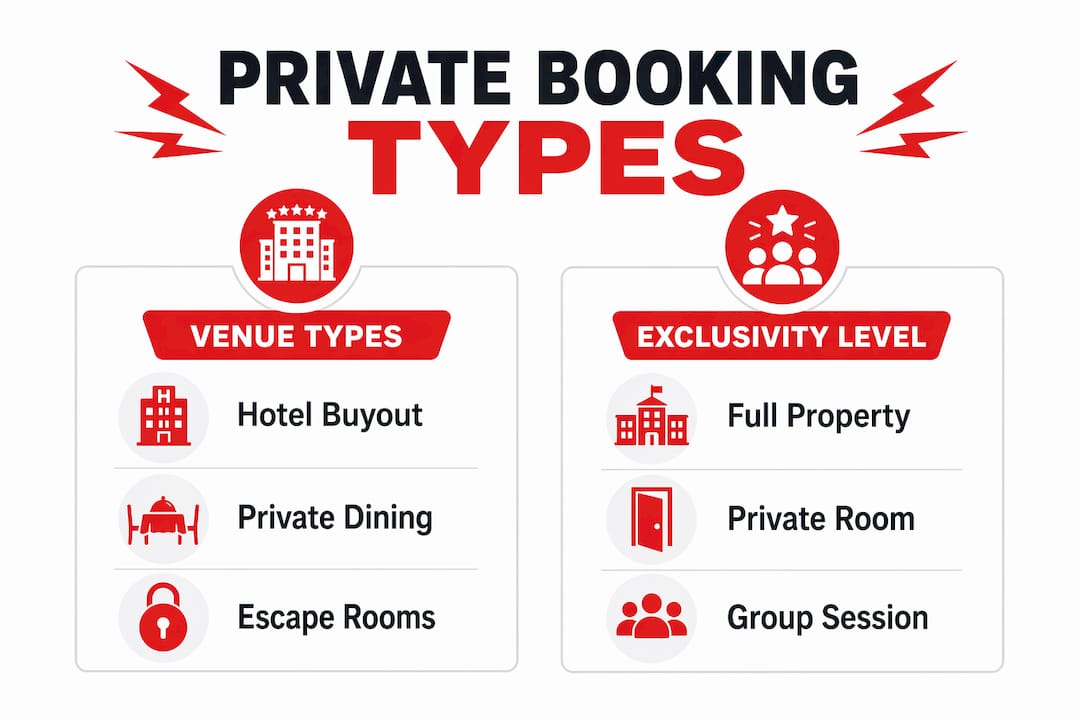
Hotel buyouts
Hotel buyouts involve reserving every room and common area exclusively, blocking all individual guest bookings during contracted dates. Boutique hotels with 8–25 rooms are the most common candidates. Your group gets complete access to all guest rooms, pools, dining spaces, and amenities. No other guests check in during your stay.
Private dining rooms
Private dining rooms are physically separated spaces with a door, dedicated staff, and contract terms. They are not just a curtained corner of the main floor. The separation is structural, and the staffing is dedicated to your party alone.
Semi-private vs. fully private
Semi-private arrangements use partitions or designated sections but do not block adjacent traffic. Fully private bookings remove all public access from the reserved space. The difference matters most in restaurants and event venues, where hallways, restrooms, and service corridors may still be shared even when the room itself is exclusive.
Escape rooms and entertainment venues
Private escape room sessions work differently from hotel buyouts. You pay for the room for your group alone, and no strangers join your session. This structure is standard at Codebustersescaperoom in Colorado Springs, where every room booking is private by default. That means your group tackles rooms like “Stranger 80’s” or “Flight of Deception” without outside players affecting your dynamic or your time.
What does a private booking cost?
Private booking pricing follows an event contract model, not a simple per-person rate. Understanding the financial structure before you sign prevents the most common complaints.
The key financial components are:
- Minimum spend: The floor amount your group must spend on food, beverages, or services. Minimum spends for 16–20 guest rooms at fine dining restaurants often range from $3,000 to $8,000, with service charges around 20–22%.
- Deposit: An upfront payment, typically non-refundable, that secures the date and blocks inventory.
- Cancellation policy: A tiered penalty structure based on how far in advance you cancel. Last-minute cancellations often forfeit the full deposit.
- Service charges and gratuity: Added on top of the minimum spend, not included in it.
The steps to secure a private booking typically run in this order:
- Submit an inquiry with your date, group size, and event type.
- Confirm availability and receive a proposal with pricing and terms.
- Review service details, menu options, or activity selections.
- Sign the contract and pay the deposit to lock the reservation.
- Finalize headcount and any special requests closer to the date.
Pro Tip: Ask the venue to itemize what counts toward the minimum spend before you sign. At some restaurants, service charges and taxes do not count toward the minimum. That gap can add hundreds of dollars to your final bill.
Booking systems enforce these terms through reservation types configured with deposits, guarantees, and inventory holds. The system does not just note the booking. It actively blocks the inventory from being sold to anyone else. That operational lock is what makes a private booking genuinely exclusive, not just preferential.
What are the benefits of private booking?
The core benefits of private booking fall into two categories: experience quality and operational control.
Experience benefits:
- Complete privacy with no strangers present
- Tailored arrangements, from custom menus to personalized activity sequences
- Full control over the guest list and atmosphere
- Dedicated staff focused entirely on your group
Operational benefits:
- Predictable timing with no public session overlap
- Ability to negotiate specific service details in advance
- Clearer accountability when something goes wrong
The scope of exclusivity determines how much of this you actually get. A private room at a restaurant gives you a closed door. A full hotel buyout gives you the entire property. Knowing which level you are paying for is the single most important question to ask before booking.
True privacy requires confirming whether the venue blocks adjacent rooms and restricts shared amenities. A “private room” may still share hallways or elevators with the public unless exclusive use is explicitly secured. That distinction separates a genuinely private experience from one that only feels private until someone else walks through the corridor.
Pro Tip: For sensitive gatherings like legal strategy sessions, medical team meetings, or high-profile celebrations, always request written confirmation that shared corridors and service entrances are restricted during your booking window.
Effective private bookings also require operational coordination from the venue side. That means blocking adjacent areas and assigning dedicated service staff so no incidental sharing occurs. Ask the venue coordinator specifically how they handle this. A venue that cannot answer clearly has not thought it through.
The advantages of private room bookings extend beyond comfort. For group activities like escape rooms, privacy directly affects performance. Your team communicates more freely, takes more risks, and engages more deeply when strangers are not watching.
How do digital platforms manage private bookings?
Online booking platforms handle private reservations through visibility controls, not just calendar blocks. The distinction matters if you are managing bookings for a venue or trying to access a private session as a customer.
| Visibility mode | Public access | Bookable | How to access |
|---|---|---|---|
| Public | Yes | Yes | Standard search or direct link |
| Private | No | Yes | Direct link only |
| Hidden | No | No | Not bookable in this state |
Platforms may offer a “Private” visibility mode that hides the listing from public storefronts but allows booking through a direct link. This is how venues offer exclusive sessions to specific clients without advertising them to the general public. The listing exists, but only the people with the link can find and book it.
Private booking links can be single-use or set to expire, which affects how recurring private sessions are managed. A venue running weekly private corporate training sessions, for example, may need to generate a new link for each session or switch to a hidden mode between bookings. Customers managing multiple private sessions should ask whether the link they receive is reusable or expires after one booking.
The operational and digital layers work together. The platform controls who can see and access the booking. The reservation system controls whether inventory is actually blocked. Both need to be configured correctly for a private booking to function as intended.
Key Takeaways
A private booking is an exclusive reservation that blocks all outside access to a space or service for your specific group, and the scope of that exclusivity determines everything from price to experience quality.
| Point | Details |
|---|---|
| Core definition | A private booking reserves a space exclusively for your group, blocking all outside bookings. |
| Exclusivity scope varies | Confirm whether you are getting a private room, full venue, or full property before signing. |
| Contract model pricing | Expect minimum spends, deposits, and cancellation penalties rather than simple per-person rates. |
| Digital visibility controls | Platforms use Public, Private, and Hidden modes to manage who can find and book a listing. |
| Shared spaces are a risk | Always confirm in writing that hallways, amenities, and service areas are restricted during your booking. |
Why I always tell groups to ask one question first
After years of helping groups plan private experiences at Codebustersescaperoom, the single most common mistake I see is assuming “private” means the same thing everywhere. It does not. A private dining room at a restaurant and a private escape room session are both called private bookings, but the operational reality is completely different.
At Codebustersescaperoom, private means your group is the only one in the room. Full stop. No other players, no shared countdown clock, no strangers watching through a window. That is the standard we hold ourselves to because anything less defeats the purpose of booking privately.
What I tell every group before they book anywhere: ask the venue to define exactly what “private” covers. Does it include the waiting area? The restrooms? The staff assigned to you? If the venue hesitates or gives a vague answer, that is your signal to push harder or look elsewhere. The contract should spell out every shared space and every restriction. If it does not, add it before you sign.
Private bookings are worth the premium when the exclusivity is real. They are not worth it when you are paying for a closed door but still sharing the experience with the public in every other way.
— CodeBusters
Private escape room bookings in Colorado Springs
Codebustersescaperoom offers fully private room bookings for every session at its Colorado Springs location. Your group gets the room, the staff, and the full experience without any outside players joining.
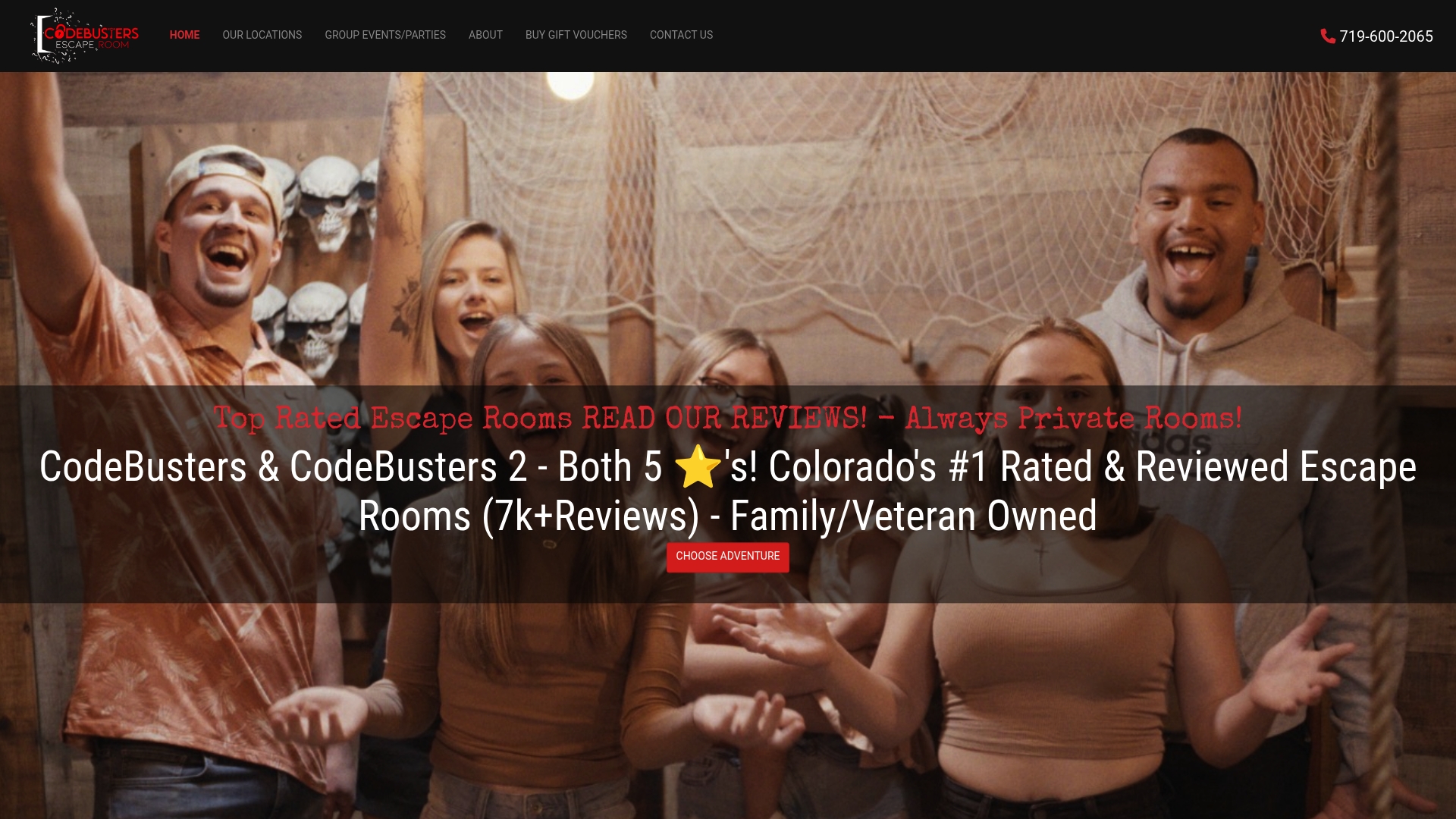
Whether you are planning a team building event, a birthday celebration, or a night out with friends, every room at Codebustersescaperoom is reserved exclusively for your group. Themed rooms like “Past to the Future” and “Stranger 80’s” are designed for groups of varying sizes and difficulty preferences. Check availability and book your private session directly on the Codebustersescaperoom website, or contact the team to discuss custom arrangements for larger groups or corporate events.
FAQ
What is a private booking in simple terms?
A private booking is an exclusive reservation where a space or service is held solely for your group, with no strangers sharing the experience during your booked time.
Is a private booking worth the extra cost?
A private booking is worth the cost when exclusivity, privacy, and tailored arrangements are priorities. The value depends on how completely the venue enforces that exclusivity across all shared spaces.
How does a private booking differ from a group reservation?
A group reservation holds capacity for your party but allows the venue to sell remaining space to others. A private booking blocks all outside access entirely.
What should I confirm before making a private reservation?
Confirm the exact scope of exclusivity, including shared corridors and amenities, minimum spend requirements, deposit terms, and cancellation policies before signing any contract.
Can I book a private escape room session for a corporate team?
Yes. Venues like Codebustersescaperoom offer private escape room sessions specifically suited to corporate teams, with rooms designed for different group sizes and difficulty levels.